University of Queensland: Home of Gardasil, the St Lucia Sandstone Campus, and Strengths in Biotech and Agriculture
Published on May 14, 2026
University of Queensland: Home of Gardasil, the St Lucia Sandstone Campus, and Strengths in Biotech and Agriculture
Published on May 14, 2026
Ranked #42 globally in QS 2026 and sixth among Australia's Group of Eight (Go8), the University of Queensland (UQ) is one of the Australian universities Taiwanese families often hear about only after first hearing about QUT. Many people confuse UQ with QUT (Queensland University of Technology), but these are two completely different types of universities in Brisbane: UQ is a century-old sandstone research flagship, while QUT is an applied university that only gained university status in 1989. UQ is one of Australia's six "Sandstone Universities," alongside Sydney, Melbourne, Adelaide, Tasmania, and UWA, and can be thought of as Australia's colonial-era equivalent of Oxbridge, built from the late 19th to early 20th century.
But what truly made UQ known worldwide is not its history or ranking. It is that UQ invented Gardasil, the world's first cervical cancer vaccine. In 1991, Professor Ian Frazer of UQ and his late colleague Jian Zhou worked together in a laboratory on the St Lucia campus to develop HPV virus-like particle (VLP) technology. That technology was later commercialized by Merck as Gardasil and launched in 2006, and has since helped protect millions of women worldwide from cervical cancer. This is the single most important achievement in Australian medicine over the past 30 years, and it is UQ's unshakable calling card in the global biomedical community. For Taiwanese students interested in Biotech, pharmacy, pharmaceutical engineering, public health, or agricultural biotechnology, UQ is one of the Go8 options that should not be overlooked.
1. Basic Information
Item | Details |
|---|---|
Founded | 1909 (Queensland's first university) |
Location | Brisbane, Queensland (main campus in St Lucia, 7 km from the CBD) |
Campuses | 3 main campuses: St Lucia (main), Herston (medicine), Gatton (agriculture and veterinary science) |
Undergraduates | ~40,000 |
Postgraduates | ~20,000 |
Student-faculty ratio | 1:20 |
Motto |
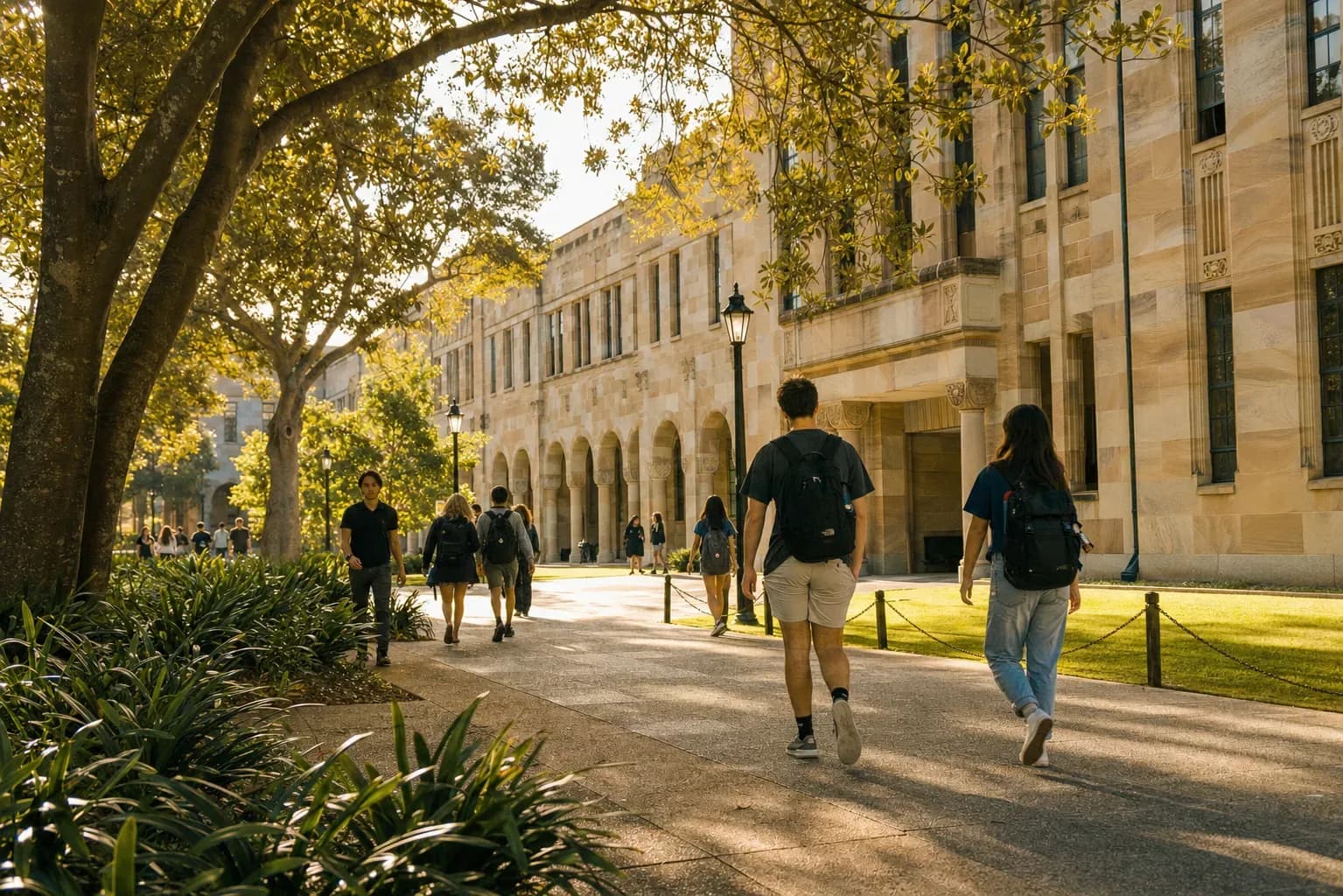
UQ is Queensland's first university. Before it was founded, students in Queensland who wanted to attend university had to go to Sydney or Melbourne. Its establishment was a key step in Queensland building its own higher education system after Australia's federation in 1901. The sandstone buildings of the St Lucia campus, the arcades and carvings of the Great Court, and the overall campus setting make UQ one of Australia's most postcard-worthy campuses, second only to the University of Sydney.
2. World Rankings
Ranking | Position |
|---|---|
QS World 2026 | #42 (sixth among Australia's Go8) |
THE World 2026 | #77 |
ARWU / Shanghai 2024 | #65 |
QS Sports-related Subjects | #3 (top three globally) |
QS Agriculture & Forestry | #10 |
QS Environmental Sciences | #18 |
QS Mineral & Mining Engineering | #14 |
UQ's individual subject rankings are even more impressive than its overall ranking: third globally in sports science, tenth globally in agriculture, and fourteenth globally in mining engineering. These three areas reflect UQ's close connection with Queensland's economic structure. Queensland is a core Australian state for agriculture, mining, and the sports industry, with the AIS-Brisbane Olympic training base located there, and UQ's research strength maps directly onto state-level industry needs. For Taiwanese students aiming for these fields, UQ is the strongest choice in Australia.
3. Admissions Data (International Students, 2026 Entry Cycle)
Indicator | Value |
|---|---|
International student ATAR equivalent | 78-98 (varies by program) |
IB Diploma | 30-42 points (Medicine pathway requires 39+) |
Approximate threshold for Taiwanese high school GPA | Top 15% of class + near-perfect grades |
IELTS requirement | 6.5 (6.0 in each band); Medicine, Pharmacy, Veterinary 7.0+ |
TOEFL iBT | 87 (including Writing 21) |
Application fee | AUD 100 (international undergraduate applicants) |
International student share |
International Students
- International students make up about 30% of the student body, slightly lower than Melbourne and UNSW, giving the campus a stronger "local Australian" feel
- Students come from 140+ countries
- Around 150-250 Taiwanese students enroll each year, across undergraduate and postgraduate levels
- Applications are mainly assessed on academic results and English proficiency; Medicine and Veterinary Science add interviews
- Key competitive gateways: Medicine (Provisional Entry), Veterinary Science, Biomedical Science, and Engineering are the most competitive
4. Tuition and Financial Aid
2026 International Student Tuition (Annual)
Program Type | Annual Tuition in AUD | NTD Estimate (AUD 1 = NTD 22.6) |
|---|---|---|
Bachelor of Arts | About AUD 41,000 | About NTD 930,000 |
Bachelor of Commerce | About AUD 51,000 | About NTD 1.15 million |
Bachelor of Science | About AUD 50,000 | About NTD 1.13 million |
Bachelor of Engineering (Honours) | About AUD 54,000 | About NTD 1.22 million |
Bachelor of Biomedical Science |
The total tuition for a 4-year Bachelor of Engineering (Honours) is about AUD 216,000 (NTD 4.88 million). Since living costs in Brisbane are about 20% lower than Sydney and 10% lower than Melbourne, UQ is one of the lowest-total-cost options in the Go8 for a 4-year degree. This is a key reason Dr. G. Academy includes UQ in its Top 30 Value-for-Money List: tuition and living costs are both lower, while the Go8 brand and research strength remain first-tier.
Scholarships and Financial Support
- UQ International Scholarship: 10-25% tuition reduction depending on program
- UQ Excellence Scholarships: One-off AUD 12,000 undergraduate award + 25% tuition reduction
- Vice-Chancellor's Scholarship: Full tuition + AUD 6,000 living allowance for top applicants
- Research Higher Degree Scholarships: Full tuition waiver + AUD 35,000 stipend for research-track master's and doctoral students
- Need-Based Aid for international students is almost nonexistent, consistent with other Go8 universities
The most practical point for Taiwanese families: UQ is one of the most friendly Go8 schools for strong but not absolute top-tier students. If your predicted IB score is 35-37 or your ATAR equivalent is 88-92, you may not receive a scholarship from Melbourne and may lose out in UNSW's Co-op competition, but at UQ you have a realistic chance of receiving an AUD 10,000-15,000 reduction. After careful budget planning, that can become a decisive difference.
5. Program Structure: 4-Year Direct Entry + Three-Campus Specialization
Not the Melbourne Model
UQ follows the traditional British-Australian structure of 4-year direct entry with embedded Honours. At 18, you can apply directly to the Bachelor of Engineering (Honours), Bachelor of Veterinary Science, or Bachelor of Laws, and after 4 years you can enter professional practice or employment. This is consistent with Monash, UNSW, and Sydney, and unlike Melbourne's 3+2 staged model.
Three-Campus Specialization
Campus | Distance from CBD | Main Subject Areas |
|---|---|---|
St Lucia (main campus) | 7 km | Engineering, Science, Arts, Business, Law, IT |
Herston | 3 km | Medicine, Public Health, Pharmacy |
Gatton | 87 km (regional) | Agriculture, Veterinary Science, Animal Science |
The Gatton campus falls under the regional definition, which is extremely important for Taiwanese students aiming for PR points. Completing a 2-year program at Gatton can add +5 PR points + an additional 1 year on the 485 visa after graduation. If your goals are agriculture, veterinary science, food science, or sustainable agriculture, Gatton is UQ's hidden trump card.
Signature Programs
- Bachelor of Biomedical Science: UQ's signature entry pathway after Gardasil, leading into MD or PhD study
- Bachelor of Engineering (Honours): 8 specializations, including Mining, Mechanical, Software, and Chemical
- Bachelor of Veterinary Science: One of Australia's top veterinary programs, based at Gatton, 6 years in length
- Doctor of Medicine (MD): 4-year graduate-entry program, usually after Bachelor of Biomedical Science or Health Sciences; Provisional Entry is available directly from high school
- UQ Business School: Holds AACSB, EQUIS, and AMBA "triple crown" accreditation, one of only two in Australia
- Bachelor of Information Technology: A strong CS-adjacent option on the St Lucia campus
- Sports Science: Ranked third globally by QS, with AIS-Brisbane collaboration
6. Campus Culture / Institutional Personality
UQ's personality can be summed up in three words: sunny, outgoing, and sports-driven. Brisbane has a subtropical climate and year-round sunshine, and both the city and the UQ campus revolve around outdoor life, sport, and the riverfront. If Melbourne students write novels in Fitzroy cafes, Sydney students sunbathe at Bondi Beach, and UNSW students write Python in Mathews Library, UQ students cycle along the Brisbane River to Toowong for a beer at 4 p.m. and go surfing on the Gold Coast over the weekend.
This DNA makes UQ especially strong in sports science, sports medicine, and the leisure industry. The Queensland branch of the Australian Institute of Sport (AIS) is in Brisbane and works closely with UQ. Many Australian Olympic athletes are UQ students or research subjects in sports science.
Student Clubs
- UQ Student Union (UQU) oversees more than 200 clubs
- UQ Debating Society: A frequent winner at the World Universities Debating Championships
- UQ Bands and Choir: Student orchestra and choir groups among the largest in Australia
- UQ Taiwanese Student Association: Runs annual welcome events and Lunar New Year celebrations
Sports Culture
- University of Queensland Rugby Club: One of Australia's strongest university rugby clubs, with many Wallabies national team players among its alumni
- UQ Sport facilities rank among Australia's top five, including a 50-meter Olympic swimming pool, rugby fields, and athletics tracks
- Signature sports: rugby, swimming, rowing (training on the Brisbane River), and cycling
7. Location / Campus Environment
City Positioning
The main campus, St Lucia, sits in Brisbane's western suburbs on a bend of the Brisbane River. It is 7 km from the CBD, 15 minutes by car, or 25 minutes by CityCat ferry directly into the city center. This CityCat route is the most romantic commute for UQ students: watching the river, the colorful bridges, the heritage bridges, and Story Bridge from the water is ten times more pleasant than taking the bus.
Brisbane is the capital of Queensland, with a population of 2.7 million, and is Australia's third-largest city. Its major industries include mining headquarters (BHP, Rio Tinto, Anglo American), agriculture, biotech, health sciences, and tourism, with the Gold Coast and Sunshine Coast nearby. Brisbane will host the 2032 Summer Olympics, creating one of the biggest employment opportunities over the next decade for students in UQ sports science, civil engineering, and urban planning.
Climate
- Summer (December-February): 22-30°C, humid, occasional cyclones
- Winter (June-August): 10-22°C, dry, warm, no snow
- Brisbane has the most comfortable climate among Australia's three largest cities: warmer than Melbourne in winter and fresher than Sydney in summer
- More than 300 sunny days per year
Campus Landmarks
- Great Court: A sandstone arcade complex built from 1937 onward, carved with Australian flora and fauna and Indigenous motifs; Australia's most postcard-worthy campus scene after Sydney's Quadrangle
- Forgan Smith Building: Administrative building with a sandstone facade and arched corridors
- UQ Lakes: Two artificial lakes in the center of campus, home to waterbirds and often black swans
- Sir James Foots Building: Main building for mining engineering
- Goddard Building (Biological Sciences): Site of Ian Frazer's early Gardasil research laboratory
- UQ Centre: Olympic-standard sports venue, used multiple times for Australian Open and pre-Olympic training
8. Research and Resources
Among the Go8, UQ is one of the most successful universities in research commercialization. The Gardasil vaccine alone generated more than AUD 20 billion in cumulative global commercial value. UQ's annual research income exceeds AUD 600 million.
Key Research Institutes
- Institute for Molecular Bioscience (IMB): A major center for molecular biology, with multiple world-class protein structure research programs
- Australian Institute for Bioengineering and Nanotechnology (AIBN): Nanobiotechnology and tissue engineering
- Queensland Brain Institute (QBI): Neuroscience and Alzheimer's disease research
- Sustainable Minerals Institute (SMI): Sustainable mining and metallurgy, top five globally
- Centre for Advanced Imaging: Medical imaging and MRI research
- Queensland Alliance for Agriculture and Food Innovation (QAAFI): Agricultural innovation center in partnership with the state government
The Story of Gardasil
In 1991, Professor Ian Frazer and Chinese postdoctoral researcher Dr. Jian Zhou, now deceased, collaborated in a laboratory on UQ's St Lucia campus to develop HPV virus-like particle (VLP) technology. This technology was later commercialized by Merck and CSL as Gardasil, which received FDA approval in 2006. Gardasil is the first vaccine in human history designed to prevent a cancer, and it has now been administered in 130+ countries worldwide, with estimates suggesting it can reduce cervical cancer incidence by 70-90%. Ian Frazer was named Australian of the Year in 2006, received the Companion of the Order of Australia in the 2010 Queen's Birthday Honours, and has won multiple international medical awards.
Dr. Jian Zhou passed away in 1999 at the age of only 42. UQ established the Jian Zhou Memorial Laboratory in the IMB building. This is UQ's strongest story in the global biomedical community: it proves that a research university in a second-tier Australian city can still produce a scientific breakthrough that changes human history.
9. Notable Alumni
- Nobel Prize: Peter Doherty (Medicine 1996, UQ undergraduate alumnus who later moved to Melbourne), John Harsanyi (Economics 1994, UQ visiting scholar)
- Politics: Wayne Goss (former Premier of Queensland), Quentin Bryce (Australia's first female Governor-General, UQ Law graduate)
- Scientists: Ian Frazer (co-inventor of Gardasil), Jian Zhou (co-inventor of Gardasil), Lawrie McIntosh (father of Australian nuclear energy)
- Business: Greg Norman (golf star and business empire founder), Trevor St Baker (founder of ERM Power)
- Film / Culture: Geoffrey Rush (Oscar-winning actor, Shine), Mary-Louise Parker
- Space / Aviation: Allan Cunningham (early Australian aeronautical engineering)
- Sports: More than 50 Australian Olympic athletes have graduated from UQ Sports Science
UQ is Australia's strongest university in two dimensions: medical commercialization and sports science. The story of Gardasil alone is worth more than a decade of research publicity from many other universities.
10. Lesser-Known Facts About UQ
- Gardasil was invented at UQ: The HPV vaccine technology developed by Ian Frazer and Jian Zhou in a St Lucia campus laboratory is estimated to have helped protect millions of women worldwide from cervical cancer.
- The Great Court's sandstone carvings include 80+ reliefs of Australian flora, fauna, and public figures: These include kangaroos, koalas, Indigenous motifs, General John Monash, Mary Reibey (Australia's first female entrepreneur), and more, making it one of Australia's most complete "sandstone carving museums."
- The black swans of UQ Lakes: The two artificial lakes in the center of campus are home to a resident group of black swans, a species native to Australia. Taking photos of them during exam season and posting them on social media is a student tradition.
- UQ alumni are involved in designing the main venues for the 2032 Brisbane Olympics: UQ civil engineering and architecture alumni are central to 2032 Olympic venue planning, a rare once-in-a-century urban development opportunity.
- One of the six Sandstone Universities: UQ is listed alongside Sydney, Melbourne, Adelaide, Tasmania, and UWA as one of Australia's six sandstone universities, the colonial-era "Australian Oxbridge" institutions built in the late 19th century.
11. Typical Admitted Student Profile
- Taiwanese international school students with predicted IB scores of 32-40, or ATAR equivalent 85-95
- Taiwanese high school system: top 10-15% of class (Taipei Municipal Jianguo High School, Taipei First Girls High School, Taipei Municipal Zhongshan Girls High School, The Affiliated Senior High School of National Taiwan Normal University, Wego, Kang Chiao, Kuei Shan, KAS), with near-perfect GPA
- IELTS 6.5-7.0 or TOEFL iBT 87-100 (although the official threshold is 6.5/87, in practice 7.0 is more competitive)
- Extracurriculars: medicine pathways look at hospital volunteering, research, and community leadership; engineering pathways look at Robotics and Hackathons; sports science pathways look at school team performance
- Medicine Provisional Entry requires UCAT and an interview; most other programs do not require interviews
- Personal Statement is required only for some programs
12. What Kind of Student Is UQ Best For?
✓ A good fit for:
- Students who want to study Biomedical Science, Biotech, Pharmacy, Medicine, or Public Health (UQ is the birthplace of Gardasil)
- Students who want to study Agriculture, Veterinary Science, or Animal Science (Australia's strongest option)
- Students who want to study Mining Engineering or Sustainable Minerals (top 14 globally by QS)
- Students who want to study Sports Science or Exercise Physiology (top three globally by QS + 2032 Olympics)
- Families with tighter budgets who want the highest-value option within the Go8 (Dr. G. Top 30 Value-for-Money List)
- Students who like sunshine, riverfront life, outdoor sports, and dislike crowded metro systems
- Students aiming to use the Gatton campus for regional study +5 PR points
- Students who want a beautiful sandstone campus for photos and daily campus life
✗ Not necessarily a good fit for:
- Students aiming for Finance, Quant, or investment banking (Sydney, UNSW, and Melbourne have stronger finance industry reputations)
- Students who want the global metropolis lifestyle of Sydney or Melbourne (Brisbane feels more like a smaller city)
- Students aiming for cutting-edge Fashion, Design, or Architecture (RMIT and UTS are stronger in these areas)
- Students who dislike heat and humidity (Brisbane summers can be 30°C+ with high humidity)
- Students who want an American Ivy-style experience with small classes and close professor mentorship (UQ is a large research university with 60,000 students)
Conclusion
Among the Go8, the University of Queensland is the school Taiwanese parents are least likely to name correctly. Many parents hear Brisbane and assume QUT (Queensland University of Technology), but these two schools are different types of institutions. QUT is an applied university that only gained university status in 1989, while UQ is a century-old sandstone research flagship founded in 1909. UQ is the Go8 member, the birthplace of Gardasil, and the university ranked third globally in sports science.
From an immigration strategy perspective, UQ has four advantages: (1) 4-year direct-entry Bachelor of Engineering (Honours) / Biomedical Science programs, allowing students to enter the 485 PHEW countdown 1-2 years earlier than under the Melbourne Model; (2) the Gatton campus falls under the regional definition, adding +5 PR points and an additional 1 year on the 485 visa after graduation; (3) after Master Coursework, the 485 PHEW Stream is 2 years (reduced from 3 years after July 1, 2024), while Master Research and PhD pathways remain 3 years; (4) Pharmacy, Medicine, Veterinary, Agriculture, and Mining Engineering are mostly on the Skilled Occupation List, giving students more room to stack PR points.
For Taiwanese students, the most practical PR strategy combination is: UQ Bachelor of Biomedical Science or Bachelor of Engineering (Honours) + Master of IT or Master of Pharmacy + PTE 79 + 2 years of work in Brisbane + NAATI Chinese certification + 189 Skilled Independent. This path can build toward 90-100 PR points. If combined with 1-2 years of regional study at Gatton, PR points can increase by another 5. UQ is one of the three Australian universities in Dr. G. Academy's Top 30 Value-for-Money List (the other two are UNSW and Monash), and it frequently appears in Dr. G.'s master's database when filtering STEM Master Coursework programs.
UQ is the Go8's hidden trump card. It will not give you Melbourne's "Australia's number one" brand, nor UNSW's Sydney engineering halo. But it will give you a sandstone campus, a CityCat commute, the story of a vaccine that changed human history, and a total cost 15-20% lower than Sydney or Melbourne. For practical, outdoorsy, biomedical-minded Taiwanese families, UQ is a seriously underrated choice.
