University of British Columbia: The West Coast's Top Public University, Sauder School of Business, and BC PNP-Friendly Immigration Pathways
Published on May 14, 2026
University of British Columbia: The West Coast's Top Public University, Sauder School of Business, and BC PNP-Friendly Immigration Pathways
Published on May 14, 2026
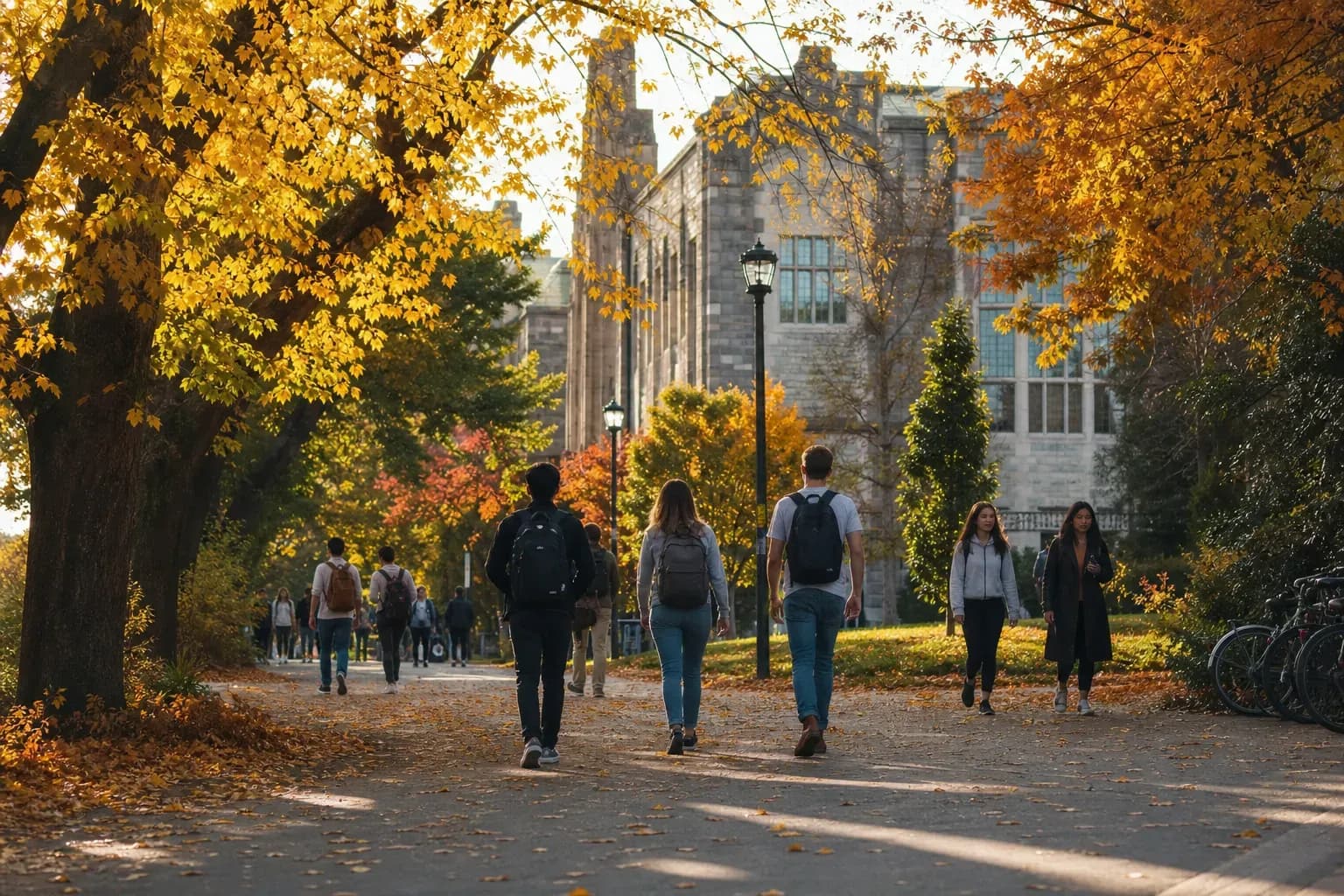
The University of British Columbia (UBC) is Canada's top comprehensive research university on the West Coast, ranked QS 2026 World #40, #3 among Maclean's medical-doctoral universities, and a founding member of the U15. If you ask ten international students in Canada where the most comfortable Canadian university is, at least eight will say UBC, because it is located on Vancouver's West Side beside Pacific Spirit Park, facing the Pacific Ocean with snow-capped mountains behind it. It is widely regarded as one of the top five most beautiful campuses in North America.
But UBC's value goes far beyond being beautiful. It is one of the only two comprehensive public universities in Canada that can stand shoulder to shoulder with U of T. Sauder School of Business is the strongest undergraduate business school on the Pacific Coast, Forestry ranks first in the world, and CS is rising rapidly thanks to Vancouver's tech ecosystem, including Amazon, Microsoft, EA, and Slack's Canadian headquarters. Most importantly for Taiwanese families: the BC PNP International Post-Graduate Stream allows master's graduates in STEM and health-related fields to apply for provincial nomination without a job offer. This is one of the most flexible immigration pathways in all of Canada.
1. Basic Information
Item | Details |
|---|---|
Founded | 1908 |
Location | Vancouver, BC (main Point Grey campus) + Kelowna (Okanagan campus) |
Campus | Vancouver campus approximately 993 acres; Okanagan approximately 250 acres |
Undergraduates | ~57,000 across both campuses; approximately 53,000 in Vancouver |
Graduate students | ~12,000 |
Student-faculty ratio | 1:19 |
Motto | Tuum est ("It is yours") |
2. World Rankings
Ranking | Placement |
|---|---|
QS World 2026 | #40 |
THE World 2025 | #41 |
US News Global Universities 2024-25 | #38 |
Maclean's Canadian Medical-Doctoral Universities | #3 |
QS Forestry | #1 globally |
QS Sports-Related Subjects | #2 globally |
QS Mineral & Mining Engineering | #11 globally |
3. Admissions Data (Fall 2024 Entry)
Metric | Figure |
|---|---|
Total applicants | ~52,000 |
Overall admit rate (domestic students) | Approximately 52% |
Overall admit rate (international students) | Approximately 47% |
Sauder School of Business | Approximately 7-10% |
Engineering overall | Approximately 28% |
Computer Science (Faculty of Science) | Approximately 5% (one of the most competitive programs) |
Faculty of Forestry | Approximately 65% |
Yield Rate | Approximately 48% |
UBC's overall admission rate looks "friendly" at 52%, but competition for popular programs is extremely intense. For international students, Sauder Commerce and CS can be even harder to enter than U of T.
International Student Standards (Direct Undergraduate Entry)
Test | Recommended Score |
|---|---|
SAT | 1400+ (1500+ recommended for CS / Sauder) |
ACT | 30+ |
IELTS | 6.5 (6.0 in each band) |
TOEFL iBT | 90+ (100+ recommended) |
IB | 30-32+ (38+ recommended for CS / Sauder) |
A-Level | ABB-AAA |
International Students
- International students make up approximately 28% of the student body
- Students come from 162 countries
- Each year, 50-80 Taiwanese undergraduates are admitted, the second-highest number in Canada after U of T
- Personal Profile: applicants must submit six short essays, each 250-350 words. UBC uses a whole-person review focused on "personal development beyond academics," making it one of the few Canadian universities that requires holistic review
4. Tuition and Financial Aid (International Student Perspective)
2024-2025 Tuition (CAD/year)
Item | Amount |
|---|---|
Tuition - Arts | CAD $42,000-$46,000 |
Tuition - Science | CAD $48,000-$53,000 |
Tuition - Engineering | CAD $58,000-$62,000 |
Tuition - Computer Science | CAD $52,000-$58,000 |
Tuition - Sauder School of Business | CAD $61,000+ |
Tuition - Faculty of Forestry | CAD $44,000-$50,000 |
Housing (on-campus Place Vanier / Totem Park / Orchard Commons) | CAD $11,000-$16,000 |
Food + miscellaneous expenses (Vancouver is expensive, second only to Toronto) | CAD $12,000-$15,000 |
Total | CAD $70,000-$95,000/year |
Financial Aid for International Students
- Karen McKellin International Leader of Tomorrow Award: UBC's largest award for international students, covering four years of tuition plus part of living expenses. Only 25-50 students worldwide receive it each year.
- International Major Entrance Scholarship (IMES): CAD $40,000-$80,000 over four years, awarded to top international first-year students.
- Outstanding International Student Award: CAD $10,000-$25,000, relatively more attainable.
- External private scholarships: Vancouver's Chinese community offers a larger number of scholarship opportunities.
5. Academic Structure / Signature Programs
Faculty Structure
UBC Vancouver has 14 Faculties: Applied Science (Engineering), Architecture and Landscape Architecture, Arts, Commerce (Sauder), Dentistry, Education, Forestry, Graduate Studies, Land and Food Systems, Law (Allard), Medicine, Music, Pharmaceutical Sciences, and Science.
Signature Programs
- Sauder School of Business (undergraduate Commerce): one of Canada's top three business schools. The BCom uses a cohort system. Students take a shared business foundation in the first year, then choose from nine options starting in the second year, including Finance, Marketing, OBHR, Operations, and BTM. Comparable to NYU Stern + USC Marshall.
- Faculty of Forestry: the world's top forestry faculty (QS Forestry #1) and one of the only schools in Canada offering a Bachelor of Science in Forestry.
- Earth & Ocean Sciences (EOAS): UBC's oceanography and geophysics are ranked among the global top 20.
- Computer Science: strongly positioned for employment thanks to Vancouver's tech hub, including Amazon, Microsoft Vancouver, and EA Burnaby. The BCS (Bachelor of Computer Science) second-degree program is Canada's only 1.5-2 year CS degree for students who already hold a university degree.
- Nursing (BSN): UBC Nursing is top three in Canada and works closely with Vancouver General Hospital.
- Cellular, Anatomical & Physiological Sciences: a traditional strength for pre-med preparation.
Co-op Programs
UBC also has strong co-op programs. Although they are not as famous as Waterloo's, Sauder Co-op, Engineering Co-op, and Forestry Co-op all offer paid internships lasting 4-8 months. Students often graduate with an average of 16-20 months of Canadian work experience. This is a critical advantage for the PGWP + PR pathway.
6. Campus Culture / Institutional Personality
UBC's culture can be summarized in one sentence: "chill, but academically serious." Vancouver has a mild climate, Pacific sea breezes, and deeply rooted East Asian culture (with a large Chinese community, plus many Korean and Japanese residents). Overall, the atmosphere is more relaxed than Toronto and more outdoors-oriented than McGill.
The student body has three major groups: one-third local BC high school students, many of whom are Asian Canadians; one-third international students from China, India, Korea, Taiwan, Iran, and elsewhere; and one-third students from other Canadian provinces. The rate of Chinese-language use on campus is among the top three in North America, alongside UToronto Scarborough and UC San Diego, so Taiwanese students can easily find a familiar community.
Student Clubs
- 500+ clubs
- AMS (Alma Mater Society) is Canada's largest student union
- The UBC Taiwanese Association is active
- The Pit Pub: the on-campus student pub, with a long-running Thursday night tradition
Sports Culture
- UBC Thunderbirds: one of the strongest U Sports schools, with men's and women's ice hockey, rugby, and rowing all ranked in the national top five
- School colors: blue and gold
- The 1929 Shrum Bowl against USC is a traditional American football game
7. Location / Campus Environment
City Positioning
The UBC Vancouver campus is located on the Point Grey peninsula on Vancouver's West Side, surrounded by water on three sides. It is about 30 minutes by bus / 25 minutes by car from downtown. This is not a downtown university. The UBC campus is a self-contained small city, with its own hospital, shopping street (University Village), residential community (Wesbrook Village), Botanical Garden, and Museum of Anthropology.
To the south of campus is Pacific Spirit Regional Park, a 740-hectare forest park. To the west are the Pacific Ocean and the North Shore Mountains to the north, where snow-capped peaks are visible in winter. It is the only university in Canada whose campus itself feels like a national-park-level destination.
Climate
- Winter: 1°C to 8°C. It almost never snows, but it is very rainy (200+ mm of rainfall per month from November to March)
- Spring and fall: 8-15°C, pleasant weather
- Summer: 18-25°C, dry and comfortable, one of the best climates in Canada
- No extreme cold year-round. It is the only Canadian university town where heavy snow gear is unnecessary, which is the biggest lifestyle difference between UBC and U of T / McGill
Campus Landmarks
- Rose Garden (overlooking the Pacific Ocean and the North Shore Mountains; one of UBC's signature views)
- Museum of Anthropology (designed by Arthur Erickson; home to Indigenous artist Bill Reid's sculpture Raven and the First Men)
- Chan Centre for the Performing Arts
- Irving K. Barber Learning Centre (library, newly built in 2008)
- Nitobe Memorial Garden (Japanese garden, built in 1960)
- Wreck Beach (west of campus, the largest legal clothing-optional beach in North America)
8. Research and Resources
Libraries
- 21 branches, with 8.7 million volumes
- Irving K. Barber Learning Centre is the main library
- Koerner Library (research-focused)
Major Research Centers
- TRIUMF (Canada's national nuclear physics laboratory and one of the world's largest particle accelerator centers, located on the UBC campus)
- Peter Wall Institute for Advanced Studies
- Brain Research Centre
- Vancouver Coastal Health Research Institute (in partnership with UBC Faculty of Medicine)
UBC alumni and faculty include eight Nobel Prize winners, including Carl Wieman (2001 Physics), Robert Mundell (1999 Economics, formerly taught at UBC), and Michael Smith (1993 Chemistry, UBC professor).
9. Notable Alumni
- Politics: Justin Trudeau (former Prime Minister of Canada, partial BEd studies), Kim Campbell (Canada's only female Prime Minister, 1993), John Turner (former Prime Minister of Canada), Pierre Trudeau (attended briefly)
- Entertainment: Carly Rae Jepsen ("Call Me Maybe" singer), Ryan Reynolds (attended briefly), Sandra Oh (Grey's Anatomy), Evangeline Lilly (LOST, Marvel Ant-Man)
- Technology and business: Stewart Butterfield (co-founder of Slack), Robert Mundell (Nobel Prize in Economics)
- Writers: Joy Kogawa, Wayson Choy
- Science: Carl Wieman, Michael Smith (Nobel laureates)
10. UBC Fun Facts
- Wreck Beach is the largest legal clothing-optional beach in North America, located just west of campus. Students joke that "when final week gets stressful, we go skinny-dipping at Wreck Beach." From May to September, it draws 5,000+ visitors each year.
- The Great Trek of 1922: after the government delayed campus expansion, 1,200 UBC students marched from downtown to the Point Grey peninsula in protest, forcing the provincial government to fund the current campus site. It is one of the most famous student movements in Canadian history.
- The Museum of Anthropology houses Bill Reid's Raven and the First Men (1980), one of the most important works of Indigenous art in Canada, which appeared on the back of the Canadian $20 bill.
- The TRIUMF particle accelerator is on campus. It is Canada's only national nuclear physics laboratory, built at the southern end of UBC's campus, and students can apply for summer internships there.
- UBC was the first university in Canada to offer a Bachelor of Forestry degree (1921), and it remains QS Forestry #1 globally.
11. Typical Admitted Student Profile
- High school average (converted): 88-92%+ (IB 36+, A-Level AAB+, top 5-8% of Taiwanese high school students)
- SAT 1450+ (1500+ recommended for Sauder / CS)
- IELTS 7.0+
- Personal Profile required: six short essays. UBC is the only U15 school that uses holistic review
- Extracurriculars: UBC places more emphasis on extracurriculars than U of T / McGill. Leadership, service, athletics, or arts strengths are recommended
- Sauder Commerce requires an additional supplementary application
12. What Kind of Student Is UBC Best For?
✓ Best suited for:
- Students who want a mild climate, outdoor lifestyle, and Pacific Ocean campus
- Students with clear interests in business, CS, forestry, ocean sciences, or Nursing
- International students who like a campus with deep Chinese / Asian cultural roots
- Families planning to stay in BC after graduation and pursue the BC PNP International Post-Graduate pathway
- Families who can afford CAD $75-90K/year
- Students who want a chance through holistic review, especially those with slightly weaker grades but a distinctive story
✗ May not be ideal for:
- Students who want to live in a "city center" and walk to class from downtown (UBC is 30 minutes from downtown)
- People who cannot tolerate four straight months of gray, rainy weather (Vancouver's winter rain really can affect your mood)
- Students who want a close-knit small community (UBC is very large)
- Families on a very tight budget (Vancouver is Canada's most expensive city; renting a 1B1B downtown costs around CAD $2,800/month)
13. Advantages for Studying in Canada + Immigration Pathways
UBC is one of the most underrated options for Taiwanese families considering Canadian immigration, mainly because of the BC PNP International Post-Graduate Stream.
PGWP (Post-Graduation Work Permit)
UBC master's graduates from programs of at least eight months can apply for a three-year Open Work Permit, regardless of field of study. The language requirement is IELTS General CLB 7 (6.0 in each band). UBC holds PGWP workshops on campus every year, making it one of the most PR-friendly university administrations in Canada.
Express Entry / CEC
During the PGWP period, students who accumulate one year of Canadian NOC TEER 0/1/2/3 work experience can apply through CEC. In 2026 Q1, the CEC draw CRS cut-off was approximately 521-547, while the STEM category was 481-524. UBC CS and Engineering graduates have Vancouver starting salaries of CAD $80-100K at employers such as Amazon, Microsoft Vancouver, and EA, with a high likelihood of TEER 1 roles.
BC PNP International Post-Graduate Stream (UBC's Biggest Advantage)
BC's provincial nomination program has an International Post-Graduate Stream specifically for international master's and doctoral graduates:
- UBC master's / doctoral graduates can apply upon graduation
- No job offer required (alongside Ontario's OINP Masters Stream, it is one of Canada's most flexible pathways)
- Requirement: major in a STEM or health science field (CS, Engineering, Math, Stats, Biology, Chemistry, Nursing, Pharmacy, and Public Health all qualify)
- Application restriction: the master's or doctoral degree must be completed in BC, and applicants must apply within three years
- Once provincial nomination is granted, CRS automatically increases by 600 points, effectively guaranteeing an ITA
UBC vs U of T comparison: UBC's BC PNP is genuinely convenient for STEM master's graduates because it does not require a job offer, but quota restrictions are tighter than Ontario's. BC's total annual quota is only 8,000-9,000 and is distributed across multiple streams. International master's graduates should be ready to submit their application in the first week after graduation.
BC PNP Skills Immigration (Other Streams)
Non-STEM graduates can pursue BC PNP Skills Immigration - International Graduates, which requires a job offer. Sauder graduates have strong access to Vancouver's business sector, with starting salaries of CAD $65-85K at employers such as CIBC, TD, HSBC Vancouver, Lululemon, and Mountain Equipment Co-op, making job offers relatively attainable.
Impact of the 2024-2025 International Student Cap
BC's study permit allocation was reduced by 28%. Master's and doctoral students are relatively protected, but undergraduate applicants need a PAL document. Because UBC has strong institutional lobbying power, master's-level allocation is expected to remain stable.
Value Compared with a Comparable U.S. School
Item | UBC | Comparable U.S. School (UC Berkeley) |
|---|---|---|
QS 2026 | #40 | #17 |
Tuition (international undergraduates) | CAD $42-62K (USD $31-46K) | USD $52-60K |
Post-graduation stay pathway | 3-year PGWP + BC PNP (no job offer required for STEM master's graduates) | OPT 1-3 years + H-1B lottery (30%) |
Campus climate | Mild year-round, Pacific setting | Mild Bay Area climate |
Campus culture | Public, chill, Asian-friendly | Public, politically active, highly competitive |
UBC's tuition is only about 70% of Berkeley's, the campus is more comfortable, and the PR pathway is clearer. For Taiwanese families targeting a "Pacific Coast lifestyle + Canadian permanent residence," UBC is the strongest alternative to Berkeley.
Conclusion
UBC is a strong fit for Taiwanese students who think, "I want to attend a great university in Canada, but I also want to live in the most beautiful and comfortable city possible." It is not the Canadian version of Berkeley; it is less politicized and less hippie in spirit. It is more like a Pacific Coast blend of Berkeley + UCLA + UWashington: public, research-intensive, Asian-heavy, outdoorsy, and strong in business.
Choosing UBC means accepting a few realities. First, the campus is 30 minutes from downtown Vancouver, so you will not experience a true "downtown university" lifestyle. Second, Vancouver's winter is gray and rainy for four to five months, and it genuinely affects mood (Vitamin D supplements are recommended). Third, Vancouver is expensive. Between food, housing, transportation, tuition, and daily living, the total four-year cost is about CAD $400,000.
But if what you want from ages 18 to 28 is a "Pacific campus + STEM master's route to BC PNP without a job offer + a long-term West Coast Chinese Canadian / Canadian citizenship pathway," UBC is one of the highest-value single choices on earth. It gives you not only a degree from a top university, but also a long-term ticket to life and work in the Pacific Northwest (PNW), something U of T and McGill simply cannot offer.
Sources
- UBC Undergraduate Admissions — International Applicants (accessed 2026-05-14) https://you.ubc.ca/applying-ubc/requirements/international-students/
- Maclean's University Rankings 2025 (accessed 2026-05-14) https://www.macleans.ca/education/university-rankings/
- QS World University Rankings 2026 (accessed 2026-05-14) https://www.topuniversities.com/world-university-rankings
- BC PNP — International Post-Graduate Stream (accessed 2026-05-14) https://www.welcomebc.ca/immigrate-to-b-c/about-the-bc-pnp/skills-immigration/international-post-graduate
- Dr. G. Academy internal file 03_Canada_Visa_Strategy.md (2026-05-02)
