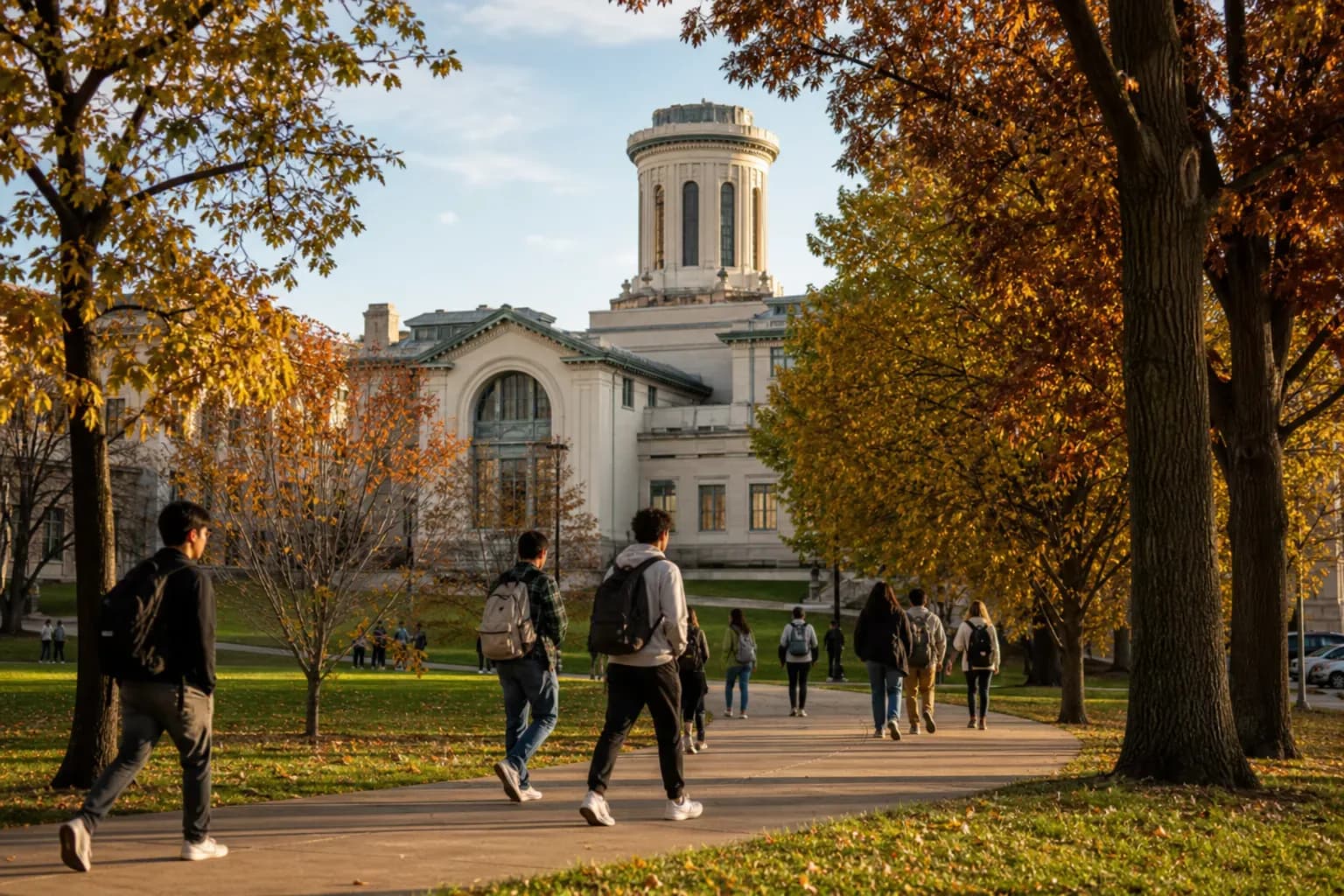
Carnegie Mellon University: America’s #1 SCS for Computer Science, Interdisciplinary DNA, and Pittsburgh’s Steel City Edge
Published on May 15, 2026
Carnegie Mellon University: America’s #1 SCS for Computer Science, Interdisciplinary DNA, and Pittsburgh’s Steel City Edge
Published on May 15, 2026
Ranked #21 nationally by US News, tied with MIT, Stanford, and UC Berkeley for #1 in Computer Science, with an overall acceptance rate of 11% but only 7% for the School of Computer Science (SCS), Carnegie Mellon is the most technology-driven, most interdisciplinary, and least traditional elite university among the Top 25. It does not have the classical feel of the Ivy League or Stanford’s sunshine, but it has one of the world’s strongest CS schools, along with one of America’s strongest drama schools, a cradle of Tony Award winners.
CMU can be summed up in one sentence: “Engineers, artists, performers, and designers inspire one another on the same campus.” You will see SCS students debugging at 3 a.m. while Drama students rehearse Shakespeare next door. This is not marketing; it is everyday life at CMU. To understand CMU, first understand its core structure: you apply to one of seven colleges, and each college has a completely different acceptance rate, culture, and applicant profile.
1. Basic Information
Item | Details |
|---|---|
Founded | 1900 (established with funding from steel magnate Andrew Carnegie) |
Location | Pittsburgh, Pennsylvania (5 km east of downtown) |
Campus | About 157 acres |
Undergraduates | ~7,500 |
Graduate students | ~8,800 (more graduate students than undergraduates) |
Student-faculty ratio | 1:6 |
Motto | "My heart is in the work." |
2. World Rankings
Ranking | Placement |
|---|---|
US News National Universities 2025 | #21 |
QS World 2025 | #58 |
THE World 2025 | #24 |
US News Computer Science | #1 (tied with MIT, Stanford, and UC Berkeley) |
US News Drama / Theater (Undergrad) | Top 3 |
US News Engineering | Top 10 |
Tepper School of Business | Top 20 |
CMU’s SCS (School of Computer Science) is the only university in the U.S. where CS stands as an independent college. At other universities, CS usually sits under Engineering or Arts & Sciences; CMU places CS at the same top-level status as Engineering. This structure defines CMU’s authority in the field of computer science.
3. Admissions Data (Class of 2028)
Metric | Figure |
|---|---|
Applicants | ~34,000 |
Admitted students | ~3,700 |
Overall acceptance rate | About 11% |
SCS acceptance rate | About 7% |
ED acceptance rate | ~17-20% |
RD acceptance rate | ~9% |
Yield Rate | ~45% |
Among Top 25 universities, CMU has one of the largest gaps in acceptance rates across colleges. SCS, Drama, and Architecture, its three signature colleges/programs, all have acceptance rates below 10%, while Dietrich (humanities) and Mellon College of Science are comparatively more accessible. Which college you apply to determines everything.
SAT/ACT Median Scores
Test | 25th percentile | Median | 75th percentile |
|---|---|---|---|
SAT | 1500 | 1540 | 1570 |
ACT | 34 | 35 | 35 |
International Students
- International students make up about 17% of the student body, one of the highest shares among Top 25 universities
- Students come from 75+ countries
- Around 5-10 students from Taiwan are admitted each year, with the CS track being the most common
4. Tuition and Financial Aid
2024-2025 Cost of Attendance
Item | Amount |
|---|---|
Tuition | USD $63,830 |
Housing | USD $11,500 |
Food | USD $7,400 |
Personal + Misc | USD $4,800 |
Total | USD $87,530+ |
Need-Based Aid
- Family income < $75,000: most tuition and housing costs are waived
- Need-Aware for international students (this is a key difference between CMU and MIT/Harvard)
- Average aid: USD $48,000/year
- CMU is more conservative than HYPM with aid for international students, so Taiwanese families should run the net price estimate first
CMU is not Need-Blind for international students, but it still offers meaningful support to students from middle- and upper-middle-income families under $200K. If you need a full ride, HYPM should be a higher priority than CMU.
5. Academic Structure / Signature Programs
Seven Undergraduate Colleges
- School of Computer Science (SCS): Ranked #1 in the U.S.; includes CS, AI, Computational Biology, HCI, and Robotics
- College of Engineering (CIT): Electrical, mechanical, chemical, and biomedical engineering
- Mellon College of Science (MCS): Physics, chemistry, biology, and mathematics
- Dietrich College of Humanities and Social Sciences: Economics, psychology, and decision sciences
- Tepper School of Business: Undergraduate business plus a major MBA powerhouse
- College of Fine Arts (CFA): Includes Drama, Music, Architecture, Art, and Design
- Heinz College (primarily graduate-level): Public policy and information systems
Signature Programs
- SCS CS Major: A rigorous four-year CS core, including the famous demanding courses 15-110, 15-122, 15-150, and 15-213
- Computational Biology (SCS): The only standalone undergraduate degree of its kind in the U.S.
- AI Major: America’s first undergraduate AI degree, launched in 2018
- HCI (Human-Computer Interaction): CMU is one of the birthplaces of the HCI field
- Drama: America’s first degree-granting drama school, founded in 1914, with an extremely high concentration of Tony Award winners
- BXA Programs: A cross-college dual-major structure connecting the College of Fine Arts with other colleges, allowing combinations such as CS + Music or Drama + Engineering
General Education Structure
General education requirements differ by college. SCS uses a strict CS core plus general education electives, while Tepper School of Business requires business core courses plus a mathematical foundation.
6. Campus Culture / Institutional Personality
CMU’s personality can be captured in one line: “Work Hard, then Work Harder.” Princeton Review has rated CMU as one of the schools where students sleep the least, one of the nerdiest schools, and one of the schools with the least party culture. This is not an insult; it is a point of pride for CMU students. There is a saying among SCS students: “Getting a B at CMU is harder than getting an A elsewhere.”
The joke CMU students repeat most often is: “I have a 15-213 assignment due at 11:59pm.” This Computer Systems course is widely known within SCS as a GPA killer, but alumni say that after finishing it, “there is no CS problem in the world you can’t write your way through.”
Greek Life / Student Organizations
- About 12% of students participate in a fraternity or sorority, a relatively low share
- Student social life is interest-club driven: robotics clubs, Drama Society, ACM programming clubs
- Signature events: Spring Carnival and Buggy Race, CMU’s unique century-old gravity vehicle race tradition
Sports Culture
- NCAA Division III (no athletic scholarships)
- CMU athletics are not a selling point; sports culture is very weak, which is a fundamental difference from UMich or USC
- Students are far more passionate about robotics competitions or ICPC than varsity sports
7. Location / Campus Environment
City Positioning
Pittsburgh is the post-steel-era “small Boston of East Coast tech.” It has a population of 300,000, but because CMU and the University of Pittsburgh sit side by side, and because Google, Uber, and Amazon have established AI R&D centers there, many founded by CMU professors, Pittsburgh is transforming from a Rust Belt city into an AI hub. It is cheaper than Boston and quieter than SF, yet still offers top-tier technology career opportunities.
Climate
- Winter: -5°C to 5°C, with snow but not as extreme as Cornell
- Summer: 22-28°C, comfortable
- Spring and fall are short; autumn foliage is pleasant
Campus Landmarks
- The Fence, CMU’s oldest tradition, where students take turns occupying and painting a wooden fence with student organization logos
- Gates and Hillman Centers, the SCS buildings jointly funded by Bill Gates and Henry Hillman
- Hunt Library
- The Mall, the central lawn
8. Research and Resources
Libraries
- Hunt Library (main library) + Sorrells Engineering Library
- Four main libraries across campus
Notable Labs / Research Centers
- Robotics Institute: The world’s first Robotics PhD-granting institution and a birthplace of autonomous vehicle technology
- Software Engineering Institute (SEI): A software engineering research institute funded by the U.S. Department of Defense
- Language Technologies Institute (LTI): A major center for NLP and machine translation
- CyLab: A cybersecurity research center
- Human-Computer Interaction Institute (HCII): One of the world’s top institutions in HCI
CMU is one of the few universities where almost every SCS professor also serves as an industry consultant. By junior or senior year, students may have opportunities to work with professors on real projects for Google, Meta, or Tesla.
9. Notable Alumni
- Tech entrepreneurship: Andy Bechtolsheim (Sun Microsystems), James Gosling (creator of Java), Vinod Khosla (Sun + Khosla Ventures)
- AI / Academia: Raj Reddy (Turing Award winner), Manuel Blum (Turing Award winner), Fei-Fei Li (Stanford AI professor, CMU PhD)
- Finance / Business: David Tepper (founder of Appaloosa and namesake of Tepper School of Business), Ted Turner
- Performing arts: Holly Hunter (Academy Award-winning actress, Drama), Ted Danson, Zachary Quinto (Star Trek), Josh Gad (Frozen voice actor)
- Academia / Nobel Prize: Herbert Simon (winner of both the Nobel Prize in Economics and the Turing Award), John Nash (former faculty member, Nobel Prize in Economics)
CMU has one of the top three concentrations of Turing Award winners in the U.S. If you want to see who defines the future of technology, CMU alumni make up a significant share.
10. CMU Trivia
- The Fence is the most frequently repainted object in the world: Students occupy it in 24-hour shifts, and different organizations paint advertisements on it each day. It is recognized by Guinness World Records.
- CMU has a traditional Buggy Race: Every Spring Carnival, student teams push self-built gravity vehicles around a campus course to compete for speed. The tradition has lasted more than 100 years.
- CMU’s Drama department has produced many Tony / Oscar winners, including Holly Hunter, Cherry Jones, and Ted Danson, earning it the nickname “the Juilliard of the East Coast.”
- Carnegie and Mellon were originally two separate schools: Carnegie Institute of Technology (1900) and Mellon Institute (1913) merged in 1967 to form CMU.
- CMU’s mascot is Scotty the Scottish Terrier, honoring Andrew Carnegie’s Scottish heritage.
11. Typical Admitted Student Profile
- GPA Unweighted ~3.9+
- SAT 1500+ or ACT 34+
- 8-12 AP courses, primarily with top scores in math and science subjects
- The spike must map clearly to a specific college:
- SCS: USACO Platinum, ICPC, Kaggle, or a GitHub repo you built yourself with meaningful stars
- Drama: Pre-college theater training, leading roles in local theater companies, Tony-level scriptwriting
- Architecture: Portfolio above everything
- Tepper: Business competitions and real entrepreneurial execution
- Essays should be direct, technical, and specific. CMU does not favor ornate self-introductions; it wants to see what you are actually doing
- The most useful recommendation letters come from teachers who can describe “how this student performs in real implementation”
CMU is the Top 25 university that cares most about concrete output. HYPM values voice; CMU values portfolio. For SCS applicants, without a serious GitHub profile or competition record, even excellent essays will struggle to carry the application.
12. What Kind of Student Fits CMU?
✓ A good fit for:
- Hardcore technical students who want CS / AI / Robotics / HCI
- Students with professional-level training in drama / music / design
- Students willing to “stay up all night for perfect code”
- Students who want interdisciplinary combinations such as CS + Music or Drama + Engineering
- Students who do not care much about sports culture or party culture
- Students with no bias against Pittsburgh as a “quiet tech city”
✗ Not necessarily a good fit for:
- Students who want Ivy-style classical atmosphere and broad liberal arts education
- Students drawn to sunshine, beaches, and a California vibe (consider UCLA or USC)
- Students who want a strong sports-centered school spirit (consider UMich or UNC)
- Students who need Need-Blind aid as international applicants (CMU is Need-Aware)
- Students who have not decided on a direction and want to “figure it out after enrolling” (CMU’s college divisions are very clear)
Conclusion
CMU is the least conventionally elite elite university in the Top 25. It does not have the Ivy League’s classical red brick, Stanford’s sunshine, or Duke’s basketball. Its value proposition is blunt: “Our students are trained to get things done.”
If you are the kind of student who is still refining an algorithm at 3 a.m. and treats GitHub as a second resume, CMU may be the best place on earth for you. If you expect college to be a “Renaissance-style formation of the whole person,” CMU may feel suffocating instead. CMU is not trying to make you a better person. CMU is trying to make you more formidable. That is the most honest reminder CMU offers Taiwanese families.
