
William & Mary: America’s Second-Oldest University, Public Ivy, Government, Pre-law, Mason Business
Published on September 23, 2025
Ranked tied #54 among National Universities by US News, #23 among Public Universities, America’s second-oldest university (founded in 1693, behind only Harvard in 1636), one of the original Public Ivies, Top 10 nationally in Government, Top 25 nationally for Pre-law, Top 50 Raymond A. Mason School of Business, birthplace of Phi Beta Kappa, a colonial-era campus in Williamsburg, Virginia, and an undergraduate population of ~6,500 — William & Mary is America’s “most private liberal arts college-like Public Ivy”, grouped with UVA, Michigan, UNC, UC Berkeley, and UCLA among the original five Public Ivies.
William & Mary in one sentence: “America’s second-oldest university + original Public Ivy + birthplace of Phi Beta Kappa + Government Top 10 + 6,500-student small public university with an LAC feel + colonial Williamsburg campus + alma mater of five U.S. presidents.” W&M is not a large Public Ivy like UVA, and it is not any other school called William and Mary (there is only this one in the United States) — it is “a university chartered in 1693 by King William III and Queen Mary II + a school that educated America’s Founding Fathers + the birthplace of Phi Beta Kappa in 1776 + a 6,500-student small public LAC.” To understand W&M, first understand this: it is one of the very few American universities with “the scale of an LAC, the tuition structure of a public university, and the prestige of an Ivy-level institution” — 6,500 undergraduates + public-university tuition (OOS USD $50K vs. Williams USD $90K) + birthplace of Phi Beta Kappa + alumni ties to five U.S. presidents (Thomas Jefferson, James Monroe, John Tyler, and others) — a combination unmatched among American public universities.
1. Basic Information
| Item | Details |
|---|---|
| Founded | 1693 (America’s second-oldest university, behind only Harvard 1636) — chartered by King William III and Queen Mary II |
| Location | Williamsburg, Virginia (Colonial Williamsburg, a historic colonial town) |
| Campus | About 1,200 acres |
| Undergraduates | ~6,500 |
| Graduate Students | ~2,500 |
| Student-Faculty Ratio | 1:11 |
| Motto | Hark Upon the Gale (Listen to the Wind) |
2. World Rankings
| Ranking | Placement |
|---|---|
| US News National Universities 2025 | #54 |
| QS World 2025 | #N/A (small public university not listed) |
| THE World 2025 | #251-300 |
| US News Public Universities | #23 |
| Government / Political Science | Top 10 |
| International Relations | Top 25 |
| History | Top 25 |
| English | Top 25 |
| Mason School of Business | Top 50 |
| Pre-law (law school placement rate) | Top 25 nationally |
| Marshall-Wythe School of Law (graduate school) | Top 35 |
| Public Affairs | Top 50 |
| Computer Science | Top 60 |
| Economics | Top 30 |
| Sociology | Top 30 |
| Anthropology | Top 25 |
W&M is nationally elite in Government, International Relations, History, English, Pre-law, and Mason Business. Government is Top 10 nationally and is W&M’s signature field — a historical tradition built on five U.S. presidential alumni and its role in educating America’s Founding Fathers. Pre-law is Top 25 nationally by law school placement rate — W&M Pre-law students enter top law schools such as Harvard, Yale, Stanford, UVA, and Georgetown at high rates. Mason School of Business is Top 50 and includes Finance, Accounting, Marketing, and Management.
3. Admissions Data (Class of 2028)
| Metric | Value |
|---|---|
| Applicants | ~17,000 |
| Admitted Students | ~5,600 |
| Overall Acceptance Rate | About 33% |
| In-State (VA) Acceptance Rate | About 40% |
| OOS / International Acceptance Rate | About 25% |
| ED Acceptance Rate | ~55% |
| Yield Rate | ~37% |
W&M is a lower-acceptance-rate, higher-quality small LAC-feel public university — its 33% overall acceptance rate is more forgiving than UVA’s (~16%) but more selective than typical public universities. The OOS / international acceptance rate is ~25% because W&M is legally required to reserve 65% of seats for in-state students (the same state-law constraint as UVA) — OOS competition is extremely intense.
W&M uses a three-round ED + EA + RD structure — the ED acceptance rate is ~55%, making it the biggest strategic option for W&M applicants.
SAT/ACT Median Scores
| Test | 25th percentile | Median | 75th percentile |
|---|---|---|---|
| SAT | 1380 | 1450 | 1510 |
| ACT | 31 | 33 | 35 |
W&M is Test-Optional — students may choose not to submit scores. However, OOS / international applicants, Honors applicants, and Mason Business applicants are advised to submit scores.
International Students
- International students make up about 6%
- Students come from 70+ countries
- More than 200 students from China
- About 3-8 students from Taiwan are admitted each year
4. Tuition and Financial Aid
2024-2025 Costs
| Item | Amount |
|---|---|
| In-State Tuition | USD $25,400 |
| OOS Tuition | USD $50,400 |
| International Student Tuition | USD $50,400 |
| Housing | USD $9,400 |
| Food | USD $6,800 |
| Personal + Misc | USD $4,500 |
| In-State Total | USD $46,100+ |
| OOS / International Total | USD $71,100+ |
W&M’s total OOS / international cost of USD $71K is a moderate-value option among Public Ivies — slightly lower than UVA OOS, USD $15K+/year cheaper than UMich OOS, and USD $20K/year cheaper than LACs such as Williams and Amherst at USD $90K+.
Need-Based Aid + Merit Aid
- Need-Aware for international students — admission chances are affected by financial need
- U.S. citizens and permanent residents: meets ~85% of demonstrated need
- William & Mary Promise: locks in four years of tuition for lower- and middle-income in-state students (protecting them from tuition increases)
- 1693 Scholars Program: W&M’s most prestigious university-wide honor — full tuition + housing + overseas summer experience + independent research funding — about 30 students/year — international students may apply — equivalent in level to a full scholarship at Williams or Amherst
- Murray Scholars: humanities / social sciences honors + USD $20,000/year
- William & Mary Scholars: USD $15,000-25,000/year
- Stamps Scholars: full-ride honors comparable to other Public Ivies
- Cypher Scholars: support for Native American students
- International students are need-aware, and aid is relatively limited
- Average aid (domestic students): USD $20,000/year
W&M’s 1693 Scholars Program, with full tuition + housing + an overseas summer experience, is a rare “full-ride honors” opportunity at a public university — equivalent in level to Williams and Amherst — and international students may apply. For Taiwanese families, the clearest strategic target is the 1693 Scholars Program — once admitted with the scholarship, a student can effectively attend W&M for four years for free.
5. Academic Structure / Signature Programs
Main Undergraduate Schools
- Faculty of Arts and Sciences: the largest school, including Government, History, English, Biology, Math, Economics, CS, Psychology, and International Relations
- Raymond A. Mason School of Business: Finance, Accounting, Marketing, Management (undergraduates enter Mason in junior year)
- School of Education: primarily graduate-level education programs
- School of Marine Science (VIMS): a Top U.S. marine science graduate school — the Virginia Institute of Marine Science in Gloucester Point, VA
- Marshall-Wythe School of Law (graduate school)
- Raymond A. Mason School of Business (graduate MBA)
Signature Programs
- Government / Political Science: Top 10 nationally — five U.S. presidential alumni + a school that educated the Founding Fathers — graduates enter the State Department, CIA, White House, Capitol Hill, and Foreign Service
- Pre-law Track: Top 25 nationally for law school placement — W&M Pre-law students enter Harvard, Yale, Stanford, UVA Law, and Georgetown at high rates
- Charles Center for Academic Excellence: interdisciplinary honors center + summer research funding
- Sharpe Community Scholars: service + academic integration program
- 1693 Scholars Program: W&M’s most prestigious university-wide honor (full tuition + housing + overseas summer experience)
- Murray Scholars: humanities / social sciences honors
- Monroe Scholars: honors program + USD $3,000 in summer research funding
- DC Summer Institute: Washington, DC internship program
- W&M-DC Office: W&M’s Washington, DC office and student internship base
- St Andrews Joint Degree Programme: W&M + St Andrews (Scotland) four-year dual degree (one of the few dual-country degree programs of its kind in the U.S.)
- VIMS (marine science graduate school) undergraduate internship opportunities
General Education Structure
W&M uses the COLL Curriculum: a four-year sequenced general education structure — COLL 100 (First-Year) → COLL 150 (Liberal Education) → COLL 200 → COLL 300 (Junior Cross-Cultural) → COLL 400 (Senior Capstone) — deeper and more cross-cultural than typical general education requirements — emphasizing a coherent four-year liberal arts education.
6. Campus Culture / Institutional Personality
W&M’s personality can be summed up in one sentence: “Public Ivy academic elite + colonial historical character + small, friendly LAC scale + Pre-law / Government / State Department pipeline + Phi Beta Kappa intellectual culture.” W&M students (who call themselves the “Tribe”) are known for being “intellectual + Pre-law anxious + historically rooted + small-school friendly” — the campus culture leans moderate, with a relatively high white student share (~60%), Asian students (~10%), and many students from Virginia, DC, and East Coast prep-school backgrounds.
W&M’s academic atmosphere is “hardworking and intellectually deep” — less intense than UVA or Michigan but more small-class-oriented, and more serious than Wake Forest or Vanderbilt. This is a paradise for students who want Public Ivy academics + a small LAC feel + a strong Pre-law / Government pipeline + a reasonable budget. Princeton Review has repeatedly recognized W&M for “Best Quality of Life,” “Most Engaged in Community Service,” “Best Career Services,” and “Best Schools for History Majors.”
Greek Life / Student Organizations
- About 30% of students join a fraternity or sorority (moderately high among Public Ivies)
- Greek Life plays a major role in W&M social life, but Pre-law / Mock Trial / Model UN / Government clubs, debate team are the academic mainstream
- Signature events: Charter Day (February 8, W&M’s founding day in 1693 — the school’s most sacred ceremony + presidential address + alumni homecoming), Yule Log Ceremony (December Christmas tradition), King and Queen’s Ball, Tribe Pride Day, Wren Building 3 PM bell-ringing tradition
- 400+ student organizations
Athletics Culture
- Coastal Athletic Association (CAA) (NCAA Division I FCS — smaller in scale than the ACC or SEC)
- Signature sports: men’s tennis, rowing, track and field, women’s soccer, baseball
- Zable Stadium: football home field (capacity 12,672)
- Kaplan Arena: basketball home court
- “The Tribe” + gold and green school colors — W&M is one of the few NCAA programs in the U.S. that uses the name “Tribe” (reflecting the history of the Powhatan people near Williamsburg)
- W&M athletics are not the center of campus culture — “Tribe Pride” is more visible in academic and cultural rituals such as Charter Day alumni homecoming and Yule Log
7. Location / Campus Environment
City Profile
W&M is located in Williamsburg — a colonial historic town in central Virginia (population 15,000, with Greater Williamsburg around 80,000). Williamsburg is a “living museum of American colonial history” — Colonial Williamsburg was restored in the 1920s with funding from the Rockefeller family to recreate the appearance of 18th-century colonial America — Williamsburg served as the capital of Virginia from 1699 to 1780 — Founding Fathers such as Thomas Jefferson, Patrick Henry, and George Washington all spent time in Williamsburg.
Distances:
- Norfolk / Virginia Beach: 1 hour by car
- Richmond, VA: 1 hour by car
- Washington, DC: 2.5 hours by car
- Newport News / Williamsburg International Airport: 30 minutes
- Norfolk International Airport: 1 hour
- Busch Gardens (theme park): 10 minutes
- Beach (Virginia Beach): 1 hour by car
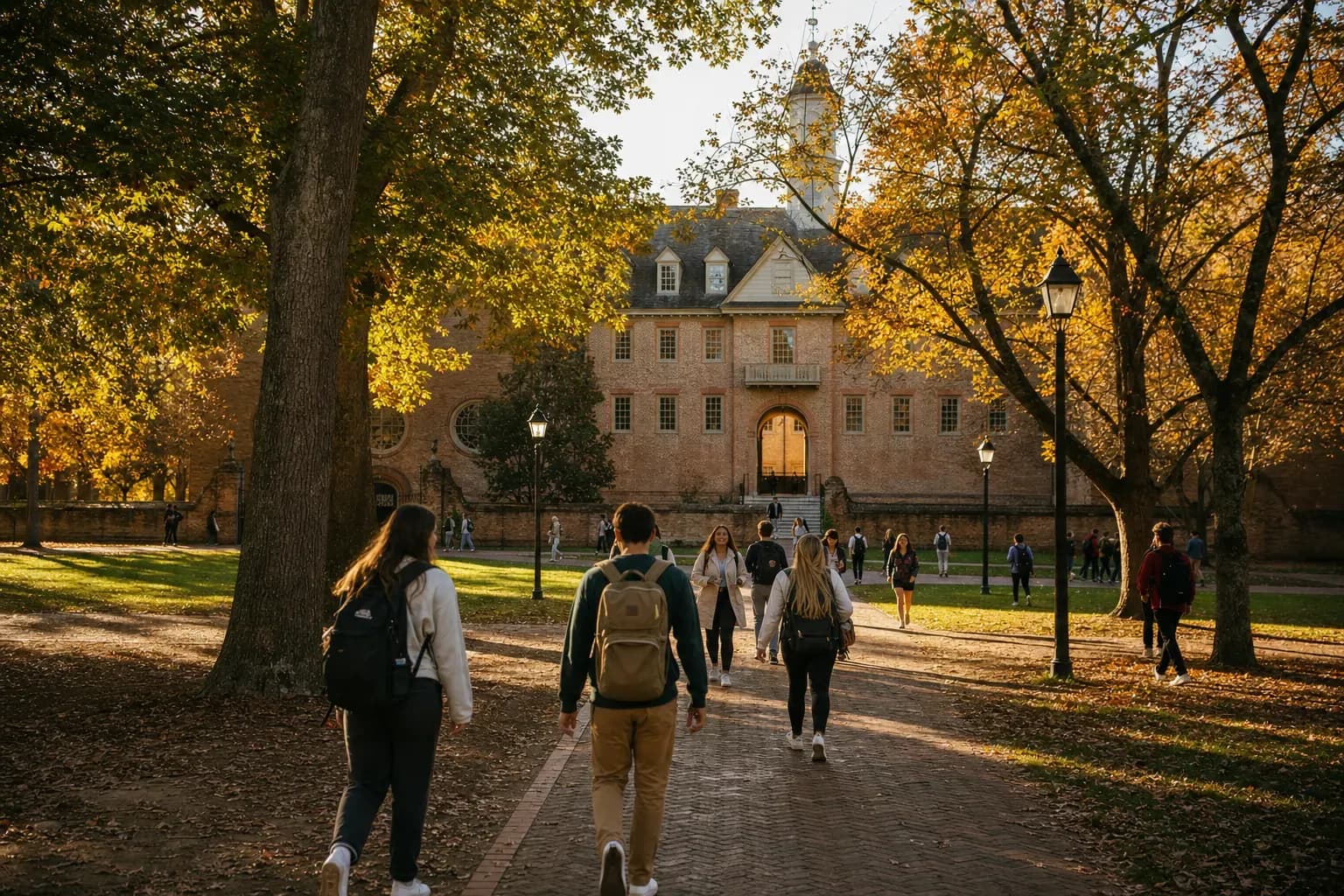
Williamsburg is “an American colonial historic town + W&M campus” — it revolves almost entirely around W&M and Colonial Williamsburg — it does not offer big-city convenience — students usually spend weekends on campus, in Richmond, or in DC (2.5 hours by car). The W&M campus partially overlaps with Colonial Williamsburg — The Wren Building (1700) is the oldest academic building in continuous use in the United States.
Climate
- Winter: 0-10°C, mild (almost no snow)
- Summer: 22-32°C, humid and hot
- Spring and fall: Virginia’s most beautiful seasons
- Winters are short, and the climate is pleasant overall
Campus Landmarks
- The Wren Building (1700): the oldest academic building in continuous use in the United States — campus landmark + Charter Day venue — W&M students pass by it every day for four years
- Sunken Garden: the sunken lawn at the center of campus — built in 1936 — graduation ceremony + Yule Log tradition site
- Earl Gregg Swem Library: main library
- Sadler Center: student center
- Crim Dell Bridge: the campus romance bridge — W&M’s traditional “three-step love bridge” legend: 1. cross it alone → destined to remain single for life; 2. cross it with a romantic partner → destined to marry; 3. cross it with a romantic partner + one pushes the other into the water afterward → destined to break up — this tradition has continued for 100+ years
- Brafferton: original 1723 Indian School building
- Wren Chapel: chapel (inside the Wren Building)
- Zable Stadium: football home field
- Sir Christopher Wren Statue: statue of the architect
8. Research and Resources
Libraries
- Earl Gregg Swem Library (main library)
- Six libraries across campus, with 2.4 million total volumes
- Special Collections include original documents related to Thomas Jefferson, James Monroe, and the founding of Phi Beta Kappa
Notable Labs / Research Centers
- Virginia Institute of Marine Science (VIMS): a Top U.S. marine science graduate school — located in Gloucester Point, VA — undergraduates can participate in internships
- Reves Center for International Studies
- Wren Society (academic honor society)
- Colonial Williamsburg collaborative research: history, archaeology, museum studies
- NASA Langley Research Center collaborative research (Hampton, VA, 30 minutes by car)
- Jefferson Lab (Thomas Jefferson National Accelerator Facility) collaborative research
W&M is world-class in marine science (VIMS), colonial history, Government / Political Science, Pre-law, and English and American literature. VIMS is a Top U.S. marine science graduate school — W&M marine science students benefit from the dual advantage of a public university and nationally leading marine research. Colonial Williamsburg collaborative research gives W&M history / archaeology students unique resources. NASA Langley and Jefferson Lab are both within 30 minutes of campus — Aerospace and Physics students have many internship opportunities.
9. Notable Alumni
- Politics / U.S. presidents: Thomas Jefferson (3rd U.S. president + principal author of the Declaration of Independence — W&M 1762), James Monroe (5th U.S. president — W&M 1776), John Tyler (10th U.S. president — W&M 1807), George Washington (1st U.S. president + Chancellor during the founding era), Benjamin Harrison (grandson of 5th president William Henry Harrison) — W&M is one of the few universities in the U.S. with ties to five presidents
- Politics / other: Robert Gates (former CIA director + U.S. Secretary of Defense + president of Texas A&M — W&M Law PhD), Christopher Wray (former FBI director), Patrick Henry (American Revolution “Give me liberty, or give me death!” speech — W&M), John Marshall (Chief Justice — W&M)
- Technology / Business: Mike Petters (CEO of Huntington Ingalls Industries), Jon Stewart (host of The Daily Show + satirical news legend — W&M Psychology 1984)
- Academia: Phi Beta Kappa was founded at W&M in 1776 — America’s oldest academic honor society
- Entertainment / Media: Jon Stewart (comedian and host of The Daily Show 1999-2015), Glenn Close (Oscar-nominated and Tony Award-winning actress — W&M Theatre + Anthropology 1974), Patton Oswalt (comedian), Christie Brinkley (model, attended)
- Sports: Mike Tomlin (NFL Pittsburgh Steelers head coach + Super Bowl XLIII champion — W&M football alumnus), Sean McDermott (NFL Buffalo Bills head coach)
W&M’s alumni network has deep influence across U.S. presidents and Founding Fathers, the CIA / FBI / State Department, the Supreme Court, Hollywood entertainment (Glenn Close + Jon Stewart), and NFL coaching. Its density of five U.S. presidential alumni ranks in the national top tier alongside Harvard, Yale, and Princeton — this is W&M’s greatest contribution to the history of American democracy. Glenn Close + Jon Stewart are W&M’s greatest honors in entertainment.
10. William & Mary Fun Facts
- W&M is America’s second-oldest university, founded in 1693: W&M was chartered in 1693 by King William III and Queen Mary II — 57 years after Harvard in 1636 — 8 years before Yale in 1701 — making it America’s second-oldest university — the name “William and Mary” honors the British royal couple. Charter Day (February 8) is W&M’s most sacred campus ceremony — the president reads the 1693 Royal Charter + alumni return to campus + bells ring — W&M’s historical tradition has continued for 332 years. The Wren Building (1700) is the oldest academic building in continuous use in the United States — designed by Christopher Wren (the architect of London’s St. Paul’s Cathedral) — rebuilt after three fires while preserving its original character.
- Five U.S. presidential ties + birthplace of Phi Beta Kappa in 1776: Thomas Jefferson (3rd) + James Monroe (5th) + John Tyler (10th) + George Washington (1st, Chancellor) + Benjamin Harrison (connected through 5th president William Henry Harrison) all have ties to W&M — its concentration of five U.S. presidents is comparable to Harvard, Yale, and Princeton — unmatched among public universities. Phi Beta Kappa (America’s oldest academic honor society) was founded on December 5, 1776, in W&M’s Wren Building — today, Phi Beta Kappa is America’s most prestigious academic honor — if a W&M student is elected to Phi Beta Kappa at graduation, it is like receiving an “intellectual elite identity card” — this is W&M’s greatest contribution to American academic history.
- The 1693 Scholars Program is one of the highest honors among Public Ivies: W&M’s 1693 Scholars Program is the university’s most prestigious honor — full tuition + housing + overseas summer experience + independent research funding + mentor — about 30 students/year — international students may apply — equivalent in level to a full scholarship at Williams or Amherst — for Taiwanese families, the clearest strategic target is the 1693 Scholars Program — after admission, it effectively means attending W&M free for four years (total value ~USD $300K) — 1693 Scholars includes annual overseas summer research + USD $5,000-10,000 in Charles Center independent research funding.
- Crim Dell Bridge is W&M’s romantic legend: Crim Dell Bridge is the red wooden bridge on W&M’s campus (built in 1966 over Crim Dell pond) — W&M students’ “three-step love bridge” tradition: 1. cross it alone → destined to remain single for life; 2. cross it with a romantic partner → destined to marry; 3. cross it with a romantic partner + one pushes the other into the water afterward → destined to break up — National Geographic once named Crim Dell Bridge one of the “Top 10 most romantic college spots in America” — every W&M student must cross it at least once in four years — this tradition has continued for 60 years — graduates often choose Crim Dell Bridge for wedding photos.
- W&M and St Andrews (Scotland) offer a four-year dual degree: W&M + University of St Andrews (Scotland, a Top 5 ancient university in the UK) four-year dual-country degree — one of the few dual-country degree designs of its kind in the U.S. — students spend two years at W&M + two years at St Andrews + graduate with degrees from both universities — majors include International Relations, English, Economics, History, Film Studies, and Classics — this is W&M’s unique opportunity for students who want “a UK experience + an American public LAC” — St Andrews is the alma mater of Prince William and Kate Middleton — W&M-St Andrews dual degree graduates gain dual employment advantages after graduation.
11. Typical Admitted Student Profile
- Unweighted GPA ~3.95+
- SAT 1450+ or ACT 33+ (1500+ for OOS / international students)
- 8-12 AP courses (with emphasis on humanities and social sciences)
- Spike for Government / Pre-law: Mock Trial, Model UN, debate team, political internships, student government
- Spike for History / English: academic writing, literary competitions, published research
- Spike for Mason Business: business competitions, entrepreneurial projects, simulated investing
- Spike for 1693 Scholars: academic depth + published research + extremely strong leadership
- Spike for Pre-Med: medical volunteering, shadowing, published research
- Essays should demonstrate “why W&M + fit with colonial history + passion for Pre-law / Government + intellectual depth” — W&M looks for the “whole person + intellectual character + service orientation + historical identity”
- Recommendation letters should tell stories of leadership + intellectual depth + writing ability
Among Public Ivies, W&M is one of the schools that cares most about “intellectual depth + fit with colonial historical character + writing ability.” Pure bragging essays will be filtered out — W&M wants to see why this student would thrive in a 6,500-student small public university, a four-year deep liberal arts COLL Curriculum, and the colonial tradition of Charter Day.
12. What Kind of Student Is It Right For?
✓ Good fit for students who:
- Want to study Government / Political Science / International Relations
- Want a Pre-law / law school pipeline
- Want to study History / English / Classics / humanities
- Want Public Ivy academics + a small LAC feel (6,500 students)
- Are drawn to American colonial history + Founding Fathers traditions
- Want the birthplace of Phi Beta Kappa + an intellectually deep atmosphere
- Want the 1693 Scholars full scholarship (international students may apply)
✗ Not necessarily a good fit for students who:
- Want coastal big-city life (Williamsburg is a small town in central Virginia)
- Want pure STEM / Engineering (W&M has no Engineering school)
- Want a strong American sports-campus culture (W&M is D1 FCS, and football is relatively weak)
- Want a Greek Life party-school culture (although 30% of students participate, academics dominate the atmosphere)
- Want Ivy branding (W&M is less famous than UVA or UNC)
- Want sunshine and beaches
- Want a highly ethnically diverse campus (white students ~60%)
Conclusion
William & Mary is the Virginia public university within the Public Ivy group that best represents “a small public university most like a private LAC + America’s second-oldest university + a famous Pre-law / Government pipeline.” It is not a large Public Ivy like UVA, nor is it a purely private LAC like Williams — but it offers Government Top 10, Pre-law Top 25 law school placement, History Top 25, English Top 25, Mason Business Top 50, and Marshall-Wythe Law Top 35, while also holding five U.S. presidential alumni ties (Jefferson, Monroe, Tyler, Washington as founding-era Chancellor) + the 1776 founding of Phi Beta Kappa on campus + The Wren Building from 1700 as America’s oldest academic building + the 1693 Scholars full scholarship + the St Andrews dual-country degree + the romantic legend of Crim Dell Bridge + 332 years of Charter Day campus ritual + entertainment alumni Glenn Close and Jon Stewart + national security alumni Robert Gates and Christopher Wray — these details create “the most historically deep LAC-feel school among American public universities.”
If you are a student who wants to study Government, Pre-law, International Relations, History, or English, W&M is one of the few choices on earth that can offer “Public Ivy academics + small LAC scale + the history of America’s second-oldest university” at the same time. Its Government students intern at the State Department, CIA, White House, and Capitol Hill (DC is 2.5 hours by car), its Pre-law students enter Harvard, Yale, UVA, and Stanford Law at high rates, and its History students collaborate with Colonial Williamsburg on 18th-century colonial history research. The intellectual tradition of Phi Beta Kappa’s birthplace + the density of five U.S. presidential alumni ties gives W&M students an academic identity rarely found at a public university.
The most concrete advice for Taiwanese families: W&M is one of the best choices for Taiwanese families who “want Government / Pre-law / humanities + want a Public Ivy + want an LAC feel + want the 1693 Scholars full scholarship.” The 1693 Scholars Program’s full tuition + housing + overseas summer experience is one of the highest honors among Public Ivies — equivalent in level to Williams and Amherst + open to international students — and the clearest strategic target for Taiwanese families is the 1693 Scholars Program. OOS / international tuition of USD $71K/year is USD $20K/year cheaper than Williams or Amherst at USD $90K+. The St Andrews dual-country degree is practical for Taiwanese students who want “a UK experience + an American public university.”
But the harshest reality for Taiwanese families: W&M’s “colonial historic small-town Williamsburg” character is a real test — Williamsburg is a colonial historic town in central Virginia (population 15,000), 2.5 hours from DC, far from major cities, and limited in cultural options — students who long for “urban convenience” will be disappointed. W&M has no Engineering school — students who want Engineering / Pure CS should not choose W&M — Computer Science is only Top 60. W&M’s “intellectual + Pre-law anxious” character — four years of substantial pressure, deep academics, and relatively traditional social life — is not suitable for students who are just here to study casually and watch football. W&M is less famous in Taiwan — “William & Mary” is unfamiliar to most Taiwanese parents (many Chinese-speaking families may mistakenly think it is a Mary school or a women’s college) — friends may not be amazed when they hear “my daughter attends William & Mary,” because its name recognition is weaker than UVA, UNC, or Georgetown. OOS tuition of USD $71K/year is not cheap either — without 1693 Scholars, the total cost is not far below many private universities. If you care about brand aura, want Engineering, want a coastal city, or want a STEM-first powerhouse, W&M is not the right fit. But if you want “Public Ivy academics + small LAC scale + America’s second-oldest university + Government Top 10 + Pre-law elite pipeline + the 1693 Scholars full scholarship,” W&M has few rivals anywhere on earth. That is the most concrete judgment W&M offers Taiwanese families.