
Washington University in St. Louis: Medical School Powerhouse, Olin Business, and an ED Strategy School
Published on October 27, 2025
Tied for #21 nationally in US News, located in the urban core of St. Louis, Missouri, a pre-med sanctuary, and home to the Top 15 Olin Business School, WashU is the quietest, most understated Top 25 university, yet one of the most worthwhile schools for an ED strategy. It does not have Ivy fame or the Stanford halo, but its medical school ranks in the Top 5 nationally, and its affiliated Barnes-Jewish Hospital is part of one of the strongest medical systems in the United States.
WashU in one sentence: “A pre-med dream school + a serious business powerhouse + ED is the key to entry.” Its ED acceptance rate is as high as 35%, more than four times higher than its RD rate of 8%, making it the Top 25 school with one of the most extreme ED/RD gaps. If WashU is your #1 dream school, not applying ED means giving up half your chances. To understand WashU, first understand one thing: this is a university that relies heavily on ED, and its admissions philosophy is that it admits students who genuinely want to be there.
1. Basic Information
| Item | Details |
|---|---|
| Founded | 1853 |
| Location | St. Louis, Missouri, about 7 miles west of downtown |
| Campus | About 169 acres, Danforth Campus + 164 acres, Medical Campus |
| Undergraduates | ~8,400 |
| Graduate students | ~7,600 |
| Student-faculty ratio | 1:7 |
| Motto | Per Veritatem Vis, Strength Through Truth |
2. World Rankings
| Ranking | Position |
|---|---|
| US News National Universities 2025 | #21 |
| QS World 2025 | #119 |
| THE World 2025 | #78 |
| WashU Medical School | #4 in the United States |
| Olin Business School, Undergrad | Top 15 |
| US News Social Work | #1, for many consecutive years |
WashU’s medical school is among the top 5 in the United States, and its affiliated hospital system, BJC HealthCare, is one of the largest in the country. This ecosystem gives pre-med students the chance to work with real research teams as early as freshman year.
3. Admissions Data, Class of 2028
| Metric | Value |
|---|---|
| Applicants | ~33,000 |
| Admitted students | ~3,900 |
| Overall acceptance rate | About 12% |
| ED acceptance rate | About 35% |
| RD acceptance rate | About 8% |
| Yield Rate | ~42% |
WashU is the school with the largest ED advantage among the Top 25. 35% vs. 8%: within the Top 25, this kind of gap is comparable only to Penn, Northwestern, and Duke. WashU also offers both ED I, 11/1, and ED II, 1/1, giving students who were rejected by HYP a second chance.
SAT/ACT Median Scores
| Test | 25th percentile | Median | 75th percentile |
|---|---|---|---|
| SAT | 1500 | 1540 | 1570 |
| ACT | 34 | 34 | 35 |
International Students
- International students make up about 12%
- Students come from 100+ countries
- About 5-10 students from Taiwan are admitted each year
4. Tuition and Financial Aid
2024-2025 Cost of Attendance
| Item | Amount |
|---|---|
| Tuition | USD $63,000 |
| Housing | USD $13,500 |
| Food | USD $7,000 |
| Personal + Misc | USD $4,500 |
| Total | USD $88,000+ |
Need-Based Aid
- Family annual income < $75,000: full coverage of tuition, housing, and meals
- Family annual income < $150,000: full tuition coverage
- WashU Pledge: full ride for low-income students from Missouri and southern Illinois
- Need-Blind for international students, changed to Need-Blind in 2021, one of the biggest recent shifts among Top 25 universities
- Average aid: USD $58,000/year
- No-Loan Policy
In 2021, WashU announced that it would become Need-Blind for international students. Overnight, it went from being a need-aware private university to one of the five most generous Top 25 universities for international students, alongside Harvard, Princeton, Yale, MIT, and Amherst. For middle-class Taiwanese families, WashU’s financial friendliness has caught up with HYPM.
5. Academic Structure / Signature Programs
Five Undergraduate Schools
- College of Arts & Sciences: the largest school, including Bio, CS, Econ, and Psych
- Olin Business School: direct undergraduate admission, Top 15
- McKelvey School of Engineering: including BME, CS, and ChemE
- Sam Fox School of Design & Visual Arts: including Architecture, Art, and Design
- Brown School, primarily graduate-level, including Social Work
Signature Programs
- Pre-Med Track: WashU has one of the highest concentrations of pre-med students in the United States, with over 30% of undergraduates on the pre-med path
- Biomedical Engineering (BME): closely connected with the medical school, Top 10
- Olin BBA: undergraduate business, with graduates entering investment banking and consulting right after college
- Architecture: integrated undergraduate + master’s pathways, Top 10
- PNP, Philosophy-Neuroscience-Psychology: a distinctive interdisciplinary program at WashU
General Education Structure
WashU uses a Distribution Requirement system. Students have room to explore freely in their first and second years and can take courses across schools. Olin Business School students can take courses in the College of Arts & Sciences, and vice versa.
6. Campus Culture / School Personality
WashU’s personality can be summarized in one line: “Midwest Nice + Pre-Med Grind.” It does not have Vanderbilt’s party atmosphere, Duke’s basketball obsession, or Emory’s overtly academic feel. Among the Top 25, it is one of the most “normal,” most friendly, and least performative universities. Students often say, “WashU is a good school for nice nerds.”
But the intensity among pre-med students is very real. WashU’s pre-med courses, including Bio 2960, Chem 105, and Orgo, are known for being difficult, and grading can be strict. Students half-jokingly say, “WashU pre-med is HYPM-rejected pre-med, we're all here to redeem ourselves.”
Greek Life / Student Organizations
- About 25% of students join a fraternity or sorority
- Greek Life exists but does not dominate campus
- WashU’s “Thurtene Carnival,” a century-old spring carnival tradition, brings student organizations together in a major campus event
Sports Culture
- NCAA Division III, no athletic scholarships
- Sports are not a selling point
- Students care far more about medical school application outcomes than athletics
7. Location / Campus Environment
City Positioning
St. Louis is the largest metropolitan area in Missouri, with a metro population of about 2.3 million. WashU is located in the University City and Clayton areas west of St. Louis, surrounded by some of the wealthiest and safest residential neighborhoods in the region. It is not at all the stereotypical “unsafe St. Louis” people often imagine. The campus sits next to Forest Park, which is larger than Central Park and one of the best university-adjacent parks in the United States.
It is a 4-hour drive from Chicago and a 4-hour drive from Kansas City, making it a true center of the Midwest.
Climate
- Winter: -5°C to 5°C, with snow, though usually short-lived
- Summer: 25-32°C, humid and muggy
- Spring and fall are the most comfortable seasons
Campus Landmarks
- Brookings Hall, the Gothic-style red-brick administrative landmark
- Olin Library, the main library
- Mildred Lane Kemper Art Museum
- Forest Park, right next to campus, with a zoo, art museum, and historic World’s Fair sites
8. Research and Resources
Libraries
- Olin Library, the main library, plus 13 specialized libraries
- Total collection of 4.6 million volumes
Notable Labs / Research Centers
- WashU School of Medicine: a Top 5 U.S. medical school, affiliated with Barnes-Jewish Hospital
- McDonnell Genome Institute: a core participant in the Human Genome Project
- Bioheart Institute: cardiovascular research
- Brown School Center for Social Development
WashU has ranked in the national Top 10 for R&D funding for many consecutive years, with most funding concentrated in biomedical research. If you want to do real medical research as an undergraduate, WashU offers more opportunities than many Ivy League schools.
9. Notable Alumni
- Politics: Harry Truman, 33rd president of the United States, attended but did not graduate
- Technology and entrepreneurship: Avram Glazer, owner of Manchester United; Edward Jones, finance
- Academia / Nobel: 25+ Nobel laureates and alumni in total, many in medicine / physiology
- Performing arts / literature: Peter Sarsgaard, Tennessee Williams, playwright
- Sports: Phil Bredesen, former governor of Tennessee
WashU’s Nobel laureates are especially concentrated in medicine / physiology, reflecting the strength of its medical school.
10. Lesser-Known Facts About WashU
- WashU has nothing to do with Washington State: the university is located in St. Louis, Missouri, and is named after George Washington, in commemoration of the centennial of his birth.
- The 1904 World’s Fair was held on the WashU campus: many buildings, including Brookings Hall, were reconstructed from the exposition pavilions.
- WashU students go to Mardi Gras together: St. Louis hosts the second-largest Mardi Gras celebration in the United States, and WashU students attend together every February.
- WashU’s bear mascot, Wash U Bear, is also casually called “Bear” by students and is one of the few U.S. university mascots without a formal name.
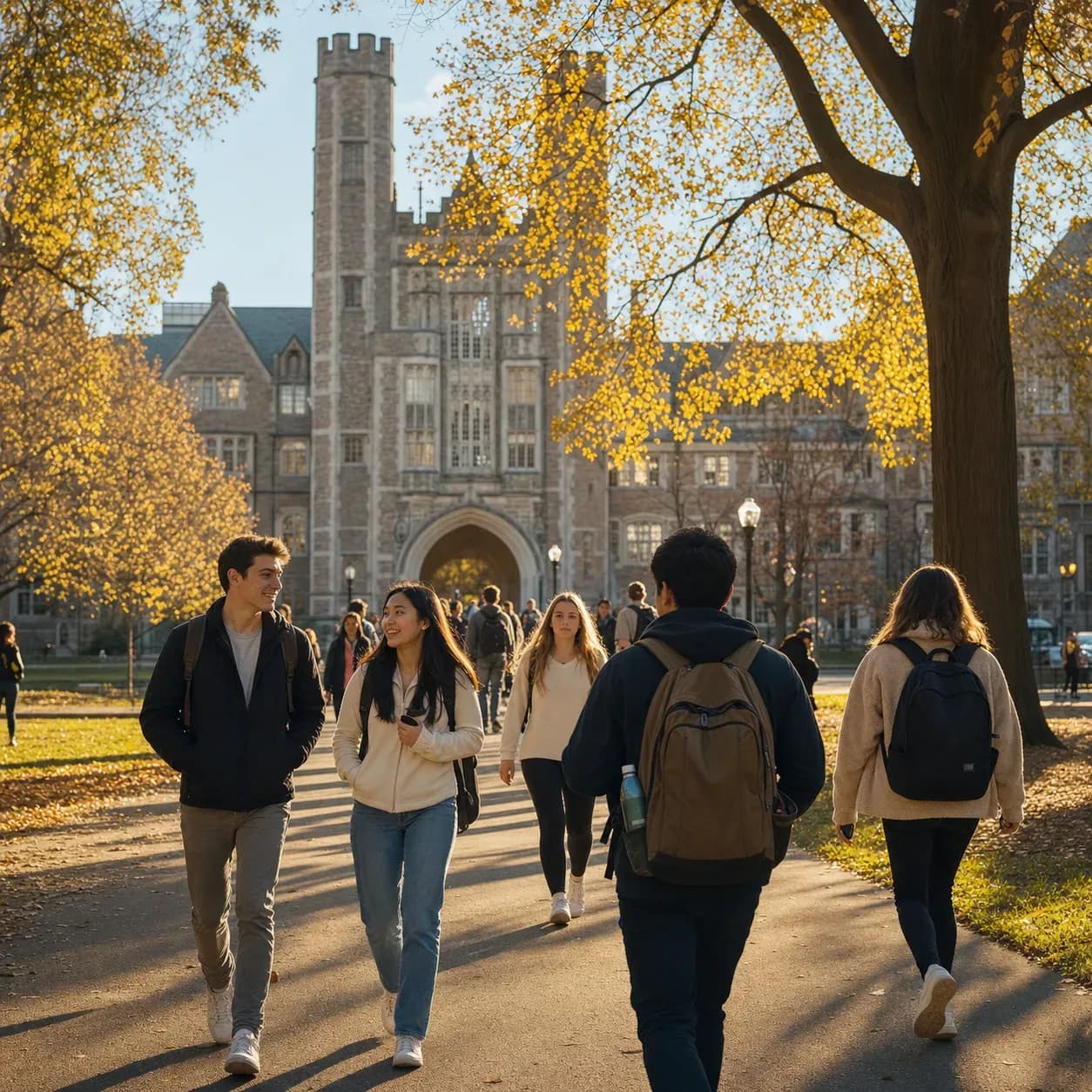
- WashU does not often appear on typical “most beautiful campus” lists: but its red-brick Gothic architecture and dense greenery have been recognized by architecture publications as one of America’s most underrated campuses.
11. Typical Admitted Student Profile
- GPA Unweighted ~3.9+
- SAT 1500+ or ACT 34+
- 8-12 AP courses, with an emphasis on math and science
- Spike for pre-med: hospital volunteering, biomedical research, Science Olympiad, HOSA
- Spike for Olin: business competitions, entrepreneurship, finance-related hands-on experience
- Essays must show “Why WashU”: the “Why WashU?” supplemental essay is a key part of evaluation
- Recommendation letters can speak to specific academic passion
WashU is one of the Top 25 universities that cares most about demonstrated interest. If your essay only says “I like St. Louis,” you will be rejected quickly. You need to write about specific professors, specific labs, and specific programs.
12. What Kind of Student Is a Good Fit?
✓ Good fit:
- Students on the pre-med path who want direct access to medical school research
- Students interested in Olin BBA and a serious business education
- Students willing to commit to one school through ED, where WashU has a major ED advantage
- Students who like a quiet, nerd-friendly, Midwest Nice culture
- Students interested in Architecture or BME
- Families with annual income < $200K who need Need-Blind international student aid
✗ Not necessarily a good fit:
- Students who want a major coastal city, such as NYC, LA, or SF
- Students who want a strong sports or Greek culture, better suited to USC or Vanderbilt
- Students who are undecided and want to “explore many options,” since most WashU students have clear goals
- Students afraid of boredom or looking for a party-school atmosphere
- Students who specifically want the Ivy brand, since WashU is not an Ivy
Conclusion
WashU is one of the most underrated Top 25 universities among Asian families. Among Taiwanese parents, WashU is far less well known than the Ivy League, but for domestic U.S. pre-med students, WashU is a dream school on the same level as Johns Hopkins, Duke, and Northwestern.
If you are the kind of student who has wanted to become a doctor since childhood, treats the lab as a second home, and does not need the stimulation of a major coastal city, WashU is one of the Top 25 options you should evaluate most seriously. And if ED is used well, WashU can be one of the “most accessible” Top 25 universities, with a 35% ED acceptance rate that reflects how strongly WashU values genuine commitment. If WashU is your #1 dream school, not applying ED means voluntarily giving up an opportunity. That is the most concrete strategic reminder WashU offers Taiwanese families.