
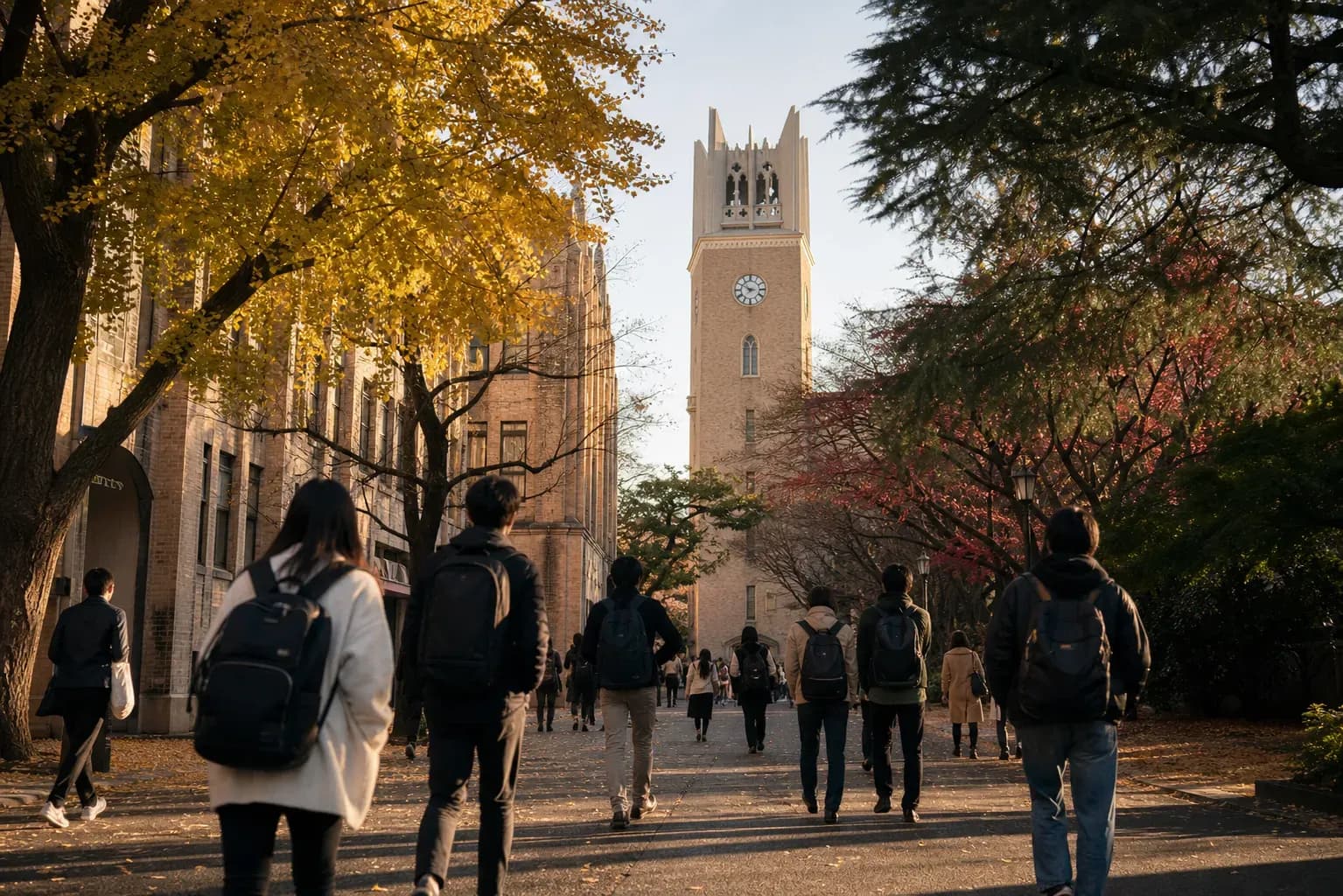
Waseda University: SILS English-Taught Liberal Studies, Japan's Private-University Powerhouse, and a Global Alumni Network
Published on January 2, 2026
Ranked QS 2026 #181, the leading name among Japan's top two private universities, Waseda and Keio, and the private university with one of Asia's largest alumni networks, Waseda University is one of the Japanese university brands most familiar to Taiwanese families. From Haruki Murakami, Takeshi Kitano, and Takashi Murakami to Ai Fukuhara, Masayoshi Son (attended), and Sadaharu Oh, being "from Waseda" is one of the most recognizable credentials in Japanese society.
Waseda's SILS (School of International Liberal Studies) is the oldest and largest English-taught undergraduate program among Japan's private universities: 600 students, more than 30 nationalities, and fully English-taught. It is, in effect, Asia's version of a liberal arts college. Waseda also offers seven English-taught programs, including PSE (Political Science and Economics), FSE / CSE / ASE (the three science and engineering schools), SSS / SPSE, giving it the broadest English-taught coverage among Japanese private universities.
If you want the combination of "top Japanese private university credential + four years fully taught in English + global alumni network + central Tokyo," Waseda is an option you need to take seriously. It is also an SGU Type A top-tier university; among private universities, only Waseda and Keio were selected.
1. Basic Information
| Item | Details |
|---|---|
| Founded | 1882, founded by Shigenobu Okuma |
| Institution type | Private university |
| Location | Four main campuses, including Waseda, Tokorozawa, and Honjo in Tokyo and surrounding areas |
| Campus | About 162 hectares, including Tokorozawa |
| Undergraduate students | ~38,000 |
| Graduate students | ~10,000 |
| Student-faculty ratio | 1:22 |
| Founding principles | "Independence of Learning," "Practical Application of Knowledge," and "The Creation of Good Citizens" |
2. World Rankings
| Ranking | Position |
|---|---|
| QS World 2026 | #181 |
| THE World 2026 | #251-300 |
| QS Asia 2026 | #28 |
| THE Asia 2026 | #41 |
| US News Global Universities | #480 |
| QS Politics | #50-100 |
| QS Sports-related Subjects | #38 |
| QS Sports-related Subjects | Top 50 worldwide |
Waseda is one of the 13 SGU Type A top-tier universities, alongside the University of Tokyo, Kyoto University, Osaka University, Tohoku University, Institute of Science Tokyo, Kyushu University, Hokkaido University, Nagoya University, University of Tsukuba, Hiroshima University, and Keio University. It is also one of only two private Type A universities, the other being Keio. In domestic reputation, Waseda stands alongside Keio and Japan's former seven imperial universities.
3. Admissions Data (2024 Entry)
Waseda has 13 undergraduate schools, of which 7 offer English-taught programs. Taiwanese applicants tend to focus on the following:
SILS (School of International Liberal Studies)
| Metric | Figure |
|---|---|
| Applicants, international student track | ~1,200-1,500 |
| Admitted students, international student track | ~200-250 |
| Overall acceptance rate | About 15-20% |
| Current enrollment | ~600, including Japanese and international students |
PSE (Political Science & Economics, English-based Degree Program, EDESSA)
| Metric | Figure |
|---|---|
| Applicants | ~500-700 |
| Admitted students | ~60-80 |
| Overall acceptance rate | About 10-15% |
FSE / CSE / ASE (English-Taught Programs in the Three Science and Engineering Schools)
| School | English name | Majors | Acceptance rate |
|---|---|---|---|
| FSE | Fundamental Science and Engineering | Mathematics, physics, applied chemistry, CS | ~15-20% |
| CSE | Creative Science and Engineering | Mechanical engineering, civil engineering, architecture | ~15-20% |
| ASE | Advanced Science and Engineering | Electrical engineering, life sciences, materials | ~15-20% |
Application Requirements (Examples: SILS and PSE)
| Item | Requirement |
|---|---|
| English proficiency | TOEFL iBT 95+ / IELTS 7.0+ |
| Standardized tests | SAT 1400+, ACT 30+, IB 38+, A-Level 3A or above |
| Japanese | Not required at entry, but SILS students must take 4 credits of Japanese; PSE does not require it |
| Recommendation letters | 1-2 letters |
| Essay | Personal Statement + Reasons for Application |
International Students
- International students make up about 33% of SILS, around 200 of 600 students
- International students make up about 50%+ of PSE
- Waseda has about 8,000 international students overall, the highest in Japan, including exchange students
- Each year, 30-50 Taiwanese students are admitted to Waseda across all programs
4. Tuition and Financial Aid
2025 Tuition (Private University)
| Item | Amount (JPY) | Approx. NTD |
|---|---|---|
| Enrollment fee | 200,000 | ~45,000 |
| Annual tuition, humanities programs such as SILS | ~1,300,000 | ~280,000 |
| Annual tuition, science and engineering programs such as FSE/CSE/ASE | ~1,700,000 | ~370,000 |
| Facilities / miscellaneous fees, annual | 100,000-300,000 | ~20,000-70,000 |
| Dormitory, WID international student dorms, monthly | 60,000-100,000 | ~13,000-22,000 |
| Living expenses, monthly in Shinjuku | 90,000-130,000 | ~20,000-30,000 |
| Estimated total cost for four years | About JPY 12-16M | ~NTD 2.6-3.5M |
As a private university, Waseda's tuition is about 2.5 times that of a national university, but compared with US private universities at USD 70,000+ per year, it is still only about one-third to one-quarter of the cost.
MEXT Scholarships
- MEXT Embassy Recommendation Scholarship: available for private universities
- MEXT University Recommendation: Waseda has a solid nomination allocation
Waseda Internal Scholarships (Extensive Options)
- W Scholarship: full tuition waiver for 4 years
- Azusa Ono Memorial Scholarship: half tuition waiver + monthly stipend
- Okuma Memorial Scholarship: named after the founder, JPY 300,000 per year
- Waseda International Student House Scholarship: full dormitory fee waiver
- Alumni association scholarships: funded by Waseda alumni associations, known as Tomonkai
Waseda has the largest total scholarship funding among Japanese private universities. About 30-40% of international students can receive full or half scholarships.
JASSO
- JASSO Honors Scholarship: JPY 48,000-80,000 per month, available to privately financed students
5. Program Structure / Signature Programs
SILS (School of International Liberal Studies)
Founded in 2004, SILS is Waseda's flagship English-taught program. It is a fully English-taught liberal arts program with the following student mix:
- 1/3 Japanese students admitted from Japanese high schools
- 1/3 returnee Japanese students from international schools or overseas high schools
- 1/3 international students, including Taiwanese students
Four-year program design:
- Year 1: foundation courses + required 4 credits of Japanese for international students
- Year 2: choose one of 7 clusters, such as Life, Environment, & Materials Science; Mathematical Sciences; Philosophy, Religion & History; Economics & Business; Governance, Peace, Human Rights, & International Relations; and Communication
- Year 3: mandatory one-year study abroad at one of Waseda's 400+ global partner universities
- Year 4: graduation thesis and internships
SILS is Japan's only English-taught undergraduate program with mandatory study abroad, and that is its defining feature.
PSE (EDESSA) - English-Taught Program in Political Science and Economics
This fully English-taught program is offered by one of Japan's strongest schools of political science and economics. Areas of specialization include:
- Political Science
- Economics
- Globalization Studies
The PSE degree has strong market value and excellent employment outcomes. Many graduates enter foreign investment banks, trading companies, Big 4 firms, and diplomatic career tracks.
FSE / CSE / ASE - English-Taught Programs in the Three Science and Engineering Schools
These are four-year, fully English-taught undergraduate programs in science and engineering:
- FSE: Fundamental Science and Engineering, including mathematics, physics, applied chemistry, CS, and applied mathematics
- CSE: Creative Science and Engineering, including mechanical engineering, civil engineering, and architecture
- ASE: Advanced Science and Engineering, including electrical engineering, life sciences, and materials
From the third year, science and engineering students enter laboratories and follow the same graduation requirements as students in the Japanese-taught divisions.
Other English-Taught Programs Such as SSS and SPSE
- SSS (School of Social Sciences): English-taught track in the School of Social Sciences
- SPSE (School of Sport Sciences): English-taught program in the School of Sport Sciences, with partnerships involving the Japan Sumo Association and JFA
Standard Undergraduate Programs (Japanese-Taught)
Waseda has 13 undergraduate schools and a very large academic structure: Political Science and Economics, Law, Culture, Media and Society, Letters, Arts and Sciences, Education, Commerce, Fundamental Science and Engineering, Creative Science and Engineering, Advanced Science and Engineering, Social Sciences, Human Sciences, SILS, and Sport Sciences.
6. Campus Culture / Institutional Personality
Waseda's character: free, eclectic, student-led, and rooted in the "Okuma spirit."
Key features of the school culture:
- "Independent spirit": Shigenobu Okuma founded Waseda in 1882 after being forced out of government following the political crisis of 1881. From the beginning, the university carried a defiant spirit of standing apart from state authority
- Many schools and more than 3,000 student clubs: Waseda has the largest number of student clubs in Japan
- Waseda-Keio games: baseball and rugby rivalries with Keio, including the fiercest matchup in the Tokyo Big6 Baseball League, held every June and November
- Tomonkai alumni associations: 700,000 alumni worldwide and 180 chapters, including Taiwan Tomonkai, making Waseda Japan's strongest private-university alumni network
Student club culture:
- Waseda Rugby Football Club: one of Japan's top three university rugby teams
- Tokyo Big6 Baseball League: the Waseda-Keio matchup is a signature event in Japanese baseball culture
- Waseda Festival: held every November, Japan's largest university festival, with 180,000+ visitors
- Waseda Theatre Museum: Japan's first theatre museum, with especially active theatre clubs
For SILS students, Waseda's advantage is Japan's richest mix of student clubs, campus activities, and alumni resources.
7. Location / Campus Environment
Urban Positioning
Waseda's four main campuses:
- Waseda Campus (main campus): located in Waseda, Shinjuku, and home to most schools, including Political Science and Economics, Law, Letters, Arts and Sciences, Culture, Media and Society, and SILS. It is 10 minutes from Shinjuku and 25 minutes from Tokyo Station
- Nishi-Waseda Campus (three science and engineering schools): home to FSE, CSE, and ASE, about a 10-minute walk from the main campus
- Toyama Campus: home to parts of Culture, Media and Society and Letters, Arts and Sciences
- Tokorozawa Campus: home to Human Sciences and Sport Sciences, located in Tokorozawa, Saitama
SILS and PSE students study on Waseda Campus (main campus), one of Tokyo's most student-oriented neighborhoods.
Waseda / Takadanobaba Area
- One stop from Shinjuku and two stops from Shibuya, with excellent access across Tokyo
- Takadanobaba, the student district: the main area for student life, packed with restaurants, bookstores, and cafes
- Monthly rent: JPY 70,000-100,000 for a single studio apartment
Climate
- Same as the rest of Tokyo: dry winters, humid summers, and snowfall 0-3 times per year
Campus Landmarks
- Okuma Auditorium: built in 1927, an Important Cultural Property and the symbol of Waseda
- Okuma Statue: statue of the university founder
- Theatre Museum: built in 1928, Asia's first museum dedicated to theatre
- Waseda campus protest sites: historic locations associated with student self-governance and protest movements
8. Research and Resources
Libraries
- Waseda University Central Library: about 5.8 million volumes, the largest among Japanese private universities
- Theatre Museum Library: world-class resources for theatre research
- Comprehensive branch libraries for each school
Notable Research Institutes
- Waseda Business School (WBS): MBA program ranked among Asia's leading business schools
- Waseda University Organization for Regional and Inter-regional Studies / Comprehensive research institutes: interdisciplinary research centers
- WIAS (Waseda Institute for Advanced Study): institute for developing young researchers
- AI Lab and Quantum Computing Research Center: collaborations with NEC, Fujitsu, and Sony
School-Level Strengths
- School of Political Science and Economics: the school with the largest number of alumni in Japanese politics
- Three science and engineering schools: Japan's strongest private science and engineering grouping, with employment ratios close to Institute of Science Tokyo
- School of Sport Sciences: a training base for Japanese professional athletes, associated with figures such as Ai Fukuhara, Rie Miyazawa, and Takeshi Kitano
9. Notable Alumni
- Politics: Noboru Takeshita, Toshiki Kaifu, Keizo Obuchi, Yoshiro Mori, Yasuo Fukuda, Yoshihiko Noda, and Fumio Kishida (for part of his education; Kishida is mainly associated with Waseda Law). At least seven former Japanese prime ministers are connected to Waseda
- Business and entrepreneurship: Masayoshi Son (attended before leaving for the US), Yoshiaki Murakami (Murakami Fund), Hiroshi Mikitani (founder of Rakuten, though he graduated from Hitotsubashi), and Yoshito Hori (founder of Globis)
- Literature / media: Haruki Murakami, Ryu Murakami, Kenzaburo Oe (attended the University of Tokyo), Takeshi Kaiko, and Kenzo Kitakata
- Entertainment: Takeshi Kitano, Yuko Tanaka, Masato Sakai, Masaharu Fukuyama, and Ai Fukuhara (table tennis player and current Tomonkai member)
- Sports: Sadaharu Oh (baseball, of Taiwanese heritage, with deep ties to Waseda Jitsugyo) and Yuko Arimori (Olympic medalist in marathon)
Waseda alumni influence + Waseda Jitsugyo, its affiliated high school + the Waseda University system + regional Tomonkai chapters = Japan's largest private-university alumni network, with 700,000 people worldwide.
10. Waseda Trivia
- The school song, "Miyako no Seihoku," is Japan's most famous university anthem: written in 1907, it is a Tokyo tradition for 50,000 people to sing it together at the end of the Waseda-Keio games.
- Waseda Jitsugyo School is an affiliated Waseda high school: Sadaharu Oh and Kotaro Kiyomiya both came from Waseda Jitsugyo. Many Taiwan Tomonkai families follow the "Waseda Jitsugyo to Waseda University" route.
- Haruki Murakami "refused" to return to Waseda for lectures for more than 30 years: he finally returned in 2018 for a talk that packed 1,500 people into Okuma Auditorium.
- Shigenobu Okuma had only 5,000 yen when he founded the university: Waseda began entirely as a private, independent institution, forming a contrasting educational philosophy with the national University of Tokyo.
- Waseda's "W" logo was designed in 1907 by alumnus Isoo Abe: it was inspired by the first letter of the English name Waseda.
11. Typical Admitted Student Profile (SILS / PSE)
- High school GPA of 3.7/4.0
- TOEFL iBT 100+ or IELTS 7.5+
- SAT 1450+, IB 39+, or A-Level 3A and above
- Extracurriculars: MUN, debate, student council, journalism, cross-cultural exchange
- Essays that can explain "why Waseda, not ICU, and not Keio," often through angles such as Waseda's free academic culture, independent spirit, or a specific SILS cluster
- Strong international perspective: overseas experience, bilingual ability, cross-cultural background
- Recommendation letters from IB / A-Level / AP teachers plus an extracurricular advisor
12. What Kind of Student Is Waseda Right For?
✓ A good fit for:
- High school students who want a top Japanese private liberal arts education
- Students interested in politics, economics, international relations, and cultural studies
- Students willing to spend their third year studying abroad at an overseas partner university, which is mandatory for SILS
- Students who want the combination of global alumni network + central Tokyo + fully English-taught degree
- Families who can afford private-university annual costs of JPY 1.3-1.7 million, without scholarships
- Students considering the HSP highly skilled professional permanent residency pathway
✗ Not necessarily a good fit for:
- Families with very limited budgets who cannot cover private-university tuition, unless the student receives a full W Scholarship
- Students seeking small classes and a tight-knit community, since Waseda is huge with 38,000 students
- Students who want to study medicine, since Waseda has no medical school
- Students who do not want any contact with Japanese culture and only want to live in English, since Waseda's campus is still mainly Japanese
13. HSP Highly Skilled Professional Permanent Residency Pathway (A Waseda Graduate Advantage)
Waseda is one of the only private universities eligible for the HSP +10 point bonus, the other being Keio:
- Master's degree + annual income of JPY 6 million -> permanent residency application after 3 years
- Doctoral degree + annual income of JPY 8 million -> permanent residency application after 1 year
Waseda's especially strong career pathways:
- Trading companies and foreign investment banks: Waseda alumni are highly influential at Mitsubishi Corporation, Mitsui, Itochu, and Goldman Sachs Tokyo
- Media and advertising: Waseda alumni have top-tier representation at Dentsu, Hakuhodo, Asahi Shimbun, and NHK
- Politics: among private universities, Waseda has the highest proportion of alumni among members of Japan's National Diet and local politicians
- Entrepreneurship: Waseda has one of Japan's highest densities of entrepreneur alumni
"SILS -> Waseda MBA / master's in law -> foreign finance / trading company -> HSP permanent residency within 3 years" is the high-income private-university route.
For detailed strategy, refer to Dr. G.'s internal resources, Master Grad School Database / Japan and Post-Graduation Visa Strategy / 05_Japan_Visa_Strategy. For families with middle school students who want to plan ahead, Japan International Schools K12 includes entry information for Waseda Jitsugyo School and the Taiwan Waseda University Alumni Association.
Conclusion
Waseda is not for students who only want "a famous Asian university." It is for students who would argue a political point with classmates in a Shinjuku izakaya until midnight and imagine themselves as the next Haruki Murakami or Masayoshi Son.
If you are drawn to liberal arts, Japan's largest alumni network, and life in central Tokyo, Waseda SILS / PSE is the most complete option among four-year, fully English-taught undergraduate programs in Japan. If the budget works, it is the top private-university choice in Japan alongside Keio. If the budget is tight, winning a full W Scholarship can reduce four years of costs to living expenses only. In one sentence: if you want to go to Japan but do not want to be locked into science and engineering, and you want global perspective plus an independent spirit, Waseda is the answer.