
Virginia Tech: Engineering Top 15, Hokies, Architecture, Corps of Cadets, Pamplin Business
Published on September 27, 2025
Ranked tied #51 among National Universities by US News, Top 22 among Public Universities, Top 15 nationally in Engineering, Top 10 in Industrial & Systems Engineering, Top 10 in Civil Engineering, Top 5 in Mining Engineering, Top 5 in Architecture, Top 50 for the Pamplin College of Business, a member of the ACC athletic conference, and home to roughly 30,000 students, Virginia Tech is America’s “Southern public engineering giant + military tradition + Top 5 national Architecture” flagship technology university in Virginia.
Virginia Tech in one sentence: “The South’s Purdue + a dual military-engineering identity + Architecture Top 5 + one of America’s 6 Senior Military Colleges through the Corps of Cadets + loyal Hokie Nation alumni + a 30,000-student public flagship in Blacksburg.” VT is not an aristocratic Jeffersonian public liberal arts school like UVA, nor a small Public Ivy like William & Mary. It is a “1872 land-grant engineering and technology flagship + Senior Military College + Hokies football” institution. To understand VT, start with one fact: its Corps of Cadets is one of America’s 6 Senior Military Colleges alongside Texas A&M, Virginia Military Institute (VMI), The Citadel, North Georgia, and Norwich. VT is a public engineering flagship that is not a military academy but has a large-scale Corps. That military tradition is something Purdue and Georgia Tech do not have.
1. Basic Information
| Item | Details |
|---|---|
| Founded | 1872 (Land-Grant University, originally Virginia Agricultural and Mechanical College) |
| Location | Blacksburg, Virginia (southwestern Virginia, near the Appalachian Mountains) |
| Campus | About 2,600 acres |
| Undergraduates | ~30,000 |
| Graduate students | ~7,500 |
| Student-faculty ratio | 1:14 |
| Motto | Ut Prosim (That I May Serve) |
2. World Rankings
| Ranking | Placement |
|---|---|
| US News National Universities 2025 | #51 |
| QS World 2025 | #336 |
| THE World 2025 | #251-300 |
| US News Public Universities | #22 |
| Engineering (Undergrad) | Top 15 |
| Industrial & Systems Engineering | Top 10 |
| Civil Engineering | Top 10 |
| Mining Engineering | Top 5 |
| Aerospace Engineering | Top 25 |
| Mechanical Engineering | Top 20 |
| Computer Science | Top 30 |
| Biological & Agricultural Engineering | Top 10 |
| Architecture (B.Arch) | Top 5 (tied nationally) |
| Landscape Architecture | Top 5 |
| Pamplin College of Business | Top 50 |
| Veterinary Medicine | Top 25 |
| Forestry | Top 5 |
VT is nationally elite in Engineering, especially Industrial, Civil, Mining, and Aerospace, as well as Architecture, Forestry, and Vet Med. Industrial & Systems Engineering is Top 10, competing with Georgia Tech and Purdue. The B.Arch in Architecture is Top 5 nationally, in the same top tier as Cornell, Cooper Union, Rice, and SCI-Arc, and VT is the only public university in the Architecture Top 5. Civil Engineering is Top 10, a core pipeline for Virginia infrastructure. Mining Engineering is Top 5, one of the few elite mining engineering programs in the U.S. Forestry is Top 5, rooted in Appalachian mountain and forest resources.
3. Admissions Data (Class of 2028)
| Metric | Value |
|---|---|
| Applicants | ~47,000 |
| Admitted students | ~26,800 |
| Overall acceptance rate | About 57% |
| In-State (VA) acceptance rate | About 65% |
| OOS / international acceptance rate | About 45% |
| ED acceptance rate | ~75% |
| EA acceptance rate | ~60% |
| Yield Rate | ~30% |
VT uses a three-track ED + EA + RD process. The ED acceptance rate of ~75% is the largest strategic option for VT applicants. The overall acceptance rate of 57% is far more accessible than UVA (~16%), but admit rates within Engineering, CS, and Architecture are lower: CS is around 30-40%, Architecture around 25-35%, and Engineering overall around 50%.
SAT/ACT Median Scores
| Test | 25th percentile | Median | 75th percentile |
|---|---|---|---|
| SAT | 1240 | 1340 | 1420 |
| ACT | 27 | 30 | 33 |
VT is Test-Optional, so students may apply without scores. However, Engineering, CS, and Architecture applicants are advised to submit strong scores.
International Students
- International students make up about 9%
- Students come from 100+ countries
- More than 800 students from China
- More than 600 students from India
- Around 8-15 students from Taiwan are admitted each year
4. Tuition and Financial Aid
2024-2025 Tuition
| Item | Amount |
|---|---|
| In-State Tuition | USD $15,500 |
| OOS Tuition | USD $35,500 |
| International Tuition | USD $35,500 |
| Housing | USD $7,800 |
| Food | USD $5,400 |
| Personal + Misc | USD $4,500 |
| In-State total | USD $33,200+ |
| OOS / international total | USD $53,200+ |
VT’s total cost of USD $53K for OOS / international students is highly cost-effective among ACC and public Top 50 universities. It is more than USD $20K per year cheaper than UVA OOS, more than USD $35K per year cheaper than UMich OOS, and more than USD $15K per year cheaper than Georgia Tech OOS.
Need-Based Aid + Merit Aid
- Need-Aware for international students, meaning financial need can affect admission chances
- U.S. citizens and permanent residents: meets ~50% of demonstrated need, not 100%
- Pamplin Leader Scholarship: USD $5,000-10,000 per year for business students
- University Honors / Galipatia / Hypatia Scholars: Honors College scholarships
- Stamps Scholars: full tuition + housing (5 students per year)
- Corps of Cadets Scholarship: additional USD $4,000-8,000 per year for Corps students
- Pratt Engineering Scholarship: College of Engineering merit award
- International students are need-aware, and aid is more limited
- Average aid for domestic students: USD $13,000 per year
VT’s Stamps Scholars full tuition + housing award is a top-tier honor, with extremely intense competition for only 5 students per year. The additional USD $4,000-8,000 per year for Corps of Cadets students is a strategic target for students interested in both the Corps and Engineering.
5. Academic Structure / Signature Programs
Main Undergraduate Colleges
- College of Engineering: CS, ECE, ME, Aerospace, Industrial, Civil, Chemical, Mining, Materials, Biomedical (one of the largest engineering colleges in the U.S.)
- Pamplin College of Business: Finance, Accounting, Marketing, Management, Hospitality, Real Estate
- College of Architecture, Arts, and Design (formerly the College of Architecture and Urban Studies): Architecture, Industrial Design, Landscape Architecture, Interior Design
- College of Agriculture and Life Sciences: Animal Science, Plant Science, Food Science, Forestry
- College of Liberal Arts and Human Sciences: includes Econ, Political Science, Psychology, Communication
- College of Natural Resources and Environment: Forestry, Wildlife, Geography
- College of Science: Bio, Math, Physics, Chemistry
- Virginia-Maryland College of Veterinary Medicine
Signature Programs
- Industrial & Systems Engineering: Top 10 nationally, with graduates entering manufacturing, logistics, and energy
- Civil Engineering: Top 10 nationally, a core pipeline for Virginia and the DC metropolitan engineering sector
- Architecture B.Arch (5-year program): Top 5 nationally, in the same top tier as Cornell, Cooper Union, and Rice
- Aerospace Engineering: closely connected with NASA Langley Research Center in Hampton, VA
- Computer Science: Top 30 nationally, tied to Virginia’s technology corridor; Northern Virginia is the heart of America’s data center industry
- Corps of Cadets: one of America’s 6 Senior Military Colleges, with ~1,100 students and ROTC officer training plus a degree
- University Honors: Honors College
- Galipatia / Hypatia / da Vinci themed living-learning communities
- Pamplin Hospitality and Tourism Management: Top 25 hospitality management
- Veterinary Medicine (Virginia-Maryland): a joint veterinary college with the University of Maryland
General Education Structure
VT uses Pathways General Education, covering areas such as Discourse, Critical Thinking, Reasoning, Quantitative & Computational Thinking, Scientific Reasoning, Critique & Practice in Design, and Ethical Reasoning. It has a more design-oriented feel than a standard general education system.
6. Campus Culture / Institutional Personality
VT’s personality can be summarized in one sentence: “Hokie Nation alumni loyalty + the service ideal of Ut Prosim + a military-engineering temperament + moderately conservative culture + an Appalachian mountain atmosphere.” VT students, who call themselves “Hokies,” are known for a mix of Southern culture, Virginia pride, practical engineering thinking, and alumni loyalty. The campus leans moderate, has a high white student share (~63%), an Asian student share of around 12%, and many students from Virginia and Mid-Atlantic backgrounds.
VT’s academic culture is “hardworking but balanced.” It is less intense than UVA and Georgia Tech, but more serious than OSU or Florida State. This is a paradise for students who want Engineering / Architecture, want ACC football, and can accept life in the Appalachian mountains. Princeton Review has repeatedly recognized VT for “Happiest Students,” “Best Career Services,” and strong community service engagement.
Greek Life / Student Organizations
- About 18% of students participate in fraternities / sororities, a moderate level
- Corps of Cadets + Hokie traditions + Greek Life run in parallel
- Signature events: The Big Event (spring service day, with ~9,000 students participating), Hokie Hi (orientation), Ring Dance (senior class ring dance), Relay for Life, Step Sing
- 800+ student organizations
Sports Culture
- ACC Conference (including Duke, UNC, Virginia, Notre Dame, Florida State, and Wake Forest)
- Signature sports: men’s football (Hokies, an ACC power), men’s basketball, baseball, women’s basketball
- Lane Stadium, the football home field (capacity 65,632): the whole-stadium jump to “Enter Sandman” is a Lane Stadium legend
- Cassell Coliseum, basketball home arena
- HokieBird mascot: an orange and maroon turkey, one of the most recognizable mascots in the U.S.
- “Let’s Go Hokies!” + “Hokie Pokie” are signature VT cheers
- Frank Beamer is VT’s legendary football coach (1987-2015, 29 years, with 23 consecutive bowl seasons)
7. Location / Campus Environment
City Positioning
VT is located in Blacksburg, a small town in southwestern Virginia with a population of around 40,000, near the Appalachian Mountains, and built almost entirely around VT. This is an “engineering college town in the Appalachian mountains.” The area around campus is framed by the Blue Ridge Mountains and rural Virginia landscapes.
Distance:
- Roanoke, VA: 45 minutes by car
- Washington DC: 4.5 hours by car
- Richmond, VA: 3.5 hours by car
- Charlotte, NC: 3 hours by car
- Roanoke-Blacksburg Regional Airport: 30 minutes
- Charlotte / DC International Airport: 4 hours
Blacksburg is an “Appalachian mountain college town.” Downtown Blacksburg has restaurants, bars, and bookstores within walking distance of campus. It is smaller than Lafayette, home of Purdue, and smaller than Athens, home of UGA. There is no big-city convenience. On weekends, students mostly stay on campus, go to Roanoke, or make the 4.5-hour trip to DC. Blacksburg has been selected as a “Top 10 Best College Town in America” for 10+ consecutive years.
Climate
- Winter: -3 to 5°C, frequent snow (mountain climate)
- Summer: 18-28°C, pleasant and dry
- Spring and fall: the most beautiful seasons in the Appalachians (mountains covered in fall color)
- Winters are snowy but not endless
Campus Landmarks
- Squires Student Center: student center
- Newman Library: main library
- Drillfield: 100-acre central campus lawn (Corps of Cadets drill ground + student leisure space + April 16 memorial gathering site)
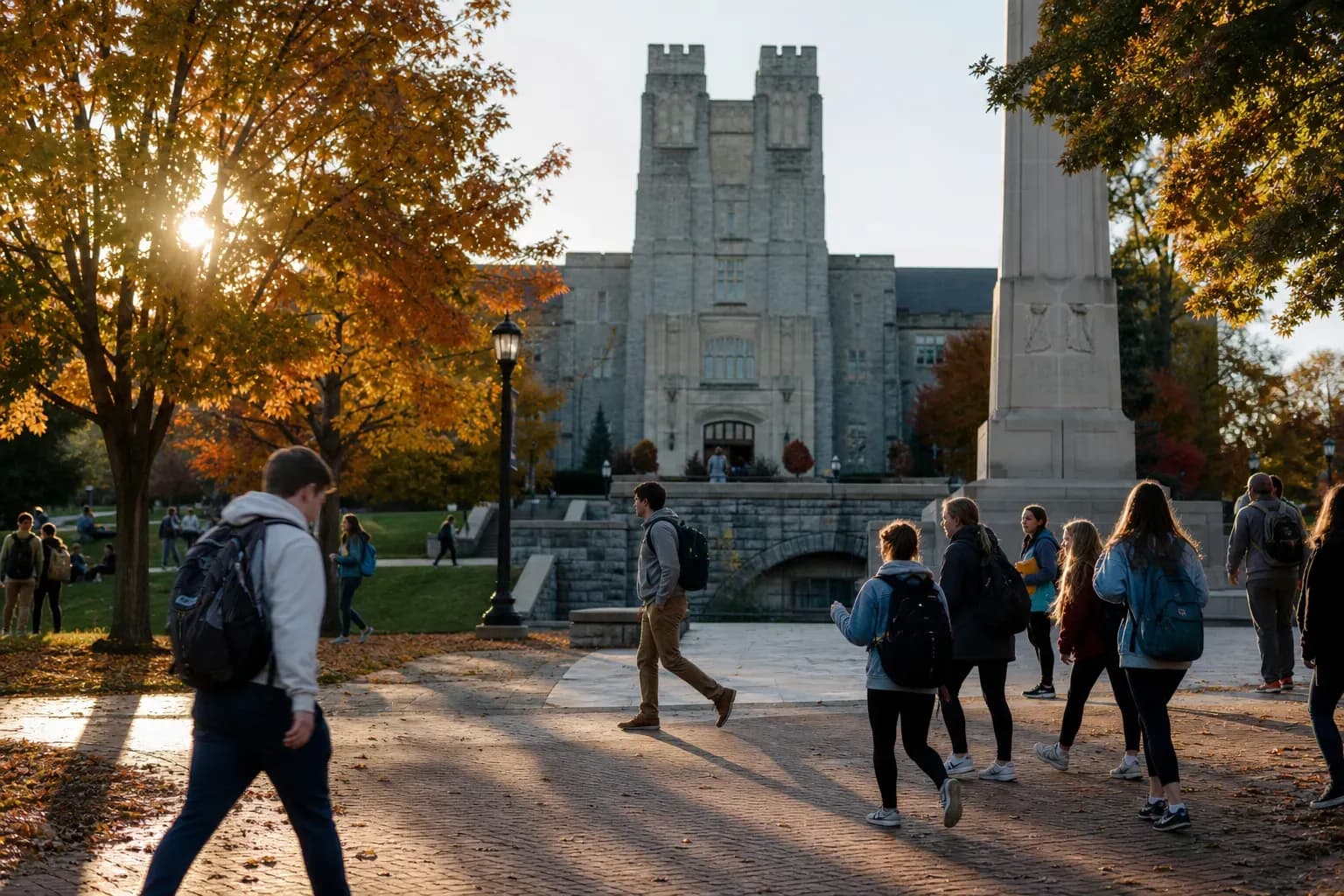
- Burruss Hall: president’s office (in front of the April 16 Memorial and a campus landmark)
- April 16 Memorial: memorial for the 32 lives lost in the April 16, 2007 VT shooting, with 32 Hokie Stone markers in front of Burruss Hall, one of the most solemn memorials on any U.S. campus
- Lane Stadium: football home field, capacity 65,632
- Hokie Stone: VT’s distinctive gray campus stone; all major buildings are built with Hokie Stone, giving the campus strong visual consistency
- War Memorial Court: military memorial
- Cassell Coliseum: basketball home arena
8. Research and Resources
Libraries
- Newman Library (main library)
- 5 libraries across the university, with a total collection of 2.9 million volumes
Notable Labs / Research Centers
- Hume Center for National Security and Technology: national security research
- Institute for Critical Technology and Applied Science (ICTAS): interdisciplinary frontier technology
- Virginia Tech Transportation Institute (VTTI): the largest university transportation research center in the U.S., focused on autonomous driving and traffic safety
- Center for Advanced Innovation in Agriculture
- Fralin Life Science Institute
- Virginia Tech Carilion Research Institute: biomedical research in partnership with Carilion Clinic
- Virginia-Maryland College of Veterinary Medicine
- Virginia Tech Innovation Campus (Alexandria, VA, near Washington DC, new campus opening in 2025), focused on CS, AI, and Cybersecurity
VT is world-class in autonomous driving / transportation research, national security, Aerospace, Architecture, Forestry, and Veterinary Medicine. Virginia Tech Transportation Institute (VTTI) is the largest university transportation research center in the U.S., partnering with GM, Ford, and Tesla on autonomous vehicle testing. Virginia Tech Innovation Campus in Alexandria, VA, completed in 2025, is located near Amazon HQ2 and collaborates with Amazon on CS / AI education. This is VT’s strategic positioning in the Washington DC technology corridor.
9. Notable Alumni
- Technology / Business: Chris Kraft (founder of NASA Mission Control and Apollo program flight director, VT Aerospace Engineering 1944), Marc Edwards (environmental engineering professor who exposed the Flint water crisis, MacArthur Genius 2018), Sasha Issenberg (journalist), Charles Schoeffler
- Politics: Jim Lehrer (PBS NewsHour anchor, not an alumnus but deeply influential to VT)
- Space / NASA: Roger Crouch (NASA astronaut), Christopher Kraft (founder of NASA Mission Control), Dave Brown (astronaut who died in the Columbia Space Shuttle disaster and VT alumnus)
- Sports: Michael Vick (former NFL Atlanta Falcons and Philadelphia Eagles QB, 4-time Pro Bowl selection, VT football alumnus), Bruce Smith (NFL Hall of Famer and all-time sack leader, VT football), DeAngelo Hall (NFL star), Frank Beamer (legendary VT football coach, 1987-2015)
- Architecture: Hani Rashid (founder of Asymptote Architecture), Olalekan Jeyifous (architectural artist)
- Academia: Carolyn Meyers (former president of Jackson State University)
VT’s alumni network has deep influence in the U.S. military, including space and defense, NASA Aerospace, NFL football, civil engineering, and architecture. Chris Kraft, the founder of NASA Mission Control, is VT’s greatest honor in space history. The Chris Kraft Mission Control Center at NASA Johnson Space Center is named after him. Michael Vick and Bruce Smith are both VT football legends. Marc Edwards exposed the Flint lead water crisis, making him a symbol of VT’s conscience in environmental engineering.
10. Virginia Tech Fun Facts
- VT is one of America’s 6 Senior Military Colleges: VT, together with Texas A&M, Virginia Military Institute (VMI), The Citadel, North Georgia, and Norwich, makes up the six “Senior Military Colleges” in the U.S. These are not military academies, but universities with large-scale Corps of Cadets programs. VT’s Corps of Cadets has ~1,100 students who take classes with regular students, but live, train, and participate in ceremonies separately. Corps students attend school in uniform, one of the most visible symbols on the VT campus. After graduation, Corps students may choose either ROTC military service or civilian careers. The four-year Corps of Cadets training includes marching, weapons, leadership, and military ceremonies. Corps students belong to the same American pre-officer training ecosystem as Aggie Cadets and VMI Keydets.
- The April 16, 2007 VT shooting is one of the most painful events in U.S. campus history: On April 16, 2007, VT student Seung-Hui Cho opened fire in Norris Hall and West Ambler Johnston Hall, causing 32 deaths, 17 injuries, and the shooter’s suicide. It was one of the deadliest campus shootings in U.S. history, and the deadliest until the 2018 Parkland shooting. At the center of the Drillfield, 32 Hokie Stone memorial markers stand in front of Burruss Hall. Every April 16, the university suspends classes and holds memorial ceremonies. “We Are Virginia Tech” became VT’s enduring spiritual commitment. Families of the 32 victims still return to campus each year and interact with VT students. This tragedy shaped every Hokie student’s commitment to the spirit of “Ut Prosim,” or service to others, within a four-year college experience.
- HokieBird + “Hokie” cannot be found in the dictionary: VT’s mascot, HokieBird, is an orange and maroon turkey. The word “Hokie” cannot be found in the dictionary. It originated from the 1896 cheer written by VT student O.M. Stull, “Old Hokie, Re Re Ri.” “Hokie” was a word Stull invented for rhyme, and it later became the self-identity of VT students and alumni. VT’s colors, Burnt Orange and Chicago Maroon, are among the most recognizable school colors in the U.S. All VT merchandise and campus branding use these two colors.
- The “Enter Sandman” entrance is a Lane Stadium legend: Before VT football games, 65,000 people jump to Metallica’s “Enter Sandman.” Because of this, Lane Stadium has been ranked among the “Top 5 hardest NCAA road environments” in America. This tradition began in 2000 and has continued for 25 years. When the crowd jumps, seismographs have actually detected vibrations from Lane Stadium. Sports media often rank Lane Stadium among the most intimidating home fields in the country.
- Hokie Stone is VT’s defining campus material: Hokie Stone, a blue-gray limestone, is VT’s signature campus building material. All major buildings, including Burruss Hall, Newman Library, Squires Student Center, Lane Stadium, and the buildings around the Drillfield, use Hokie Stone. VT is one of the few U.S. universities with a single defining campus building material. The Hokie Stone quarry is 7 miles south of campus. The campus maintenance team still uses this stone each year to repair buildings. This visual consistency has made VT’s campus known among architecture circles as one of America’s most beautiful public engineering campuses.
11. Typical Admitted Student Profile
- Unweighted GPA ~3.85+
- SAT 1340+ or ACT 30+ (1450+ for CS / Engineering / Architecture applicants)
- 8-12 AP courses, with a STEM-heavy profile
- Engineering spike: FIRST Robotics, Science Olympiad, research publication
- CS spike: USACO, hackathons, open-source GitHub
- Architecture spike: drawing portfolio, architectural models, ARC competitions
- Pre-Vet spike: animal medical volunteering, veterinarian shadowing, farm work
- Corps of Cadets spike: Eagle Scout, JROTC, military summer camp
- Essays should show “why VT + Ut Prosim service + Hokie Nation fit”. VT looks for the whole person, a service mindset, and practical engineering character.
- Recommendation letters should tell stories of leadership + ethical judgment + community service
Among ACC schools, VT is one of the most attentive to the Ut Prosim service ideal and fit with Hokie alumni loyalty. Essays that are pure bragging will not work. VT wants to see why a student would thrive in Blacksburg, in Hokie culture, and around the military temperament of the Corps of Cadets.
12. What Kind of Student Is a Good Fit?
✓ Good fit for students who:
- Want Engineering, especially Industrial, Civil, Aerospace, or Mining
- Want a 5-year Architecture B.Arch
- Are drawn to American military tradition through the Corps of Cadets
- Want ACC football and the Lane Stadium “Enter Sandman” legend
- Want top public engineering with reasonable tuition (OOS ~USD $53K per year)
- Like the Appalachian mountain atmosphere and the Blacksburg college town
- Are willing to embrace lifelong Hokie Nation alumni identity
✗ Not necessarily a good fit for students who:
- Want coastal urban life, since Blacksburg is a small Appalachian mountain town
- Dislike military tradition / the Corps of Cadets
- Want a highly ethnically diverse campus, since the white student share is ~63%
- Want small-class LAC-style education, since 200+ student lectures are common at VT
- Want Ivy prestige, since VT is less famous than UVA and Georgia Tech
- Want pure liberal arts or pure business, since VT is primarily STEM + Architecture
- Are afraid of snow or the feeling of being isolated in the mountains
Conclusion
Virginia Tech is Virginia’s ACC flagship for “Southern public engineering giant + military tradition + Architecture Top 5.” It is not a Jeffersonian aristocratic public liberal arts school like UVA, nor a purely technical powerhouse like Georgia Tech. But its Engineering is Top 15 nationally, Industrial Top 10, Civil Top 10, Mining Top 5, Aerospace Top 25, CS Top 30, Architecture B.Arch Top 5, and Forestry Top 5. It also has one of America’s 6 Senior Military Colleges through the Corps of Cadets, lifelong Hokie Nation alumni loyalty, the Ut Prosim service ideal, the whole-stadium “Enter Sandman” jump at Lane Stadium, the HokieBird turkey mascot, Hokie Stone as the defining campus building material, the April 16 memorial spirit, Chris Kraft of NASA Mission Control, football legends Michael Vick and Bruce Smith, and the Virginia Tech Innovation Campus in Alexandria for AI / CS. Together, these details form the identity of a “Southern public engineering flagship.”
If you are a student who wants Engineering / Architecture / Mining, wants American military tradition, wants ACC football, wants lifelong alumni identity, and needs a reasonable budget, VT is one of the few choices on earth that can satisfy all of those conditions at once. Its Engineering students are closely connected to the Northern Virginia technology corridor, including Amazon HQ2, Boeing, and Lockheed Martin. Its Architecture B.Arch students graduate into the same tier of top firms as Cornell and Cooper Union peers. Its Aerospace students intern at NASA Langley Research Center. Virginia Tech Innovation Campus in Alexandria, VA, completed in 2025, gives VT CS / AI students direct access to Amazon HQ2 and the Washington DC technology ecosystem.
The most concrete advice for Taiwanese families: VT is one of the best choices for Taiwanese families who want Engineering / Architecture, have a limited budget, want a lifelong alumni network, and can accept life in the Appalachian mountains. OOS / international total cost of USD $53K per year is USD $20-35K per year cheaper than UMich and UCLA OOS, making it one of the best-value public engineering options in the Top 50. Architecture B.Arch Top 5 is VT’s greatest strategic value for Taiwanese students interested in architecture, because students can complete a professional undergraduate degree in five years. Virginia Tech Innovation Campus is practical for CS / AI students.
But the harshest truth for Taiwanese families: VT’s “Blacksburg in the Appalachian mountains” character is a real test. Blacksburg is a small town in southwestern Virginia, 4.5 hours from DC, far from major cities, snowy in winter, and limited in cultural options. Students who dream of “urban convenience” or “East Coast prep culture” may be disappointed. VT’s “Corps of Cadets + military atmosphere” is real: uniforms, marching, and military ceremonies are visible across campus. Students who dislike military tradition may feel out of place. VT’s “Hokie Nation alumni loyalty” requires high participation: students need to embrace Hokie traditions, Lane Stadium jumping, the class ring culture, and more within four years. It is not a good fit for students who are “just here to study.” VT has weaker name recognition in Taiwan, where most parents see “Virginia Tech” as less prestigious than UVA or Georgia Tech. If you care about brand halo, want a coastal city, or dislike military / Hokie culture, VT is not a fit. But if you want “Engineering Top 15 + Architecture Top 5 + Corps of Cadets + lifelong Hokie Nation identity + reasonable cost,” VT is very hard to beat anywhere on earth. That is the most concrete judgment VT offers Taiwanese families.