
UTS University of Technology Sydney: Australia’s #1 Non-Go8 University, Frank Gehry’s Paper Bag Business School, and the Ultimo City Campus
Published on February 18, 2026
Ranked #96 globally in QS 2026, Australia’s #1 non-Go8 university, and the flagship of the ATN (Australian Technology Network), the University of Technology Sydney (UTS) is one of the top Sydney options Taiwanese families most often overlook. Parents usually stop after checking the Go8 list (Sydney, UNSW) without realizing that UTS is the only university in the entire Sydney CBD located right next to Central Station, one of Australia’s most industry-connected universities in design and engineering, and the world’s first university with a business school designed by Frank Gehry (shaped like a crumpled brown paper bag). Among the five ATN universities (UTS, RMIT, Curtin, QUT, Deakin), UTS is the clear flagship: its QS ranking is 30 places higher than RMIT, the next-ranked university in the group.
UTS is overshadowed from two directions: first by the Go8 halo of USYD and UNSW, and second by its own lack of “sandstone tradition” as historical packaging. Its predecessor was the NSW Institute of Technology, founded in 1965, and it only became a university in 1988. In Australian higher education, that makes it a “new elite.” But seen from the other side, that youth is UTS’s greatest advantage: it does not carry the ivory-tower baggage of the Go8, its curriculum design and industry links are extremely flexible, and many professors come from industry backgrounds (engineers and designers from IBM, Cisco, Telstra, and Animal Logic). For Taiwanese students who want to “graduate in four years and start working” and do not want to be held hostage by historical tradition, UTS can be the more practical choice. This article explains what UTS is really like, what kind of student it suits, and how to think about PR strategy.
1. Basic Information
| Item | Details |
|---|---|
| Founded | 1988 (predecessor: NSW Institute of Technology, 1965) |
| Location | Sydney, NSW (main Ultimo campus, southwestern edge of Sydney CBD, next to Central Station) |
| Campus | Single urban campus, about 13 hectares, almost fully integrated into central Sydney |
| Undergraduates | ~36,000 |
| Postgraduates | ~13,000 |
| Total students | About 49,000 |
| Student-faculty ratio | 1:24 |
| Motto | Think. Change. Do. |
| Network identity | Flagship of the ATN (Australian Technology Network) |
UTS is the largest and highest-ranked of all Australia’s “modern universities.” Its motto, “Think. Change. Do.,” is not in Latin, and that alone reflects the university’s DNA: no classical pretension, strong emphasis on practice.
2. World Rankings
| Ranking | Position |
|---|---|
| QS World 2026 | #96 (Australia’s #1 non-Go8 university) |
| THE World 2026 | #154 |
| ARWU / Shanghai 2024 | #201-300 |
| QS Young University Rankings (founded within 50 years) | Global Top 10 |
| QS Sports Related Subjects | Global Top 10 |
| QS Nursing | Global Top 50 |
| QS Communication & Media Studies | Global Top 30 |
| QS Art & Design | Global Top 30 |
| QS Architecture & Built Environment | Global Top 50 |
| QS Computer Science | Global Top 100 |
UTS has long ranked in the global Top 10 in the QS Young University Rankings (for universities founded within the past 50 years). This is a metric for evaluating “modern research and teaching capacity without historical baggage.” For families that do not care about the Go8 label and value a university’s modernity, this ranking is more meaningful than QS World. UTS’s subject rankings in Communication, Media, Design, Nursing, and Sports Science even outperform some Go8 universities.
3. Admissions Data (International Students, 2026 Entry Cycle)
| Indicator | Value |
|---|---|
| International student ATAR equivalent | 75-92 (depending on program) |
| IB Diploma | 28-36 points |
| Approximate GPA threshold for Taiwanese high school students | Top 15-25% of class + near-perfect grades |
| IELTS requirement | 6.5 (6.0 in each band); Communication and Nursing 7.0 |
| TOEFL iBT | 79 (including Writing 21) |
| Application fee | AUD 100 (international undergraduate applicants) |
| International student proportion | About 40% (one of the highest in Australia) |
| Bachelor of Engineering entry threshold | ATAR 80 / IB 30 |
| Bachelor of Design in Architecture entry threshold | ATAR 85 / IB 32 + portfolio |
| Bachelor of Communication entry threshold | ATAR 88 / IB 33 (highly competitive) |
| Bachelor of Animation Production (in partnership with Animal Logic) threshold | ATAR 85 / IB 32 + portfolio |
International Students
- International students make up about 40% of the student body, higher than UNSW (30%) and Sydney (35%), making UTS one of Australia’s most internationally oriented universities
- Students come from 130+ countries, with a very high proportion of Chinese students (over 20%), followed by India and Southeast Asia
- Around 150-200 Taiwanese students enroll each year (including undergraduate and postgraduate students)
- Practical admissions approach: UTS emphasizes portfolios and industry links; Design, Communication, and Animation programs require portfolios, while STEM subjects are assessed mainly by grades
4. Tuition and Financial Aid
2026 International Student Tuition (Annual)
| Program category | Annual tuition in AUD | NTD equivalent (AUD 1 = NTD 22.6) |
|---|---|---|
| Bachelor of Arts | About AUD 38,000 | About NTD 860,000 |
| Bachelor of Business | About AUD 48,000 | About NTD 1.08 million |
| Bachelor of Science | About AUD 46,000 | About NTD 1.04 million |
| Bachelor of Engineering (Honours) | About AUD 51,000 | About NTD 1.15 million |
| Bachelor of Information Technology | About AUD 49,000 | About NTD 1.11 million |
| Bachelor of Design (Architecture / Animation / Fashion) | About AUD 45,000 | About NTD 1.02 million |
| Bachelor of Communication | About AUD 44,000 | About NTD 990,000 |
| Bachelor of Nursing | About AUD 41,000 | About NTD 930,000 |
| Master of Information Technology | About AUD 47,000 | About NTD 1.06 million |
| Master of Data Science and Innovation | About AUD 48,000 | About NTD 1.08 million |
| Living costs (Sydney CBD) | About AUD 35,000-45,000 | About NTD 790,000-1.02 million |
The total tuition for a four-year Bachelor of Engineering (Honours) is about AUD 204,000 (NTD 4.61 million), roughly AUD 30,000-40,000 cheaper than an equivalent UNSW program. But Sydney is the most expensive city in Australia. While UTS tuition is slightly lower, living costs are pushed up by its CBD location (a single studio around Ultimo costs AUD 450-600 per week, similar to the area around UNSW’s Kensington campus).
Scholarships and Financial Aid
- UTS International Student Scholarships: 25-50% tuition reduction for undergraduates, requiring high ATAR / IB results
- Vice-Chancellor's Postgraduate Research Scholarship: full tuition + AUD 35,000 stipend for research-track master’s and doctoral students
- UTS Insearch Pathway Scholarships: scholarships for students entering degree programs through the UTS pathway program
- Faculty-Specific Awards: additional awards available from Engineering, IT, Business, and other faculties
- Industry Sponsored Scholarships: partner companies such as IBM, Cisco, Telstra, and Westpac provide sponsored placements, some with tuition support and guaranteed internships
The most realistic reminder for Taiwanese families: UTS’s “Industry Sponsored Scholarship” is an advantage the Go8 cannot offer in the same way. What you receive is not just money, but a direct entry ticket into industry internships. IBM, Cisco, and Telstra recruit around 200 UTS students for internships each year through this channel, a scale not matched at UNSW or Sydney.
5. Program Structure: Four-Year Direct Entry + Industry Sandwich
No Melbourne Model
UTS follows the traditional UK-Australian four-year direct professional degree structure. At age 18, students can apply directly to Bachelor of Engineering (Honours), Bachelor of IT, or Bachelor of Design programs and graduate into employment after four years, without spending another two years on a master’s degree.
Signature “Bachelor + Diploma in Professional Engineering Practice” Structure
The UTS Faculty of Engineering and IT offers a distinctive “five-year sandwich model.” In addition to the standard four-year bachelor’s degree, students can add the Diploma in Professional Engineering Practice, which means completing 12 months of full-time, paid internships at IBM, Cisco, Telstra, Westpac, or CSIRO during years 3 and 4. These 12 months are not just one line on a CV. The Diploma is a separate Australian-recognized qualification, can be listed on LinkedIn, and can count toward PR work experience points. For students targeting PR, this is UTS’s unique strategic advantage.
Signature Programs
- Bachelor of Engineering (Honours): 8 specializations, including Software, Mechatronics, Civil, and Biomedical
- Bachelor of Information Technology: industry-oriented, in partnership with IBM, Microsoft, and Atlassian
- Bachelor of Design in Architecture: one of Australia’s top architecture and design programs, at the same university as the Frank Gehry business school
- Bachelor of Design in Animation: in partnership with Animal Logic (the studio behind The LEGO Movie and Happy Feet), unique in Australia
- Bachelor of Design in Fashion and Textiles: connected with Sydney Fashion Week
- Bachelor of Communication: one of Australia’s top communication faculties, covering journalism, Strategic Communication, and Media Arts
- Bachelor of Business: UTS Business School (designed by Frank Gehry), accredited by both AACSB and EQUIS
- Bachelor of Nursing: one of Australia’s leading nursing programs, linked with Royal Prince Alfred Hospital
- Master of Data Science and Innovation: a strong CS-related option with a clear PR pathway
What This Means for Taiwanese Students
- Advantages: a four-year direct path is 1-2 years shorter than the Melbourne Model; students can add the Sandwich Diploma to build paid work experience; industry partnerships are extremely deep
- Disadvantages: research-track resources are not as strong as the Go8; the academic brand is less familiar to Taiwanese parents
- Consultant’s recommendation: if you already know at age 18 that you want Engineering, IT, Design, Communication, or Nursing, UTS is a more practical choice than Sydney/UNSW; if you need the Go8 brand on your résumé, plan to pursue a PhD, or want an academic career, choose Sydney/UNSW instead
6. Campus Culture / University Personality
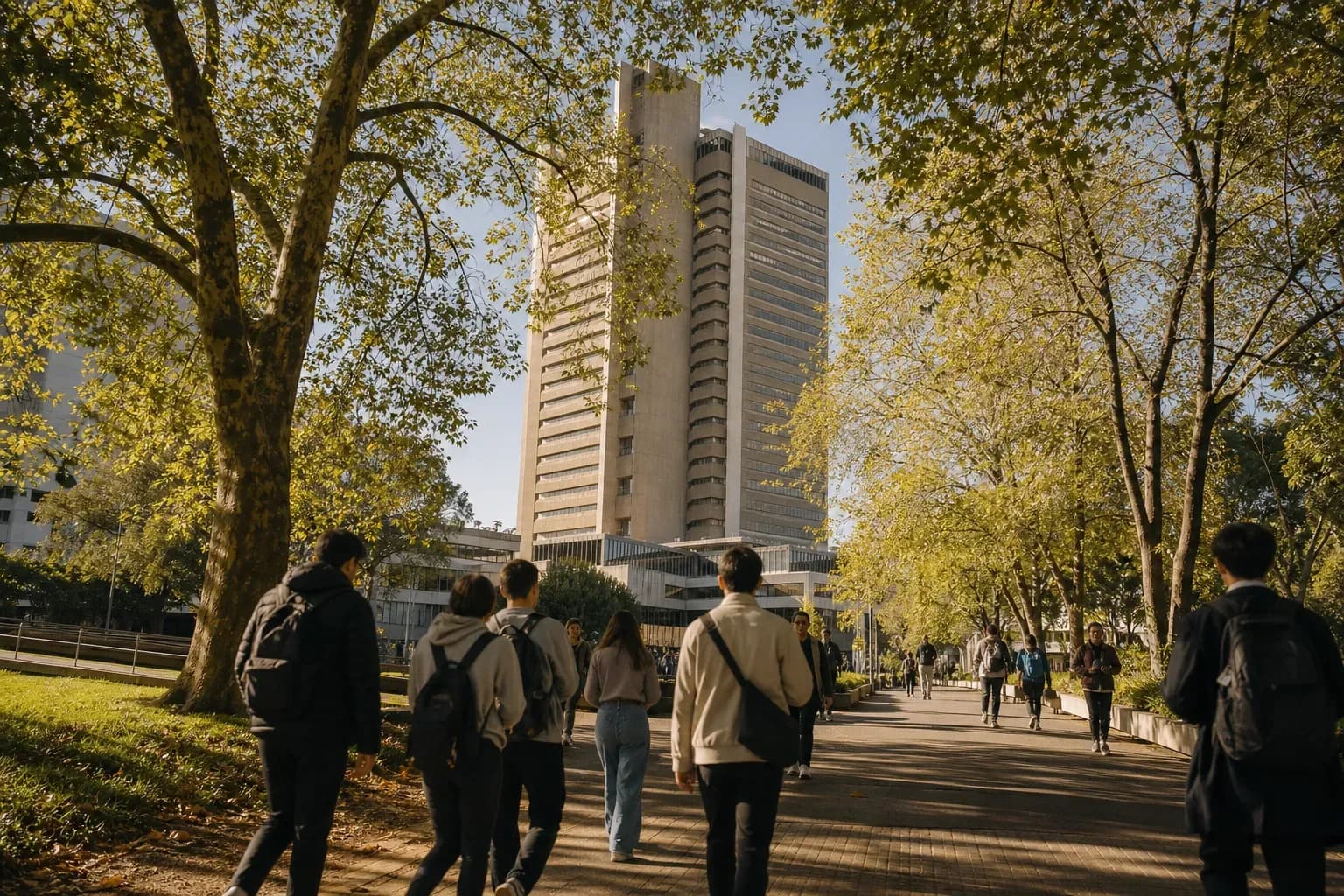
UTS’s personality can be summed up in three words: modern, practical, unpretentious. It does not carry the sandstone tradition of the University of Sydney, founded in 1850, and it does not have UNSW’s hardcore engineering competitiveness. It is a university on the southwestern edge of Sydney CBD built around urban modernist architecture, studio-based learning, and industry-led teaching. Your first impression when entering the UTS campus may be: “This feels like an IBM or Google office, not a university.”
The student body leans toward Asian international students (China, India, Southeast Asia, Taiwan, Korea) + local Sydney middle-class white students + first-generation university students. The proportion of first-generation university students is very high. Many UTS students have parents who are engineers, designers, nurses, accountants, or immigrant business owners; from a young age, they were taught that university is for professional skills and employment, not for “finding yourself.”
This DNA gives UTS a campus atmosphere that is practical, goal-oriented, and project-based. If you are the kind of high school student in Taiwan who does not want to just chase GPA and exam scores, but wants to build a portfolio, join hackathons, and create a startup, UTS is a better fit than Sydney/UNSW.
Student Clubs
- UTS Students Association (UTSSA) oversees more than 200 clubs and societies
- UTS Programming Society: one of Australia’s top student programming societies, with regular ICPC participation
- UTS Motorsports: Formula SAE student racing team
- UTS Taiwanese Student Association (UTSTSA): Taiwanese student society
Sports Culture
- UTS Sport: UTS Tower includes an Olympic-standard swimming pool
- Signature sports: Rugby, Football (soccer), Basketball
- UTS was the home base for the UTS Sentinels in Australia’s NBL (National Basketball League), now integrated into the Sydney Kings system
7. Location / Campus Environment
Urban Positioning
The main campus is in Ultimo, a former industrial district on the southwestern edge of Sydney CBD. It is a 5-minute walk from Central Station, 10 minutes from Darling Harbour, 8 minutes from Chinatown, and 12 minutes by train from the Sydney Opera House. This is one of the most central university campuses in all of Australia. Your “campus” is almost the entire Sydney CBD.
Sydney is the capital of NSW, Australia’s largest city, with a population of 5.4 million. Its major industries include finance (headquarters of CBA, Westpac, Macquarie Group), media (ABC, Channel 9, Fairfax), technology (Atlassian, Canva, Afterpay), law, and design. UTS’s location allows students to walk to work. Many UTS students take part-time internships at tech startups in King Street, Pyrmont, and Surry Hills.
Climate
- Summer (December-February): 20-28°C, humid, with frequent thunderstorms
- Winter (June-August): 8-17°C, warmer than Melbourne, no snow
- Sydney’s climate is more stable than Melbourne’s. “Four seasons in one day” is Melbourne’s tradition; Sydney is basically defined by hot summers and cool winters
Campus Landmarks
Dr Chau Chak Wing Building (Frank Gehry’s Paper Bag Business School)
UTS’s most famous landmark. It is the first building in Australia designed by master architect Frank Gehry (designer of the Guggenheim Museum Bilbao and the Walt Disney Concert Hall in Los Angeles). Completed in 2014 at a cost of AUD 150 million, the building looks like a crumpled brown paper bag. It is made from 320,000 specially hand-fired red bricks, and the interior structure resembles a tree, extending from the roots (underground lecture theatres) to the canopy (top-floor offices). Frank Gehry personally described it as his “most honest building” because it expresses the idea that “business education is not about building a pyramid, but about growing a tree.”
UTS Tower (One of Australia’s Top 10 Ugliest Buildings / Top 10 Iconic Buildings)
The core of the main campus: a black-brick skyscraper completed in 1979. For many years, Sydneysiders voted it one of “Australia’s top 10 ugliest buildings.” Paradoxically, it is also one of “Australia’s top 10 most iconic buildings.” This contrast has made UTS Tower a meme: students jokingly call it “The Castle of Mordor.” UTS is proud of its ugliness. The university once printed T-shirts saying “I survived UTS Tower” and sold them to students. Aesthetically, it is brutalism pushed to the limit; functionally, it densely accommodates the needs of 25,000 students and staff, plus a library, gym, and lecture theatres.
UTS Central (Building 2 with Six Stacked Maple-Syrup Spheres)
The flagship student center completed in 2019. Its exterior consists of six stacked oval “maple-syrup spheres,” while the interior contains 24-hour study spaces, the library, and the student services center.
Tech Lab + Data Arena
UTS’s strongest internal research facilities:
- Tech Lab: mechanical engineering, robotics, and 3D printing laboratories, in partnership with Boeing, Cochlear, and CSIRO
- Data Arena: one of Australia’s leading 360-degree immersive data visualization spaces; a circular room 10 meters in diameter with six 4K projectors, allowing students to “walk into” their own data for analysis. It is the only facility of its kind in Australia.
Animal Logic Academy
UTS’s specialist animation academy in partnership with Animal Logic (the studio behind The LEGO Movie, Happy Feet, and Bridge to Terabithia). It is the only university academy in Australia directly co-operated by a commercial animation studio.
8. Research and Resources
UTS is the ATN flagship, with annual research funding of about AUD 250 million. While this is not at Go8 scale (Melbourne AUD 1.1 billion, Sydney AUD 800 million), its concentration is extremely high, and its industry partnership density is the highest in Australia.
Key Research Institutes
- UTS Tech Lab: robotics, 3D printing, aerospace materials
- Data Arena: data visualization, AI human-computer interfaces
- Centre for Quantum Software and Information: quantum computing research
- Institute for Sustainable Futures (ISF): sustainability and energy transition policy research, in partnership with the United Nations
- UTS Business Intelligence and Data Analytics Research Centre
- Animal Logic Academy: 3D animation and visual effects production research
- Centre for Health Economics Research and Evaluation: one of Australia’s top health economics research centers
Industry Connection (UTS’s Real Signature Strength)
UTS has the highest density of industry collaboration in Australia:
- IBM: co-developed an R&D lab with UTS at its Sydney headquarters and recruits 50+ UTS interns each year
- Cisco: UTS is Cisco’s only university partner in Australia designated as a “Centre of Expertise”
- Telstra: the largest employment destination for UTS Engineering students
- Atlassian, Canva, Afterpay: Sydney tech unicorns that recruit large numbers of UTS graduates
- Animal Logic: exclusive animation program partner
- CBA, Westpac, Macquarie Group: partner banks in the Business School’s Industry Placement Program
- CSIRO + Data61: data research collaboration with Australia’s federal science agency
For students targeting PR, UTS’s Industry Connection is equivalent to “a degree plus half a job offer.” Its graduate-to-industry conversion rate is among the highest in Australia.
9. Notable Alumni
- Politics: Verity Firth (former NSW Minister for Education)
- Media: Adam Liaw (MasterChef Australia winner and bestselling cookbook author), Lisa Wilkinson (Channel 9 breakfast program host), Karl Stefanovic (Today Show host)
- Business: Mike Cannon-Brookes (Atlassian co-founder, one of Australia’s richest people, Tech.Co Net Worth about USD 13 Billion), Scott Farquhar (Atlassian co-founder)
- Technology: Daniel Petre (former Microsoft Australia president), multiple senior executives at Canva and Afterpay
- Design: Marc Newson (one of the world’s leading industrial designers, with works in MoMA’s collection; UTS design graduate)
- Architecture: Glenn Murcutt (Pritzker Architecture Prize winner, completed part of his studies at a UTS predecessor institution)
- Sports: Petria Thomas (Sydney Olympic swimming gold medalist)
Both Atlassian co-founders came from UTS, which is the strongest marker of UTS’s alumni strength. This software company, worth more than USD 60 billion (maker of Jira, Confluence, and Trello), is the most successful company in Australian technology history, a fact that outshines many CEOs from Go8 business schools. Mike Cannon-Brookes graduated from UTS Business in 2007, showing that UTS’s energy in technology entrepreneurship education is real.
10. Lesser-Known Facts About UTS
- Atlassian was born in UTS student accommodation: Mike Cannon-Brookes and Scott Farquhar founded Atlassian in 2002 while studying business at UTS, using AUD 10,000 in credit card limits from campus housing. Today, Atlassian is Australia’s largest technology company, worth more than USD 60 billion, and both founders rank among Australia’s top 5 richest people.
- UTS Tower is both “one of Australia’s ugliest” and “one of Australia’s most iconic”: this 1979 black-brick skyscraper was voted one of the ugliest buildings by Sydneysiders, but it is also one of the most recognizable buildings on the Sydney skyline. In its official history, the university openly admits, “we know it is ugly, but it is ours.”
- Frank Gehry’s business school is his only work in the Southern Hemisphere: Dr Chau Chak Wing Building is Gehry’s only work in Australia, New Zealand, and the entire Southern Hemisphere. Its donor, Dr Chau Chak Wing, is an Australian Chinese entrepreneur who donated AUD 20 million.
- Animal Logic Academy is the world’s only university academy directly operated by a commercial animation studio: nearly all talent in Australia’s animation industry passes through this pipeline.
- UTS was the first Australian university with an LGBTIQ+ Inclusivity center: it has had a formal Ally Network since the 1990s, 10-15 years earlier than most Go8 universities.
- No traditional school song, simple logo: UTS has no traditional university anthem, and its logo is a minimalist “UTS” wordmark with a modern graphic. This perfectly matches its “no classical pretension” DNA.
11. Typical Admitted Student Profile
- Taiwanese international school students with predicted IB scores of 30-36, or ATAR equivalent 80-92
- Taiwanese high school system: top 15-25% of class (such as Jianguo High School, Taipei First Girls, Zhongshan Girls, Affiliated Senior High School of NTNU, Wesley Girls, Kang Chiao, Kuei Shan, and similar schools), with near-perfect GPA
- IELTS 6.5-7.0 or TOEFL iBT 79+ (Communication and Nursing require 7.0+)
- Extracurriculars: Design / Animation / Architecture tracks require portfolios; Engineering looks at Robotics, Hackathon, and Olympiad experience; Business looks at MUN, community leadership, and entrepreneurship experience
- Most programs do not require interviews (some Design and Animation programs are exceptions)
- Written statements (Personal Statement) are required only by some programs
12. What Kind of Student Is UTS Best For?
✓ Best suited for:
- Students who want Engineering, IT, Design, Communication, or Nursing
- Students who want a four-year direct professional degree and early employment (rather than the five-to-six-year Melbourne Model)
- Students who want Animation and hope to enter the Pixar / Disney / Animal Logic animation industry (unique in Australia)
- Students interested in the Frank Gehry business school, an industry-connected MBA, and UTS Business School’s triple-crown accreditation
- Students who like an urban campus, a Sydney CBD location within walking distance, and many industry internship opportunities
- Families with tighter budgets who still want Sydney (AUD 20,000-40,000 cheaper in tuition than UNSW and Sydney)
- PR strategists who want to build 12 months of paid work experience through the “Bachelor + Diploma in Professional Engineering Practice”
- First-generation university families, students who do not care about the Go8 label, and students who prioritize employment outcomes
✗ Not necessarily suited for:
- Families that care heavily about the “Go8 brand” and need an easy explanation when returning to Taiwan after graduation (Sydney and UNSW are still safer choices)
- Students who plan to enter academia, pursue a PhD, or take a research path after graduation (Go8 research resources are deeper)
- Students who want a “sandstone tower, British classical campus” experience (UTS is a mix of modernism, brutalism, and maple-syrup spheres, not classical)
- Students who want an Ivy-style American experience with residential life, fraternities, and large stadiums (UTS does not have American-style residential culture)
- Students interested in pure humanities, Philosophy, Classical Studies, or Pure Mathematics (Sydney is stronger in these fields)
- Families who cannot absorb Sydney living costs; RMIT may be worth considering (Melbourne living costs are 15-20% lower)
Conclusion
UTS is the top Sydney university that Taiwanese families most often overlook. Parents stop after checking the Go8 list and never see UTS. But in reality, UTS is the only university in Sydney CBD within a 5-minute walk of Central Station, Australia’s #1 non-Go8 university, the home of Frank Gehry’s only work in the Southern Hemisphere, and the alma mater of both Atlassian founders. Taken together, these signatures give UTS a stronger story than many Go8 universities.
From an immigration strategy perspective, UTS has four advantages: (1) Bachelor of Engineering / IT / Design / Nursing programs offer a four-year direct path, allowing students to enter the 485 PHEW countdown 1-2 years earlier than the Melbourne Model; (2) the Diploma in Professional Engineering Practice provides “12 months of paid internship” that can count toward PR work experience points, which other universities do not offer; (3) after Master Coursework, the 485 PHEW Stream is 2 years (reduced from 3 years after 2024-07-01), while Master Research and PhD remain 3 years; (4) UTS’s Industry Sponsored channels give it one of Australia’s highest success rates for graduates staying and working in the country, with IBM, Cisco, Atlassian, and Canva recruiting directly from UTS.
The most practical PR pathway combination: UTS Bachelor of Engineering (Honours) or Bachelor of IT + Diploma in Professional Engineering Practice + Master of Data Science and Innovation + PTE 79 + two years of Sydney work experience + NAATI Chinese certification + 189 Skilled Independent. This pathway can build up to 90-105 PR points and is one of the highest-scoring non-Go8 pathways in the STEM Master Coursework results in Dr. G. Academy’s master’s database.
UTS is not a substitute for the Go8; it is the provider of what the Go8 will not give you. It will not give you Sydney’s sandstone century of tradition, UNSW Engineering’s academic brand, or Melbourne’s artsy temperament. But it will give you a business school designed by Frank Gehry, an exclusive Animal Logic animation pathway, direct recruitment pipelines into IBM/Cisco/Atlassian, and the convenience of being a 5-minute walk from Sydney CBD. For Taiwanese families who know how to calculate the whole picture and understand “practice > brand,” UTS is the ATN flagship most worth serious consideration.