
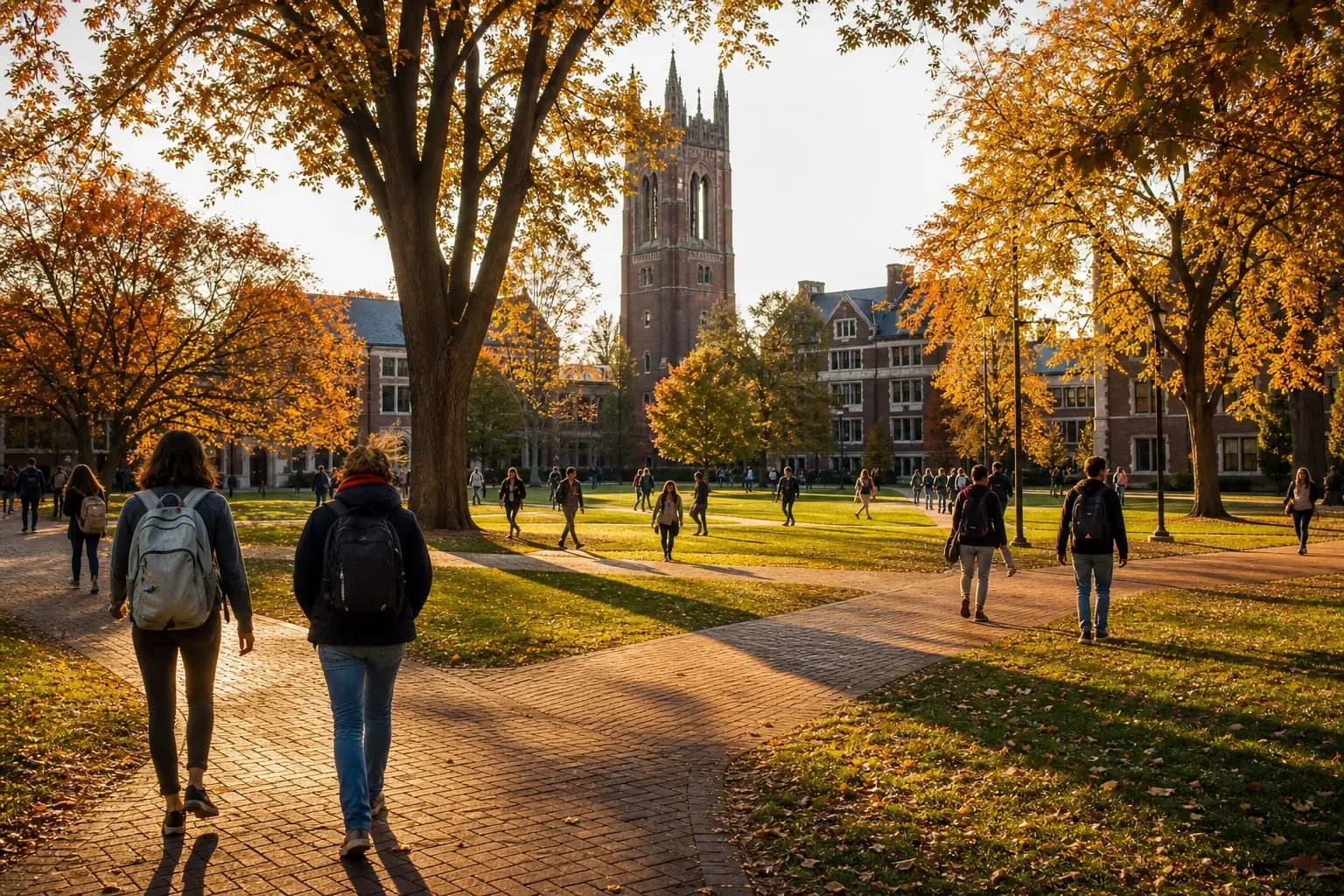
Urban vs Suburban vs Rural Colleges: A Complete Analysis of the Tradeoffs Across 3 Environments (2026 Consultant Insights)
Published on May 23, 2026
Every year in late April, one conversation always happens in Dr. G.’s office:
Parent: “Teacher, my son got into Columbia and Dartmouth. They are so different. Which should he choose?”
I ask in return: “Is he willing to spend four years in Hanover at -20°C with no Uber Eats, no 7-11, and no KTV?”
The parent freezes. They thought “Columbia in New York vs Dartmouth in New Hampshire” was just a difference in location. Wrong. It is a fundamental difference in four years of lifestyle. A Columbia student can walk out of the dorm at midnight and find a 24-hour bagel shop. After 10 p.m., almost all of Hanover is closed for Dartmouth students, and there is not even a 7-11.
The tradeoff among urban, suburban, and rural colleges is not as simple as “city vs countryside”. It affects internship access, social patterns, mental stability, sense of safety, and even the likelihood of staying in the area after graduation. Drawing on 15 years of consulting experience, this article breaks down the real trade-offs among these three environments.
1. Definitions and Categories of the 3 Environments
The “campus environment” of U.S. colleges can be divided into three major types:
| Type | Definition | Representative Schools |
|---|---|---|
| Urban | Campus buildings are spread throughout a major city and integrated into the city | NYU, Columbia, USC, GWU, BC, BU, Northeastern |
| Suburban | A self-contained campus, but 30-60 minutes from a city | Stanford, Princeton, Duke, Vanderbilt, Northwestern, Rice |
| Rural | The campus is the center of a small town, with no major city nearby | Dartmouth, Cornell, Williams, Bowdoin, Notre Dame, Penn State |
Some schools fall into gray areas:
- Harvard: Technically in Cambridge next to Boston, but functionally a suburban campus
- MIT: Similar to Harvard, located in Cambridge but with a strong campus feel
- UPenn: In urban Philadelphia, but the campus has a walled “Penn Bubble” feel
- UChicago: In Hyde Park, a Chicago neighborhood, with a strong campus atmosphere
2. Urban Colleges: Deep Dive Into 5 Signature Schools
1. NYU
- Location: Central Manhattan, around Washington Square Park
- Campus feel: Almost none. Buildings are scattered across New York City blocks, with no “campus gate”
- Cost of living: Manhattan-level high. Dorms cost $1,800+ per month, and eating out costs $25+ per meal
- Internship convenience: No. 1 in the U.S.. Wall Street, Big Tech NYC offices, media, and fashion are all within walking distance
- Safety: Urban New York, weaker than suburban campuses and requiring alertness
- Best for: Highly extroverted students who want to explore the city independently and can manage their time
2. Columbia University
- Location: Manhattan Upper West Side, at 116th Street
- Campus feel: A walled campus. Morningside Heights forms Columbia’s bubble
- Cost of living: Manhattan-level, but slightly lower than NYU if living in a dorm
- Internship convenience: Close to NYU. Wall Street is about 30 minutes away by subway
- Safety: Relatively good, since Morningside Heights is a university district
- Signature feature: “Core Curriculum”: the whole school reads classics together, creating a highly academic atmosphere
- Best for: Students who want both academic intensity and city access
3. USC
- Location: Los Angeles, 5 minutes from Downtown
- Campus feel: Strong campus feel. A 226-acre campus with deep Trojan culture
- Cost of living: Moderate for LA, about 30% lower than New York
- Internship convenience: Hollywood and the LA tech industry are accessible by walking or Uber
- Safety: Poor surrounding safety. LA Skid Row is 10 minutes from campus, and students avoid going out at night
- Signature feature: The “Trojan Family,” one of the strongest alumni networks in the U.S.
- Best for: Students interested in entertainment, extroverted students, and students who can adapt to LA’s pace
4. GWU / Georgetown / American
- Location: Urban Washington DC
- Campus feel: Georgetown has a bubble; GWU and American are more spread out
- Cost of living: High in DC, with rent second only to New York
- Internship convenience: Government, policy, and think tanks are concentrated here, making it a dream setting for students interested in public service or policy
- Safety: Some parts of DC are unsafe, so caution is necessary
5. Boston Schools (BC / BU / Northeastern)
- Location: Boston / Brookline / Fenway areas
- Campus feel: BC > Northeastern > BU
- Internship convenience: Boston is a major hub for biotech, consulting, and finance
- Signature feature: Northeastern’s required co-op plus five-year degree is one of the strongest employment guarantees for international students
3. Suburban Colleges: Deep Dive Into 5 Signature Schools
1. Stanford
- Location: Palo Alto, at the heart of Silicon Valley
- Campus feel: 8,180 acres. One of the largest campuses in the U.S., with palm trees and a red-brick church
- Distance to city: 40 minutes by car to SF; 10 minutes to downtown Palo Alto
- Cost of living: High in Palo Alto, with rent at New York levels
- Internship convenience: Silicon Valley surrounds the campus. Google HQ is 10 minutes away by car
- Signature feature: The “Stanford bubble”: a self-contained campus ecosystem surrounded by Silicon Valley
- Best for: Students interested in tech or startups who want a safe campus feel and access to Silicon Valley
2. Princeton
- Location: Princeton, New Jersey, a small town
- Campus feel: 500 acres. Historic Gothic architecture with an Old Tigers atmosphere
- Distance to city: 1 hour by train to NYC; 1 hour to Philly
- Cost of living: Moderate, about 30% lower than urban colleges
- Internship convenience: Convenient summer internships in NYC, with a 1-hour train ride
- Signature feature: “Eating Clubs,” Princeton’s distinctive upperclassman social organizations
- Best for: Academically oriented students who like tradition and are not afraid of a quiet small town
3. Duke
- Location: Durham, North Carolina, in the Research Triangle
- Campus feel: 8,500 acres. Gothic architecture and Duke Forest
- Distance to city: 5 minutes to downtown Durham; 30 minutes to Raleigh
- Cost of living: Low, with Southern prices
- Internship convenience: Research Triangle Park, including IBM, Cisco, and Bayer, is within driving distance
- Signature feature: Basketball culture plus a “Southern hospitality” atmosphere
- Best for: Students who like warm weather, basketball culture, and Greek Life
4. Vanderbilt
- Location: Nashville, Tennessee
- Campus feel: 330 acres. Tree-lined and known as an “arboretum”
- Distance to city: 1.5 miles from downtown Nashville, walkable
- Cost of living: Lower-middle, Southern cost of living
- Internship convenience: Strong healthcare sector, with HCA HQ in Nashville, plus a strong Country Music industry
- Signature feature: “Anchor Down” tradition plus strong academics
- Best for: Students who like Southern culture, healthcare fields, and a pace slower than New York
5. Northwestern
- Location: Evanston, IL, north of Chicago
- Campus feel: 240 acres. On the shore of Lake Michigan, balancing city access and campus atmosphere
- Distance to city: 30 minutes by train to the Chicago Loop
- Cost of living: Moderate
- Internship convenience: Chicago has dense finance and consulting opportunities
- Climate: Harsh winters, -10 to -20°C
- Best for: Students who want both campus and city access and can handle Chicago winters
4. Rural Colleges: Deep Dive Into 5 Signature Schools
1. Dartmouth
- Location: Hanover, New Hampshire, population 11,000
- Campus feel: 269 acres. Classic colonial architecture by the Connecticut River
- Distance to city: The nearest major city is Boston, 2.5 hours away by car; Manchester is 1 hour away
- Cost of living: Low, with few restaurants and limited options
- Internship convenience: Very poor. Summer internships require flying to New York, Boston, or Silicon Valley
- Climate: Extremely cold. From December to March, temperatures can reach -20°C, with a four-month snow season
- Signature feature: The “D-Plan” flexible academic calendar plus a tight cohort
- Best for: Students who can handle extreme cold and enjoy the outdoors and deep friendships
2. Cornell
- Location: Ithaca, New York, population 30,000
- Campus feel: 745 acres. Lakes, waterfalls, and the Engineering Quad
- Distance to city: 4 hours by car to NYC and 5 hours to Boston, which is very far
- Cost of living: Low, with rural prices
- Internship convenience: Many summer internship opportunities in NYC, but internships during the semester are difficult
- Climate: Cold, -10 to -15°C from November to March, and cloudy and rainy, with the gorges area known for gloom
- Signature feature: The “Big Red Network” of 270,000 alumni
- Best for: Students who can handle cold and isolation and want a large research university
3. Williams / Amherst (Two Top LACs)
- Location: Williamstown / Amherst, Massachusetts, population under 8,000
- Campus feel: 450 acres / 1,200 acres. Traditional LAC bubble
- Distance to city: 3 hours to Boston and 3 hours to NYC, very far
- Cost of living: Low
- Internship convenience: Summer internships require flying or traveling to New York or Boston
- Climate: Cold, New England climate
- Signature feature: 400-person cohorts, knowing everyone over four years, and extremely deep friendships
- Best for: Students who like small colleges, deep learning, and not being in a large institution
4. Bowdoin
- Location: Brunswick, Maine, population 21,000
- Campus feel: 215 acres. Near the coastline, surrounded by Maine nature
- Distance to city: 30 minutes to Portland; 2 hours to Boston
- Signature feature: “Polar Bears” plus Maine’s famous lobster meals
- Best for: Students who like the outdoors, the coast, and the New England atmosphere
5. Notre Dame
- Location: South Bend, Indiana, population 100,000, but functionally a small town
- Campus feel: 1,250 acres. Catholic traditional architecture and Touchdown Jesus
- Distance to city: 2 hours by car to Chicago
- Signature feature: Catholic identity, football culture, and extremely strong alumni loyalty
- Best for: Catholic students and students who like tradition, rituals, and football culture
5. Comparing the 3 Environments Across 6 Dimensions
| Dimension | Urban | Suburban | Rural |
|---|---|---|---|
| Internship convenience | Strongest, often walkable | Moderate, 30-60 minutes | Weak, often requires flying |
| Cost of living | Highest, including dorms and eating out | Moderate | Lowest |
| Safety | Moderate, depending on area | High | Highest |
| Social depth | Broad but shallow, commuter-heavy | Balanced | Deepest, bubble-based |
| Academic focus | Lower, with many distractions | High | Highest |
| Climate challenge | Depends on the city | Depends on the region | Usually more extreme |
6. The Real Costs of Urban Colleges: The Underestimated Parts
The “urban college costs” parents most often overlook:
Cost 1: Commuter Culture Weakens Cohesion
The biggest issue at urban colleges like NYU, BU, and Northeastern: many students go home at night and do not live on campus. Classmates “only see each other in class.” Over four years, friendships tend to be shallower than at rural schools.
Cost 2: Social Diffusion
NYU students go to different bars, different clubs, and different friends’ apartments at night. There is no collective experience. Dartmouth students are all on campus at night, naturally forming deep cohorts of four to six people.
Cost 3: Academic Distractions
New York has 1,000 distractions: Broadway, clubs, museums, and cafes. Students with self-discipline are fine, but many students discover after four years that their GPA is 0.3-0.5 lower than expected.
Cost 4: An Unstable Home Base
Manhattan dorms may change once or twice a year. After freshman year, students often need to find apartments themselves. Housing anxiety is a hidden cost.
7. The Real Costs of Rural Colleges
The “rural college costs” parents most often overlook:
Cost 1: Psychological Isolation
Hanover has 11,000 people and Ithaca has 30,000 people. Winter can mean five months of snowbound life, and students may experience seasonal depression. Dartmouth’s counseling center has one of the highest winter usage rates among U.S. LACs.
Cost 2: Internship Travel Costs
Cornell and Dartmouth students must fly to NYC or Boston for summer internships. One-way airfare plus three months of housing can cost NT$200,000-300,000. Columbia students can walk to their summer internships.
Cost 3: The Double-Edged Bubble Effect
Deep friendship is the biggest advantage of rural schools, but it also means bridging to the outside world after graduation can be harder. Williams alumni may still socialize mainly with Williams alumni four years after graduation. For some students this is an advantage; for students who want to expand their world, it is a limitation.
Cost 4: Transportation Is Difficult
No Uber, no buses. For a Dartmouth student to go to Boston for a concert means borrowing a classmate’s car and driving 2.5 hours.
8. Suburban Colleges: Why They Are the “Best Balance”
My standard advice to most Taiwanese families: suburban colleges are the safest choice.
| Advantage | Explanation |
|---|---|
| Campus depth | A self-contained ecosystem with dorm life and collective experience |
| City access | 30-60 minutes by car to a major city, with enough summer internship opportunities |
| Cost of living | 30-50% lower than New York |
| Safety | Campus has a walled-in feel and good safety |
| Climate flexibility | Most are in mild climates, except Northwestern |
Stanford, Princeton, Duke, Vanderbilt, Northwestern, Rice, and Notre Dame all fall into this category.
The 4 most suitable options for Taiwanese families:
- Stanford (if admitted): Silicon Valley next door, bubble plus access
- Princeton: Academically intense, safe, and 1 hour from NYC
- Duke: Southern warmth, Research Triangle access, and safety
- Vanderbilt: Nashville city feel, campus bubble, and strong healthcare
9. Matching Environment to Personality
The “personality × environment matching table” I give every Dr. G. student:
| Student Personality | Recommended Environment | Not Recommended |
|---|---|---|
| Highly extroverted, stress-tolerant, wants freedom to explore | Urban colleges (NYU, Columbia) | Rural colleges, which may feel boring |
| Balanced, social but needs a home base | Suburban colleges (Stanford, Northwestern) | — |
| Introverted, needs deep friendships | Rural colleges (Dartmouth, Williams) | Pure urban colleges, which may feel isolating |
| Very introverted, needs a small cohort | Rural LACs (Bowdoin, Amherst) | Big-city colleges |
| Wants entertainment or Wall Street | Urban colleges (USC, NYU, Columbia) | Rural colleges, with weak access |
| Wants startup or VC | Suburban colleges (Stanford) | Rural colleges |
| Taiwanese students who fear the cold | California, the South, Texas | New England, Great Lakes region |
| Lower stress tolerance, first time away from home | Suburban colleges, with a home base | Pure urban colleges, where commuter culture can make students feel lost |
10. Climate Considerations: A Hidden Blind Spot for Taiwanese Families
Most Taiwanese students have never experienced weather below -10°C. Winters that are too cold are one of the major reasons students withdraw or transfer.
| School | Winter Low | Snow Season |
|---|---|---|
| Dartmouth | -20°C | November-April |
| Cornell | -15°C | November-March |
| Williams / Amherst | -15°C | December-March |
| Northwestern | -15°C | December-March |
| Princeton | -5°C | December-February |
| UPenn / Columbia | -3°C | December-February |
| Vanderbilt / Duke | 5°C | Occasional snow |
| Stanford / UCLA | 10°C | No snow |
| USC | 10°C | No snow |
| Rice / UT Austin | 5°C | No snow |
Real case: I worked with one Taipei student who got into Dartmouth. When the first snow came in November, she called me crying: “Teacher, I never imagined it could be this cold.” She eventually adapted, but another student in the same year transferred to USC in December.
Climate is not a small matter. If your child has never experienced a cold climate, try to choose a warmer school for the first year.
11. The Real Safety Considerations
What parents most often overlook: campus safety.
| School | Surrounding Safety | On-Campus Safety |
|---|---|---|
| USC | Relatively poor, due to LA safety issues | High, with dense campus police presence |
| JHU | Relatively poor, in Baltimore | High |
| UChicago | Average, in Hyde Park | High |
| NYU | Moderate, in Manhattan | — |
| Columbia | Relatively good, in Morningside Heights | High |
| Stanford | Extremely high | Extremely high |
| Princeton | Extremely high | Extremely high |
| Cornell / Dartmouth | Extremely high, rural | Extremely high |
For parents of Taiwanese daughters: JHU, UChicago, and USC may be Top 20-30 schools, but surrounding safety must be part of the decision. If your daughter needs to go to the lab at night for research and walk back to the dorm alone, these three schools will create more anxiety than Princeton or Cornell.
12. Conclusion: Environment Determines the “Texture of Life” for 4 Years
The biggest insight from 15 years of consulting is this: ranking is logic when choosing a school, but environment is emotion, and emotion determines whether you can make it through four years.
I have worked with students who enrolled at Top 5 schools and then withdrew. Not because the academics were too hard, but because the winter was too long and the isolation too heavy. I have also worked with students who went to Top 30 schools and were happy for all four years because the environment matched their personality perfectly.
If your child is someone who “grew up on the streets of Taipei and loves a 24/7 city that never sleeps,” choose NYU or Columbia. If your child is “introverted, needs a close cohort, and wants to avoid distractions,” choose Dartmouth or Williams. If your child is “balanced and wants the best of both worlds,” choose Stanford, Princeton, or Duke.
There is no “best” among the three environments, only the “best fit.” Next time you are holding admission offers and unsure which school to choose, do not compare rankings. Ask your child: “Are you willing to live here for all four years?”
Further Reading: