
University of Toronto: Canada’s Top Comprehensive University, Rotman Commerce, AI, and Ontario PNP Advantages
Published on February 1, 2026
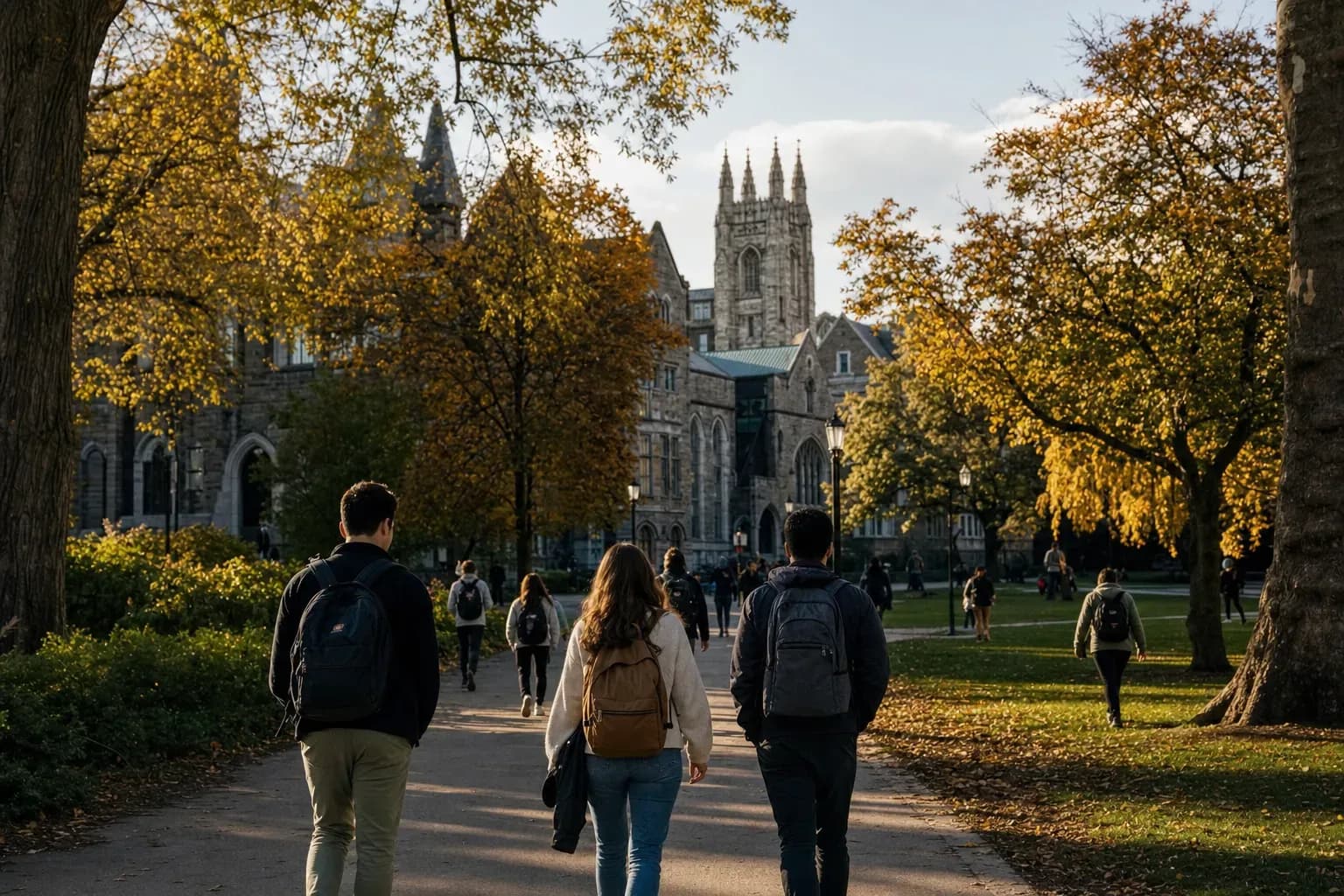
The University of Toronto (U of T) is the leader of Canada’s U15 research universities, ranked #29 globally in QS 2026, and has long held its position as Canada’s top comprehensive university. Its role is straightforward: if you are looking for the Canadian university that most closely resembles a combination of UC Berkeley and the University of Michigan, this is it. Across its three campuses (St. George, Mississauga, and Scarborough), U of T enrolls more than 90,000 students and covers almost every academic field imaginable.
To understand U of T, remember two things first. One, it is one of the birthplaces of deep learning in AI. Geoffrey Hinton advanced backpropagation and deep neural networks here, and his student Ilya Sutskever later became a co-founder of OpenAI. Two, it sits in the heart of Canada’s largest metropolitan area. The St. George campus is part of downtown Toronto itself, with blurred boundaries between campus and city. For Taiwanese families, U of T also has an often-overlooked advantage: after completing a master’s degree, graduates may apply through the Ontario OINP Masters Graduate Stream without needing a job offer.
1. Basic Information
| Item | Details |
|---|---|
| Founded | 1827 |
| Location | Toronto, Ontario (the main St. George campus is in downtown Toronto) |
| Campus | Around 1,924 acres across three campuses (St. George around 180 acres) |
| Undergraduates | ~76,000 (across three campuses) |
| Graduate students | ~22,000 |
| Student-faculty ratio | 1:18 |
| Motto | Velut arbor aevo (May it grow as a tree through the ages) |
2. Global Rankings
| Ranking | Position |
|---|---|
| QS World 2026 | #29 |
| THE World 2025 | #21 |
| US News Global Universities 2024-25 | #18 |
| Maclean's Medical Doctoral Universities in Canada | #1 |
| QS Computer Science | #14 globally |
| QS Medicine | #13 globally |
3. Admissions Data (Fall 2024 Entry / Class of 2028)
| Metric | Figure |
|---|---|
| Total applicants | ~106,000 (all programs across three campuses) |
| Overall acceptance rate | around 43% (university-wide weighted rate) |
| Rotman Commerce acceptance rate | around 7% |
| Engineering Science acceptance rate | around 19% |
| Computer Science Specialist acceptance rate | around 6% (most competitive program) |
| Life Sciences acceptance rate | around 35% |
| Yield rate (overall) | around 55% |
What makes U of T distinctive is that acceptance rates vary dramatically by program. General direct-entry Arts & Science programs are relatively accessible for international students, but popular programs such as Rotman Commerce, CS Specialist, and Engineering Science are as competitive as U.S. Top 20 universities.
International Student Standards (Direct Undergraduate Entry)
| Test | Recommended Score |
|---|---|
| SAT | 1380+ (1500+ recommended for CS / Engineering) |
| ACT | 30+ (33+ recommended for CS / Engineering) |
| IELTS | 6.5 (6.0 in each band) |
| TOEFL iBT | 100 (Writing 22+) |
| IB | 30-32+ (HL subjects such as Math and Physics should be 6+) |
International Students
- International students make up around 28% of the student body, one of the highest shares among Canadian domestic universities
- Students come from 170+ countries
- Around 30-50 Taiwanese students are admitted to undergraduate programs each year, with master’s and doctoral students counted separately
4. Tuition and Financial Aid (International Student Perspective)
2024-2025 Tuition (CAD/year)
| Item | Amount |
|---|---|
| Tuition - Arts & Science | CAD $61,720 |
| Tuition - Computer Science Specialist | CAD $69,930 |
| Tuition - Engineering | CAD $69,930 |
| Tuition - Rotman Commerce | CAD $69,930 |
| Housing (on campus) | CAD $11,000-$17,000 |
| Food + miscellaneous | CAD $6,000-$8,000 |
| Total (non-high-demand programs) | CAD $82,000-$90,000/year |
| Total (CS / Eng / Rotman) | CAD $90,000-$98,000/year |
Financial Aid for International Students
- Lester B. Pearson International Scholarship: U of T’s flagship full scholarship. Only 37 students worldwide receive it each year. It covers full tuition plus living costs for four years and is the university’s most prestigious international scholarship.
- Most international students should expect to be primarily self-funded, with a small number of faculty-level scholarships available. Engineering offers entrance awards of CAD $5,000-15,000.
- Compared with U.S. Top 30 private universities at USD 90K+ per year, U of T is in a similar cost range but offers a Canadian PR pathway, making its value proposition stronger.
5. Program Structure / Signature Programs
Undergraduate Majors
- 700+ programs across the three campuses
- The main St. George campus focuses on Arts & Science, Engineering, Rotman Commerce, and Music
- UTM (Mississauga) is strong in Forensic Science and Theater & Drama
- UTSC (Scarborough) is known for Co-op, Management, and Computer Science
Signature Programs
- Engineering Science (EngSci): The most difficult engineering program to enter in Canada. The first two years follow a shared foundation, while the final two years split into 8 majors, including AI, Robotics, Biomedical, and Aerospace. It is comparable to MIT Course 6-2.
- Computer Science Specialist: Closely connected with the Vector Institute for AI, and globally top 5 in AI / Machine Learning.
- Rotman Commerce: The undergraduate business program. Graduates enter the Big 4 and Bay Street investment banks. It is comparable to NYU Stern.
- Life Sciences + Pre-Med Stream: A traditional strength for students preparing for medical school.
- Trinity One / Vic One / New One: College-based first-year seminars, similar to freshman seminars at Princeton.
College System
The St. George campus uses a British-style college system. Its 7 colleges (Trinity, Victoria, University, St. Michael's, New, Innis, and Woodsworth) each have their own residences, dining halls, and student societies. Academically, they do not divide students by major, but they carry strong social identities. Trinity and Victoria are the most historic, and Trinity still requires students to wear academic gowns at dinner, giving it a Canadian version of Oxford atmosphere.
6. Campus Culture / Institutional Personality
U of T’s campus culture can be summed up in one sentence: academically intense, pressure-filled, and internationally diverse. Roughly one-third of students come from Canada, one-third from Asia (China, India, Taiwan, Korea), and one-third from other countries. U of T is widely known for strict grading. In the same program and at a similar ranking level, average GPAs at U of T are about 0.3 lower than at UBC / McGill. Students joke that "a B at U of T is an A- elsewhere."
Student Clubs
- 800+ clubs, covering everything from academic competitions (Hart House Debate, UTAT Aerospace) to cultural societies.
- Hart House: The campus activity center, built in 1919, with a gym, art gallery, and debating society.
- The Taiwanese Students' Association is active and hosts an annual Lunar New Year gala.
Athletics Culture
- A major name in U Sports, Canada’s university athletics system
- Signature sports: men’s and women’s ice hockey, basketball, and rowing
- Varsity Blues is the team name, and the school colors are blue and gold
7. Location / Campus Environment
Urban Positioning
The St. George campus is located beside Queen's Park in downtown Toronto, surrounded by three subway stations: St. George, Spadina, and Museum. From campus, it takes about 10 minutes to reach CN Tower, Bay Street, and Yonge-Dundas Square. This is Canada’s only university that is truly located inside a financial metropolitan core. Bay Street investment banks and the Toronto offices of Google, Microsoft, and Shopify are all within a 20-minute transit radius.
UTM (Mississauga) is a 30-minute drive west of the main city, quieter and close to lake views. UTSC (Scarborough) is in the eastern part of the city and is strong in Co-op programs.
Climate
- Winter: -10°C to -5°C, with frequent snow from January to March, but milder than Edmonton / Calgary
- Summer: 22-28°C, humid but pleasant
- Spring and fall: short, with spectacular maple colors
Campus Landmarks
- University College (built in 1859, the heart of campus)
- Robarts Library (a brutalist building shaped like a peacock, with 8 million volumes)
- Convocation Hall (graduation venue, capacity 1,700)
- Hart House
- CN Tower (not technically on campus, but visible from many classroom windows)
8. Research and Resources
Libraries
- Robarts Library is the largest university library in Canada, with 8 million volumes
- The university has 44 libraries and more than 12 million total volumes, behind only Harvard and Yale
Notable Labs / Research Centers
- Vector Institute for AI: An AI research institute closely connected with U of T; Geoffrey Hinton is its chief scientific adviser
- Munk School of Global Affairs & Public Policy: A major center for public policy research
- MaRS Discovery District: One of North America’s largest urban innovation districts, located right next to campus
- Centre for Cellular and Biomolecular Research (CCBR)
- Donnelly Centre: Connected to the discovery of insulin in 1921 by Banting & Best
9. Notable Alumni
- Politics: Lester B. Pearson (former Canadian prime minister and Nobel Peace Prize laureate), William Lyon Mackenzie King, Stephen Harper (former prime minister)
- Technology AI: Geoffrey Hinton (professor, 2024 Nobel Prize in Physics), Ilya Sutskever (co-founder of OpenAI), Raquel Urtasun (founder of autonomous driving company Waabi)
- Finance and business: Galen Weston, Heather Reisman (founder of Indigo)
- Academia / Nobel Prizes: Frederick Banting (discoverer of insulin), Charles Best, John Polanyi, Bertram Brockhouse
- Film, arts, and literature: Atom Egoyan, Margaret Atwood, Norman Jewison
U of T has the largest number of Nobel laureates of any university in Canada, with 12 alumni and faculty members combined.
10. U of T Facts
- Insulin was discovered here: In 1921, Banting and Best isolated insulin in a small laboratory at U of T’s medical school, one of the most important medical discoveries of the 20th century.
- Trinity College still requires academic gowns at dinner: Students joke that studying here means experiencing university and Hogwarts at the same time.
- U of T’s Engineering Science is often called “the hardest undergraduate program in Canada”: It admits only a little over 200 students each year, with an average GPA of 3.95+, and is seen as Canada’s version of Caltech.
- When Geoffrey Hinton was acquired by Google in 2013, the company he built with two PhD students, DNNresearch, was sold directly from campus. It remains one of the best-known “professor and students sell a company” stories in AI history.
- U of T has the largest library system in Canada, but students joke that “Robarts looks like an ugly peacock.” Its brutalist design looks bird-like from above, but up close it feels like a concrete beast.
11. Typical Admitted Student Profile
- High school average (converted): 88-92%+ (IB 36+, A-Level AAB+, top 5% of a Taiwanese high school)
- SAT 1450+ (1500+ recommended for CS Specialist)
- IELTS 7.0+ / TOEFL 100+
- Engineering / CS: math and science competitions are strongly recommended (AMC, Taiwan Physics Olympiad / Math Olympiad, ISEF)
- Rotman Commerce: supplementary essay + video interview required
- Essays should show deep interest in a specific academic field. There is no need to write a life story the way students often do for the U.S. Common App. U of T cares more about academic fit.
12. What Kind of Student Is a Good Fit?
✓ Good fit for:
- Students who want Canada’s top university and big-city life
- Students with a clear direction in popular fields such as AI, CS, pre-med, or business
- Students who can handle strict grading and high competitive pressure
- Families planning for the student to stay and build a career in Canada after graduation, with an immigration pathway in mind
- Students who enjoy multicultural environments and do not mind a high international student share
- Families who can afford a budget of CAD 90K/year without a full scholarship
✗ Not necessarily a good fit for:
- Students who want an “American-style” holistic liberal arts education and dislike large lectures (U of T first- and second-year classes can have 300 students)
- Students who need close attention and a small close-knit experience (consider Queen's, McGill, or Mount Allison)
- Students who dislike harsh winters and want a warmer climate (consider UBC)
- Students who want intense school spirit and a sports-driven campus culture (U.S. public universities such as UMich / UF deliver this more directly)
13. Advantages for Studying in Canada + Immigration Pathways
U of T’s value in Canadian immigration pathways is the part Taiwanese families most often underestimate.
PGWP (Post-Graduation Work Permit)
After completing a master’s degree program of at least 8 months, graduates can apply for a 3-year Open Work Permit, with no restriction on field of study. The PGWP reforms effective from 2024-11-01 remain flexible for university degrees. Language requirement: IELTS General CLB 7 (6.0 in each band). Taiwanese students who score IELTS 7.0 usually meet the threshold.
Express Entry / CEC
During the PGWP period, students who accumulate 1 year of Canadian work experience in NOC TEER 0/1/2/3 may apply through CEC. U of T graduates commonly enter Bay Street finance, Toronto Tech, and AI companies, making TEER 1 roles highly likely. In 2026 Q1, CEC draw CRS cut-offs were around 521-547, while CS / STEM categories were lower (481-524). A typical profile of a 29-year-old single applicant with a U of T master’s degree and 1 year of Canadian work experience would have a CRS score of around 530-540, placing them in the draw’s sweet spot.
Ontario OINP Masters Graduate Stream (U of T’s Biggest Advantage)
Ontario’s provincial nomination program has a dedicated Masters Graduate Stream for master’s graduates:
- U of T master’s graduates may apply directly (including graduates from St. George, UTM, or UTSC)
- No job offer required (one of the most flexible pathways, alongside BC)
- Once provincial nomination is granted, CRS is automatically increased by 600 points, effectively guaranteeing an ITA
- Drawback: quotas fill almost instantly. Since 2024, intake has opened every 1-2 months, with spots filling within hours each time
- Since 2025, quotas have been cut in half (55,000 across all provincial streams), so applicants must be ready to submit immediately when intake opens
Impact of the 2024-2025 International Student Cap
Ontario was the province hit hardest by Canada’s 2024-2025 international student cap, with study permit allocations cut by 50%. However, U of T is a research university, and master’s and doctoral degrees are generally exempt from the cap, so Taiwanese applicants for graduate programs are relatively unaffected. Undergraduate applicants, however, should pay attention to PAL documentation.
Value Compared with Equivalent U.S. Universities
| Item | U of T | Comparable U.S. University (UMichigan) |
|---|---|---|
| QS 2026 | #29 | #44 |
| Tuition (international undergraduate) | CAD $62K-$70K (USD $46-52K) | USD $63-67K |
| Post-graduation stay pathway | 3-year PGWP + EE/PNP | H-1B lottery (30% selection rate) |
| Permanent residence | 2-4 years (master’s + 1 year of work) | OPT 1-3 years + H-1B + green card in 5-10 years |
U of T tuition is around 25% cheaper than UMichigan, with a clearer and more controllable immigration pathway.
Conclusion
U of T is a strong fit for Taiwanese students who think, “I want to study at the best university in Canada, then stay to work and obtain PR.” It is not Canada’s version of Princeton, meaning a small, polished undergraduate model. It is closer to Canada’s version of UC Berkeley plus UMichigan: large, diverse, competitive, research-intensive, urban, and immigration-friendly.
If what you want from ages 18 to 28 is “English-speaking urban life + frontline North American research training + Canadian citizenship + a lifetime Bay Street / Tech network,” U of T may be the single highest-value option on the planet. But do not expect a small close-knit community, professors who know your name, or small seminars in the first year. U of T does not offer those things. What U of T offers is scale, depth, a major city, and a clear pathway to staying in Canada. For many Taiwanese middle-class families, that is more pragmatic than paying the same tuition for a U.S. Top 30 university and betting on the H-1B lottery.
Sources
- University of Toronto Office of Admissions — International Students (accessed 2026-05-14) https://future.utoronto.ca/apply/requirements/
- Maclean's University Rankings 2025 (accessed 2026-05-14) https://www.macleans.ca/education/university-rankings/
- QS World University Rankings 2026 (accessed 2026-05-14) https://www.topuniversities.com/world-university-rankings
- Ontario Immigrant Nominee Program — Masters Graduate Stream (accessed 2026-05-14) https://www.ontario.ca/page/oinp-masters-graduate-stream
- Dr. G. Academy internal file 03_Canada_Visa_Strategy.md (2026-05-02)