
University of Tokyo: PEAK English-Taught Bachelor's Programs, Asia's Strongest National University, and the HSP Fast Track to Permanent Residency
Published on January 7, 2026
Ranked #32 globally in QS 2026, behind only Peking University and the National University of Singapore in Asia, and unquestionably the apex of Japan's "Tokyo-first" academic hierarchy, the University of Tokyo, commonly known as Todai, is the ceiling of Japan's national university system. Its two English-taught bachelor's pathways, PEAK(Programs in English at Komaba)and GSC(Global Science Course), are the most direct routes for Taiwanese students who want to enter Japan's top university even without Japanese.
Todai is not "the Harvard of the East." It is Japan's first imperial university, founded after the Meiji Restoration to train the country's national elite. From prime ministers and Nobel Prize-winning physicists to the founder of Sony and the CEO of 7-Eleven Japan, Todai alumni have occupied much of postwar Japan's core decision-making class. To understand Todai, understand this first: in Japanese society, the words "Todai graduate" are a lifelong identity card.
1. Basic Information
| Item | Details |
|---|---|
| Founded | 1877(Meiji 10) |
| Institution type | National university |
| Location | Bunkyo, Tokyo(Hongo, Komaba, and Kashiwa campuses) |
| Campus | Approximately 326 hectares(including Kashiwa Campus) |
| Undergraduates | ~14,000 |
| Graduate students | ~14,000 |
| Student-faculty ratio | 1:6 |
| Motto | No official motto(guiding phrase: "World-leading intellectual creativity in action") |
2. Global Rankings
| Ranking | Position |
|---|---|
| QS World 2026 | #32 |
| THE World 2026 | #28 |
| QS Asia 2026 | #6 |
| THE Asia 2026 | #5 |
| US News Global Universities | #71 |
| QS Engineering & Technology | #14 |
| QS Physics | #11 |
Todai is both an original member of G30(Global 30)and one of the 13 SGU(Super Global University)Type A top-tier institutions. This means Japan's Ministry of Education, Culture, Sports, Science and Technology has designated it as a flagship university with strong openness to international students and substantial resources to support English-taught programs.
3. Admissions Data(2024 Entry)
Todai undergraduate admission has two routes:
- General Japanese admissions: entirely in Japanese; very few Taiwanese students take this route
- PEAK + GSC(English-taught): the focus of this article and the main route for Taiwanese students
PEAK(College of Arts and Sciences / primarily humanities and social sciences)
| Indicator | Figure |
|---|---|
| Applicants | ~400 |
| Admitted students | ~30 |
| Overall acceptance rate | Approximately 7-8% |
| Main tracks | International Program on Japan in East Asia(international relations / Japanese studies), Environmental Sciences |
GSC(Faculty of Science transfer program / entry into third year)
| Indicator | Figure |
|---|---|
| Applicants | ~150 |
| Admitted students | ~15-20 |
| Overall acceptance rate | Approximately 10-13% |
| Admitting majors | Mathematics, Physics, Chemistry, Biophysics, Biology |
Application Requirements(PEAK)
| Item | Requirement |
|---|---|
| English proficiency | TOEFL iBT 100+ / IELTS 7.0+ |
| Standardized tests | SAT, ACT, IB, A-Level, or AP; any one is acceptable(the key point is that SAT is accepted) |
| Japanese | Not required at entry, but students must take Japanese courses after enrollment |
| Recommendation letters | 2 |
| Essay | Personal statement and academic interest statement |
International Students
- International students make up over 90% of PEAK(it is an English-taught program)
- International students make up around 12% of Todai overall(including graduate school)
- Around 1-3 Taiwanese students are admitted to PEAK each year
4. Tuition and Financial Aid
2025 Tuition(standard national university rate)
| Item | Amount(JPY) | Approx. in New Taiwan Dollars |
|---|---|---|
| Admission fee | 282,000 | ~NT$60,000 |
| Tuition(annual) | 535,800 | ~NT$110,000 |
| Dormitory(Komaba I Lodge, monthly) | 18,900-32,100 | ~NT$4,000-7,000 |
| Living expenses(monthly, central Tokyo) | 90,000-130,000 | ~NT$20,000-30,000 |
| Estimated total cost for four years | Approx. JPY 7-9M | ~NT$1.5-1.9M |
Note: Since 2025, some national universities have begun discussing tuition increases to JPY 642,960 per year, but the standard figure remains 535,800 for now.
MEXT Scholarships(Ministry of Education, Culture, Sports, Science and Technology)
- MEXT Embassy Recommendation Scholarship(undergraduates): full tuition waiver + monthly living stipend of JPY 117,000 + round-trip airfare; competition through the Japan-Taiwan Exchange Association is extremely intense each year
- MEXT University Recommendation Scholarship: Todai directly nominates candidates to MEXT
- JASSO Honors Scholarship: JPY 48,000-80,000 per month for privately financed international students
Todai Internal Scholarships
- PEAK Scholarship: full tuition waiver + monthly living stipend of JPY 100,000; PEAK entrants may apply
- Friends of UTokyo Scholarship: for international students from specific regions
For middle-class Taiwanese families, even if fully self-funded, four years at Todai still costs less than one year of tuition at a private U.S. university. This is the core competitive advantage of Japan's national universities.
5. Program Structure / Signature Programs
PEAK(Programs in English at Komaba)
PEAK is Todai's most important English-taught undergraduate entry route. It is based on the Komaba Campus. Students take liberal arts courses in their first and second years, then enter their specialized track in the third and fourth years:
- International Program on Japan in East Asia(IPJEA): Japanese and East Asian studies, politics, economics, culture
- Environmental Sciences Program: environmental science, sustainable development, foundations in natural sciences
PEAK students are required to take Japanese in their first and second years. In theory, they can reach around N3-N2 level by graduation. This is the clever design behind Todai's model: it attracts students through English-taught admission, but by graduation they can work in Japan using Japanese.
GSC(Global Science Course)
- Third-year transfer system, Faculty of Science only
- Applicants must have completed two years of undergraduate science or engineering education in their home country
- Accepts majors such as Mathematics, Physics, Chemistry, Biology, and Biophysics
- Graduates receive a bachelor's degree from Todai's Faculty of Science
General Undergraduate Programs(Japanese-taught)
Todai uses a unique "Shinfuri" system: all students enter the College of Arts and Sciences for their first and second years, then at the end of the second year are assigned to one of 10 faculties based on grades and preferences:
- Faculty of Law, Faculty of Economics, Faculty of Letters, Faculty of Education, College of Arts and Sciences
- Faculty of Science, Faculty of Engineering, Faculty of Agriculture, Faculty of Pharmaceutical Sciences, Faculty of Medicine
The advantage of this system is delayed specialization and more room for exploration; the downside is intense grade pressure in the first two years. For Taiwanese students entering through PEAK, this is a special route that bypasses Shinfuri and leads directly into English-taught liberal arts education.
Informal Professor Acceptance System(graduate level)
Applications to Todai graduate schools commonly rely on the informal acceptance system from a supervising professor: before formal application, students must contact the target professor and obtain a verbal commitment that the professor is willing to supervise them. Taiwanese students applying to Todai master's or doctoral programs should begin emailing professors at least six months in advance. This can matter even more than the transcript.
6. Campus Culture / Institutional Personality
Todai's campus culture can be summarized in one sentence: extreme elite status, extreme internal competition, extreme understatement. Students will not necessarily volunteer that they attend Todai, but they may be preparing for next year's National Public Service Examination Type I or the bar exam.
Todai has more than 400 student clubs(circles). Among them, Todai Rowing Club, Todai Baseball Club, and Todai American Football Club are traditional flagships. The strongest cultural organizations include The University of Tokyo Newspaper, the Komaba Festival Committee, and the May Festival Committee.
The PEAK student community is relatively independent. At the PEAK Lounge on the Komaba Campus, students meet classmates from 30 countries, but to integrate into the "real Todai" led by Japanese student clubs, Japanese ability is essential.
Sports Culture
- The annual Todai-Kyodai Athletic Competition between Todai and Kyoto University is a century-old tradition
- Baseball's Tokyo Big6 Baseball League(Todai, Kyoto University, Waseda, Keio, Meiji, Rikkyo)-- Todai's team is usually at the bottom, but it remains an important cultural symbol
7. Location / Campus Environment
City Positioning
Todai's three main campuses are distributed as follows:
- Hongo Campus: the core campus, home to most faculties including Letters, Law, Economics, Medicine, and Engineering; located in Bunkyo, about 20 minutes from Tokyo Station
- Komaba Campus(where PEAK is based): home to the College of Arts and Sciences, all first- and second-year students, and PEAK students. Located in Komaba, Meguro, just one stop from Shibuya
- Kashiwa Campus: Graduate School of Frontier Sciences, located in Kashiwa, Chiba, about one hour from central Tokyo
PEAK students mainly move within the Komaba-Shibuya-Shimokitazawa triangle, one of Tokyo's most creative and youth-oriented lifestyle areas.
Climate
- Winter: 1-10°C, dry and cold with little snow, far more comfortable than northeastern Japan
- Summer: 25-35°C, humid and muggy; this is Tokyo's truly difficult season
- Cherry blossom season in spring and maple season in autumn are when the campus is at its most beautiful
Campus Landmarks
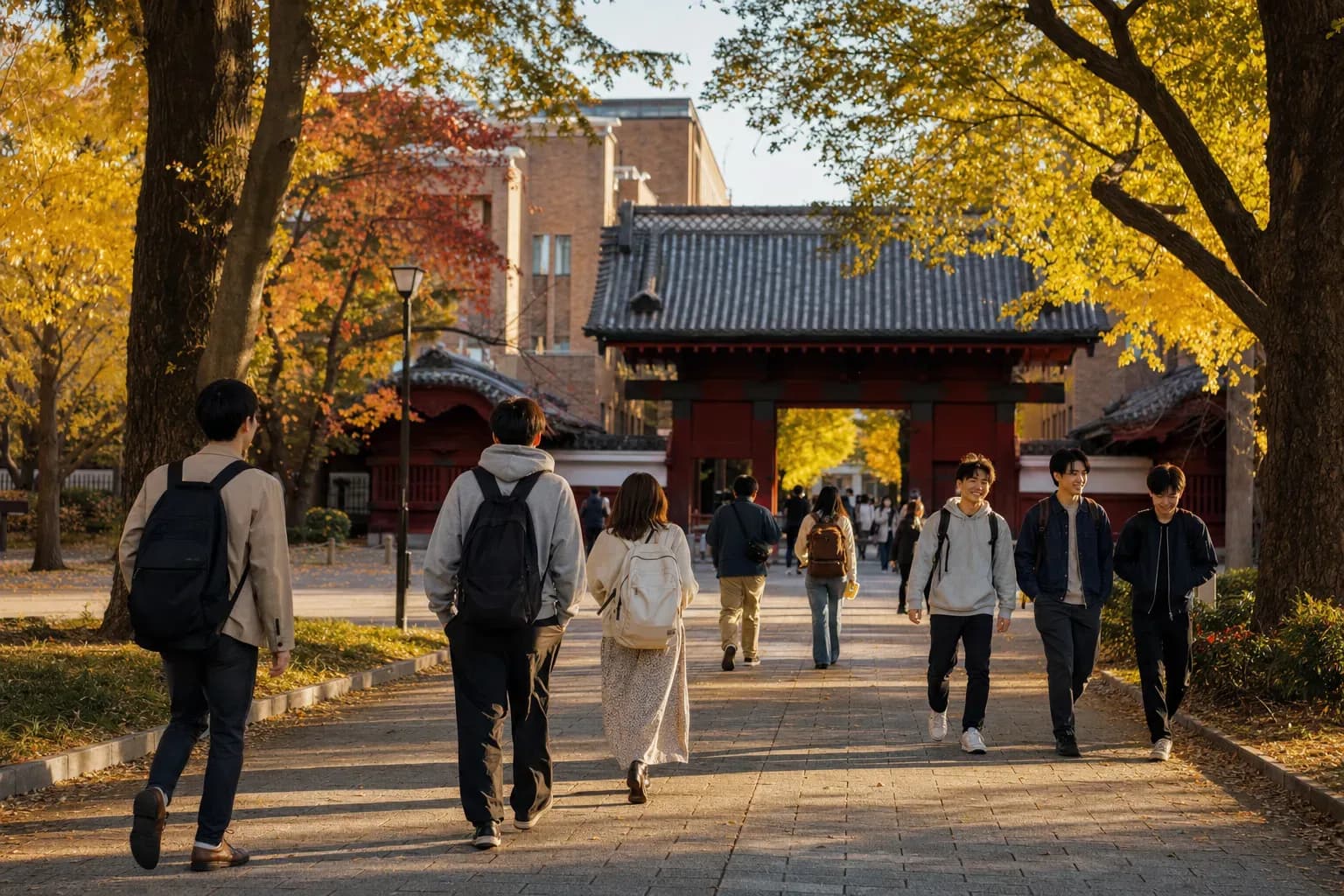
- Akamon: the red gate on Hongo Campus, an Important Cultural Property and symbol of Todai
- Yasuda Auditorium: built in 1925; the historical site of the 1968 Todai student protests
- Ginkgo Avenue: a golden ginkgo tunnel on Hongo Campus in autumn
- Komaba Building 1: a landmark building on the Komaba Campus
8. Research and Resources
Libraries
- University of Tokyo General Library: approximately 10 million volumes, the largest university library collection in Japan
- 30 branch libraries across the university, covering all faculties
Notable Research Institutes
- International Center for Elementary Particle Physics(ICEPP), The University of Tokyo: collaborates with CERN
- Institute for Cosmic Ray Research(ICRR), The University of Tokyo: leading institution behind the Kamioka detectors(KamiokaNDE, Super-K); connected to the 2002 and 2015 Nobel Prizes in Physics
- Earthquake Research Institute, The University of Tokyo: Japan's flagship institution for earthquake science
- IPMU(Kavli Institute for the Physics and Mathematics of the Universe): a top theoretical physics institute
Todai is the Japanese university with the largest number of Nobel Prize winners(11 as of 2025), most of them in physics and chemistry.
9. Notable Alumni
- Politics: Fumio Kishida, Yasuo Fukuda, Kiichi Miyazawa, Ryutaro Hashimoto, Tomiichi Murayama(five Japanese prime ministers), Taiwanese President Lee Teng-hui(Faculty of Agriculture, Tokyo Imperial University)
- Technology and entrepreneurship: Akio Morita(co-founder of Sony), Masayoshi Son(attended before leaving for the United States without graduating)
- Academia / Nobel: Leo Esaki(1973 Nobel Prize in Physics), Masatoshi Koshiba(2002 Nobel Prize in Physics), Takaaki Kajita(2015 Nobel Prize in Physics), Yoshinori Ohsumi(2016 Nobel Prize in Physiology or Medicine)
- Business: Shoichiro Toyoda(former chairman of Toyota), Nobuyuki Idei(former CEO of Sony)
- Literature: Yasunari Kawabata(1968 Nobel Prize in Literature, Todai English Literature), Yukio Mishima, Natsume Soseki, Ryunosuke Akutagawa
The names that resonate most strongly with Taiwanese families are Lee Teng-hui, Wang Jin-pyng, and Peng Ming-min, all alumni from the Tokyo Imperial University era.
10. Lesser-Known Facts About the University of Tokyo
- "Todai" is not officially abbreviated as UTokyo in Japan: Domestically, people commonly say "Todai," but the official English brand is The University of Tokyo, and the university encourages international media to use "UTokyo."
- Akamon is not actually Todai's main gate: Akamon was built in 1827 by the Maeda family of the Kaga Domain to welcome the daughter of Shogun Ienari. Todai's main gate is actually a short distance north of Akamon.
- Sanshiro Pond: a small pond on Hongo Campus made famous by Natsume Soseki's novel Sanshiro; a romantic landmark for Todai students.
- The Todai protests(1968-69): the peak of the Zenkyoto student movement. Yasuda Auditorium was occupied by students, riot police intervened, and in 1969 Todai even suspended all entrance examinations--the only time in its history.
- Todai's mascot is neither a bear nor a tiger: it is the ginkgo, and the university emblem consists of two ginkgo leaves.
11. Typical Admitted Student Profile(PEAK)
- High school GPA of 4.0/4.0
- TOEFL iBT 105+ or IELTS 7.5+
- SAT 1500+ or IB 40+ or A-Level 3A*
- Concrete long-term engagement with Japanese culture, East Asian politics, or sustainable development(not last-minute resume padding)
- Essays that can explain "why Todai, not UCL, not the National University of Singapore"
- Recommendation letters from IB / A-Level / AP teachers
- Important: PEAK prefers students with a clear motivation related to Japan. It does not favor applicants who simply say, "I'm open to anything, so I thought I'd apply."
12. What Kind of Student Is a Good Fit?
✓ Good fit:
- Students who want to enter an elite Asian university at relatively low cost(annual tuition around NT$110,000)
- Students with genuine interest in Japanese culture, East Asian studies, or environmental sustainability
- Students willing to study Japanese seriously in their first and second years and plan for post-graduation work in Japan
- Students who may pursue the HSP permanent residency route in the future(master's degree + annual salary of JPY 6 million -> permanent residency in 3 years)
- Students who enjoy urban life and can handle living independently in Tokyo, a city of 14 million people
- Highly self-disciplined students who do not need American-style club culture
✗ Not necessarily a good fit:
- Students who have no desire to learn Japanese and want to live only in English for four years(PEAK still requires Japanese after enrollment)
- Students who want an undergraduate business school(Todai has no undergraduate business major; the Faculty of Economics is close but different)
- Students dreaming of an American-style campus, Greek Life, or sports-driven school culture
- Students who want to study medicine(Todai's Faculty of Medicine is Japanese-taught and open only to Japanese nationals)
- Families who expect the student to return to Taiwan for employment(Todai's name recognition in Taiwan is far below that of top U.S. universities)
13. HSP Permanent Residency Route(Exclusive Advantage for Todai Graduates)
This is the information Taiwanese families most often overlook, but it is critical for planning a student's identity and residency status from age 18 to age 30:
- Since 2012, Japan has implemented the Highly Skilled Professional(HSP) system, based on a points system
- Master's or doctoral degrees from top universities such as Todai, Kyoto University, Osaka University, Tohoku University, and IST = bonus points
- Master's degree + annual salary of JPY 6 million -> permanent residency application in 3 years
- Doctoral degree + annual salary of JPY 8 million -> permanent residency application in 1 year
- After obtaining permanent residency, spouses may work, parents may stay long-term, and children may naturalize
In other words: Todai undergraduate degree -> Todai master's degree -> major Japanese company -> permanent residency within 3 years is a clear route that can settle long-term status by age 25. For detailed strategy, refer to Dr. G.'s internal guide, Post-Graduation Visa Strategy / 05_Japan_Visa_Strategy.
Conclusion
Todai is not for students who say, "I want to go to Japan, see cherry blossoms, and study a little on the side." It is for the kind of student who will still be searching through the Meiji historical archives at 3 a.m. for a paper on East Asian political history, and who sees Japan as a second home rather than a vacation destination.
If that profile fits, Todai is Japan's best undergraduate institution--full stop--and PEAK is the most direct route around the Japanese-language torii gate. The most common mistake Taiwanese families make is treating Todai as a "backup for U.S. Top 30 universities." But Todai's tuition is only 1/15 of a private U.S. university's, and its employment power in Japan is equivalent to Harvard's in the United States. If your goals are an Asian elite network, HSP permanent residency, and the strongest Asian credential at the lowest cost, Todai is the answer.
For deeper guidance on graduate school applications, professor pre-approval, and scholarship strategy, refer to Dr. G.'s internal Master Grad School Database / Japan section.