
University of Saskatchewan: Veterinary Medicine, Synchrotron Research, and Canada's Fastest SINP PR Pathway
Published on January 17, 2026
The University of Saskatchewan, commonly known as USask, is widely regarded by Canadian immigration pathway consultants as the best-value "immigration king": QS 2026 global ranking #340-380, a member of Canada's U15 group of research-intensive universities, #13 in Maclean's Medical Doctoral category, and founded in 1907. USask's real value lies in three areas: one of the lowest tuition levels in the U15 (tied with Dalhousie at CAD 22-32K), Canada's only synchrotron light source, the Canadian Light Source Synchrotron, located on campus, and Canada's most immigration-friendly PNP pathway, the SINP International Graduate Path, which allows PR application after only six months of Saskatchewan work experience.
To understand USask, remember three things. First, SINP is one of Canada's fastest PR pathways: 12-18 months faster than Express Entry CRS draws, and with quotas 5-10 times more flexible than BC PNP / OINP. In Taiwanese immigration consulting circles, Saskatchewan is known as the "Cathedral of PNP." Second, the Western College of Veterinary Medicine is the only veterinary college in Western Canada, serving Saskatchewan, Alberta, Manitoba, and British Columbia, and only 80 veterinary students are admitted across Canada each year through this college. Third, the Canadian Light Source Synchrotron is on campus: Canada's version of Stanford SLAC, where even undergraduates can participate in particle physics and synchrotron experiments.
Saskatoon is the largest city in Saskatchewan, with a population of 300,000. Winters are harsh at -20 to -30°C, but the city has the most sunshine in Canada, with 2,400+ hours per year. For middle-class families from Taiwan, the equation is clear: a CAD 25K budget + the fastest SK PNP pathway + interest in veterinary medicine / agriculture / medicine / physics = USask is Canada's best-value university.
1. Basic Information
| Item | Details |
|---|---|
| Founded | 1907 (two years after Saskatchewan became a province) |
| Location | Saskatoon, Saskatchewan |
| Campus | Approximately 2,425 acres, including the main campus beside the South Saskatchewan River |
| Undergraduates | ~21,000 |
| Graduate students | ~5,000 |
| Total enrollment | ~26,000 |
| Student-faculty ratio | 1:19 |
| Motto | Deo et Patriae (For God and Country) |
2. World Rankings
| Ranking | Position |
|---|---|
| QS World 2026 | #340-380 |
| THE World 2025 | #301-350 |
| US News Global Universities 2024-25 | #356 |
| Maclean's Medical Doctoral Universities in Canada | #13 |
| QS Veterinary Science | Global Top 100 (only one in Western Canada) |
| QS Agriculture & Forestry | Global Top 100 |
USask sits in the middle range of overall global rankings, but its U15 membership + leading veterinary medicine profile + unique Synchrotron access + top-tier agriculture programs give it an academic level far stronger than its QS number alone suggests.
3. Admissions Data (Fall 2024 Entry)
| Indicator | Figure |
|---|---|
| Total applicants | ~22,000 |
| Overall acceptance rate | Approximately 75% (one of the most accessible in the U15) |
| Western College of Veterinary Medicine | Approximately 12% (only 80 seats per year) |
| College of Medicine (MD) | Approximately 10% |
| Edwards School of Business | Approximately 50% |
| Engineering | Approximately 35% |
| Computer Science | Approximately 45% |
| Yield Rate | Approximately 55% (high proportion of Saskatchewan residents) |
USask is one of the most accessible universities in the U15 (alongside Dalhousie), and it is friendly to international students. Veterinary medicine and medicine, however, remain highly competitive. Vet Med has only 80 seats per year in Canada through this college, making it one of the country's hardest programs to enter.
International Student Standards (Direct Undergraduate Entry)
| Test / Requirement | Recommended Score |
|---|---|
| High school average (general programs) | 70%+ (IB 24+) |
| High school average (Engineering / Sciences) | 78%+ (IB 28+) |
| High school average (Pre-Vet / Pre-Med) | 85%+ (IB 32+) |
| SAT | 1100+ (1250+ recommended for Engineering) |
| ACT | 22+ |
| IELTS | 6.5 (6.0 in each band) |
| TOEFL iBT | 86 (Writing 19+) |
International Students
- International students make up approximately 14% of enrollment
- Students come from 100+ countries
- Around 5-15 Taiwanese undergraduates are admitted each year, mostly in Engineering, Agriculture, Veterinary-related pathways, and CS
4. Tuition and Financial Aid (International Student Perspective)
2024-2025 Tuition (CAD/year)
| Item | Amount |
|---|---|
| Tuition - Arts & Science | CAD $22,000-$26,000 |
| Tuition - Engineering | CAD $28,000-$32,000 |
| Tuition - Edwards Business | CAD $24,000-$28,000 |
| Tuition - College of Agriculture | CAD $22,000-$26,000 |
| Tuition - Pre-Vet (Agriculture path) | CAD $24,000-$28,000 |
| Tuition - Computer Science | CAD $24,000-$30,000 |
| Residence (on campus) | CAD $7,000-$10,000 |
| Food + miscellaneous | CAD $5,000-$7,000 |
| Total (general program) | CAD $32,000-$41,000/year |
| Total (Engineering / Vet path) | CAD $38,000-$47,000/year |
Compared with other U15 universities: U of T CAD $90K+, UBC CAD $75K+, McGill CAD $65K+, Dalhousie CAD $44K, Laval CAD $30K. USask is among the most affordable U15 options, alongside Dalhousie, Laval, and UManitoba, saving CAD $150K-$200K over four years (approximately NTD 3.5-4.6 million).
Financial Aid for International Students
- International Excellence Award: CAD $10,000, automatically considered for students with IB 32+ / 90%+ high school average
- George and Marsha Ivany International Scholarship: CAD $30,000 over four years, 10 recipients per year
- Edwards Scholarship (business school): CAD $15,000 over four years
- Vanier Canada Graduate Scholarships (graduate students): CAD $50,000/year
- Compared with similar U.S. universities at USD $50K+: USask at CAD $32K is the lowest-barrier best-value option in the U15
5. Academic Structure / Signature Programs
College Structure
USask has 14 Colleges / Schools, making it a highly comprehensive mid-sized Canadian university.
Signature Programs
- Western College of Veterinary Medicine (WCVM): The only veterinary college in Western Canada, founded in 1965 and serving Saskatchewan, Alberta, Manitoba, and British Columbia. It admits only 80 DVM students per year (including 30 from Saskatchewan, 20 from Alberta, 15 from Manitoba, and 15 from British Columbia), making it one of Canada's most difficult programs to enter. International seats are extremely limited (< 5/year).
- Edwards School of Business: AACSB accredited and a training ground for Saskatchewan's business elite. Offers BComm + MBA + MPAcc.
- College of Agriculture and Bioresources: Among Canada's leading agriculture schools alongside Guelph, with strengths in agriculture, plant science, food science, and land reclamation. USask is one of Canada's "Prairie Three" agriculture leaders: Guelph, UAlberta, and USask.
- College of Medicine: A frontline medical school in Western Canada, with an MD program primarily serving healthcare needs in Saskatchewan.
- Canadian Light Source Synchrotron: Canada's only synchrotron light source, located on campus.
- College of Engineering: Strong in chemical engineering, geological engineering, and biological engineering.
- College of Pharmacy and Nutrition: A dual college covering pharmacy and nutrition.
Canadian Light Source Synchrotron (CLS)
CLS is USask's most distinctive research facility:
- Canada's only synchrotron light source (built at a cost of CAD 170 million and opened in 2004)
- Canada's version of Stanford SLAC / an entry point into CERN-level research in Europe
- 200+ international scientist users per year
- Applications: materials science, medical imaging, environmental research, drug design, and energy (batteries)
- Undergraduates can participate: USask students have work-study opportunities inside CLS laboratories
For students from Taiwan: if you are interested in physics, chemistry, or materials science, USask is the only Canadian university where undergraduates can directly access a Synchrotron facility.
6. Campus Culture / Institutional Personality
USask's campus culture can be summarized in one line: Prairie friendliness + agricultural tradition + a close-knit university town. USask students are more relaxed than U of T students and more down-to-earth than UBC students. Saskatoon is Canada's "second-largest Prairie city": a city of 300,000 with a deep agricultural culture and rent at one-third of Toronto levels.
Campus Legends
- Varsity team name: Huskies: A strong U Sports program, especially in men's and women's basketball, football, and hockey.
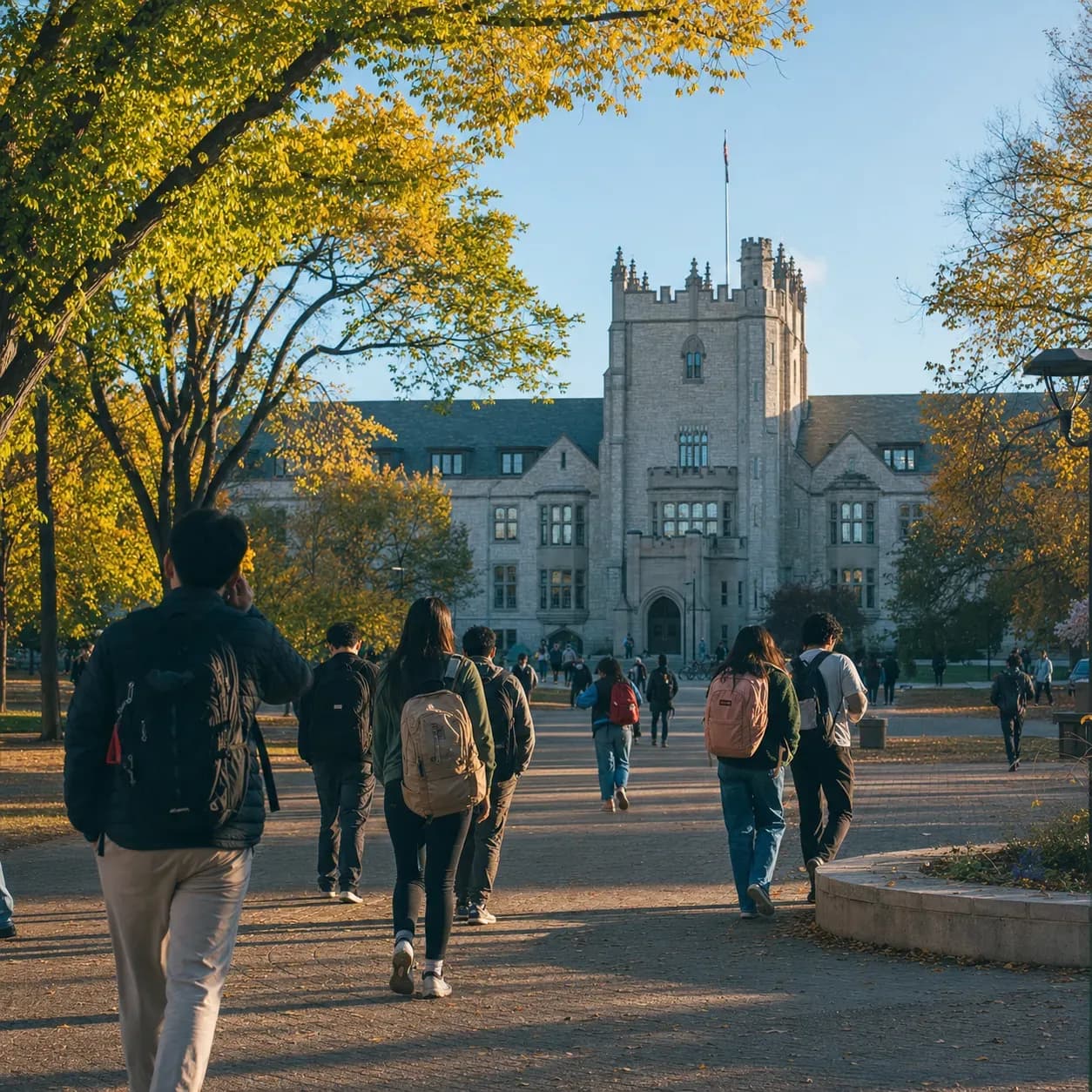
- Greystone stone buildings: Prairie Gothic stone buildings built in 1916 and the signature look of the USask campus.
- University Bridge: A bridge across the South Saskatchewan River connecting campus with downtown Saskatoon.
- The Bowl: The central campus lawn, used every year for Welcome Week and spring rituals.
Student Clubs
- 250+ clubs
- USSU (University of Saskatchewan Students' Union) is the student union
- USask TSA is small but tightly connected
- Aboriginal Students' Centre: USask is among Canada's stronger universities for Indigenous education support
- Agricultural Students' Association: A student association with a long tradition
Sports Culture
- Varsity team name: Huskies
- A strong U Sports university, especially in men's and women's basketball and football
- Moderate sports atmosphere: weaker than Western / Queen's, but stronger than U of T
7. Location / Campus Environment
City Positioning
Saskatoon is the largest city in Saskatchewan, with a population of 300,000, located beside the South Saskatchewan River. Saskatoon's three main industries are agriculture (Canada's grain belt), mining (potash and uranium), and education (USask).
Saskatoon is known as the "Paris of the Prairies": riverbanks, seven bridges, and Gothic buildings make it one of the most beautiful cities in the Prairie provinces. For families from Taiwan, Saskatoon's cost of living is extremely low: rent is CAD 800-1,200/month (vs Toronto at CAD 2,500+), and overall living costs are about 50% of Toronto / Vancouver.
USask's main campus is on the east bank of Saskatoon, a 15-minute walk or 5-minute bus ride from downtown. The campus sits beside the South Saskatchewan River, and students can walk to the river in five minutes.
Climate
- Winter: -20°C to -30°C (harsh cold, the biggest barrier to studying at USask)
- Summer: 22-28°C, dry and pleasant
- Spring and fall: short
- Saskatoon has the most sunshine in Canada: 2,400+ hours per year (vs Vancouver 1,900 and Toronto 2,000)
- Winters are dry rather than damp: more comfortable than the damp cold of Toronto / Halifax
Campus Landmarks
- Greystone Buildings: Prairie Gothic stone buildings from 1916
- College Building: The building featured in USask's emblematic identity
- Place Riel Student Centre: Student centre
- Murray Library: Main library
- Canadian Light Source Synchrotron: A major research hub on campus
- WCVM Building: Veterinary medicine building
8. Research and Resources
Library
- Murray Library is the main library, with two million volumes
- Five branch libraries, including Vet Med, Engineering, Law, Education, and Agriculture
Notable Research Centres
- Canadian Light Source Synchrotron: Canada's only synchrotron light source
- VIDO-InterVac: One of Canada's top vaccine research centres and a key Canadian COVID-19 laboratory
- Global Institute for Food Security (GIFS): In partnership with Nutrien, the potash giant
- Canadian Hub for Applied and Social Research
- Sylvia Fedoruk Canadian Centre for Nuclear Innovation
9. Notable Alumni
- Politics: John Diefenbaker (former Prime Minister of Canada, 1957-1963, alumnus of the USask College of Law), Lynn Beyak (former senator)
- Entertainment: Lorne Greene (actor, star of Bonanza), Gordon Lightfoot (folk singer and creator of If You Could Read My Mind, briefly attended USask)
- Sports: Mike Babcock (NHL hockey coach, former head coach of the Toronto Maple Leafs / Detroit Red Wings, USask Huskies alumnus)
- Academia: Henry Taube (1983 Nobel Prize in Chemistry, USask undergraduate alumnus)
- Business: W.P. Thompson (Canadian pioneer in agricultural breeding), Allan Markin (energy industry)
USask is the alma mater of Henry Taube, Canada's first Nobel Prize winner in Chemistry, who received the 1983 Chemistry prize.
10. USask Facts You May Not Know
- Varsity team name: Huskies: The name has been used since 1903, during the University of Saskatoon era before USask's current form, making it one of the earliest Canadian university teams to use the name.
- The campus sits beside the South Saskatchewan River: The Greystone stone buildings built in 1916 are representative of Prairie Gothic architecture and create a striking contrast with the golden wheat fields of the Prairies.
- The Synchrotron is on campus: Undergraduates can participate in particle physics / synchrotron experiments, which is unique among Canadian universities. It is like having Stanford SLAC built directly on campus.
- USask was the first Canadian university where women could vote for the university president: This was true from its founding in 1907, while other Canadian universities did not open this up until the 1920s.
- Canada's first Nobel Prize winner in Chemistry came from USask: Henry Taube graduated from USask's chemistry department in 1935 and won the 1983 Nobel Prize in Chemistry for his research on electron transfer reaction mechanisms.
11. Typical Admitted Student Profile
- High school average after conversion: 75-85%+ (IB 26+, A-Level BBB+, top 40% of a Taiwanese high school class)
- SAT 1100+ (1250+ recommended for Engineering)
- IELTS 6.5+ / TOEFL 90+
- Vet Med applicants: veterinary shadowing experience required (200+ hours), plus animal-related volunteering
- Pre-Med applicants: chemistry / biology GPA of 90%+, with MCAT preparation ahead
- No need to write a life story like the U.S. Common App; USask values academic fit + Saskatchewan fit
- USask is friendly to mid-range Taiwanese students and is one of the most accessible U15 options
12. What Kind of Student Is USask Right For?
✓ A good fit for:
- Families with a CAD 32-47K/year budget, among the lowest in the U15
- Students interested in veterinary medicine, agriculture, medicine, pharmacy, or physics through Synchrotron access
- Families planning to stay in Saskatchewan after graduation and use the fastest SINP PR pathway
- Students who want a close-knit, small-city, uncrowded lifestyle
- Students with IB 26+ / top 40% high school standing who want a U15 university but have a limited budget
- Students who do not mind harsh winters, especially since dry cold is more comfortable than damp cold
- Students who like abundant sunshine and dry air
✗ Not necessarily a good fit for:
- Students who want big-city life or a Tech hub environment, because Saskatoon is not a Tech hub
- Students determined to enter Bay Street investment banking / Silicon Valley, because USask's alumni network is concentrated in the Prairies and Western Canada
- Students who cannot adapt to -25°C winters; UVic / Dalhousie may be better choices
- Students who strongly need a Chinese-speaking / Asian cultural circle, because Saskatoon's Asian population is below 10%
- Students who want intense school spirit or Greek Life
13. Canadian Study + Immigration Pathway Advantages
USask's SINP pathway in Saskatchewan is the fastest PR route in Canada that Taiwanese families should understand.
PGWP (Post-Graduation Work Permit)
After completing a USask degree program of at least eight months, graduates can apply for a three-year Open Work Permit, regardless of major. The language requirement is IELTS General CLB 7 (6.0 in each band), which Taiwanese students typically meet with IELTS 6.5-7.0. The PGWP reforms that began on 2024-11-01 remain relatively flexible for university degrees.
SINP (Saskatchewan Immigrant Nominee Program): USask's Biggest Advantage
SINP is widely known in Taiwanese immigration consulting circles as the "Cathedral of PNP": Canada's most immigration-friendly PNP.
1. SINP International Graduate Path
- Applies to: USask graduates
- Application possible after only six months of Saskatchewan work experience (vs one year for OINP and one year for BC PNP)
- No high CRS required (does not rely on the EE pool)
- Quotas are 5-10 times more flexible than ON / BC because Saskatchewan has a smaller population and lower PNP competition
- Processing time: 6-9 months
2. SINP Experience - Students Sub-Category
- Six months of Saskatchewan work experience + job offer = direct provincial nomination pathway
- Once provincially nominated, CRS automatically increases by 600 points, effectively guaranteeing an ITA
Typical USask timeline:
- T0: Start at USask
- T0-T48m: Four-year undergraduate degree (CS / Eng / Agriculture)
- T48m: Graduate + apply for three-year PGWP
- T48-T54m: Work in Saskatchewan for six months (any NOC TEER 0/1/2/3)
- T54m: Apply through SINP International Graduate Path
- T60-T63m: SINP nomination (6-9 months) + EE application
- T70m: PR landing, around age 23-24
Compared with ON OINP (requires one year of work and quotas disappear instantly) and BC PNP (master's pathway without job offer but limited to STEM): SINP is the fastest and most flexible at six months.
Express Entry / CEC + STEM / French / Healthcare Category
If SINP does not work out, USask graduates can still use EE / CEC:
- 2026 Q1 CEC cut-off approximately 521-547 (general rounds)
- STEM category 481-524 (directly applicable to USask Engineering / CS / Synchrotron physics graduates)
- French category 379-428 (the most attractive route if Taiwanese students reach TEF B2)
- Healthcare category 422-461 (applicable to USask Vet Med / Med / Pharmacy graduates)
A USask graduate at age 24 with one year of work experience and IELTS 7.0 can reach a CRS of approximately 500-530. Combined with STEM / Healthcare category draws, they are almost certain to be selected.
Impact of the 2024-2025 International Student Cap
Saskatchewan is one of the provinces least affected by the cap, with only a -5% impact in 2024, which is 45 percentage points friendlier than Ontario's -50%. As a U15 research university, USask's master's and doctoral programs are relatively protected. Undergraduate applicants should pay attention to PAL documentation. Saskatchewan is highly welcoming to international students, and the provincial government actively wants them to stay.
Best-Value Comparison with Comparable U.S. Schools
| Item | USask | Comparable U.S. Schools (North Dakota State / Iowa State) |
|---|---|---|
| QS 2026 | #340-380 | NDSU #800+ / Iowa State #350 |
| U15 / research level | U15 member, one of Canada's top 15 research universities | Iowa State R1 / NDSU R2 |
| Tuition (international undergraduate) | CAD $24K (USD $18K) | USD $30-40K |
| Veterinary medicine / agriculture / Synchrotron | Frontline level in Canada | Mid-range |
| Post-graduation pathway | Three-year PGWP + fastest SINP six-month route | OPT 1-3 years + H-1B lottery (30%) |
| Permanent residency | PR by age 23-24 through SINP pathway | OPT + H-1B + green card in 5-10 years |
USask's "U15 + CAD 24K tuition + fastest six-month SINP PR pathway + Synchrotron + Vet Med" combination may be the highest-value U15 university immigration pathway on earth.
Conclusion
USask is right for Taiwanese families thinking, "I have a CAD 32-40K budget, want the fastest PR pathway in Canada, and my child is interested in veterinary medicine / agriculture / physics / medicine." It is not a downtown research machine like U of T, nor a Vancouver ocean-view campus like UBC. It is closer to Canada's version of Iowa State + Kansas State: a Prairie university town, U15 research strength, affordable tuition, and the most flexible SINP immigration pathway.
Choosing USask means accepting a few realities. First, Saskatoon is not a major metropolis: it has a population of 300,000, and relatives or friends in Taiwan may not have heard of it. Second, winter is harsh at -25°C: but the dry cold is more comfortable than Halifax's damp cold, and Saskatoon has the most sunshine in Canada. Third, Tech concentration is low: if your goal is to become a software engineer heading to Bay Street / Silicon Valley, choose Waterloo / U of T instead.
But if your child follows the pathway successfully: studying CS / Engineering / Agriculture / Vet-related tracks at USask at 18, graduating at 22 with a three-year PGWP in hand, working in Saskatchewan for six months, applying for provincial nomination through SINP, and receiving PR at 23-24, this is the fastest closed-loop path on earth for "a U15 degree + four-year total cost of NTD 7-9 million + Canadian PR by age 24."
USask is one of the most underrated hidden best-value universities in the U15, alongside Dalhousie and UManitoba. It offers a realistic path to Canadian PR within 3-4 years, a degree from the same U15 research tier as U of T, tuition at only one-third of U of T's level, and the added strengths of the Synchrotron and veterinary college. Most Taiwanese parents have not yet recognized this value. Saskatchewan is the "Cathedral of PNP," and USask is its chapel.
Sources
- University of Saskatchewan - International Admissions (accessed 2026-05-14) https://admissions.usask.ca/international.php
- Canadian Light Source Synchrotron (accessed 2026-05-14) https://www.lightsource.ca/
- Maclean's University Rankings 2025 (accessed 2026-05-14) https://www.macleans.ca/education/university-rankings/
- Saskatchewan SINP - International Graduate Path (accessed 2026-05-14) https://www.saskatchewan.ca/residents/moving-to-saskatchewan/immigrating-to-saskatchewan/saskatchewan-immigrant-nominee-program
- Dr. G. Academy internal file 03_Canada_Visa_Strategy.md (2026-05-02)