
University of Rochester: Eastman Music Ranked No. 1, Optics Ranked No. 1, Open Curriculum
Published on October 5, 2025
Tied for No. 44 among National Universities in US News, Eastman School of Music ranked No. 1 in the United States, Optics ranked No. 1, Brain & Cognitive Sciences in the national Top 5, Audiology in the Top 10, Simon Business School in the Top 25, and Political Science in the Top 25, the University of Rochester is the most academically independent and most underrated mid-sized private university in Upstate New York, standing alongside Carnegie Mellon and Johns Hopkins as one of the “big three” mid-sized private research universities.
In one sentence, the University of Rochester is: “A completely flexible Open Curriculum + world-class Eastman music + globally leading Optics + a small but powerful 6,800-student private university in Upstate New York.” UR is not an Ivy giant like Cornell, nor an applied technology school like RIT. It is defined by maximum student freedom through the Open Curriculum + three world-class signatures: Eastman, Optics, and Brain Science. To understand UR, start with one fact: its Open Curriculum is one of the most flexible academic structures in the United States. Only Brown, Amherst, and UR offer a true Open Curriculum, with no general education requirements and no core curriculum. Students have four years to explore freely.
1. Basic Information
| Item | Details |
|---|---|
| Founded | 1850 |
| Location | Rochester, New York (Upstate NY, near Lake Ontario) |
| Campus | Approximately 707 acres (River Campus main campus + Eastman Music downtown campus) |
| Undergraduates | ~6,800 |
| Graduate students | ~5,000 |
| Student-faculty ratio | 1:10 |
| Motto | Meliora (Ever Better) |
2. Global Rankings
| Ranking | Placement |
|---|---|
| US News National Universities 2025 | #44 |
| QS World 2025 | #161 |
| THE World 2025 | #198 |
| Eastman School of Music | #1 (tied among U.S. music schools) |
| Optics (Institute of Optics) | #1 (United States, the only independent Optics department) |
| Brain and Cognitive Sciences | Top 5 |
| Audiology | Top 10 |
| Simon Business School (Undergrad) | Top 25 |
| Political Science | Top 25 |
| Economics | Top 30 |
| Biomedical Engineering | Top 25 |
| Computer Science | Top 50 |
| Nursing (DNP) | Top 30 |
| Music Theory | #1 (United States) |
UR is nationally elite in music, optics, cognitive neuroscience, audiology, and business. Eastman School of Music has long ranked alongside Juilliard and Curtis among the top three music schools in the United States, and it is the largest top-tier music school in the country. The Institute of Optics is the only independent Optics department in the United States; its graduates have shaped the American optics industry, including Corning, Bausch & Lomb, and Kodak, all of which are rooted in Rochester. Brain & Cognitive Sciences is a national Top 5 program, making UR a global hub for cognitive neuroscience.
3. Admissions Data (Class of 2028)
| Metric | Value |
|---|---|
| Applicants | ~21,000 |
| Admitted students | ~7,400 |
| Overall acceptance rate | Approximately 35% |
| ED acceptance rate | ~50% |
| RD acceptance rate | ~32% |
| Yield Rate | ~16% |
UR uses a three-round ED + EA + RD admissions structure. The ED acceptance rate is about 50%, making it the most important strategic option for UR applicants. Eastman School of Music and Optics are especially selective (10-20%), and Eastman also requires an additional Audition. The overall yield rate of 16% is relatively low because many admitted students choose larger or more famous schools such as Cornell or Carnegie Mellon.
SAT/ACT Middle Range
| Test | 25th percentile | Median | 75th percentile |
|---|---|---|---|
| SAT | 1380 | 1470 | 1530 |
| ACT | 31 | 33 | 35 |
UR is Test-Optional, so applicants do not have to submit scores. However, applicants to Optics, Engineering, and Simon Business are advised to submit scores if they are strong.
International Students
- International students make up about 28% of the student body (one of the highest proportions among Top 50 universities)
- Students come from 100+ countries
- More than 800 students are from China
- About 5-15 Taiwanese students are admitted each year
- UR is one of the U.S. private universities with the largest international student populations
4. Tuition and Financial Aid
2024-2025 Costs
| Item | Amount |
|---|---|
| Tuition | USD $66,500 |
| Housing | USD $11,800 |
| Food | USD $7,400 |
| Personal + Misc | USD $5,000 |
| Total | USD $90,700+ |
UR’s total cost of about USD $91K is comparable to other East Coast Top 50 private universities such as BU, NYU, and Tufts.
Need-Based Aid
- Need-Aware for international students, meaning financial need can affect admission chances
- U.S. citizens and permanent residents: Meets 100% of Demonstrated Need
- Renaissance Scholarship: Merit Aid, available to international students, USD $30,000/year
- Eastman School Merit Scholarships: the music school is fully Merit-based
- Genesee Scholarship: USD $20,000/year
- Bausch & Lomb Honorary Science Award: for high school science award recipients, USD $15,000/year
- About 64% of students receive Need-Based Aid
- Average Aid: USD $52,000/year
UR’s Renaissance Scholarship of USD $30,000/year is the most worthwhile strategic target for international students. This amount has real value for Taiwanese families. UR’s Merit Aid is more generous than Cornell’s, which makes UR more family-friendly for Taiwanese applicants than Cornell in this respect.
5. Academic Structure / Signature Programs
Main Undergraduate Schools
- School of Arts & Sciences: the largest school, including Brain & Cognitive Sci, Math, Bio, Econ, CS, and English
- Hajim School of Engineering & Applied Sciences: Optics, ECE, ME, CS, ChemE, and Biomedical
- Eastman School of Music: undergraduate music majors (ranked No. 1 in the United States; located in downtown Rochester, a 5-minute drive from River Campus)
- Simon Business School: MBA + undergraduate Business minor (mainly graduate-focused; undergraduates only have Economics and Business minor options)
- School of Nursing
- School of Medicine and Dentistry
Signature Programs
- Eastman School of Music: ranked No. 1 in the United States; a 900-student music school with Performance, Composition, Music Theory, Music Education, Jazz, and Conducting. Graduates go on to the New York Philharmonic, Boston Symphony, Juilliard faculty, and Hollywood scoring
- Institute of Optics: the only independent Optics department in the United States; “the MIT of optics”. Graduates have shaped the American optics industry, including Corning glass, Bausch & Lomb lenses, Kodak cameras, and ASML semiconductor lithography
- Brain & Cognitive Sciences: national Top 5; undergraduates can participate in research at the Center for Visual Science
- Take Five Scholars Program: a UR signature. Students can apply for an additional fifth year of free tuition to explore any topic (the only program of this kind in the United States)
- Renaissance Scholars Program: UR’s most prestigious university-wide honors program
- Eastman + River Campus dual degree: a small number of students can earn a dual degree in music and the College of Arts & Sciences
- REMS Program (Rochester Early Medical Scholars): an 8-year direct path from undergraduate study to the University of Rochester School of Medicine
- Take Five free fifth year: students may apply for an additional year (full tuition waiver) to pursue an interdisciplinary project
General Education Structure
UR uses the Rochester Curriculum (Open Curriculum): no general education requirements + no core curriculum. Students choose one cluster (three related courses) in each of three broad areas: humanities, social sciences, and natural sciences. Everything else is fully open. Only Brown, Amherst, and UR offer a true Open Curriculum in the United States.
6. Campus Culture / Institutional Personality
UR’s personality can be summed up in one sentence: “Maximum freedom through the Open Curriculum + Eastman’s musical character + hard-core survival in an Upstate New York winter.” UR students, known as "Yellowjackets," are known for intellectual freedom, artistic and musical sensibility, and international diversity. The atmosphere is looser than Cornell and more humanistic than RIT. UR students are the “Upstate New York version of Brown”; the Open Curriculum attracts independent thinkers.
UR’s academic style is “moderate intensity with real depth”. It is less intense than Cornell or CMU, but more serious than a typical state university. This is a paradise for students who want a mid-sized private university, an Open Curriculum, and less Ivy-style anxiety. Princeton Review has repeatedly recognized UR for “Best Quality of Life” and “Most Engaged in Community Service.”
Greek Life / Student Organizations
- About 18% of students participate in Fraternity / Sorority life, which is moderately high for a mid-sized private university
- Greek Life is visible on campus, but Eastman Music, Optics clubs, and interdisciplinary research organizations are more central
- Signature events: Yellowjacket Day (student organization fair), Wilson Day (first-year service day), Boar's Head Dinner (annual medieval-style dinner in December), and Meliora Weekend (October alumni homecoming)
- 300+ student organizations
Athletics Culture
- Liberty League + University Athletic Association (NCAA Division III)
- Signature sports: men’s tennis, rowing, basketball, and soccer
- No D1 American football culture. UR is a D3 school, and athletics are not the core of campus culture
- The Eastman School of Music Symphony Orchestra is the “real varsity team” on campus, often collaborating and performing with the New York Philharmonic and Boston Symphony
7. Location / Campus Environment
City Positioning
UR is located in Rochester, an Upstate New York city with a population of about 210,000 (the fourth-largest city in New York State). Rochester is the “heart of America’s optics industry.” Kodak (bankrupt but with facilities still present), Bausch & Lomb (lenses), Corning Glass (glass), and Xerox all originated in Rochester. UR has 100+ years of partnership history with these companies.
Distance:
- New York City: 6 hours by car / 1 hour by plane
- Toronto, Canada: 3 hours by car
- Buffalo (Niagara Falls): 1 hour by car
- Syracuse: 1.5 hours by car
- Boston: 6 hours by car
- Rochester International Airport: 15 minutes
Rochester is an Upstate New York Rust Belt city. It was once an industrial stronghold for Kodak, Xerox, and Bausch & Lomb. After Kodak’s 2012 bankruptcy, parts of the city declined, but UR and the Rochester medical system, including Strong Memorial Hospital, have become Rochester’s largest employers. Eastman School of Music is located in downtown Rochester, where students practice and perform in historic concert halls.
Climate
- Winter: -7 to -2°C, one of the snowiest cities in the United States, with 100+ inches of annual snowfall due to Lake Ontario Lake Effect Snow
- Summer: 18-27°C, comfortable
- Spring and fall: the most beautiful seasons in Upstate New York
- Winter is long (November-April), and serious cold-weather gear is necessary
Campus Landmarks
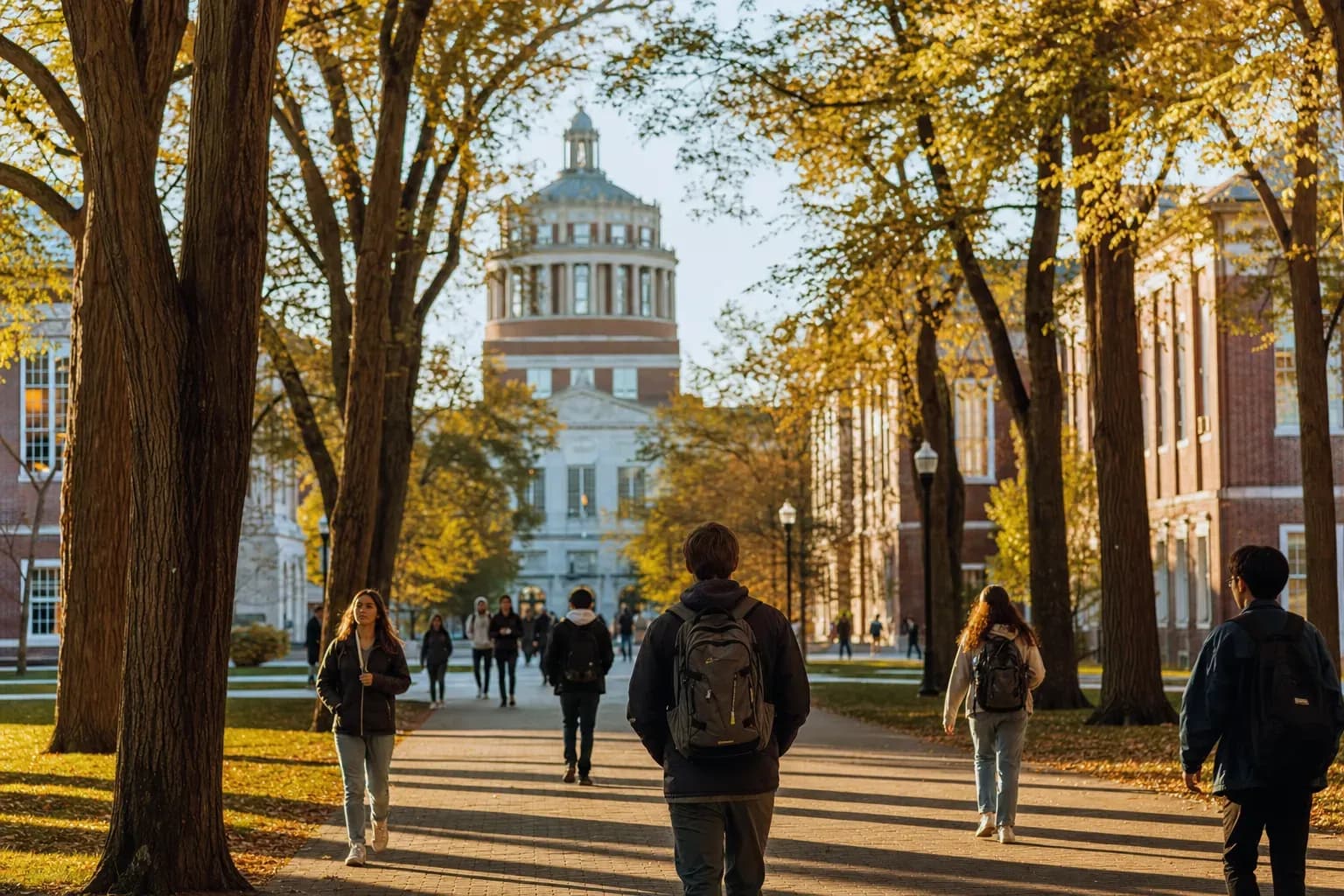
- Rush Rhees Library: the main library, a 1930 Neo-Georgian building. The library’s Bell Tower is a UR campus landmark
- River Campus: the main campus, built along the Genesee River
- Eastman Theatre: Eastman School performance hall (downtown Rochester, seating 2,326, and home to the Rochester Philharmonic Orchestra)
- Strong Memorial Hospital: UR’s teaching hospital (the largest in Upstate New York)
- Wilson Quadrangle: the central campus lawn
- Hopeman Memorial Carillon: the library bell tower
- Frederick Douglass Building: student center named for the abolitionist who lived in Rochester
8. Research and Resources
Libraries
- Rush Rhees Library (main library)
- Sibley Music Library (Eastman School, the largest music library in the United States)
- 8 libraries university-wide, with a total collection of 3.8 million volumes
- Sibley Music Library holds 750,000 music-related items, making it a pilgrimage site for music scholars in the United States
Notable Laboratories / Research Centers
- Laboratory for Laser Energetics (LLE): the world’s largest university laser laboratory (OMEGA Laser), and one of the core U.S. Department of Energy nuclear fusion research sites
- Center for Visual Science: cognitive / visual neuroscience
- Institute of Optics: world-class optical engineering
- Wilmot Cancer Institute
- Center for Coordination Chemistry
- Goergen Institute for Data Science
- del Monte Institute for Neuroscience
UR is world-class in laser fusion, optical engineering, cognitive neuroscience, vision science, and musicology. OMEGA Laser is the world’s second-most powerful university laser, behind only NIF/Lawrence Livermore. UR Physics and Engineering students can participate in laser fusion research.
9. Notable Alumni
- Politics: Steven Chu (2013 Nobel Prize in Physics and former U.S. Secretary of Energy; UR undergraduate in Mathematics + Physics), Eric Cantor (former U.S. House Majority Leader)
- Technology / Business: George Eastman (founder of Kodak; UR’s most important early donor, funding Eastman School of Music + Eastman Theatre + Eastman School of Medicine), Daniel Carp (former Kodak CEO), John Wargo
- Music / Arts: Renée Fleming (world-class soprano, Eastman alumna), Ron Carter (legendary Jazz bassist, Eastman alumnus), Mitch Miller (conductor, Eastman), Charles Strouse (Broadway composer), William Warfield (opera bass-baritone)
- Academia / Nobel Prizes: UR alumni and faculty include 9 Nobel laureates, including Vera Rubin (discoverer of dark matter, UR undergraduate in Physics), Steven Chu (2013 Nobel Prize in Physics), and Robert Marshak (physics)
- Entertainment / Media: Robert B. Parker (novelist), Don Featherstone (inventor of the Pink Flamingo lawn ornament)
UR’s alumni network has deep influence in music, optics, physics, and medicine. George Eastman, founder of Kodak, is UR’s permanent benefactor. He personally funded Eastman School of Music, Eastman Theatre, Eastman Dental Center, and Eastman Quadrangle. His donations would be worth more than USD $200M today.
10. University of Rochester Fun Facts
- Eastman School of Music was funded by George Eastman in 1921: Kodak founder George Eastman donated USD $4M in 1921 (about USD $60M today) to establish Eastman School of Music. He wanted it to be “one of America’s finest music schools.” Today, Eastman ranks alongside Juilliard and Curtis among the top three in the United States. George Eastman’s vision came true. Eastman also donated funds for MIT’s chemistry building, unrelated to UR but a sign of his generosity.
- OMEGA Laser is the world’s second-most powerful university laser: The OMEGA Laser inside UR’s Laboratory for Laser Energetics is the world’s second-most powerful university-based laser, behind only NIF at Lawrence Livermore National Lab. It is used for nuclear fusion research. Undergraduate students in Optics, Physics, and Mechanical Engineering can participate in OMEGA experiments, a hands-on opportunity that Stanford and Harvard cannot offer in the same way.
- Take Five Scholars Program provides a free fifth year: UR students can apply for Take Five Scholars. Selected students receive one additional year of free study with full tuition waived to pursue an interdisciplinary project. No other U.S. university has this exact design. This program is the ultimate expression of UR’s Open Curriculum philosophy: “We do not just give you four years of freedom; we give you five.” About 80 students are selected each year.
- Rochester is one of the snowiest cities in the United States: Because of Lake Effect Snow from Lake Ontario, Rochester receives 100+ inches of snow each year, making it one of the top three snowiest major cities in the United States. Students spend four years learning to walk through snow, shovel snow, and have snowball fights. The motto “Meliora” takes on a literal meaning in Rochester winters. If you can survive four Rochester winters, most other challenges in life feel manageable.
- Vera Rubin earned her undergraduate Physics degree at UR: Vera Rubin, the discoverer of dark matter, graduated from UR in 1948 with an undergraduate degree in astronomical physics. At the time, she was the only woman in the Physics department. She later earned a master’s degree at Cornell and a PhD at Georgetown, then discovered anomalies in galaxy rotation curves, key evidence for the existence of dark matter. The Vera Rubin Telescope in Chile is named after her.
11. Typical Admitted Student Profile
- GPA Unweighted ~3.85+
- SAT 1450+ or ACT 32+ (1500+ for Optics, Engineering, and Simon applicants)
- 8-12 AP courses, depending on academic direction
- Spike for Eastman Music: world-class level in instrumental performance / voice / composition (must pass an Audition)
- Spike for Optics: physics competitions, Science Olympiad, research publication
- Spike for Brain & Cognitive: research publication, psychology competitions, neuroscience camps
- Spike for Simon Business: business competitions, entrepreneurship projects
- Essays must show “why Open Curriculum freedom + why UR fit”. UR looks for intellectual curiosity and interdisciplinary thinking
- Recommendation letters should tell stories of independent thinking + interdisciplinary connection + intellectual depth
Among Top 50 universities, UR is one of the schools that cares most about Open Curriculum fit + intellectual freedom. A purely brag-based essay will not work. UR wants to know why this student needs an Open Curriculum rather than a standard required curriculum.
12. What Kind of Student Is a Good Fit?
✓ Good fit for students who:
- Want to major in music (Eastman is one of the strongest music schools on earth)
- Want to study optical engineering (Optics is the only independent department of its kind in the United States)
- Are drawn to the complete freedom of an Open Curriculum
- Want a mid-sized private university (6,800 undergraduates) where professors can know them
- Have a clear passion for Brain & Cognitive Sciences
- Want a Top 50 private university with a balance of cost and Merit Aid
- Are not afraid of harsh Upstate New York winters and snowstorms
✗ Not necessarily a good fit for students who:
- Want a highly urban lifestyle (Rochester is a mid-sized Rust Belt city)
- Fear snow or long winters (100+ inches of annual snowfall)
- Want a strong traditional American campus sports culture (UR is D3 and has no major football culture)
- Feel lost with Open Curriculum freedom (students who need a structured curriculum may not fit)
- Want the Ivy brand halo (UR is less famous than Cornell or UPenn)
- Want a strong Greek Life party culture
Conclusion
Among Top 50 universities, the University of Rochester is the mid-sized private university that is “the most flexible, most musical, and most optical.” It is not an Ivy giant like Cornell, nor a rigorously tech-centered school like CMU. But Eastman School of Music is ranked No. 1 in the United States, the Institute of Optics is the only independent department of its kind in the country, Brain & Cognitive is Top 5, and the Open Curriculum is offered by only three U.S. schools. Add in Take Five’s free fifth year, the legend of George Eastman as a lifelong benefactor, OMEGA Laser research, Renée Fleming as a music alumna, and Vera Rubin as a physics alumna, and these details form the identity of “the East Coast’s most flexible elite private university.”
If you are a student who wants music, optics, cognitive neuroscience, or the freedom of an Open Curriculum, UR is one of the rare places on earth that can combine all of those conditions. Eastman students practice in historic concert halls in downtown Rochester, Optics students work on laser fusion at OMEGA Laser, and Brain & Cognitive students conduct fMRI research at the Center for Visual Science. This combination of professional depth and free exploration is rare in American higher education.
The most concrete advice for Taiwanese families: UR is one of the best choices for families who want a mid-sized private university, want Merit Aid, and are interested in Eastman / Optics / Brain & Cognitive. The Renaissance Scholarship of USD $30,000/year is one of the most valuable scholarships for international students in practical terms. Combined with other Merit Aid options such as Genesee and Bausch & Lomb, UR is more generous to international students than Cornell or Carnegie Mellon. Eastman School of Music is one of the most strategically valuable options for Taiwanese musicians. It is easier to enter than Juilliard, and after tuition discounts and Merit Aid, the real cost can be lower.
But the harshest reality for Taiwanese families: UR’s local Rochester character is a real test. It is in an Upstate New York Rust Belt city, receives 100+ inches of snow a year, is six hours from New York City, and parts of the city declined after Kodak’s bankruptcy. Students who dream of urban convenience or sunny weather may be disappointed. UR’s name recognition in Taiwan is weaker. “U Rochester” is unfamiliar to many Taiwanese parents, and friends may not be impressed when they hear “my daughter studies at the University of Rochester.” If you care about brand halo, want sunshine, or want a big-city environment, UR is not the right fit. But if you want Open Curriculum freedom + world-class Eastman music + globally leading Optics + a mid-sized private university where professors know you, UR has few rivals anywhere on earth. That is the clearest judgment UR offers Taiwanese families.