
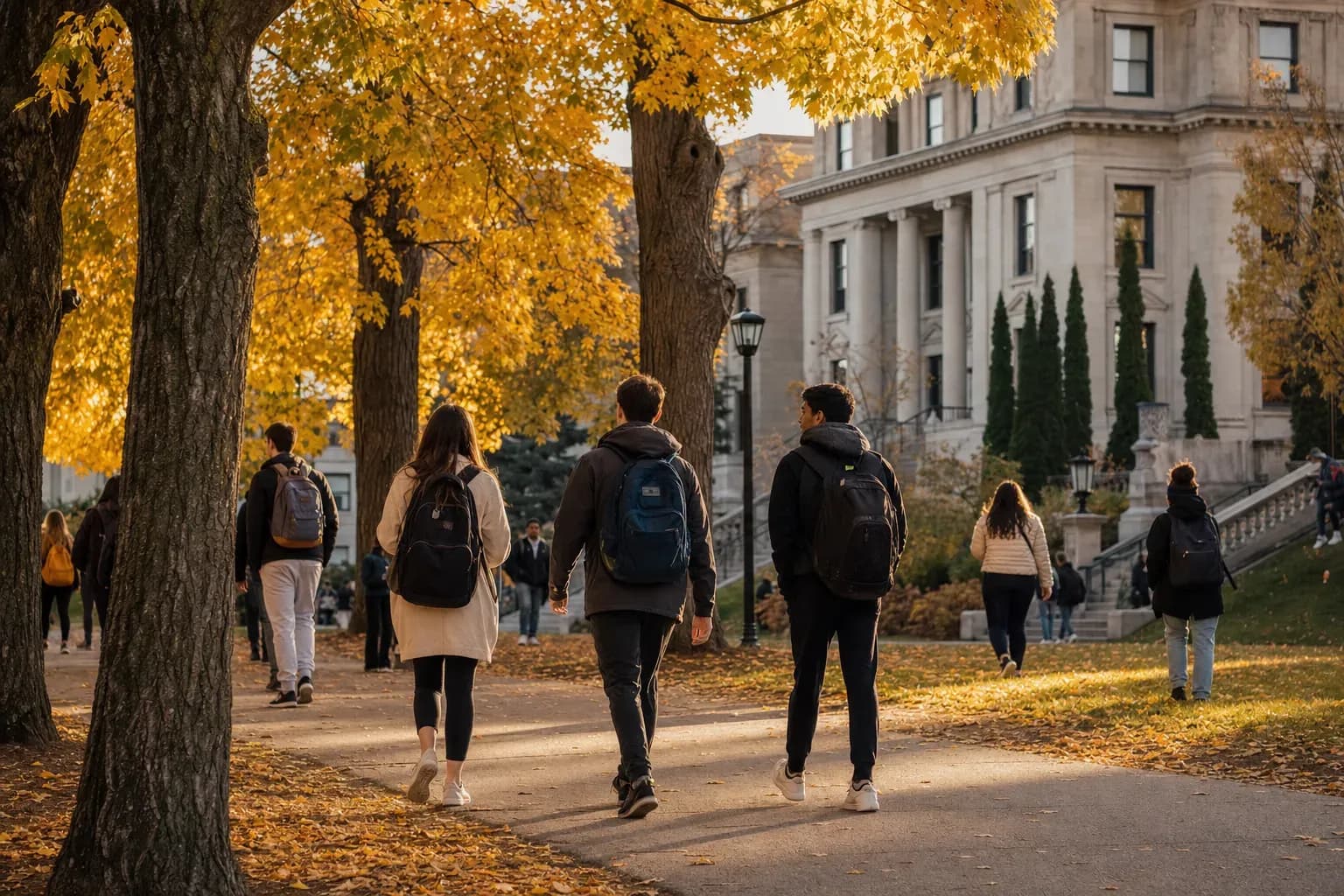
University of Ottawa: Canada’s Only Top Fully English-French Bilingual University, Capital-City Advantage, Common Law + Civil Law
Published on January 25, 2026
The University of Ottawa (uOttawa) is the only top university in Canada that teaches fully in both English and French: QS 2026 #187, a member of the U15, and ranked #7 among Maclean's Medical Doctoral universities. Its value can be summed up in one sentence: if you want to study in Canada’s capital, develop both English and French, and be within walking distance of Parliament Hill, this is the only option on earth. Most Canadian universities lean either English-speaking (U of T, UBC, McMaster) or French-speaking (UdeM, Laval). Only uOttawa is truly 50/50 bilingual. All major campus documents are presented in both languages, students can choose to take many courses in English or French, and even the university song has both English and French versions.
For Taiwanese families, uOttawa’s value is often underestimated. Its location, a five-minute walk from Parliament Hill, makes it a talent pipeline for the Canadian government, international organizations, and NGOs. Global Affairs Canada, IDRC, UNICEF Canada, and the Canada Revenue Agency are all within five kilometers. If your child’s goal is the federal government, Big 4 public-sector consulting, international development, diplomacy, or a Supreme Court internship, uOttawa’s geographic advantage is more practical than any ranking. Its U.S. counterparts would be Georgetown or George Washington, universities shaped by the political ecosystem of a national capital.
1. Basic Information
| Item | Details |
|---|---|
| Founded | 1848 (originally a Catholic seminary; secularized in 1965) |
| Location | Ottawa, Ontario (Canada’s capital; a five-minute walk from Parliament Hill) |
| Campus | Main campus of about 42 acres (compact urban campus) |
| Undergraduates | ~37,000 |
| Graduate students | ~10,000 |
| Total enrollment | ~47,000 |
| Student-faculty ratio | 1:18 |
| Motto | Deus scientiarum Dominus est (God is the Lord of knowledge; now used less prominently) |
2. World Rankings
| Ranking | Position |
|---|---|
| QS World 2026 | #187 |
| THE World 2025 | #176 |
| US News Global Universities 2024-25 | #199 |
| Maclean's Canadian Medical Doctoral Universities | #7 |
| QS Law | #51-100 globally |
| QS Communication & Media | #51-100 globally |
| Scale of Canadian Co-op program | Second largest in Canada (behind Waterloo only) |
uOttawa’s Faculty of Law is respected in the Canadian legal world, behind only U of T, McGill, and Osgoode (York) in reputation. But in terms of the concentration of graduates entering government, uOttawa ranks first.
3. Admissions Data (Fall 2024 Entry)
| Indicator | Figure |
|---|---|
| Overall applicants | ~50,000 |
| Overall acceptance rate | About 58% |
| Faculty of Medicine | About 5-7% (extremely difficult for international students) |
| Faculty of Law - JD | About 12-15% (5-8% for international students) |
| Telfer School of Management - BCom | About 15-25% |
| Engineering | About 35% |
| Arts | About 65% |
| Yield Rate | About 50% |
Compared with other elite U15 universities, uOttawa is relatively admissions-friendly, and this is one of its hidden advantages. Undergraduate Arts, Health Sciences, and International Development programs are open to international students and have reasonable admissions thresholds.
International Student Standards (Direct Undergraduate Entry)
| Test | Recommended Score |
|---|---|
| High school average | 80-85%+ (90%+ needed for Law / Med) |
| SAT | 1200+ (1380+ recommended for Engineering / Telfer) |
| ACT | 26+ |
| IELTS (English-taught programs) | 6.5 (6.0 in each component) |
| TOEFL iBT | 86+ |
| TEF / TCF / DELF (French-taught programs) | B2 minimum |
| French-taught programs | Additional language certificate available (French Immersion Stream) |
International Students
- International students make up about 17% of the student body
- Students come from 150+ countries, with strong representation from Francophone Africa, Lebanon, and the Middle East
- 5-15 Taiwanese undergraduates are admitted each year
- About 30% of students study in French, 50% in English, and 20% bilingually
4. Tuition and Financial Aid (International Student Perspective)
2024-2025 Tuition (CAD/year)
| Item | Amount |
|---|---|
| Tuition - Arts / Social Sciences | CAD $32,000-$38,000 |
| Tuition - Science | CAD $45,000-$50,000 |
| Tuition - Engineering | CAD $48,000-$52,000 |
| Tuition - Telfer School of Management BCom | CAD $40,000-$45,000 |
| Tuition - Faculty of Law JD | CAD $50,000-$55,000 |
| Tuition - Medicine | CAD $50,000+ (very few places for international students) |
| Housing (on-campus Residence) | CAD $11,000-$15,000 |
| Food + miscellaneous (Ottawa has moderate living costs) | CAD $9,000-$12,000 |
| Total | CAD $52,000-$80,000/year |
Compared with the same programs at U of T or UBC, uOttawa is about 20-25% less expensive. Ottawa’s cost of living is also 15-20% lower than Toronto or Vancouver, making uOttawa the second-best-value U15 option after UdeM.
Financial Aid for International Students
- University of Ottawa International Scholarship: CAD $7,500-$30,000, awarded automatically based on admission average
- Differential Tuition Fee Exemption Scholarship: tuition differential exemption for international master’s and doctoral students in selected programs
- Telfer International Entrance Scholarship: CAD $10,000-$15,000
- Common Law Section Entrance Scholarship: CAD $5,000-$30,000
5. Academic Structure / Signature Programs
Faculty Structure
uOttawa has 10 faculties: Arts, Social Sciences, Science, Health Sciences, Engineering, Education, Law (with Common Law and Civil Law sections), Medicine, Telfer School of Management, and Graduate and Postdoctoral Studies.
Signature Programs
- Faculty of Law (dual system): Canada’s only law faculty offering both Common Law and Civil Law legal education:
- Common Law Section: taught in English; graduates can practice in Ontario, most Canadian provinces, and the United States
- Civil Law Section: taught in French; graduates can practice in Quebec
- Programme de droit canadien: Canada’s only four-year joint JD/LLL dual-system program
- Telfer School of Management: AACSB-accredited business school; BCom Co-op has an especially high placement rate in Canadian government agencies
- Faculty of Medicine: also offers French-language instruction; extremely difficult for international students
- Faculty of Engineering: Mechanical, Electrical, Computer, and Civil; strong Co-op outcomes
- School of International Development and Global Studies: Canada’s only undergraduate program focused specifically on international development, with close ties to IDRC and Global Affairs Canada
- Graduate School of Public and International Affairs (GSPIA): master’s-level public policy training ground and senior fellow hub for the Canadian government
Co-op Program
At uOttawa, about 6,000+ students participate in Co-op, making it the second-largest program in Canada after Waterloo. Its strengths are:
- A large share of employers are Canadian federal government bodies (Treasury Board, CRA, Health Canada, Global Affairs)
- Co-op student pay ranges from CAD $4,500-$7,500/month
- Government internships convert to full-time roles at a very high rate, as federal public service employers prioritize Co-op alumni
6. Campus Culture / Institutional Personality
uOttawa’s campus culture can be summarized in one phrase: a bilingual, political, urban university with a public-service orientation. The student body is about 50% from Ontario, 25% from Quebec, 15% from other Canadian provinces, and 10% international. Conversations switching between English and French in campus corridors are normal, which gives Taiwanese students a free French immersion environment.
Campus Activities
- Panda Game: the annual football rivalry between the uOttawa Gee-Gees and Carleton Ravens, held every year since 1955 and the wildest day of the year for Ottawa university students
- 101 Week: freshman orientation week; red T-shirt street parades are a tradition
- Bilingual Bistro: an on-campus bilingual cafe that hosts weekly French conversation exchanges
Student Clubs
- 250+ clubs
- uOttawa Model UN: one of Canada’s strongest university Model UN teams
- The Taiwanese student association is small but active
Sports Culture
- Varsity team name: Gee-Gees (in French, "Gee Gee" is the sound used to urge a horse onward, originating from carriage commands)
- Main sports: football, basketball, ice hockey
- Panda Game is the peak of the sports calendar; other events have a more moderate atmosphere
7. Location / Campus Environment
City Positioning
uOttawa’s main campus is in Sandy Hill in downtown Ottawa. From Tabaret Hall at the campus entrance, it is a 12-minute walk to Parliament Hill, five minutes to ByWard Market (market and nightlife), and three minutes to the Rideau Canal (a UNESCO World Heritage Site). This is the only university in Canada whose campus gate is within a five-minute walk of Parliament Hill.
Geographic advantages:
- Parliament Hill (Parliament, the Supreme Court, and the Prime Minister’s Office) is within walking distance
- Global Affairs Canada is a 10-minute drive away
- IDRC is a five-minute drive away
- Many international organizations, including UNICEF Canada, Plan Canada, and Oxfam Canada, are in Centretown
Climate
- Winter: -15°C to -25°C (the coldest G7 capital in Canada), often reaching -30°C in January and February
- Snow remains from December to March. In winter, the Rideau Canal becomes the world’s longest skating rink (7.8 km), and students can skate from near campus to Parliament Hill
- Summer: 22-30°C and humid
- Spring and fall are short, but the maple leaves around ByWard Market are spectacular
Campus Landmarks
- Tabaret Hall (built in 1859, the heart of campus and the image on the university crest)
- STEM Complex (opened in 2018, Canada’s largest interdisciplinary science building)
- Faculty of Social Sciences Building (FSS, a modern 13-storey building)
- Rideau Canal (student commute route; skating in winter)
- ByWard Market (10-minute walk; an open-air market dating back to 1826)
8. Research and Resources
Libraries
- Five library branches with five million volumes
- Morisset Library is the main library
- Brian Dickson Law Library is Canada’s second-largest law library, behind only U of T
Notable Research Centres
- Centre for Law, Technology and Society: a major research hub for technology law, privacy law, and AI ethics
- Institute for Science, Society and Policy
- uOttawa Heart Institute: one of Canada’s top three cardiovascular research institutions
- Centre for International Policy Studies
- Public Law Centre: a public law research centre that works with the Supreme Court
At uOttawa, 40% of research funding comes directly from Canadian federal government grants, the highest proportion of government research collaboration among U15 universities.
9. Notable Alumni
- Politics: Paul Martin (former Prime Minister of Canada, 2003-2006, BA + JD), David Crombie (former mayor of Toronto), Mona Fortier (former President of the Treasury Board)
- Law / Judiciary: Antonio Lamer (Chief Justice of the Supreme Court of Canada, 1990-2000), Louise Charron (former Supreme Court justice), Marie Deschamps (former Supreme Court justice)
- Media: Wendy Mesley (CBC News), Adrienne Arsenault (CBC News)
- Technology / Business: Calin Rovinescu (former Air Canada CEO)
- Academia: Charles Taylor (philosopher and former faculty member)
- International: numerous senior United Nations officials and Canadian ambassadors
10. uOttawa Facts You May Not Know
- The Tabaret Building is eight years older than Canada as a country: it was completed in 1859, while Canadian Confederation took place in 1867. The oldest red-brick building on campus is still in use today.
- The Rideau Canal becomes the world’s longest skating rink in winter: it stretches 7.8 km from near the uOttawa campus to Parliament Hill, and skating along this route is a defining feature of Ottawa winters.
- Canada’s first Francophone Chief Justice of the Supreme Court was a uOttawa alumnus: Antonio Lamer served as Chief Justice from 1990 to 2000 and graduated from the Civil Law Section.
- The team name Gee-Gees comes from a carriage command: in French, "Gee Gee" is the sound used to urge a horse onward, originating from the era when campus transport relied on horse-drawn carriages.
- The Panda Game began with a stuffed panda wager: in 1955, the uOttawa and Carleton student associations bet on the outcome of a football game, with a stuffed panda as the prize. The tradition has continued every year since.
11. Typical Admitted Student Profile
- High school average (converted): 80-88% (90%+ for Law / Med; IB 34-38)
- SAT 1300+ (1400+ recommended for Telfer / Engineering)
- English-taught programs: IELTS 6.5-7.0+ / TOEFL 86+
- French-taught programs: DELF B2+ / TEF B2+
- Bilingual applicants have a significant advantage, as uOttawa places high value on bilingual capacity
- Personal Statement should show interest in a bilingual environment, public service, and an international outlook
- Law / Med require interviews and additional application essays
12. What Kind of Student Is uOttawa Best For?
✓ A strong fit for:
- Students who want to develop both English and French and eventually enter the Canadian government or international organizations
- Students with clear interests in law, public policy, international development, or diplomacy
- Students attracted to a Common Law / Civil Law dual-system law faculty
- Students who like capital-city life, political environments, and high museum density
- Families with a budget of CAD $60,000-$80,000/year (about 25% cheaper than U of T)
- Students interested in Telfer Co-op, government employment, and Big 4 consulting pathways
- Students who want a close-knit urban campus (uOttawa’s campus is compact, unlike the broad U of T campus)
✗ Not necessarily a fit for:
- Students who want no exposure to French at all (the campus is about 50% French-speaking)
- Students seeking an American-style college town experience
- Students who dislike severe cold (Ottawa is about 5°C colder than Toronto)
- Students seeking a purely research-oriented university experience (uOttawa is applied and government-oriented)
- Students who judge business schools only by ranking (Telfer does not have the same brand power as U of T Rotman or Western Ivey)
13. Advantages for Canadian Study + Immigration Pathways
Among U15 universities, uOttawa offers some of the most diverse immigration pathways. Students can pursue federal EE, Ontario OINP, Quebec PEQ if they work across the river in Gatineau, and French category draws.
PGWP (Post-Graduation Work Permit)
After completing a uOttawa degree program of at least eight months, graduates can apply for a three-year Open Work Permit, regardless of major. The language requirement is IELTS General CLB 7 or TEF NCLC 7, and uOttawa bilingual graduates can use either pathway.
Express Entry French Category (One of uOttawa’s Biggest Advantages)
If you take a substantial number of French courses at uOttawa and reach TEF NCLC 7:
- 2026 Q1 French category cut-offs were only 379-428 (general rounds were 530+)
- French CLB 7 directly adds 50 CRS points for single applicants
- uOttawa bilingual graduates usually have CRS scores of 420-490, making selection in the French category almost guaranteed
Ontario OINP Masters Graduate Stream
uOttawa master’s graduates can apply:
- No job offer required
- Automatic CRS +600
- Quotas fill instantly, usually opening every one to two months and closing within hours
Co-op + Federal Government Employment + CEC
The main destination for uOttawa Co-op students is the Canadian federal government, where the Public Service Commission recruits directly. Federal public service roles are generally NOC TEER 1 positions, such as policy analyst or program officer. After graduation, if students obtain an indeterminate position:
- They immediately begin accumulating NOC TEER 1 work experience
- After one year, they can apply through CEC, with CRS scores typically around 510-540
- Federal public service roles are highly stable, and moving into an indeterminate full-time role during PGWP is favorable for PR applications
Cross-River to Gatineau (A Special Strategy)
Just across the Ottawa River is Gatineau, Quebec. If you earn a French-taught degree at uOttawa and work across the river in Gatineau:
- You may pursue Quebec PEQ (French CLB 7 + one to three years of Quebec work experience)
- This is a hidden pathway for uOttawa French-language graduates
Impact of the 2024-2025 International Student Cap
Ontario is the province most affected by the cap, with undergraduate study permit allocations down 50%. uOttawa is a research university of medium scale, so master’s and doctoral programs are relatively protected. Undergraduate applicants should pay close attention to PAL documentation.
Value Comparison with Comparable U.S. Universities
| Item | uOttawa | Comparable U.S. Universities (Georgetown / George Washington) |
|---|---|---|
| QS 2026 | #187 | Georgetown #225 / GWU #321 |
| Tuition (international undergraduate) | CAD $32K-$50K (USD $24K-$37K) | USD $66K-$67K |
| Capital-city advantage | Five-minute walk to Ottawa Parliament Hill | DC Capitol Hill by metro |
| Bilingual environment | Truly 50/50 English-French | English-only |
| Post-graduation stay pathway | Three-year PGWP + French category EE | One to three years OPT + H-1B lottery |
uOttawa’s tuition is only half of Georgetown’s, its bilingual environment is something Georgetown simply cannot offer, and its PR pathway is clear. For Taiwanese families focused on government, international organizations, and Canadian permanent residence, uOttawa is a hidden champion.
Conclusion
uOttawa is best suited to Taiwanese students who want to study in Canada’s capital, develop English and French at the same time, enter government or international organizations, and pursue PR immigration. It is not for students who only want to speak English or only want Bay Street investment banking. Choosing uOttawa means accepting one fact: you will hear French on campus every day. That is both its distinctive feature and its filter.
Choosing uOttawa also means accepting several realities. First, it is not a “brand-name elite school” in the same way as U of T or McGill. Its recognition among Taiwanese parent communities is lower, but its reputation in Canada’s government, legal, and policy circles is extremely strong. Second, capital-city life means many museums, many political events, and very cold winters, while nightlife and metropolitan diversity are not at the same level as Toronto or Montreal. Third, a bilingual environment is a free lifelong asset. By graduation, your child may be able to interview with Global Affairs Canada or the United Nations in both English and French, and no other university can offer Taiwanese students the same combination.
For many Taiwanese middle-class families, uOttawa’s real value is the four-in-one combination of lowest cost, strongest bilingual environment, closest proximity to government, and the French category EE sweet spot. This is more practical than paying similar money in the United States to gamble on H-1B through Georgetown. If your child is committed to public service, international development, diplomacy, or bilingual law, uOttawa is the single highest-value option on earth.
Sources
- University of Ottawa — International Admissions (accessed 2026-05-14) https://www.uottawa.ca/study/international-students
- University of Ottawa Faculty of Law — Common Law + Civil Law (accessed 2026-05-14) https://commonlaw.uottawa.ca/en
- Maclean's University Rankings 2025 (accessed 2026-05-14) https://www.macleans.ca/education/university-rankings/
- QS World University Rankings 2026 (accessed 2026-05-14) https://www.topuniversities.com/world-university-rankings
- Ontario Immigrant Nominee Program — Masters Graduate Stream (accessed 2026-05-14) https://www.ontario.ca/page/oinp-masters-graduate-stream