
University of Melbourne: Australia’s No. 1 University, the Melbourne Model, and the Parkville Urban Flagship
Published on February 26, 2026
Ranked #19 globally in QS 2026 and Australia’s top university for multiple consecutive years, the University of Melbourne, commonly known as Unimelb or UoM, is the flagship of Australia’s Group of Eight (Go8). It is not only “the best university in Australia,” but also the only university in the Southern Hemisphere to place in the world’s top 25 across all three indicators of academic reputation, research output, and employer reputation. For Taiwanese families, this is a university that needs no explanation: once a student receives an offer, even grandparents understand what it means.
But what truly makes Melbourne distinctive is not its ranking. It is the only university in Australia that uses the Melbourne Model, which requires students to first complete a broad 3-year Bachelor’s degree, with only six main undergraduate degrees to choose from, before specializing at the Master’s level. This resembles the American “Bachelor + Graduate School” structure rather than the traditional British-Australian model of a 4-year direct-entry professional degree. If you want to study Law, Medicine, or Architecture at the University of Melbourne, you cannot enter directly from high school. You must first complete a Bachelor of Arts or Bachelor of Science, then apply for the JD, MD, or M.Arch. This can be a conceptual shock for Taiwanese parents, but it is often an advantage for Taiwanese students because it connects best with the U.S. system.
1. Key Facts
| Item | Details |
|---|---|
| Founded | 1853, Australia’s second-oldest university after Sydney |
| Location | Melbourne, Victoria, with the main Parkville campus a 10-minute walk from the CBD |
| Campus | Main campus of about 22 hectares, plus Southbank, Burnley, Werribee, Dookie, and other campuses |
| Undergraduates | ~32,000 |
| Graduate students | ~22,000 |
| Student-faculty ratio | 1:21 |
| Motto | Postera Crescam Laude, “Later I shall grow by the praise of posterity” |
2. Global Rankings
| Ranking | Position |
|---|---|
| QS World 2026 | #19, Australia’s #1 |
| THE World 2026 | #39 |
| ARWU / Shanghai 2024 | #37 |
| QS Education | #14 |
| QS Law and Legal Studies | #11 |
| QS Medicine | #18 |
| QS Accounting and Finance | #14 |
| US News Global Universities | #25 |
Melbourne has long held Australia’s top position in the QS rankings. In THE and ARWU, ANU or UQ may occasionally move ahead, but overall, its status as “Australia’s leading university” is extremely stable. For Taiwanese students, this means its brand effect on a resume is the strongest among the Go8.
3. Admission Data for International Students, 2026 Entry
| Indicator | Value |
|---|---|
| International student ATAR equivalent | ~85-95, depending on program |
| IB Diploma | 32-40 points, with the Medicine pathway requiring 40+ |
| Approximate threshold for Taiwanese high school GPA | Top 10% of the class + near-perfect grades |
| IELTS requirement | 6.5, with no band below 6.0; some programs require 7.0 |
| TOEFL iBT | 79, including Writing 21 |
| Application fee | AUD 100 for international undergraduate applicants |
| International student share | About 40%, among the highest in the Go8 |
| Overall application acceptance | Varies significantly by program; Commerce and Biomedicine are the most competitive |
International Students
- International students make up about 40% of the student body. On campus, you may hear Mandarin, Hindi, and Malay as often as English.
- Students come from 130+ countries.
- Around 200-300 Taiwanese students enroll each year across undergraduate and graduate programs.
- Important: Melbourne does not use a U.S.-style “Common App + recommendation letters + essays” system. It primarily evaluates academic results and English scores, with interviews added for some programs such as Music and Architecture.
4. Tuition and Financial Aid
2026 International Student Tuition, Annual Fees
| Program Category | Annual Tuition in AUD | NTD Estimate, AUD 1 = NTD 22.6 |
|---|---|---|
| Bachelor of Arts | About AUD 50,000 | About NTD 1.13 million |
| Bachelor of Commerce | About AUD 56,000 | About NTD 1.27 million |
| Bachelor of Science | About AUD 56,000 | About NTD 1.27 million |
| Bachelor of Biomedicine | About AUD 58,000 | About NTD 1.31 million |
| Master of Information Technology | About AUD 53,000 | About NTD 1.20 million |
| Doctor of Medicine, MD | About AUD 100,000+ | About NTD 2.26 million+ |
| Living costs in inner Melbourne | About AUD 32,000-40,000 | About NTD 720,000-900,000 |
For a 3-year Bachelor’s degree plus a 2-year Master’s degree, total tuition is around AUD 250,000-280,000, or NTD 5.65-6.33 million. This is the most common budget range for Taiwanese families planning an Australian pathway.
Scholarships and Aid
- Melbourne Welcome Scholarship: A one-time AUD 10,000 award for international undergraduates.
- Melbourne International Undergraduate Scholarship: Partial tuition remission of 10-50%, with extremely intense competition.
- Graduate Research Scholarships: Research-track Master’s and PhD students may apply for full tuition remission plus an AUD 37,000 stipend.
- For international students, need-based aid is almost nonexistent. This is completely different from the logic at U.S. HYPM schools. Australian elite universities generally assume international students are self-funded.
The most realistic reminder for Taiwanese families: Melbourne will not give you a discount. Like UCLA, it is a “top resources + self-funded” university. Do not evaluate it with an American Ivy League financial aid mindset.
5. Degree Structure: What Is the Melbourne Model?
The Three Stages of the Melbourne Model
Since 2008, Melbourne has fully adopted the Melbourne Model, inspired by the Bologna Process. Its structure is:
- 3-year Bachelor’s degree: Students can choose only six main undergraduate degrees: Arts, Biomedicine, Commerce, Design, Music, and Science.
- 1-year Honours, optional: Research training that can lead into a PhD.
- 2-4-year Master’s or Professional Master’s degree: Students enter professional degrees such as Law, JD; Medicine, MD; Architecture, M.Arch; Teaching; Engineering; and Psychology only at this stage.
What This Means for Taiwanese Students
- Advantages: It aligns with the U.S. Bachelor → Graduate School system; it provides greater flexibility for changing direction; students who want Law do not need to decide at age 18.
- Disadvantages: The total study timeline extends to 5-6 years; total tuition is higher than at other universities that offer the traditional British-Australian 4-year direct-entry path, such as UNSW and Sydney, which still offer 4-year Bachelor of Engineering or LLB pathways.
- Counselor advice: If you are already certain at age 18 that you want Engineering and hope to graduate and work in 4 years, UNSW or Monash’s direct-entry Bachelor of Engineering is better value. If you are still exploring, want interdisciplinary flexibility, or plan to pursue a Master’s degree later, the Melbourne Model may actually be the best design.
Signature Programs
- Bachelor of Biomedicine → MD, one of Australia’s top medical pathways.
- Bachelor of Commerce → Master of Management / Master of Finance, with Australia’s top business school.
- Melbourne Law School, JD: QS Law #11, admitting graduate students only.
- Melbourne Conservatorium of Music: One of the leading conservatories in the Southern Hemisphere.
- Master of Information Technology: A strong CS pathway with a smooth PR route for graduates.
6. Campus Culture and University Personality
Melbourne’s personality can be summarized in three words: sophisticated, artistic, left-leaning. Melbourne itself has been repeatedly ranked by The Economist as one of the world’s most livable cities. Its coffee culture, street art, and live music scene are unmatched in the Southern Hemisphere. Melbourne students spend weekends seeing exhibitions in Fitzroy, drinking specialty coffee in Brunswick, and watching live bands in St Kilda. This is not Sydney’s “beach + party” atmosphere. It is closer to the tone of European urban intellectuals.
The contrast with Sydney students is especially clear: Sydney students tend to be “outgoing, commercial, and finance-driven,” while Melbourne students are “introspective, left-leaning, and equally interested in writing novels and building startups.” If you are the kind of Taiwanese high school student who hangs out in bookstores, identifies with independent culture, and listens to indie bands, Melbourne may feel like your spiritual home.
Student Clubs
- More than 200 clubs under the University of Melbourne Student Union (UMSU).
- The renowned Melbourne University Debating Society is one of the world’s top debating societies.
- The Farrago: A student magazine and one of Australia’s oldest student publications.
Sports Culture
- Unlike the U.S., Australia does not have an NCAA-style college sports industry.
- Inter-university competition mainly takes place through Australian University Sports (UniSport).
- Signature sports include Australian Rules Football, AFL, and rowing on the Yarra River.
7. Location and Campus Environment
City Positioning
The main Parkville campus is located just north of Melbourne’s city center: 10 minutes on foot to the CBD and 5 minutes to the Royal Botanic Gardens, Royal Exhibition Building, and Melbourne Museum. The campus boundaries blend into the city. There is no American-style suburban great lawn. The entire Melbourne CBD becomes your backyard.
Melbourne is the capital of Victoria and has a population of 5.1 million, making it Australia’s second-largest city after Sydney. Its key industries include finance, law, health sciences, design, and sports. Major companies such as ANZ Bank, NAB, BHP, and Rio Tinto have a major presence here.
Climate
- Summer, December-February: 18-30°C, with occasional 40°C heatwaves.
- Winter, June-August: 6-14°C, no snow but damp and cold.
- Melbourne weather is famous for “four seasons in one day”: sunny in the morning, rainy at noon, windy in the afternoon, then sunny again in the evening. Always remember to carry an umbrella.
Campus Landmarks
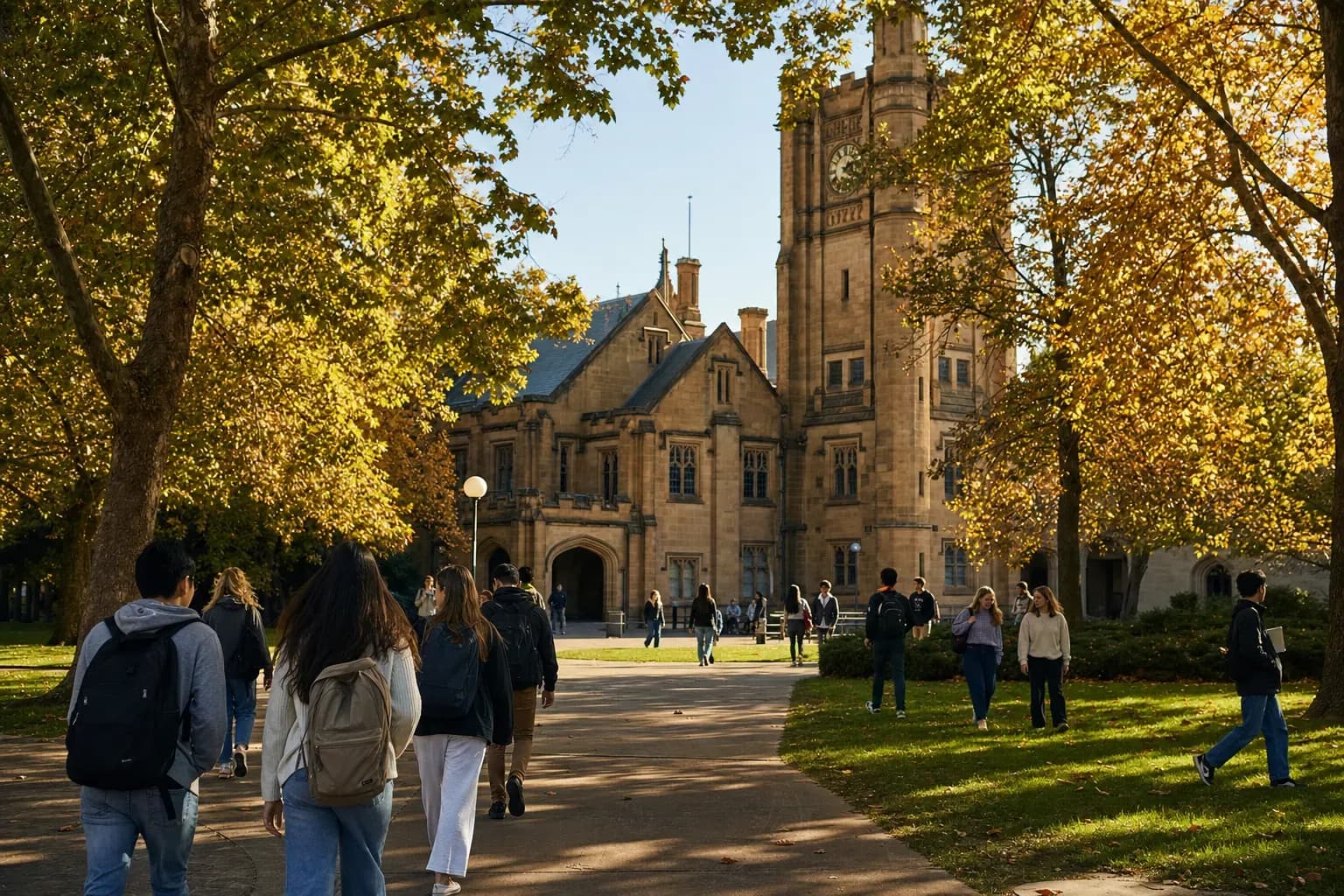
- Old Quad: Built in 1854, with Gothic sandstone architecture.
- Baillieu Library: The main library, with a collection of 3.5 million volumes.
- South Lawn: The iconic lawn for student picnics, protests, and graduation viewing.
- Parkville Biomedical Precinct: Connected with Royal Melbourne Hospital, WEHI, and Peter MacCallum Cancer Centre, forming Australia’s largest biomedical research cluster.
8. Research and Resources
Melbourne has one of the highest research budgets in the Go8, with annual research income exceeding AUD 1.1 billion.
Key Research Institutes
- Peter Doherty Institute for Infection and Immunity: One of the first laboratories in the world to isolate the virus strain during COVID.
- Walter and Eliza Hall Institute (WEHI): A world-leading medical research institute with close ties to the university.
- Melbourne School of Engineering: Australia’s first engineering school, founded in 1861.
- Centre for Quantum Computation and Communication Technology: A major center for quantum computing.
- Melbourne Business School: Australia’s first MBA school.
9. Notable Alumni
- Prime ministers / politics: Robert Menzies, Australia’s longest-serving prime minister; Julia Gillard, Australia’s first female prime minister; Alfred Deakin, Australia’s second prime minister.
- Nobel Prizes: Sir Lawrence Bragg, Physics 1915, who won at age 25 and remains the youngest Physics Nobel laureate in history; Sir Macfarlane Burnet, Medicine 1960; Peter Doherty, Medicine 1996; Elizabeth Blackburn, Medicine 2009.
- Business / law: James Wolfensohn, former World Bank president; Rupert Murdoch, founder of News Corp.
- Academia / culture: Germaine Greer, major feminist writer; Clive James.
- Film / entertainment: Cate Blanchett, Academy Award-winning actress, who studied part of a BA before transferring; Tim Minchin.
- Technology: Brad Smith, president of Microsoft, completed part of his studies there.
Melbourne has produced more Nobel laureates than any other Australian university, with 8 Nobel Prize winners associated with the institution.
10. Melbourne Trivia
- The blue crest and the university song “Veritate Eademque”: The blue color comes from the flag of the 1888 Melbourne International Exhibition, and the university song is one of the few Latin university songs still retained in Australia.
- The Royal Exhibition Building is a World Heritage site: Located right beside campus, it was built in 1880 and became the first building in Australia to receive UNESCO recognition. Australia’s first federal parliament opened here in 1901.
- The Braggs’ Nobel Prize in Physics: Sir William Bragg and his son Lawrence Bragg jointly won the 1915 Nobel Prize in Physics. Lawrence studied at Melbourne and was 25 when he won, making him the youngest Nobel laureate in history.
- The story of the Old Arts clock tower: Every year before Christmas, students secretly climb up to hang large Christmas lights. The university knows but quietly allows it, and the tradition has lasted more than 50 years.
- Australia’s first PhD degree: Melbourne awarded Australia’s first PhD in 1948, in Botany. Before that, Australian students had to go to the United Kingdom to earn a doctorate.
11. Typical Admitted Student Profile
- Predicted IB score of 35-40 from a Taiwanese international school, or ATAR equivalent of 85-95.
- Taiwanese high school system: top 5-10% of the class at leading schools such as Taipei Municipal Jianguo High School, Taipei First Girls High School, Zhongshan Girls High School, or National Taiwan Normal University Affiliated Senior High School, with near-perfect GPA.
- IELTS 7.0 or TOEFL iBT 100+. Although the official threshold is 6.5/79, in practice 7.0 is more competitive.
- Extracurriculars: Unlike the U.S. Ivy League, Melbourne does not require a spike, but business and medical tracks may consider research experience, community service, and leadership roles.
- No interview, except for Music and Design. The application process is relatively mechanical and grade-based.
- A Personal Statement is required only for some programs. The focus is “why this program,” not the American-style goal of “showing a unique personality.”
12. What Kind of Student Is It Best For?
✓ Best suited for:
- Students who want the brand of “Australia’s top university” and may later return to Taiwan or work in Europe or North America.
- Students who are still exploring academic directions and do not want to lock in their lifelong field at age 18.
- Students drawn to Melbourne’s artistic, left-leaning, coffee-and-indie-music atmosphere.
- Students planning to pursue professional degrees such as the MD, JD, or M.Arch, which require the Melbourne Model.
- Families with a budget above NTD 6 million who can support the full 3+2-year timeline.
- Students who want to use Australia as a platform for graduate school or work in Europe or North America.
✗ Not necessarily ideal for:
- Students who want a direct 4-year Engineering degree and early employment. UNSW and Monash’s Bachelor of Engineering pathways are more direct.
- Students with limited budgets who hope to finish a Master’s in 2 years, leave, and apply for PR. The Melbourne Model extends the timeline.
- Students who prefer beaches, tropical weather, and outdoor sports. Sydney, Brisbane, or Perth may be a better fit.
- Students who want small-class, American-style “one-on-one professor guidance.” Melbourne is a large research university.
- Students who are immigration-oriented but choose the wrong major. Pure humanities, communications, and Marketing are weaker for PR points; look closely at STEM.
Conclusion
The University of Melbourne is the “safe” choice Taiwanese parents understand best. An offer requires no explanation; everyone knows it is Australia’s top university. But “safe” does not automatically mean “suitable.” The Melbourne Model’s 3+2 structure is a double-edged sword: it is an advantage for students who want interdisciplinary exploration and future graduate school, but it can become a burden for students who want to graduate in 4 years, enter the workforce directly, and maximize 485 visa time and PR points.
From an immigration strategy perspective, Melbourne’s Master Coursework programs give you 2 years under the 485 PHEW stream; Master Research and PhD programs give you 3 years; the Australian Study Requirement adds 5 PR points. If your goal is PR, prioritize a STEM Master + Coursework combination, such as the Master of Information Technology. Combined with PTE 79 and NAATI Chinese certification, PR points can reach the 85-95 range. If your goal is simply to earn a top-university credential and experience life in Australia, Melbourne remains the least risky choice among the Go8.
Melbourne is a brand, not a shortcut. It will not give you the cheapest tuition, the shortest timeline, or the easiest PR route, but it will give you a degree that carries weight anywhere in the world.