
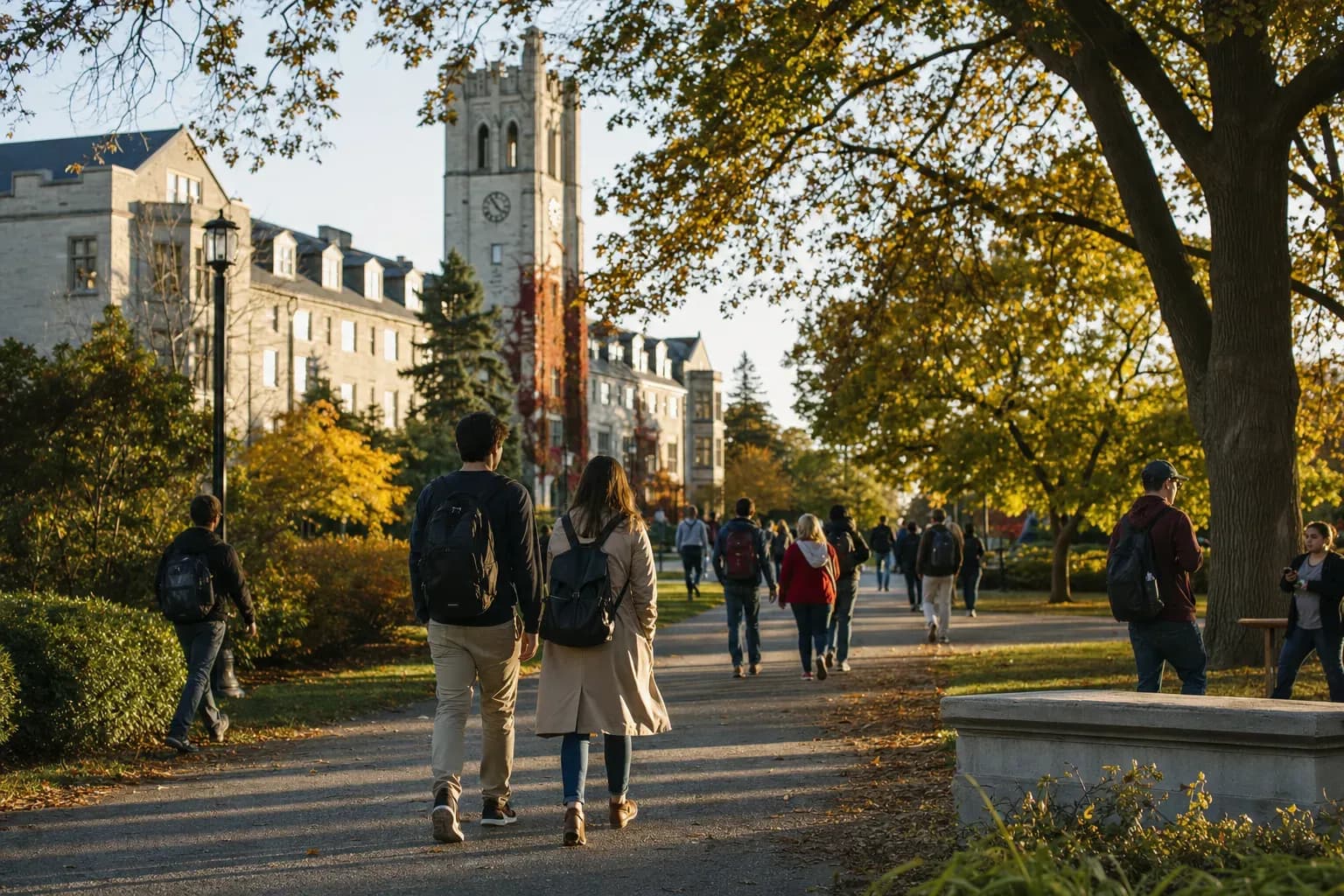
University of Guelph: Canada’s Leader in Food, Agriculture, and Veterinary Medicine, Top 5 Global OVC, Royal City Campus
Published on January 12, 2026
For Taiwanese families planning to study in Canada, University of Guelph is one of the most underrated high-quality universities, often hidden behind the halo of U of T and Waterloo. Its QS 2026 global ranking of #580-600 may look mid-tier, and Maclean's places it #7 in the Comprehensive category, but Guelph’s real value has never been about QS. It lies in the six-part combination of “Ontario Veterinary College as Canada’s #1 veterinary school + global top 5 + Canada’s #1 food science + Canada’s #1 agricultural biotechnology + quiet Royal City campus + ON OINP-friendly pathways.”
To understand Guelph, remember three things first. First, Ontario Veterinary College (OVC) is Canada’s first veterinary college. Founded in 1862, five years before Canadian Confederation in 1867, it is also the only veterinary college in Eastern Canada, training veterinary talent for Ontario, Quebec, and the four Atlantic provinces. Its global veterinary medicine ranking is QS global #4-5, placing it in the same tier as UC Davis, Cornell, and the Royal Veterinary College London. Second, Ontario Agricultural College (OAC) is one of the world’s first institutions to offer an agriculture degree. Founded in 1874, it is ranked #1 in Canada for food science, agricultural biotechnology, and animal science. Third, Guelph’s entire campus identity is “Improving Life”. Every program and research direction is organized around improving life for humans, animals, and the environment.
Guelph is not a U15 member. U15 refers to Canada’s 15 leading research-intensive universities. But in the decision matrix for Taiwanese families, students interested in food science, agriculture, veterinary medicine, biology, environmental science, or animal science will find that Guelph is an irreplaceable single choice in Canada.
1. Basic Information
| Item | Details |
|---|---|
| Founded | 1964 (merger of Ontario Agricultural College 1874 + Macdonald Institute 1903 + Ontario Veterinary College 1862) |
| Location | Guelph, Ontario (1.5 hours west of Toronto by car, next to Kitchener-Waterloo) |
| Campus | About 1,000 acres (including OVC Cattle Barn, Arboretum, and research farms) |
| Undergraduates | ~25,000 |
| Graduate students | ~5,000 |
| Total enrollment | ~30,000 |
| Student-faculty ratio | 1:21 |
| Motto | Rerum cognoscere causas (to understand the causes of things) |
2. World Rankings
| Ranking | Placement |
|---|---|
| QS World 2026 | #580-600 |
| THE World 2025 | #401-500 |
| US News Global Universities 2024-25 | #340 |
| Maclean's Comprehensive Universities | #7 |
| QS Veterinary Science | Global #4-5 |
| QS Agriculture & Forestry | Global #20-25 |
| QS Food Science | #1 in Canada |
Key point: Guelph’s overall QS ranking is not especially eye-catching, but Veterinary Science is global #4-5, Agriculture & Forestry is global top 25, and food science is #1 in Canada. These three flagship strengths are enough to outperform many QS top 100 universities in the relevant fields. Across the four axes of humans, animals, food, and the environment, Guelph is a global leader.
3. Admissions Data (Fall 2024 Entry)
| Indicator | Figure |
|---|---|
| Overall applicants | ~36,000 |
| Overall acceptance rate | About 75% |
| Ontario Veterinary College (DVM) | About 12% (the only veterinary college in Eastern Canada) |
| Bachelor of Commerce | About 35% |
| Bachelor of Science in Engineering | About 32% |
| Bachelor of Bio-Medical Science | About 25% |
| Food Science | About 38% |
| Bachelor of Arts | About 80% |
| Yield Rate | About 40% |
Key point: Guelph’s overall 75% acceptance rate is highly friendly to Taiwanese students, but OVC DVM, the veterinary degree, has only about a 12% acceptance rate. OVC has strict limits on international students, is the only veterinary college in Eastern Canada, and draws competition from students across four provincial regions. It is one of the hardest undergraduate-to-professional pathways in Canada. Taiwanese students aiming for OVC DVM should also consider USask Western College of Veterinary Medicine in parallel.
International Student Standards (Direct Undergraduate Entry)
| Test / Requirement | Recommended Score |
|---|---|
| High school average (general programs) | 78%+ (IB 26+) |
| High school average (Bio-Med Science) | 85%+ (IB 32+) |
| High school average (Engineering) | 85%+ (IB 32+) |
| High school average (Food Science) | 80%+ (IB 28+) |
| SAT | 1200+ (1350+ recommended for Bio-Med / Engineering) |
| IELTS | 6.5 (6.0 in each band) |
| TOEFL iBT | 89 (writing 21+) |
International Students
- International students account for about 16%
- Students come from 130+ countries
- Major source regions include China, India, Iran, Nigeria, and the Caribbean
- About 10-15 Taiwanese undergraduates are admitted each year, mostly in Bio-Med Science, Food Science, Animal Science, and Environmental Science
4. Tuition and Financial Aid (International Student Perspective)
2024-2025 Tuition (CAD/year)
| Item | Amount |
|---|---|
| Tuition - Arts & Bachelor of Commerce | CAD $34,000-$38,000 |
| Tuition - Science | CAD $36,000-$40,000 |
| Tuition - Bio-Medical Science / Animal Science | CAD $38,000-$42,000 |
| Tuition - Engineering | CAD $40,000-$44,000 |
| Tuition - DVM (graduate-level, very limited international seats) | CAD $70,000+ |
| Housing (on campus) | CAD $9,000-$13,000 |
| Food + miscellaneous | CAD $6,000-$9,000 (Guelph is cheaper than Toronto) |
| Total (general programs) | CAD $49,000-$60,000/year |
| Total (Bio-Med / Engineering) | CAD $53,000-$66,000/year |
Compared with U of T: Comparable undergraduate programs at U of T cost CAD $62-70K in tuition. Guelph is about 25-30% cheaper. Guelph is the “Royal City”, with living costs 15-20% lower than both Toronto and Waterloo. A one-bedroom apartment costs about CAD $1,300-$1,700/month. Over four years, families can save CAD $40-60K, or about NTD 920,000-1.38 million.
Financial Aid for International Students
- President's Scholarship: CAD $32,500 total over four years, high school average 95%+
- International Student Scholarships: CAD $4,000-$15,000, automatically considered
- Lincoln Alexander Chancellor's Scholarship: CAD $24,000 over four years, based on diversity + leadership
- OAC Entrance Scholarship: CAD $3,000-$10,000, for OAC-related programs
5. Academic Structure / Signature Programs
Faculty / College Structure
Guelph has 7 Colleges / Schools: Ontario Agricultural College (OAC), Ontario Veterinary College (OVC), College of Biological Science, Gordon S. Lang School of Business and Economics, College of Engineering and Physical Sciences, College of Arts, and College of Social and Applied Human Sciences.
Signature Programs
- Ontario Veterinary College (OVC, founded 1862): Canada’s first veterinary college and QS Veterinary Science global #4-5, in the same tier as UC Davis, Cornell, and the Royal Veterinary College London. It is the only veterinary college in Eastern Canada, serving all veterinary training needs for ON, QC, and the four Atlantic provinces (NB, NS, PE, NL). The DVM (Doctor of Veterinary Medicine) is a four-year graduate-level program; there is no direct-entry undergraduate pre-vet program. OVC Companion Animal Hospital is Canada’s largest veterinary teaching hospital.
- Ontario Agricultural College (OAC, founded 1874): One of the world’s first institutions to offer an agriculture degree. Food Science, Agricultural Biotechnology, Animal Science, Plant Science, and Environmental Science are all #1 in Canada. The Bachelor of Bio-Resource Management is Canada’s first undergraduate program integrating agricultural economics and environmental management.
- College of Biological Science: Integrated with OAC, its Bachelor of Bio-Medical Science is a standout Canadian undergraduate pre-med / pre-vet program. Cell & Molecular Biology, Microbiology, and Zoology are especially strong.
- Food Science Program: Canada’s #1 food science program. Integrated with OAC and Lang Business, its Co-op students enter major food companies such as Cargill, Maple Leaf Foods, Loblaws, Nestlé Canada, and PepsiCo Canada as a key talent pipeline.
- Gordon S. Lang School of Business and Economics: AACSB-accredited, a solid mid-tier Canadian business school. Food and Agricultural Business is a uniquely Canadian undergraduate flagship, focused on management in food and agricultural enterprises.
- College of Engineering and Physical Sciences: Strong in Biological Engineering, Environmental Engineering, and Water Resources Engineering, with cross-disciplinary integration across OAC and OVC.
The Food / Agriculture / Veterinary Triangle (Guelph’s Core Identity)
Guelph’s entire campus identity is "Improving Life". Every program and every research direction revolves around improving life for humans, animals, and the environment. Guelph works closely with major Canadian food companies:
- Cargill Canada has a research center in Guelph
- Maple Leaf Foods is a major Co-op employer for Guelph Food Science students
- Loblaws collaborates on food safety research and development
- Nestlé Canada, PepsiCo Canada, and Coca-Cola Canada are part of the Co-op pipeline
- Ontario Ministry of Agriculture, Food and Rural Affairs (OMAFRA) has offices on the Guelph campus
6. Campus Culture / Institutional Personality
Guelph’s campus culture can be summed up in one sentence: warm, practical, natural, and traditional. The student body is more homogeneous than U of T or York, with a high proportion of Canadian middle-class families, students from agricultural backgrounds, and students interested in food, veterinary medicine, and the environment. The atmosphere is friendly and close-knit, with strong campus social connections. Guelph students describe themselves as part of the “Gryphon family,” with a sense of closeness similar to Queen's or Western, but without the same level of party culture or Greek Life.
Campus Legends
- The Bullring: A student center that now functions as a dining and event space. It was once a real cattle auction ring. When OAC was founded in 1874, this was the site of cattle market auctions. It was converted into a student center in 1962 and still retains its circular structure.
- OVC Cattle Barn (built 1928): Still houses dairy cows today and serves as a clinical training site for OVC students. Taiwanese students are often surprised the first time they see real dairy cows on campus.
- Guelph Arboretum: A 408-acre arboretum, one of the largest plant collections in Eastern Canada, and an experimental site for OAC Plant Science students.
Student Clubs
- 250+ clubs
- CSA (Central Student Association) is the student government
- OAC Aggie Days: An annual OAC student tradition every September, with tractor displays, agricultural competitions, and Aggie Pub
- OVC Open House: Held every March, opening the campus to the community; more than 5,000 people attend to watch veterinary demonstrations and procedures
- The Taiwanese Student Association (Guelph TSA) is small but active
Sports Culture
- Varsity teams are called the Gryphons. The red-and-black mascot, with a lion body and eagle wings, symbolizes the merger of OAC, OVC, and Macdonald
- A strong U Sports institution: Gryphons Football is a strong OUA team, and Gryphons Wrestling is among Canada’s best
- The sports atmosphere is moderately strong. Guelph culture emphasizes academics, close community, and a balanced level of athletics
7. Location / Campus Environment
City Positioning
Guelph is a mid-sized city in southwestern Ontario with a population of 140,000. It is a classic Canadian “Royal City,” planned in 1827 by the Galt and Gow brothers with a royal-style urban layout.
Its location is strategically useful:
- 1.5 hours from Toronto by car (90 km; GO Train directly to Union Station in 1 hr 45 min)
- 25 minutes from Kitchener-Waterloo by car (25 km; KW is Canada’s Tech Triangle)
- 1 hour from Hamilton by car (50 km)
Guelph and KW form the “western Toronto Innovation Corridor”, with a startup ecosystem in agriculture, food, biotechnology, and Smart Agriculture.
Living costs are 15-20% lower than Toronto and Waterloo. A one-bedroom apartment costs about CAD $1,300-$1,700/month, far below Toronto’s roughly $2,200.
Climate
- Winter: -10°C to -5°C, frequent snow from January to March, slightly colder than Toronto
- Summer: 22-28°C, humid and pleasant
- Spring and fall: short, with spectacular maple colors in October
- Because Guelph is inland and at a slightly higher elevation, it gets 1-2 more weeks of snow than Toronto
Campus Landmarks
- The Bullring: Student center, formerly a cattle auction ring
- OVC Cattle Barn (1928): Dairy barn for the veterinary college
- Johnston Hall: Built in 1932, the main OAC building and a campus landmark
- University Centre (UC): Student services center
- Macdonald Institute Building (1903): Historic Macdonald Institute site
- Guelph Arboretum: 408-acre arboretum
8. Research and Resources
Library
- McLaughlin Library is the main library, with 2.2 million volumes
- Annex for archives and special collections
- 24/7 study space during final exam weeks
Notable Research Centers
- OVC Companion Animal Hospital: Canada’s largest veterinary teaching hospital
- OAC Research Stations: Six agricultural research stations across Ontario
- Centre for Biodiversity Genomics: Global leader in DNA barcoding
- Guelph Food Innovation Centre: Food innovation R&D center
- Ontario Agri-Food Innovation Alliance: Partnership with OMAFRA and Canada’s #1 agricultural innovation alliance
9. Notable Alumni
- Academia / Economics: John Kenneth Galbraith (Harvard economics professor, author of The Affluent Society, one of the most famous Canadian economists in history, OAC 1931)
- Politics: David Onley (former Ontario Lieutenant Governor, OAC political science), Eugene Whelan (former Canadian Minister of Agriculture)
- Environment / Science: David Suzuki (leading figure in Canada’s environmental movement, frequent OAC speaker and honorary degree recipient)
- Academic History: Tom Daschuk (historian / writer)
- Veterinary Medicine: William Lyon Mackenzie (early Canadian veterinary pioneer, OVC alumnus)
Guelph alumni have their broadest influence in Canada’s food, agriculture, and environmental policy circles and the OVC veterinary network. About 50% of veterinarians in ON / Atlantic Canada are OVC alumni.
10. Guelph Trivia
- OVC is Canada’s first veterinary college: Founded in 1862, five years before Canadian Confederation in 1867. Andrew Smith came from Scotland to Canada and founded the Upper Canada Veterinary School, later renamed OVC. It was the third veterinary college in North America, after New York and Philadelphia. The OVC crest still includes 1862 today.
- The Bullring was a real cattle auction ring: When OAC was founded in 1874, it was a circular cattle market auction venue. It was converted into a student center in 1962 and still preserves its original circular structure. The place where students eat today was where cattle were auctioned 100 years ago.
- OAC is one of the world’s first institutions to offer an agriculture degree: When OAC was founded in 1874, the agriculture degree was among the first of its kind globally, alongside early agricultural universities such as Iowa State 1858 and Michigan State 1855. OAC was the starting point of Canada’s “green revolution.”
- OVC Cattle Barn, built in 1928, still houses dairy cows today: It is a clinical training site for students. On campus, you can actually see dairy cows and smell feed. Taiwanese students are often surprised during their first visit and ask, “Is this really a university?” The answer is yes: this is Canada’s top veterinary college.
- Guelph works closely with Cargill, Maple Leaf Foods, and Loblaws: Cargill Canada has a research center in Guelph, Maple Leaf Foods is a major Food Science Co-op employer, and Loblaws collaborates on food safety R&D. Guelph is the academic support base for Canada’s food industry.
11. Typical Admitted Student Profile
- High school average, converted: 78-88%+ (IB 28+, A-Level BBB+, top 35% of Taiwanese high schools)
- SAT 1200+ (1350+ recommended for Bio-Med / Engineering)
- IELTS 6.5+ / TOEFL 89+
- Bio-Med Science: Biology / Chemistry AP or IB HL 5+ strongly recommended
- OVC DVM (graduate-level): Undergraduate GPA 3.7+, 1,000+ hours of animal-related experience, GRE, interview
- Food Science / Agricultural Science: High school biology / chemistry + clear motivation for food or agriculture
- Unlike the U.S. Common App, Guelph does not ask students to write a life story. Guelph values academic fit + motivation for the “Improving Life” mission
- Guelph is friendly to Taiwanese IB / A-Level / top 35% high school students. It is a high-value option among Ontario public universities
12. What Kind of Student Is Guelph Best For?
✓ Good fit:
- Students who want food science / agriculture / veterinary medicine / animal science / environmental science (Canada #1)
- Students with a clear direction in Pre-Med / Pre-Vet / Bio-Med Science (Guelph Bio-Med is a top undergraduate pre-vet choice in Ontario)
- Students who want a close-knit traditional Canadian campus and do not prefer a big city
- Families with a budget of CAD $49-66K/year, about 25-30% cheaper than U of T
- Students who like quiet Royal City life, proximity to the KW Tech Triangle, and access to Toronto
- Families planning to stay in Canada after graduation through the ON OINP Masters Stream immigration pathway
✗ Not necessarily a good fit:
- Students focused purely on research / PhD / medical school pathways, where U15 universities such as U of T, McMaster, or UBC may be more suitable
- Students who want a Toronto or Vancouver big-city campus
- Students focused purely on business school or law school, who should consider Queen's Smith, Western Ivey, U of T Rotman, or York Schulich
- Students focused purely on CS / Engineering, who should consider Waterloo, U of T, or UBC
- Students who want OVC DVM but do not have 1,000+ hours of animal experience; international seats at OVC DVM are extremely limited, so USask should be considered in parallel
- Students who want a strong city vibe or party school; Guelph is friendly but quiet
13. Canada Study + Immigration Pathway Advantages
Guelph’s value in Canadian immigration pathways is very high and often underestimated. Tuition is 25-30% cheaper than U of T, the Guelph-Toronto commute is manageable, ON OINP Masters Stream does not require a job offer, and Guelph’s food, agriculture, and environmental programs directly match STEM, Healthcare, and Agriculture category-based draws.
PGWP (Post-Graduation Work Permit)
After completing a Guelph degree from an eligible program of at least 8 months, graduates can apply for a 3-year Open Work Permit, regardless of major. The language requirement is IELTS General CLB 7, with 6.0 in each band. Guelph graduates in food, agriculture, environment, and veterinary fields have relatively protected employment prospects in Canada. The Canadian food industry and veterinary sector include shortage occupations in NOC TEER 1 / 2.
Express Entry / CEC + Category-Based Draws (Guelph’s Core Advantage)
- 2026 Q1 CEC cut-off is about 521-547 for general rounds
- Agriculture category cut-off 430-470 (applicable to Guelph OAC / Food Science)
- STEM category cut-off 481-524 (applicable to Bio-Med, Engineering, Environmental Sci)
- Healthcare category cut-off 463-510 (Veterinary and Public Health are not directly applicable, but later OVC pathways may fit)
- A 27-year-old single applicant with a Guelph Master of Food Science, one year of work at Cargill / Maple Leaf, and IELTS 7.0 would have a CRS of about 490-520, with a strong chance under the Agriculture category
Ontario OINP Masters Graduate Stream
Ontario’s provincial nomination pathway for master’s graduates is the Masters Graduate Stream:
- Guelph master’s graduates can apply directly (MSc Food Science, MSc Animal Science, MEng, MA, etc.)
- No job offer required, making it one of the most flexible routes alongside BC
- Once a provincial nomination is received, CRS is automatically increased by 600 points, effectively guaranteeing an ITA
- OINP Employer Job Offer International Student Stream: Another OINP route, available with an Ontario employer offer. For Guelph students, entering Cargill / Maple Leaf through Co-op and receiving a return offer is a common path
- Since 2025, OINP quotas have been cut in half, so applicants should be ready to submit immediately once eligible
Impact of the 2024-2025 International Student Cap
Ontario is the province most affected by the 2024-2025 international student cap. Undergraduate study permit allocations were cut by 50%, then another 15% in 2025. As a mid-sized comprehensive university, Guelph faces a significant undergraduate cap impact, but master’s and doctoral degrees are generally exempt from the cap. Taiwanese students applying to MSc Food Science, MSc Animal Science, or MSc Environmental Sci are relatively less affected. Undergraduate applicants should pay close attention to PAL documents.
Value Comparison with Comparable U.S. Schools
| Item | Guelph | Comparable U.S. Schools (UC Davis / Cornell CALS) |
|---|---|---|
| QS 2026 | #580-600 | UC Davis #94 / Cornell #16 |
| QS Veterinary Science | Global #4-5 | UC Davis #1 / Cornell #4 |
| Tuition (international undergraduate) | CAD $34-44K (USD $25-32K) | UC Davis USD $48K / Cornell USD $68K |
| Food Science / Agriculture | Canada #1 | UC Davis #1 / Cornell #1 |
| Post-graduation stay pathway | 3-year PGWP + ON OINP + Agriculture category | OPT 1-3 years + H-1B lottery |
| Permanent residence timeline | 2-4 years (master’s + 1 year + EE) | 5-10 years |
Guelph’s academic quality in food, agriculture, and veterinary medicine is fully comparable to UC Davis, while tuition is only about half as much.
Conclusion
Guelph is best suited to Taiwanese families who can say: “We want food, agriculture, veterinary medicine, animal science, or environmental science; we accept close-knit Royal City living; and we want a pathway to stay in Canada through ON OINP.” It is not an old U15 metropolitan university like U of T, nor is it an American-style college-town party school like Queen's or Western. It is Canada’s version of UC Davis + Cornell CALS: elite in food, agriculture, and veterinary medicine; quiet Royal City environment; close-knit campus culture; and a strong Improving Life mission.
Choosing Guelph means accepting a few realities. First, it is not in U15. Its academic prestige is lower than U of T, McGill, or UBC, and Taiwanese parents or relatives may react coolly when they hear “Guelph.” In fact, many Taiwanese parents have never heard of it. Second, the campus is in the small city of Guelph, population 140,000. It is not Toronto or Vancouver; the social circle is more contained, though Toronto and KW are only 1.5 hours and 25 minutes away. Third, international seats for OVC DVM are extremely limited. If your goal is to become a veterinarian, entering Guelph Bio-Med Science as an undergraduate and then applying to OVC DVM is still highly competitive, so USask should be considered in parallel.
But if your child is the kind of student who knows at 18 that they want Food Science and dream of doing food R&D at Cargill; or wants Bio-Med Science with the goal of entering OVC DVM and becoming a veterinarian; or wants Animal Science for animal welfare or livestock research; or wants Environmental Engineering to solve food, water, and sustainability problems in Canada, Guelph is one of the best investments on earth for “Canada’s #1 food / agriculture / veterinary ecosystem + ON OINP stay-in-Canada pathway + exceptional value.”
OVC 1862, OAC 1874, the academic backbone of Canada’s food industry, QS Veterinary global #4-5, and the Agriculture category-based EE sweet spot are things U of T and Waterloo cannot give you. What Guelph offers is the clarity of an “Improving Life” mission, the academic depth of Canada’s top food, agriculture, and veterinary ecosystem, and a clear ON OINP pathway to remain in Canada. For Taiwanese students with a clear sense of mission, families with a CAD 50K budget, and those willing to embrace small-city Canadian life, Guelph is one of the most underrated boutique choices available.
Sources
- University of Guelph — Future Students, International Admissions (accessed 2026-05-14) https://admission.uoguelph.ca/internationalstudents
- Maclean's University Rankings 2025 (accessed 2026-05-14) https://www.macleans.ca/education/university-rankings/
- QS World University Rankings 2026 (accessed 2026-05-14) https://www.topuniversities.com/world-university-rankings
- Ontario Immigrant Nominee Program — Masters Graduate Stream (accessed 2026-05-14) https://www.ontario.ca/page/oinp-masters-graduate-stream
- Dr. G. Academy internal file 03_Canada_Visa_Strategy.md (2026-05-02)