
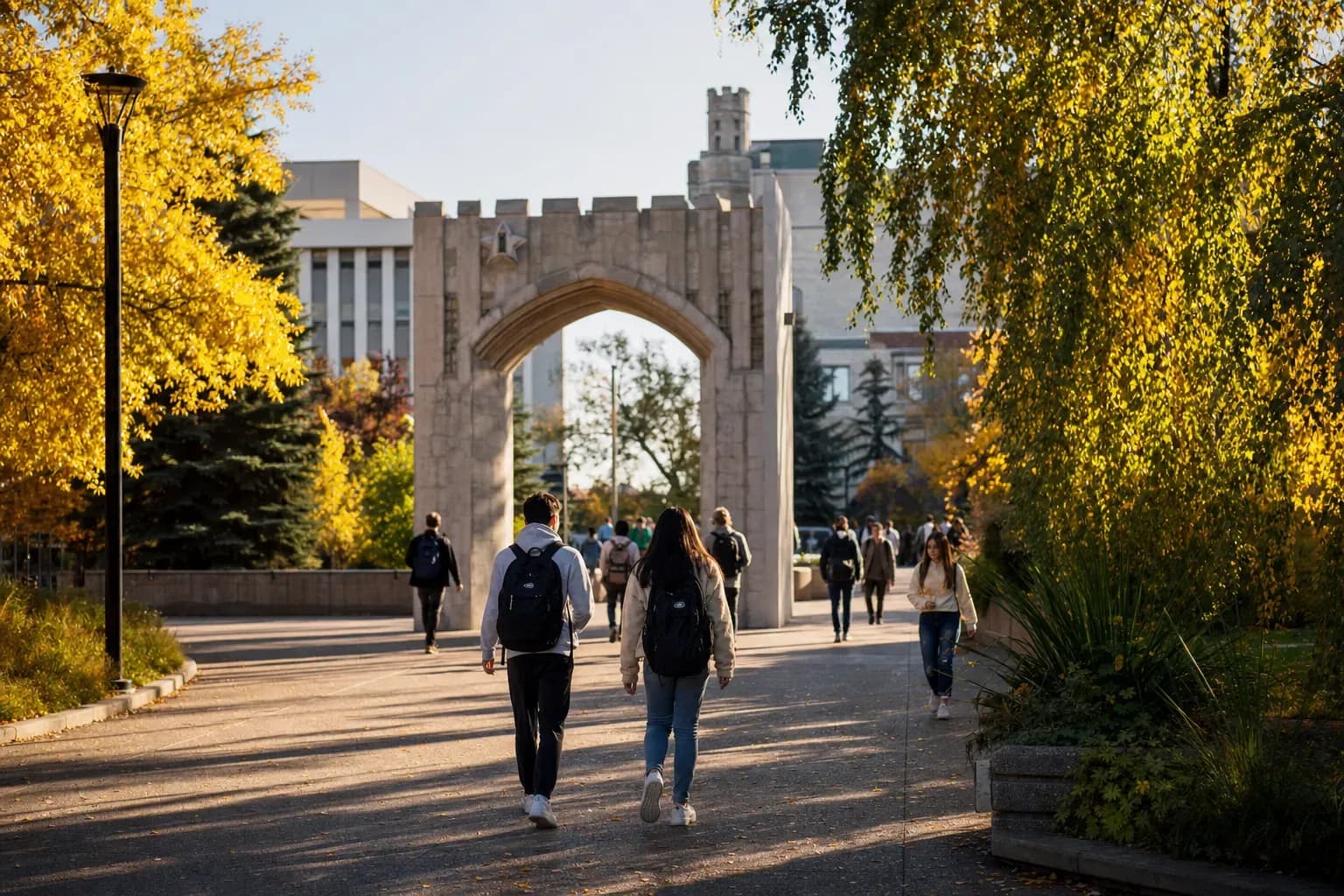
University of Calgary: Energy Capital, Haskayne School of Business, and AAIP’s 2-Week Fast-Track PR Pathway
Published on January 24, 2026
University of Calgary, commonly known as UCalgary or U of C, is the youngest member of Canada’s U15. It became independent from the University of Alberta only in 1966, making it just 60 years old, yet it has already secured QS 2026 #200 and #8 among Maclean's Medical Doctoral universities. It is located in Calgary, Alberta, Canada’s energy capital, where the North American headquarters of Shell, Suncor, Imperial Oil, and Canadian Natural Resources are all based.
For Taiwanese families, UCalgary is the “most underrated high-value U15 choice.” Tuition is CAD $26-40K, about 35-40% cheaper than U of T / UBC; Calgary’s cost of living is about 30% lower than Toronto’s; and the Alberta AAIP Accelerated Tech Pathway can approve provincial nomination in just 2 weeks, making it the fastest PR route in Canada. If your child is aiming for the energy sector, business, or Big Tech, including Calgary’s rising AI / Fintech players such as Benevity, Symend, and Neo Financial, UCalgary is one of the highest-ROI U15 university pathways anywhere. Its U.S. peer comparison is the University of Texas at Austin: energy + business + emerging tech hub, but at only half the tuition of UT Austin.
1. Key Facts
| Item | Details |
|---|---|
| Founded | 1966 (youngest in the U15) |
| Location | Calgary, Alberta (northwest of downtown, about 20 minutes by CTrain / bus from the city center) |
| Campus | Main campus of about 530 acres |
| Undergraduates | ~29,000 |
| Graduate students | ~6,500 |
| Total enrollment | ~35,000 |
| Student-faculty ratio | 1:21 |
| Motto | Mo shùile togam suas (Gaelic: I will lift up my eyes) |
2. World Rankings
| Ranking | Position |
|---|---|
| QS World 2026 | #200 |
| THE World 2025 | #201-250 |
| US News Global Universities 2024-25 | #182 |
| Maclean's Canadian Medical Doctoral Universities | #8 |
| QS Petroleum Engineering | #23 globally |
| QS Veterinary Science | #51-100 globally |
| Bloomberg Businessweek - Haskayne MBA | Top 8 in Canada |
The Energy Finance program at Haskayne School of Business is Canada’s best, training CFOs and upstream investment bankers for the Canadian energy industry.
3. Admissions Data (Fall 2024 Entry)
| Metric | Figure |
|---|---|
| Total applicants | ~35,000 |
| Overall acceptance rate | About 62% |
| Haskayne School of Business BComm | About 25-30% |
| Schulich School of Engineering | About 32% |
| Cumming School of Medicine | About 7% (extremely difficult for international students) |
| Faculty of Veterinary Medicine | About 12% (one of Canada’s only standalone veterinary faculties) |
| Yield Rate | About 58% |
UCalgary has a relatively high acceptance rate among U15 universities, making it friendly to students with mid-range GPAs. However, popular specializations in Business and Engineering, such as Oil & Gas Engineering and Petroleum Land Management, remain competitive at around 25-30%.
International Student Standards (Direct Undergraduate Entry)
| Test | Recommended Score |
|---|---|
| High school average | 80-85% (Med 90%+) |
| SAT | 1200+ (Engineering / Haskayne recommended 1350+) |
| ACT | 25+ |
| IELTS | 6.5 (6.0 in each band) |
| TOEFL iBT | 86+ |
| IB | 28-32+ |
| A-Level | BBB+ |
International Students
- International students make up about 24%
- Students come from 150+ countries
- Around 10-25 Taiwanese undergraduates are admitted each year
- Most instruction is in English; a small number of French electives are available
4. Tuition and Financial Aid (International Student Perspective)
UCalgary has one of the most international-student-friendly tuition structures among the U15, reflecting Alberta’s broader higher education policy of attracting talent.
2024-2025 Tuition (CAD/year)
| Item | Amount |
|---|---|
| Tuition - Arts / Science | CAD $26,000-$32,000 |
| Tuition - Schulich Engineering | CAD $35,000-$40,000 |
| Tuition - Haskayne BComm | CAD $32,000-$38,000 |
| Tuition - Cumming Medicine | CAD $35,000-$40,000 (very few international students) |
| Tuition - Veterinary Medicine | CAD $45,000+ |
| Residence (on-campus) | CAD $8,000-$12,000 |
| Food + miscellaneous (Calgary has a moderately low cost of living) | CAD $8,000-$11,000 |
| Total | CAD $42,000-$60,000/year |
Compared with U of T Engineering at CAD $69,930, UCalgary Engineering is 40%+ cheaper. Compared with UBC Sauder at CAD $60,000, Haskayne BComm is 35%+ cheaper.
Financial Aid for International Students
- International Entrance Scholarship: CAD $5,000-$15,000, awarded automatically based on entrance grades
- International Student Award: CAD $5,000, rolling application
- Haskayne School Entrance Award: CAD $10,000-$25,000
- Schulich Engineering Scholarship: CAD $5,000-$15,000
- Indigenous Bursary: not applicable to Taiwanese students, but it reflects UCalgary’s emphasis on diversity
5. Academic Structure / Signature Programs
Faculty Structure
UCalgary has 14 Faculties / Schools, including Arts, Science, Engineering (Schulich), Business (Haskayne), Medicine (Cumming), Veterinary Medicine, Nursing, Education, Law, Kinesiology, Social Work, Public Policy (Calgary School), Environmental Design, and Graduate Studies.
Signature Programs
- Haskayne School of Business: Founded in 1956, with Canada’s top Energy Finance program and dual AACSB + EQUIS accreditation. Many graduates enter senior finance roles at Shell, Suncor, and TC Energy. Its MBA is a training ground for CFOs in Canada’s energy sector.
- Schulich School of Engineering: Founded in 1965, almost the same age as the university. Petroleum Engineering is ranked QS #23 globally, offering full-chain training across earth sciences, drilling engineering, and reservoir management. Mechanical, Chemical, Software, and Biomedical Engineering are also strong.
- Cumming School of Medicine: The medical program is shortened to 3 years, the only one of its kind in Canada, making it a popular option for medical students who want to enter the profession quickly.
- Faculty of Veterinary Medicine: One of Canada’s five veterinary schools and the only one in Western Canada.
- School of Public Policy (Calgary School): A major center for conservative economic policy research, established during the Stephen Harper government era and influential in Canada’s federal energy policy.
Co-op program
UCalgary’s Co-op program is medium-sized, with about 3,000 participating students, but its employment profile is highly distinctive:
- Engineering / Geology students frequently enter Shell, Suncor, CNRL, and Imperial Oil
- Haskayne students enter Calgary Big 4 consulting and energy investment banking, including TD Securities and RBC Capital Markets’ Calgary offices
- Emerging in recent years: Co-op placements at Tech / Fintech companies such as Benevity, Symend, and Neo Financial
6. Campus Culture / School Personality
UCalgary’s campus culture can be summed up in one sentence: Western energy + cowboy spirit + emerging tech hub. The student body is diverse: 60% local Alberta students, 20% from other Canadian provinces, and 20% international students from China, India, Taiwan, Korea, Nigeria, and beyond. The school culture is practical, unpretentious, and career-oriented. This university’s spirit lives more in the Shell building than in a literary salon.
Calgary Stampede
Every early July, Calgary hosts the world’s largest rodeo festival, the Calgary Stampede: 10 days and more than 1 million visitors. UCalgary students volunteer, join Pancake Breakfast events, and participate in horseback parades. This is central to Calgary’s cultural identity.
Student Clubs
- 200+ clubs
- Schulich Engineering Society and Haskayne Commerce Society are the two major student organizations
- The Taiwanese Student Association is small but active
- TEDxYouth@Calgary is student-run
Sports Culture
- Varsity teams are called the Dinos (dinosaurs, because Alberta is one of the world’s richest regions for dinosaur fossils)
- Main sports: football, basketball, hockey, speed skating (Olympic Oval training base)
- The campus is next to McMahon Stadium, home of the Calgary Stampeders in the CFL, and the student game-day atmosphere becomes active from September onward
7. Location / Campus Environment
City Positioning
UCalgary’s main campus is located in Capitol Hill in northwest Calgary, about 20 minutes from downtown by CTrain. Calgary is Canada’s fourth-largest city, with a population of about 1.6 million, and combines North America’s energy headquarters, Stampede cowboy culture, and the Rocky Mountains within a 1-hour drive.
Geographic advantages:
- Downtown Calgary has the Plus 15, North America’s largest indoor pedestrian skywalk system
- Banff National Park is 1.5 hours away by car, making it a weekend ski / hiking destination
- The Rocky Mountains are 80 km from campus, and students are enthusiastic about hiking and skiing
- Calgary International Airport (YYC) is 25 minutes away by car, with flights of 4 hours to Toronto and 3 hours to Silicon Valley
Climate
- Winter: -10°C to -20°C, but Chinook winds bring “overnight warming of 15°C” several times a year. This is Calgary’s defining climate feature and makes it 5-10°C warmer than Edmonton.
- Summer: 18-25°C, dry and pleasant (Alberta is one of Canada’s least humid regions)
- Spring and fall: short, but with many cloudless days (Calgary is Canada’s sunniest major city)
- Snow season is short but intense; the campus tunnel system and Calgary’s downtown Plus 15 allow students to avoid going outdoors in winter
Campus Landmarks
- MacEwan Student Centre
- Taylor Family Digital Library (opened in 2011, an internationally awarded architectural building)
- Olympic Oval (1988 Winter Olympics speed skating venue, now the training base for Canada’s national speed skating team, located on campus)
- Schulich Engineering Building
- Haskayne School of Business (Scurfield Hall)
- Foothills Campus (medical school + Foothills Medical Centre teaching hospital)
8. Research and Resources
Libraries
- 5 branches, with 2.5 million volumes
- Taylor Family Digital Library serves as the main library
Notable Research Centers
- Schulich School of Engineering — Centre for Energy and Environment
- Hotchkiss Brain Institute: a major neuroscience research center
- Libin Cardiovascular Institute
- Arctic Institute of North America: an Arctic research institute administered by UCalgary, founded in 1945
- Canadian Centre for Advanced Leadership in Business (CCAL)
- Centre for Military, Security and Strategic Studies
About 50% of UCalgary’s research funding comes from energy-sector partnerships, including Shell Endowed Chair and Suncor Research Grants. Academically, this is a double-edged sword: industry collaboration is close, but the share of pure basic research is lower.
9. Notable Alumni
- Politics: Stephen Harper (former Prime Minister of Canada, 2006-2015, BA + MA Economics), Naheed Nenshi (former Calgary mayor, 2010-2021, now leader of the Alberta NDP; MIT MBA + Haskayne alumnus), Joe Clark (former Prime Minister of Canada, 1979-1980, attended but did not graduate)
- Energy industry: Charlie Fischer (former Nexen CEO), Murray Edwards (founder of CNRL)
- Academia: David Pratt (former dean of the Munk School)
- Media: Wendy Mesley (CBC News)
- Sports: Numerous Winter Olympic speed skaters and hockey players trained at the Olympic Oval
UCalgary alumni are highly concentrated in Canada’s political right, especially the Conservative Party. Several ministers in Stephen Harper’s cabinet were UCalgary alumni.
10. Little-Known Facts About UCalgary
- The Olympic Oval is a 1988 Winter Olympics venue that is still in use: The 1988 Calgary Winter Olympics speed skating venue was built on campus. It is now the training base for Canada’s national speed skating team, and students can buy low-cost passes to use world-class facilities.
- Chinook warm winds are Calgary’s climate miracle: In winter, when it is -20°C, Chinook winds can cross the Rocky Mountains and raise temperatures by 15-20°C overnight. Calgary is the only North American city where winter can briefly return to +15°C in a single day.
- The Dinos name comes from Alberta’s dinosaur fossils: Drumheller in southern Alberta is one of the world’s richest dinosaur fossil sites, and the dinosaur head in UCalgary’s emblem refers to this.
- Stephen Harper wrote his master’s thesis here: He studied MA Economics at UCalgary Haskayne, and his thesis topic was “Political Business Cycle.” It later had a strong influence on his economic policy as prime minister.
- Naheed Nenshi was the first Muslim mayor of a major North American city: Elected Calgary mayor in 2010, he is a Haskayne MBA alumnus. During his 11 years as mayor, Calgary went through an oil-price crash yet remained energetic, making him one of UCalgary’s standout alumni examples.
11. Typical Admitted Student Profile
- High school average (converted): 80-88% (Haskayne / Schulich require 85%+, Med 95%+)
- SAT 1280+ (Engineering / Haskayne recommended 1380+)
- IELTS 6.5+ / TOEFL 86+
- No need for extensive extracurriculars: UCalgary’s review is GPA-oriented
- Haskayne BComm requires a supplementary application + interview
- Schulich Engineering requires specific subject scores in Math, Physics, and Chemistry
12. What Kind of Student Is It Best For?
✓ Good fit:
- Families who want a U15 degree on a limited budget (tuition is 40% cheaper than U of T)
- Students with clear goals in the energy sector, petroleum engineering, geology, or business finance
- Students who like Western Canadian life, outdoor sports, Rocky Mountains skiing, and hiking
- Families who want the fastest PR route (AB AAIP Accelerated Tech Pathway approval in 2 weeks)
- Entrepreneurial students who want to join Calgary’s emerging Tech / Fintech ecosystem
- Students who do not mind that Calgary lacks big-city nightlife
- Families with a budget of CAD 45-55K/year
✗ Not necessarily a good fit:
- Families who want the “global elite brand” aura of U of T
- Artsy students who want the metropolitan culture of Montreal / Toronto
- Students who dislike Western cowboy and conservative culture
- Research-oriented students who want pure basic research with little industry contact
- Students who are afraid of winter Chinook winds making it impossible to decide what to wear (this is real; Calgary’s daily temperature swing can reach 30°C)
13. Advantages for Studying in Canada + Immigration Pathways
Among U15 universities, UCalgary has the fastest and simplest immigration pathway, thanks to the Alberta government’s AAIP Accelerated Tech Pathway.
PGWP (Post-Graduation Work Permit)
Graduates of UCalgary degree programs (programs of at least 8 months) can apply for a 3-year Open Work Permit, regardless of major. The language requirement is IELTS General CLB 7 (6.0 in each band).
Alberta AAIP Accelerated Tech Pathway (UCalgary’s Biggest Advantage)
The Accelerated Tech Pathway under the Alberta Advantage Immigration Program (AAIP) is the fastest provincial nomination pathway in Canada:
- Processing time of only 2 weeks (PNP in other provinces usually takes 3-6 months)
- Applicable to UCalgary graduates in technology / engineering / business / data-related fields
- Employer must be registered in Alberta + job offer must be NOC TEER 0/1
- CRS automatically +600, effectively guaranteeing an ITA
For UCalgary students who receive a Calgary tech / energy employer offer immediately after graduation, the path from graduation to PR landing can be completed within 12-18 months, the fastest in Canada.
AAIP Alberta Opportunity Stream (General Pathway)
- Can apply after 12 months of work
- Job offer + IELTS CLB 4-5, depending on occupation
- Processing time of 6 months
Express Entry / CEC
- 2026 Q1 CEC cut-off around 521-547 (general)
- STEM category cut-off 481-524
- A typical profile of a 27-year-old single UCalgary master’s graduate with 1 year of Calgary work experience has a CRS of about 510-540
Impact of the 2024-2025 International Student Cap
Alberta has been relatively less affected by the cap (-13%), far less than Ontario at -50% or Quebec at -20%. In the cap era, UCalgary is one of the easiest U15 universities to enter, and with AAIP-friendly immigration options, it is a strong choice for risk-averse families.
Cost-Performance Comparison with a Comparable U.S. University
| Item | UCalgary | Comparable U.S. University (UT Austin) |
|---|---|---|
| QS 2026 | #200 | UT Austin #61 |
| Tuition (international undergraduate) | CAD $26K-$40K (USD $19-30K) | USD $56,000+ |
| Energy industry links | Calgary, North America’s energy capital | Houston energy center + Austin Tech |
| Post-graduation stay pathway | PGWP 3 years + AAIP 2-week fast-track PR | OPT 1-3 years + H-1B lottery |
| Permanent residency | 1.5-2 years (including AAIP acceleration) | 5-10 years |
| Outdoor lifestyle | Rocky Mountains 1.5 hours away | Hill Country |
UCalgary has only 50% of UT Austin’s tuition and a clear, fast PR pathway, making it one of the strongest value options for families seeking energy + business + North American permanent residency.
Conclusion
UCalgary is suitable for Taiwanese families who think, “We have a limited budget, but we want a U15 degree, the fastest PR pathway, and we do not care about big-city branding.” It is not for students who want the metropolitan glow of Toronto / Vancouver. Choosing UCalgary means accepting that Calgary is a medium-sized city, its cultural depth is not Montreal’s, and its academic brand is not U of T’s. But what you receive is a U15 credential + AAIP 2-week fast-track PR + tuition that is 40% cheaper, a three-in-one package that no other U15 school in Canada can offer.
Choosing UCalgary also means accepting several realities. First, energy industry cycles affect employment: when oil prices are low, Calgary’s job market tightens, and this is a structural risk. But the rise of Tech / Fintech in recent years, including Benevity, Symend, and Neo Financial, has diversified that risk. Second, Calgary is not a metropolis. Weekend entertainment leans toward outdoor sports such as skiing, hiking, and horseback riding rather than urban nightlife. Third, the alumni network has a strong Western Canadian character, with a heavy Conservative Party presence. For some international families, this may be a point of cultural adjustment.
But if your child wants to spend ages 18-26 earning a U15 degree in Canada, use the AAIP 2-week fast-track PR pathway, build a resume in energy or tech, and ski in Banff on weekends, UCalgary is the single highest-value option on earth. It is not Canada’s top university, but it is the top-name university that lets students stay the fastest. For risk-averse, budget-conscious Taiwanese middle-class families with clear goals, this is far more practical than paying similar tuition in the U.S. at UT Austin and gambling on the H-1B lottery.
Sources
- University of Calgary — International Admissions (accessed 2026-05-14) https://www.ucalgary.ca/future-students/international-students
- Haskayne School of Business — Programs (accessed 2026-05-14) https://haskayne.ucalgary.ca/programs
- Maclean's University Rankings 2025 (accessed 2026-05-14) https://www.macleans.ca/education/university-rankings/
- QS World University Rankings 2026 (accessed 2026-05-14) https://www.topuniversities.com/world-university-rankings
- Alberta Advantage Immigration Program — Accelerated Tech Pathway (accessed 2026-05-14) https://www.alberta.ca/aaip-alberta-opportunity-stream