
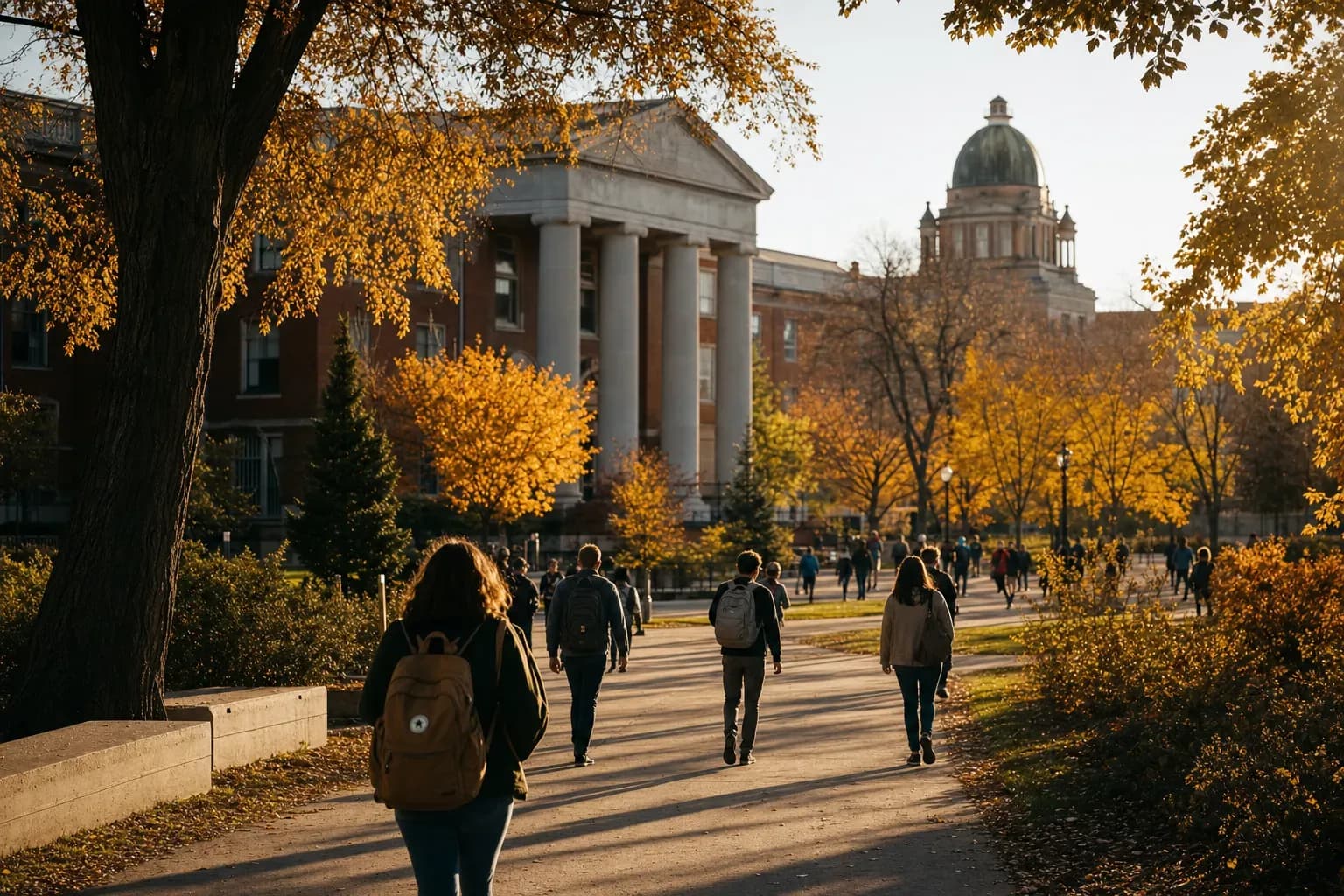
University of Alberta: The Best Value Pick, an AI and Reinforcement Learning Powerhouse, and AAIP-Friendly
Published on January 29, 2026
If U of T, McGill, and UBC are Canada's "big three peaks," then the University of Alberta (UAlberta) is the high-value U15 university most overlooked by Taiwanese families. It ranks #94 globally in QS 2026, #4 among Maclean's Medical Doctoral universities, and is a founding member of the U15. Its academic strength is real, but because it is located in Edmonton rather than the three major Chinese-speaking hotspots of Toronto, Vancouver, and Montreal, it receives noticeably fewer applications from Taiwanese students.
That is exactly where UAlberta's alpha lies: tuition is only about 70% of UBC's (CAD $30-40K vs. UBC $50-60K), immigration pathways are especially friendly (AAIP Accelerated Tech Pathway), and AI / Reinforcement Learning is globally top 3. Google DeepMind once had an early Edmonton office (2017-2023), and its current Chief Scientific Advisor, Richard Sutton, widely known as the "father of reinforcement learning," still teaches at UAlberta. If your goal is "I want a top Canadian STEM degree, controlled costs, and a realistic path to stay," UAlberta is the most underrated value choice in the U15.
1. Basic Information
| Item | Details |
|---|---|
| Founded | 1908 |
| Location | Edmonton, Alberta (53.5°N, Canada's fifth-largest city) |
| Campus | 5 campuses; the main North Campus is about 89 acres and sits beside the North Saskatchewan River valley |
| Undergraduates | ~33,000 |
| Graduate students | ~9,000 |
| Student-faculty ratio | 1:21 |
| Motto | Quaecumque vera (Whatsoever things are true) |
2. World Rankings
| Ranking | Position |
|---|---|
| QS World 2026 | #94 |
| THE World 2025 | #109 |
| US News Global Universities 2024-25 | #138 |
| Maclean's Canadian Medical Doctoral Universities | #4 |
| QS Mineral & Mining Engineering | #11 globally |
| QS Petroleum Engineering | #14 globally |
| CSRankings Reinforcement Learning | Top 5 globally |
3. Admissions Data (Fall 2024 Entry)
| Indicator | Figure |
|---|---|
| Overall applicants | ~38,000 |
| Overall acceptance rate | About 58% (one of the most accessible in the U15) |
| Engineering overall | About 40% |
| Computer Science | About 35% |
| Business (Alberta School of Business) | About 30% |
| Nursing | About 25% |
| Medicine (MD), international students | <2% (extremely difficult) |
| Yield Rate | About 50% |
UAlberta is one of the most admissions-friendly universities in the U15. For Taiwanese high school students, IB 32+ / top 15% in GSAT / SAT 1300+ is usually enough to be competitive. But that does not mean the degree carries less weight. UAlberta's master's, PhD, and research strength are on par with UBC.
International Student Standards (Direct Undergraduate Entry)
| Test | Recommended Score |
|---|---|
| SAT | 1300+ (1400+ recommended for CS / Engineering) |
| ACT | 28+ |
| IELTS | 6.5 (6.0 in each band) |
| TOEFL iBT | 90+ |
| IB | 28-32+ |
| A-Level | BBB-AAB |
International Students
- International students make up about 15% of the student body (relatively low among U15 universities)
- Students come from 150+ countries
- Around 10-20 Taiwanese undergraduates are admitted each year (clearly fewer than U of T / UBC)
- No Personal Profile required: admissions review is grade-driven
4. Tuition and Financial Aid (International Student Perspective)
This is one of UAlberta's biggest advantages.
2024-2025 Tuition (CAD/year)
| Item | Amount |
|---|---|
| Tuition - Arts | CAD $28,000-$32,000 |
| Tuition - Science | CAD $32,000-$36,000 |
| Tuition - Engineering | CAD $38,000-$42,000 |
| Tuition - Computer Science | CAD $35,000-$40,000 |
| Tuition - Business | CAD $33,000-$38,000 |
| Tuition - Nursing | CAD $30,000-$35,000 |
| Housing (on-campus Lister Centre / HUB Mall) | CAD $9,000-$13,000 |
| Food + miscellaneous (Edmonton has some of the lowest costs among major Canadian cities) | CAD $9,000-$11,000 |
| Total | CAD $50,000-$70,000/year |
Comparison: The total four-year cost for an international student in UAlberta Engineering is about CAD $240,000-$280,000, CAD $80,000-$100,000 cheaper than UBC, CAD $120,000-$150,000 cheaper than U of T, and CAD $50,000-$80,000 cheaper than McGill.
International Student Financial Aid
- International Student Scholarship: CAD $5,000-$10,000, for applicants with IB 36+ or SAT 1450+.
- President's International Distinction Scholarship: CAD $120,000 total over 4 years, awarded to only 10-15 international freshmen university-wide.
- Engineering / Science Entrance Scholarship: CAD $5,000-$15,000 entrance award, comparatively easier to obtain.
5. Academic Structure / Signature Programs
Faculty Structure
UAlberta has 18 Faculties in total. The main undergraduate Faculties include Arts, Business, Education, Engineering, Kinesiology, Sport, and Recreation, Native Studies, Nursing, Pharmacy, Science, and Augustana, a small liberal arts satellite campus.
Signature Programs
- Department of Computing Science: Top 5 globally in Reinforcement Learning. Professor Richard Sutton (former distinguished research scientist at DeepMind, author of Reinforcement Learning: An Introduction, and a foundational figure in RL) still teaches here. The on-campus Amii (Alberta Machine Intelligence Institute) is one of Canada's three major AI institutes, alongside Mila and the Vector Institute.
- Faculty of Engineering: #1 in Canada and top 15 globally for Petroleum Engineering (Alberta is the base of Canada's oil sands and petroleum industry), with strong Chemical Engineering and Mining Engineering.
- Alberta School of Business: The undergraduate BCom offers Co-op and has close ties to Calgary's energy industry.
- Faculty of Nursing: One of Canada's largest nursing schools, with strong employment outcomes from its four-year BSN.
- Faculty of Native Studies: Canada's only independent Faculty of Native Studies, with world-class standing.
- Faculty of Agricultural, Life and Environmental Sciences (ALES): Agriculture, nutrition, and environmental science.
Co-op Programs
UAlberta Engineering, Computing Science, and Business all offer Co-op, typically extending graduation to five years and including 1-1.5 years of paid internships. Co-op employers are concentrated in Alberta energy + tech: Suncor, CNRL, Imperial Oil, TransAlta, Telus, and Servus Credit Union. This is a key pathway for employment in Alberta after PGWP.
6. Campus Culture / School Personality
UAlberta's culture can be summarized in one line: "practical, technical, and prairie-minded." The student body is roughly 60% local Albertan, 20% from other Canadian provinces, 15% international, and 5% from the United States / elsewhere. This is the most locally rooted U15 university in Canada, unlike the more internationalized U of T / UBC.
Student Clubs
- 450+ clubs
- Week of Welcome hosted by the Students' Union (SU)
- The Taiwanese Students' Association is small but active
- HUB Mall: an indoor shopping street on campus, connected to residences and academic buildings, designed to help students avoid -30°C winter weather
Sports Culture
- UAlberta Golden Bears (men) / Pandas (women): one of Canada's strongest U Sports systems nationally
- Men's ice hockey has won national championships across many years
- Pandas basketball and rowing are strong
- School colors: green and gold
Academic Culture
UAlberta has a genuine work-hard culture. Engineering, Petroleum, and Computing Science students face strong GPA pressure, but it is not as cutthroat as U of T. It feels more like prairie collectivism: "we are all working hard, and we help one another through it."
7. Location / Campus Environment
City Positioning
UAlberta's North Campus is located 10 minutes south of downtown Edmonton by car, right beside the North Saskatchewan River Valley, North America's longest urban park, covering 6,500 hectares, 22 times larger than New York's Central Park. Just east of campus is Whyte Avenue, Edmonton's artsy bar street, somewhat like Montreal's Saint-Laurent.
Edmonton is the capital of Alberta, not Calgary, which is a common misconception. It is Canada's fifth-largest city, with a population of about 1.1 million. Jasper National Park in the Rocky Mountains is about a 4-hour drive away, making weekend skiing, hiking, and aurora viewing possible.
Climate (Important Warning)
- Winter (November-March): -15°C to -30°C, with extremes reaching -40°C
- Spring and fall: 5-15°C, both short
- Summer: 18-25°C, with very long daylight hours (17 hours of daylight at the summer solstice because of the high northern latitude)
- Annual snowfall is about 130 cm, but it is dry cold rather than damp cold, making it more tolerable than Toronto's wet cold
Edmonton winters are genuinely cold. This is the biggest adjustment threshold for Taiwanese families considering UAlberta. But students usually adapt after 1-2 years, and with HUB Mall plus the campus Pedway indoor walkway system, it is possible to get everything done for a full week in winter without stepping outdoors.
Campus Landmarks
- Convocation Hall (built in 1915, graduation ceremony venue)
- HUB Mall (built in 1973, the campus core, a 1.6 km indoor shopping street)
- Cameron Library / Rutherford Library
- Saville Community Sports Centre
- River Valley Park (south of campus, one of the world's longest urban parks)
8. Research and Resources
Libraries
- 13 branches, 8 million volumes (Canada's second-largest university library system)
- Rutherford Library is the main library
Notable Research Centers
- Amii (Alberta Machine Intelligence Institute): One of Canada's three major AI institutes. Google DeepMind had an Edmonton office from 2017 to 2023 and collaborated with Amii, and the university remains globally leading in deep reinforcement learning research.
- Li Ka Shing Institute of Virology
- Alberta Diabetes Institute
- Faculty of Engineering Nanotechnology Initiative (in collaboration with NRC NINT)
- Reinforcement Learning and Artificial Intelligence Lab (RLAI): Led by Richard Sutton, a textbook-level RL lab.
Among UAlberta alumni / faculty are 2 Nobel Prize winners: Richard E. Taylor (1990 Nobel Prize in Physics, UAlberta BSc) and Raymond Lemieux (a foundational figure in synthetic carbohydrate chemistry).
9. Notable Alumni
- Politics: Joe Clark (former Prime Minister of Canada, 1979-80), Lois Hole (former Lieutenant Governor of Alberta), Anne McLellan (former Deputy Prime Minister)
- Science: Richard E. Taylor (Nobel Prize in Physics), Raymond Lemieux (chemistry), Richard Sutton (professor and foundational figure in AI reinforcement learning)
- Sports: Wayne Gretzky (the greatest hockey player in history, briefly attended UAlberta and later played for the Edmonton Oilers), Hayley Wickenheiser (five-time Olympic gold medalist in women's hockey)
- Business: Daryl Katz (billionaire and owner of the Edmonton Oilers)
- Entertainment: Nathan Fillion (actor in Firefly / Castle / Resident Alien), Tommy Chong (Cheech & Chong)
10. UAlberta Fun Facts
- DeepMind (Google's AI subsidiary) had an Edmonton office from 2017 to 2023. It was DeepMind's second-largest AI research center outside its London headquarters, entirely because Richard Sutton was at UAlberta. DeepMind downsized and closed the Edmonton office in 2023, but the RL research legacy remains at Amii.
- HUB Mall was built in 1973 for "cold-weather avoidance." The 1.6 km indoor shopping street connects 17 buildings and was one of North America's first campus malls designed around climate as the starting point.
- Edmonton has Canada's only campus directly connected to LRT light rail. UAlberta Station connects directly to downtown, reaching the city center in 5 stops and 12 minutes.
- The campus sits beside Canada's longest urban park. River Valley Park extends 88 km from campus, allowing students to go trail running, paddling, or cross-country skiing right after class.
- The Bachelor of Native Studies is Canada's only Indigenous studies degree housed in an independent Faculty. At other universities, it is usually only a program or minor.
11. Typical Admitted Student Profile
- High school average (converted): 82-88%+ (IB 30-34, A-Level BBB-AAB, top 15-25% of a Taiwanese high school class)
- SAT 1350+ (1450+ recommended for Engineering / CS)
- IELTS 6.5-7.0
- No Personal Profile / Essay required: grades are the main factor, with no holistic review
- Extracurricular activities can be added optionally but are not key to admission
- Medicine (MD) is extremely difficult for international students (<5 admitted per year); students typically complete an undergraduate degree at UAlberta first before applying
12. What Kind of Student Is It Right For?
✓ Good fit for:
- Taiwanese families who are budget-conscious and want a U15 degree without spending CAD $90K/year
- Students with clear direction in AI, reinforcement learning, Petroleum, Mining, Chemical, or Nursing
- Families planning to stay in Alberta after graduation through the AAIP Accelerated Tech Pathway
- Students who do not need to be in Toronto / Vancouver and can adapt to extremely cold winters
- Students who like a technical, practical academic culture and prairie collectivism
- Students interested in Wayne Gretzky / Oilers hockey city culture
✗ Not necessarily a fit for:
- Students who absolutely cannot tolerate -30°C winters or need sunshine (UBC is recommended)
- Students who want a dense Chinese-speaking community and a large Taiwanese social circle (UAlberta has fewer Taiwanese students)
- Business students aiming specifically for Wall Street / Bay Street / Big 4 routes (U of T Rotman / UBC Sauder are recommended)
- Students seeking a close-knit small American college experience (Mount Allison / Queen's are recommended)
13. Canadian Study + Immigration Pathway Advantages
UAlberta is one of the fastest and most affordable PR-pathway choices in the U15.
PGWP (Post-Graduation Work Permit)
UAlberta master's graduates (programs of at least 8 months) can apply for a 3-year Open Work Permit, regardless of field. The language requirement is IELTS General CLB 7 (6.0 in each band), which Taiwanese students typically meet with IELTS 7.0.
Express Entry / CEC
During PGWP, students who accumulate 1 year of Canadian NOC TEER 0/1/2/3 work experience can apply through CEC. In 2026 Q1, CEC CRS cut-offs were about 521-547, while STEM category cut-offs were 481-524. UAlberta CS graduates working in Edmonton (Amii, AltaML, Jobber, Showpass, Spartan Controls) or moving to Calgary / Toronto have a high likelihood of entering TEER 1 roles.
AAIP Accelerated Tech Pathway (UAlberta's Biggest Advantage)
The Alberta Advantage Immigration Program (AAIP) has a fast-track stream designed specifically for tech workers: the Accelerated Tech Pathway:
- 25 eligible tech NOC occupations (software engineers, data scientists, machine learning engineers, cybersecurity, cloud architects, etc.)
- Processing time within 2 weeks (vs. Ontario OINP Masters Stream quota races and waiting)
- No Alberta residence-duration requirement (some streams require 6-12 months)
- Once a provincial nomination is received, CRS is automatically +600 points, effectively guaranteeing an ITA
UAlberta CS / Engineering graduates who enter tech companies should use this pathway. It is faster than both BC PNP and Ontario OINP.
AAIP Alberta Opportunity Stream (Other Graduates)
Non-tech graduates, such as Business, Nursing, and Petroleum Engineering students, can use the Alberta Opportunity Stream:
- Requires a full-time job offer from an Alberta employer
- Application after 6-12 months of work, depending on occupation
- Nursing, Petroleum, and Chemical Engineering face serious labor shortages in Alberta, with very high employment rates
2024-2025 International Student Cap Impact
Alberta's study permit allocation was reduced by 13%, compared with Ontario at -50% and BC at -28%. Alberta is one of the provinces least affected by the cap. UAlberta's allocation is expected to remain stable.
Value Comparison With Comparable U.S. Universities
| Item | UAlberta | Comparable U.S. Universities (UMinnesota / UWashington) |
|---|---|---|
| QS 2026 | #94 | UMN #74 / UW #65 |
| Tuition (international undergraduate) | CAD $30-42K (USD $22-31K) | UMN USD $36-40K / UW USD $42-45K |
| Post-graduation stay pathway | PGWP 3 years + AAIP (2-week fast track) | OPT 1-3 years + H-1B lottery (30%) |
| Campus culture | Public, technical, prairie | Public, Big Ten, very cold |
| Climate | Edmonton extreme cold | Minneapolis / Seattle |
UAlberta's tuition is only about 60% of UMinnesota's and 50% of UW's, and its immigration pathway is among the fastest on earth.
Conclusion
UAlberta is right for practical Taiwanese families who are thinking: "We have a limited budget, we want a real top Canadian degree, and we ultimately want to stay and obtain PR." It is not Canada's version of UC Berkeley or UMichigan. It is less star-driven in personality, and its location is not a major metropolis. It is more like Canada's version of UMinnesota or UW-Madison: public, research-strong, inland, extremely cold, and technical.
Choosing UAlberta means accepting a few realities. First, Edmonton winters at -30°C will genuinely test you; the first 1-2 years are an adjustment period. Second, the campus is not in the middle of downtown like U of T, but it is not remote either, with downtown only 12 minutes away by LRT. Third, there are fewer Taiwanese students. That is a double-edged sword: you need to be more proactive in building community, but you may also receive more campus resources and professor attention than at UBC / U of T.
But if what you want between ages 18 and 28 is "a U15 degree + tuition CAD $100,000 cheaper than UBC + a 2-week fast-track PR pathway + global top 5 AI reinforcement learning," UAlberta is one of the highest-value single choices on earth. The most common decision mistake Taiwanese families make is spending CAD $90K/year at U of T for an ordinary major, while at UAlberta, the same student could study frontline RL-focused CS for CAD $35K/year. That is the real value gap.
Sources
- University of Alberta — International Undergraduate Admissions (accessed 2026-05-14) https://www.ualberta.ca/admissions/international/admission/
- Maclean's University Rankings 2025 (accessed 2026-05-14) https://www.macleans.ca/education/university-rankings/
- QS World University Rankings 2026 (accessed 2026-05-14) https://www.topuniversities.com/world-university-rankings
- Alberta Advantage Immigration Program — Accelerated Tech Pathway (accessed 2026-05-14) https://www.alberta.ca/aaip-alberta-opportunity-stream-eligibility
- Dr. G. Academy internal file 03_Canada_Visa_Strategy.md (2026-05-02)