
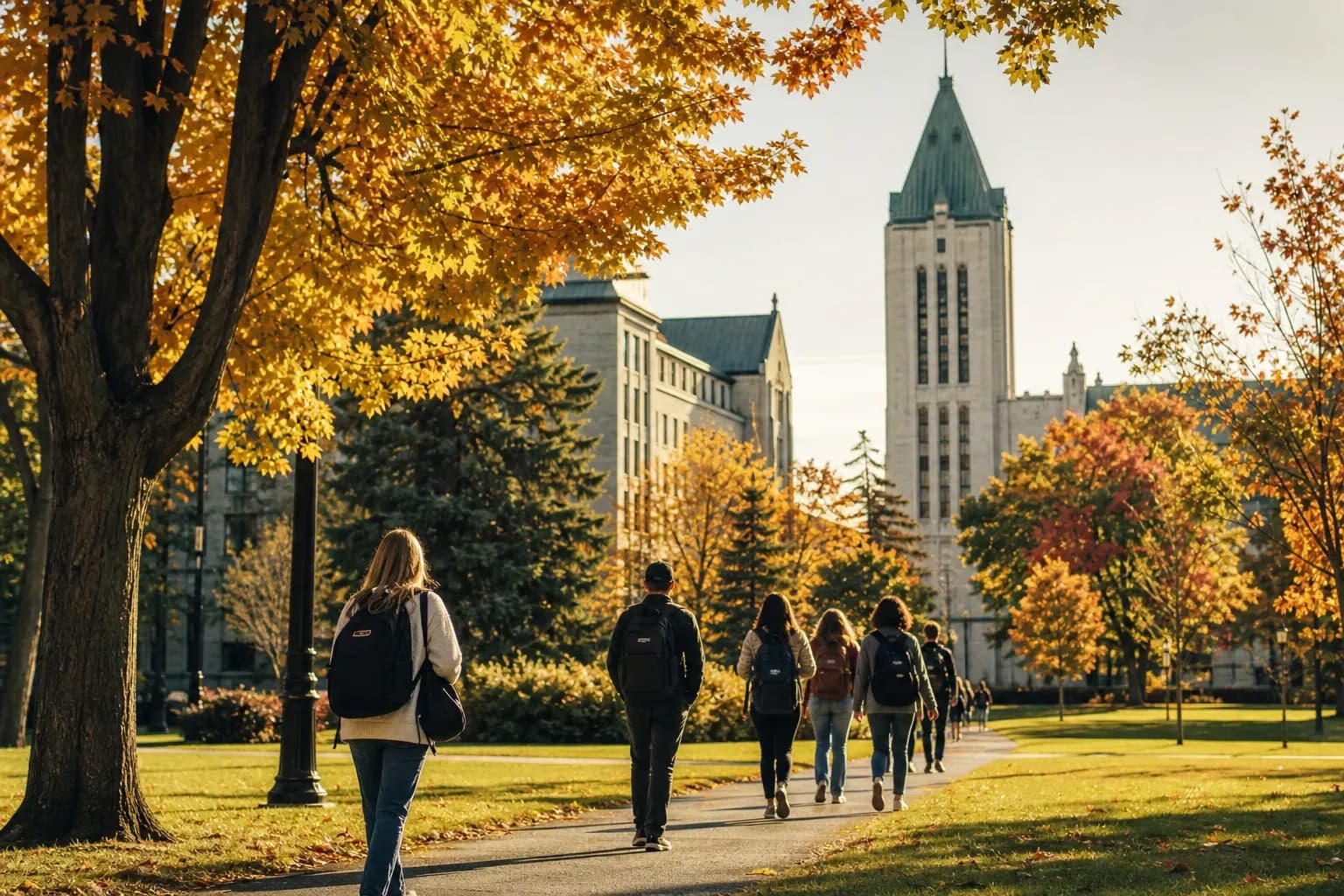
Université Laval: North America's Oldest French-Language University, Forestry and Arctic Research, and the PEQ French-Language PR Pathway
Published on January 18, 2026
Université Laval (Laval for short) is one of the least familiar universities for Taiwanese families, yet it may be the most underrated U15 university for immigration value. It ranks #350-380 globally in QS 2026, is a member of Canada's U15 group of research universities, and ranks #12 in Maclean's Medical Doctoral category. But Laval's true historical significance is this: it originated from the Séminaire de Québec in 1663, was formally elevated to university status in 1852, is North America's oldest French-language university, and is also Canada's first university.
To understand Laval, remember three things. First, instruction is entirely in French. For Taiwanese students, this is both a barrier and an advantage. After four years, students can reach native-level French, opening a dual PR pathway through Quebec PEQ + EE French Category. Second, tuition of CAD 20-32K is among the lowest in the entire U15 (alongside USask and UManitoba as the three most affordable options). Combined with Quebec's tuition subsidy system, the overall cost is about half that of U of T / UBC. Third, forestry, the civil law system, Arctic research, and French-language medicine are Laval's four academic signatures. Its Centre d'études nordiques is especially world-class in Arctic research.
Quebec City is a UNESCO World Heritage old city, one of the few walled cities in North America, and a 95% French-speaking environment (vs Montreal at 60%), making it a true French immersion setting. If your child is willing to learn French and wants one of Canada's lowest U15 tuition costs plus one of the fastest PR pathways, Laval is one of the most overlooked options for Taiwanese families.
1. Basic Information
| Item | Details |
|---|---|
| Founded | 1663 (North America's oldest French-language university) / elevated in 1852 |
| Location | Quebec City, Québec (capital of QC province, UNESCO old city) |
| Campus | Main Sainte-Foy campus, about 1.8 square kilometers |
| Undergraduates | ~32,000 |
| Graduate students | ~10,000 |
| Total enrollment | ~42,000 |
| Student-faculty ratio | 1:17 |
| Motto | Deo Favente Haud Pluribus Impar (With God's favor, inferior to none) |
| Language of instruction | French (a small number of graduate programs in English) |
2. World Rankings
| Ranking | Position |
|---|---|
| QS World 2026 | #350-380 |
| THE World 2025 | #251-300 |
| US News Global Universities 2024-25 | #259 |
| Maclean's Canadian Medical Doctoral Universities | #12 |
| QS Forestry / Agricultural Sciences | Global Top 50 (tied with UBC for first in Canada) |
| QS Law | Global #150-200 (first in the civil law system) |
Laval ranks somewhat lower in the English-speaking world, but in the French-language academic sphere, forestry, Arctic research, and civil law, it is world-class. Its U15 membership is an academic brand signal equivalent to being among Canada's top 15 research universities.
3. Admissions Data (2024 Fall Entry)
| Indicator | Value |
|---|---|
| Overall applicants | ~50,000 |
| Overall acceptance rate (international students) | about 50% (requires French B2+) |
| Faculté de médecine | about 8% |
| Faculté de droit (civil law JD/LLB) | about 20% |
| Faculté de génie | about 30% |
| Faculté de foresterie | about 35% |
| Yield Rate | about 60% (high among Quebec residents) |
Laval's defining feature: the French requirement is the biggest filter. If Taiwanese students meet DELF B2, an overall acceptance rate of about 50% is relatively friendly, though medicine and law remain highly competitive.
International Student Standards (Direct Entry to Undergraduate Programs)
| Test / Requirement | Recommended Score |
|---|---|
| High school average | 75%+ (IB 26+) |
| French DELF / DALF | B2 minimum (some programs require C1) |
| English (some graduate programs) | IELTS 6.5 / TOEFL 90 |
| SAT / ACT | Not required |
International Students
- International students account for about 18% (mostly from France, North Africa, French-speaking Africa, and Haiti)
- Students come from 120+ countries
- Very few Taiwanese students are admitted to undergraduate programs each year (< 5), mainly due to the French requirement
- French students account for about 8%, making them Laval's largest source of international students
4. Tuition and Financial Aid (International Student Perspective)
2024-2025 Tuition (CAD/year)
| Item | Amount |
|---|---|
| Tuition - Arts & Sciences sociales | CAD $20,000-$24,000 |
| Tuition - Sciences | CAD $22,000-$28,000 |
| Tuition - Génie (Engineering) | CAD $26,000-$32,000 |
| Tuition - Droit (Law, Civil Law) | CAD $22,000-$28,000 |
| Tuition - Médecine | CAD $32,000-$40,000 |
| Housing (on campus) | CAD $5,000-$8,000 (among the cheapest in QC) |
| Food + miscellaneous | CAD $5,000-$7,000 |
| Total (general programs) | CAD $30,000-$40,000/year |
| Total (Engineering / Law) | CAD $36,000-$47,000/year |
Compared with other U15 universities: U of T CAD $90K+, UBC CAD $75K+, McGill CAD $65K+, Dalhousie CAD $44K. Laval is one of the cheapest universities in the entire U15 (alongside USask and UManitoba as the three most affordable options), saving CAD $150K+ over four years (NTD 3.5 million+).
Quebec incentives for French-speaking students: Laval has Quebec government French-language subsidies for international French-speaking students (including students from France), reducing tuition in some programs to Canadian domestic levels. Taiwanese students who meet the French requirement may also apply.
Financial Aid for International Students
- Bourse d'exemption (French-language exemption scholarship): automatic for French / Belgian students; Taiwanese students may apply if they reach French C1
- Bourse de la Faculté: faculty-specific scholarships, CAD $2,000-$8,000
- Bourse Mitacs (graduate students): CAD $15,000-$20,000
- Compared with U.S. Top 50 universities at USD $60K+, Laval at CAD $30K is among the lowest tuition costs for a U15-level research university anywhere in the world
5. Program Structure / Signature Programs
Faculté Structure
Laval has 17 Facultés / Écoles, making it one of Canada's most comprehensive universities.
Signature Programs
- Faculté de foresterie, de géographie et de géomatique: Forestry, geography, and geomatics. Tied with UBC as Canada's top forestry faculty, this is Laval's most internationally recognized signature field.
- Faculté de médecine: Canada's leading French-language medical faculty, founded in 1848. It is the flagship of French-language medical education, with graduates serving healthcare needs across French-speaking Quebec.
- Faculté de droit: First in the Civil Law system. Quebec uses a civil law system, and Laval is the national authority in civil law education. Common Law / Civil Law dual-degree programs are open to students with strong French.
- Faculté des sciences et de génie + Centre d'études nordiques (CEN): World-class Arctic / cold-region research. The Sentinel North program is a Canadian government-designated Arctic research hub, studying climate change, Arctic ecosystems, and Indigenous health.
- Faculté des sciences de l'agriculture et de l'alimentation: Agriculture and food science, ranking alongside Guelph and UBC in Canada's top three.
- Faculté des sciences de l'administration: Business school with AACSB accreditation; the MBA is mainly taught in French.
Arctic Research
Laval's Centre d'études nordiques (CEN) is a world-leading Arctic research center:
- Sentinel North program: CAD $98 million in Canadian government funding
- Interdisciplinary research: Arctic ecosystems, permafrost, Indigenous health, and climate change
- Direct collaboration with Inuit communities
- Students may have opportunities to conduct field research at Arctic research stations in Nunavut and Greenland
For Taiwanese students: if you are interested in polar science or climate change, Laval is one of the few degree-granting institutions in the world where you can conduct Arctic research.
6. Campus Culture / School Personality
Laval's campus culture can be summed up in one sentence: French immersion + North America's oldest university + the cultural center of Quebec. Laval students have a strong Quebec identity; they see themselves not simply as "Canadian" but as "Québécois." Quebec City is more French-speaking than Montreal. About 95% of conversations on the street are in French, and English in Quebec City functions like a "foreign language."
Campus Legends
- Varsity team name Rouge et Or (Red and Gold): the Canadian university football team with the most championships (10+ Vanier Cup titles), with a very strong sports culture. Every Coupe Vanier final is a major Laval event.
- Pavillon Pollack: a representative example of Brutalist architecture
- Bibliothèque de l'Université Laval: 5 million volumes
- PEPS sports complex: one of North America's largest university sports centers, with Olympic-level facilities
Student Clubs
- 250+ clubs (led primarily by Quebec French-speaking students)
- CADEUL (Confédération des associations d'étudiants) is the undergraduate student union
- Festival d'été de Québec (summer music festival) attracts one million visitors every July, with strong Laval student participation
- One of the most active French-language debate communities in Canada
Sports Culture
- Varsity team name: Rouge et Or (Red and Gold)
- The Canadian university football team with the most championships: 10+ Vanier Cup titles (Laval has dominated Canadian university football since 1995)
- Basketball, Track & Field, and Cheerleading are all strong nationally
- The sports atmosphere is extremely intense, even stronger than Western / Queen's
7. Location / Campus Environment
City Positioning
Quebec City is the capital of QC province, a UNESCO World Heritage old city, and one of the few walled cities in North America. With a population of about 800,000, it is Canada's oldest city (founded in 1608). Quebec City is the cultural heart of French Canada. Festival d'été, Carnaval de Québec, and the Château Frontenac hotel are all here.
Compared with Montreal (bilingual and metropolitan), Quebec City is purely French-speaking, historic, and slower-paced. Laval's main campus is in Sainte-Foy (a suburb of Quebec City). It moved out of the UNESCO old city in the 1950s and became a modern university town. It is 15 minutes by car and 20 minutes by bus from downtown Quebec City.
Climate
- Winter: -15°C to -25°C (1.5 times more snow than Montreal, second-highest snowfall in Canada)
- Summer: 22-28°C, pleasant
- Spring and autumn: short, but the fall foliage is spectacular
- Quebec City is Canada's "winter carnival capital". Carnaval de Québec draws one million visitors every February, and students going to class in snow boots is part of daily life
Campus Landmarks
- Pavillon Charles-De Koninck (CDK): main humanities and social sciences building
- Pavillon Alphonse-Desjardins: student center
- Pavillon Adrien-Pouliot: Sciences building
- PEPS (Pavillon de l'éducation physique et des sports): one of North America's largest university sports centers
- Bibliothèque (library): 5 million volumes
- Château Frontenac (not on campus, but a Quebec City landmark visible on student commutes)
8. Research and Resources
Library
- 4 branch libraries
- The main library holds 5 million volumes and is Canada's second-largest French-language library
Notable Research Centers
- Centre d'études nordiques (CEN): world-leading Arctic research
- Sentinel North: Canadian government-designated Arctic hub
- Institut nordique du Québec (INQ): Laval + McGill + UQAR three-university Arctic alliance
- Institut sur le vieillissement et la participation sociale des aînés (IVPSA): aging research
- Centre de recherche du CHU de Québec: the largest French-language medical research center
9. Notable Alumni
- Politics: Louis St. Laurent (former Prime Minister of Canada, 1948-1957), Jean Chrétien (former Prime Minister, 1993-2003), Jean Charest (former Quebec Premier and PC leader), Pierre Marc Johnson (former Quebec Premier)
- Law / international organizations: Louise Arbour (UN High Commissioner, former Supreme Court Justice, UN Human Rights Commissioner), Robert Bourassa (former Quebec Premier)
- Business: Pierre Karl Péladeau (founder of Quebecor)
- Academia / literature: Anne Hébert (novelist, Governor General's Award), Roger Gaudry (first rector of U de Montréal)
- Science: Mario J. Molina (Nobel Prize in Chemistry, briefly researched the ozone layer at Laval)
Laval is a training ground for Canada's French-speaking political elite, with multiple Canadian prime ministers, Quebec premiers, and federal ministers among its alumni.
10. Lesser-Known Facts About Laval
- Laval originated from the Séminaire de Québec in 1663: founded by François de Laval (the first bishop of Quebec), it was elevated from a church college to a university in 1852. It is 27 years younger than Harvard (1636), but 38 years older than Yale (1701).
- Rouge et Or is a powerhouse in Canadian university football: with 10+ Vanier Cup titles, it is one of the most dominant teams in Canadian university sports.
- The campus is not inside the UNESCO old city: Laval moved from Vieux-Québec to Sainte-Foy in the 1950s, though students still refer to downtown as the cultural center.
- Pavillon Pollack is Brutalist architecture: built in the 1960s, this concrete building is a representative work of Canadian Brutalism.
- Quebec City is one of the few walled cities in North America: founded in 1608, with walls built in the 1690s, it is a UNESCO World Heritage site. Laval students can explore Vieux-Québec on foot.
11. Typical Admitted Student Profile
- High school average (converted): 75-85%+ (IB 26+, A-Level BBB+)
- French DELF B2 minimum (some programs require C1)
- SAT / ACT not required
- IELTS / TOEFL depends on the program
- Strongly recommended: high school French + summer exchange in Quebec / France
- No need to write a life story like the U.S. Common App. Laval values academic fit + French ability
- Laval strategy for Taiwanese students: if you already have DELF B2 in high school, Laval is the most affordable and among the easiest-to-enter options in the U15
12. What Kind of Student Is Laval Best For?
✓ Best fit:
- Students who already have French DELF B2 or above
- Families with a budget of CAD 30-47K/year (one of the lowest in the entire U15)
- Students interested in forestry, Arctic research, Civil Law, or French-language medicine
- Families planning to stay in Quebec after graduation and pursue the PEQ French-language PR pathway
- Students who want a fully immersive French environment (native-level French by graduation)
- Students who like historic old cities, slower living, and less crowded environments
- Taiwanese middle-class families who want a U15 degree with a CAD 30K budget
✗ Not necessarily a fit:
- Students who do not speak French and do not want to learn French
- Students who want a metropolitan lifestyle or Tech hub environment (Quebec City is not a Tech hub)
- Students who want a strongly English-speaking environment (McGill / Concordia in Montreal are better choices)
- Students who dislike harsh winters (-25°C + very heavy snowfall)
- Students who are set on Bay Street or Silicon Valley (Laval's alumni network is concentrated in Quebec + French-speaking regions)
13. Advantages for Canadian Study + Immigration Pathways
Laval's dual PEQ + EE French Category pathway in Quebec is a hidden value champion that Taiwanese families should understand.
PGWP (Post-Graduation Work Permit)
After completing a Laval degree (program of at least 8 months), graduates can apply for a 3-year Open Work Permit, regardless of major. The language requirement is CLB 7 (French TEF NCLC 7 or IELTS 6.0). Laval graduates taught in French naturally meet this standard. After four years of French immersion, TEF NCLC 7 (B2) is a baseline expectation for Laval graduates. The PGWP reforms effective from 2024-11-01 remain relatively flexible for university degrees.
Quebec PEQ (Programme de l'expérience québécoise): Laval's Biggest Advantage
PEQ is Quebec's PR fast track designed specifically for Quebec graduates and workers:
- French CLB 7 (B2 oral) required
- Laval graduates from fully French-taught programs have a natural advantage (four years in a French environment)
- Requires 12-24 months of Quebec work experience (new rules since 2020-07)
- Processing time: 6-12 months (faster than general EE rounds)
- Not affected by Express Entry CRS
Typical Laval timeline:
- T0: Begin studies at Laval (French instruction)
- T0-T48m: 4-year bachelor's degree (French immersion)
- T48m: Graduate with native-level French + apply for 3-year PGWP
- T48-T60m: 12-24 months of Quebec work (NOC TEER 0/1/2/3)
- T60m: Apply for PEQ
- T66-T72m: PR landing (around age 25-26)
PRTQ (Programme régulier des travailleurs qualifiés) / PSTQ
Starting 2024-11-29, Quebec launched PSTQ (replacing the old PRTQ), divided into 4 streams:
- Stream 1: Highly specialized occupations (regulated professions)
- Stream 2: Regulated occupations
- Stream 3: French-language talent (CCQ B2 oral + B1 written): the most direct pathway for Laval graduates
- Stream 4: Regional needs
Bill 96 French-language strengthening: Since 2022, Quebec has implemented Bill 96, strengthening the dominant role of French in Quebec's public sector, higher education, and business environment. This benefits Laval's French-speaking graduates. Demand for French-speaking talent in the Quebec market has surged, improving employability.
Express Entry French Category (Federal French Draw): Laval's Second Safety Net
If students do not take the Quebec pathway, Laval graduates can still pursue the federal EE French Category:
- Meeting TEF NCLC 7 (B2) qualifies applicants for French category draws
- 2026 Q1 French Category cut-off: 379-428 (the most favorable range)
- General draw cut-off: 521-547; STEM: 481-524; Healthcare: 422-461
- Laval graduates receive +50 CRS points for French + lower French category cut-offs = a second layer of security
Impact of the 2024-2025 International Student Cap
Quebec was affected by the 2024 cap through a -20% reduction + Bill 96 + a 33% tuition increase. However, Laval is a U15 research university, and master's and PhD students are relatively protected. Laval also offers subsidies for Quebec French-language students, so overall costs have not risen significantly.
Value Comparison with Equivalent U.S. Universities
| Item | Université Laval | Comparable U.S. Universities (Tulane / Vermont) |
|---|---|---|
| QS 2026 | #350-380 | Tulane #426 / Vermont #800+ |
| U15 / research level | U15 member (Canada's top 15 universities) | Tulane R1 / Vermont R2 |
| Tuition (international undergraduate) | CAD $24K (USD $18K) | USD $60K+ |
| Arctic / forestry / civil law | First in Canada | Mid-tier |
| Post-graduation stay pathway | 3-year PGWP + PEQ French pathway | OPT 1-3 years + H-1B lottery |
| Permanent residence | PR by age 25-26 (PEQ pathway) | OPT + H-1B + green card in 5-10 years |
Laval's four-part combination of "U15 + French instruction + CAD $24K tuition + PEQ dual PR pathway" makes it one of the highest-value U15 university options on earth for French learners.
Conclusion
Laval is best suited for Taiwanese families who think, "We are willing to spend 1-2 years learning French, want the lowest tuition in the U15, and want Canadian PR." It is not an English-speaking urban research machine like U of T, nor an Atlantic ocean-focused university like Dalhousie. It is Canada's version of Sorbonne + UC Davis: a French-immersion historic city, top-tier forestry and agriculture, global Arctic research, and authority in the civil law system.
Choosing Laval means accepting several realities. First, instruction is entirely in French. You need at least DELF B2 and must accept four years of academic life primarily in French, with English as a secondary language. Second, Quebec City is not a metropolis. It has a population of 800,000, lacks the international immigrant circles of Toronto / Vancouver, and has an Asian population below 5%. Third, winter is severe, with heavy snowfall. You need to be mentally prepared for -25°C temperatures and 3 meters of snow each year.
But if your child can do it, the path is powerful: start learning French at 18, reach DELF B2 at 20, enter Laval for forestry / civil law / Arctic science, graduate at 22-23 with native-level French, work in Quebec for 12-24 months through PEQ, and obtain Quebec permanent residence by 26. This is a complete pathway combining "U15 degree + CAD 150K total four-year cost + bilingual competitiveness + Canadian PR by age 26".
Laval is the most overlooked U15 option, but the strongest one for French learners. For Taiwanese middle-class families willing to invest in French, seeking Canada's lowest tuition, and aiming for Quebec PR, Laval is the most underrated hidden value champion in the U15. French is the barrier, but it is also one of the most underestimated shortcuts in Canada's immigration system.
Sources
- Université Laval — International Admission (retrieved 2026-05-14) https://www.ulaval.ca/etudes/admission
- Centre d'études nordiques — Sentinel North (retrieved 2026-05-14) https://www.cen.ulaval.ca/
- Maclean's University Rankings 2025 (retrieved 2026-05-14) https://www.macleans.ca/education/university-rankings/
- Quebec PEQ / PSTQ (MIFI Quebec, retrieved 2026-05-14) https://www.quebec.ca/en/immigration/permanent/skilled-workers/quebec-experience-program
- Dr. G. Academy internal file 03_Canada_Visa_Strategy.md (2026-05-02)