
Université de Montréal: French-Taught Programs, HEC Montréal, Mila AI, and the Quebec PEQ Immigration Pathway
Published on January 27, 2026
Université de Montréal (UdeM) is Canada's largest French-taught research university, ranked QS 2026 #150 and Maclean's Medical Doctoral #6, and is a founding member of the U15. If you ask locals in Montreal, "Which university best captures the soul of Quebec?" the answer is always UdeM. Its two affiliated schools, HEC Montréal (a French-language business school) and Polytechnique Montréal (a French-language engineering school), are also benchmarks for French-language higher education in North America.
For Taiwanese families, UdeM is a seriously underrated hidden option. Most people hear "French-taught" and skip it immediately, but that is exactly its greatest advantage: French CLB 7 = Quebec PEQ permanent residence + Express Entry French category draw cut-offs of only 379-428 (compared with 530+ for general draws). In other words, the French-language immigration pathway for UdeM graduates may be one of the fastest routes on earth to Canadian PR. UdeM is also a core partner of Mila (Quebec AI Institute), led by Yoshua Bengio. Bengio is one of the three giants of deep learning, alongside Hinton and LeCun, and shared the 2018 Turing Award.
1. Basic Information
| Item | Details |
|---|---|
| Founded | 1878 (with origins including Polytechnique, founded in 1873 and later affiliated) |
| Location | Montreal, Quebec (main campus on the northwestern slope of Mont-Royal) |
| Campus | Main campus of about 168 acres + Laval satellite campus |
| Undergraduates | ~52,000 (including HEC + Poly) |
| Graduate students | ~15,000 |
| Total enrollment | ~67,000 (Canada's largest French-language university) |
| Student-faculty ratio | 1:17 |
| Motto | Fide splendet et scientia (Through faith and knowledge it shines) |
2. World Rankings
| Ranking | Position |
|---|---|
| QS World 2026 | #150 |
| THE World 2025 | #131 |
| US News Global Universities 2024-25 | #115 |
| Maclean's Canadian Medical Doctoral Universities | #6 |
| QS Veterinary Science | #20 worldwide |
| QS Linguistics | #41 worldwide |
HEC Montréal holds AACSB + EQUIS + AMBA triple crown accreditation, making it one of the few triple-accredited business schools in North America. In Europe and French-speaking African markets, its reputation exceeds that of many Ivy schools in North America.
3. Admissions Data (Fall 2024 Entry)
| Metric | Figure |
|---|---|
| Total applicants | ~58,000 |
| Overall acceptance rate | About 57% (assuming French proficiency is met) |
| Faculté de médecine | About 7% (extremely difficult for international students) |
| HEC Montréal BBA | About 15-22% |
| Polytechnique Génie Informatique | About 20% |
| Faculté de droit | About 25% |
| Yield Rate | About 65% (mainly French-speaking students) |
The biggest difference between UdeM and other U15 universities is this: admission depends heavily on French. International students with DELF B2 / TEF B2 can enter directly. Otherwise, they must first complete one year of French preparation through École de français (CAD $15,000-$20,000).
International Student Standards (Direct Undergraduate Entry)
| Test | Recommended Score |
|---|---|
| French (required) TEF / TCF / DELF | B2 minimum, C1 is safer |
| SAT (optional) | 1300+ (1400+ recommended for HEC / Poly) |
| IB | 30+ (French-language or bilingual IB preferred) |
| High school average | 85%+ |
International Students
- International students make up about 25% of the student body (mostly from French-speaking Africa, France, Haiti, and Lebanon)
- Students come from 150+ countries
- Each year, 5-10 Taiwanese students are admitted to undergraduate programs (master's and doctoral students counted separately, mostly those who already have a French foundation)
- 90%+ of courses are taught in French, with English options available only in some master's and doctoral programs
4. Tuition and Financial Aid (International Student Perspective)
UdeM is relatively less affected by the Bill 96 tuition reform because it was already a French-language institution. The Quebec government's policy intent is to protect it, not penalize it.
2024-2025 Tuition (CAD/year)
| Item | Amount |
|---|---|
| Tuition - Arts & Sciences sociales | CAD $32,000-$38,000 |
| Tuition - Sciences | CAD $38,000-$44,000 |
| Tuition - HEC Montréal BBA | CAD $40,000-$46,000 |
| Tuition - Polytechnique Engineering | CAD $42,000-$46,000 |
| Tuition - Médecine | CAD $45,000+ |
| École de français (one-year French preparation) | CAD $15,000-$20,000 |
| Housing (on-campus Résidences) | CAD $7,000-$10,000 |
| Food + miscellaneous expenses (Montreal has the lowest cost of living among Canada's major cities) | CAD $9,000-$12,000 |
| Total | CAD $50,000-$70,000/year |
Compared with CAD $90K+ for an international undergraduate engineering degree at U of T or McGill, UdeM is 30-40% cheaper. Combined with Montreal's lower cost of living, it is one of the best-value options in the U15.
Financial Aid for International Students
- Bourses d'exemption des droits de scolarité supplémentaires: Special tuition exemptions for students from French-speaking Africa and France (not applicable to Taiwanese students).
- Bourse de la Faculté des études supérieures: Graduate entrance awards of CAD $5,000-$15,000.
- HEC Montréal Bourse d'excellence: CAD $10,000-$20,000, for the top 5% of applicants.
- Scholarships for general international undergraduates are limited, mostly entrance merit awards of CAD $3,000-$8,000.
5. Academic Structure / Signature Programs
Undergraduate Majors
UdeM follows a French-style Faculté system, with 13 faculties + 2 affiliated schools (HEC and Poly), offering about 600 programs in total.
Signature Programs
- Faculté de médecine: A Top 3 French-taught medical school in Canada and one of Quebec's main training institutions for French-speaking physicians. It is extremely difficult for international students to enter, and most applicants need Quebec citizenship or PR status first.
- HEC Montréal: Founded in 1907, it is the leading French-language business school in North America, with AACSB + EQUIS + AMBA triple crown accreditation and close exchange relationships with INSEAD, HEC Paris, and ESSEC. Its three flagship programs are the BBA, MBA, and MSc Finance.
- Polytechnique Montréal: Founded in 1873, five years before UdeM, and now affiliated with it. It is the leading French-language engineering school, with close AI / Machine Learning collaboration with Mila. Génie informatique, Génie biomédical, and Génie aérospatial are three major strengths.
- Faculté de musique: A top music school in the French-speaking world, strong in classical, jazz, and electronic music.
- Faculté de droit: Teaches Civil Law in French, and graduates can enter Quebec's legal system.
Partnership with Mila
Mila (Quebec AI Institute) was founded by Yoshua Bengio at UdeM in 1993. It has since expanded into a cross-university AI ecosystem across Quebec, but Bengio himself remains a full-time professor at UdeM. Mila is jointly built with UdeM, Polytechnique, and McGill, but many of its core researchers are UdeM professors. A very high proportion of students from this ecosystem go on to Google Brain, DeepMind, OpenAI, and Element AI, which was later sold to ServiceNow.
6. Campus Culture / Institutional Personality
UdeM's campus culture can be summed up in one sentence: a Montréalais French-language metropolitan university + the academic heart of North America's French-language cultural capital. About 70% of students are from Quebec, 15% from French-speaking Africa and France, and 15% from other countries. You will hear almost no English here. For Taiwanese students educated mainly in English, that can be a shock, but it is also the fastest route into French immersion.
Life on the Mont-Royal Campus
UdeM's main campus is built on Montreal's landmark Mont-Royal mountain. It shares the same mountain with McGill, but McGill is on the southern slope while UdeM is on the northwestern slope. Student commuting mainly relies on the Blue Line metro, with Université-de-Montréal station reaching the heart of campus directly. In winter, students can walk from academic buildings into the metro without going outdoors.
Student Clubs
- 250+ clubs, most operating in French
- The international student association, Association des étudiants internationaux, is the main English-speaking social circle
- CISM-FM 89.3: UdeM's student radio station and an important platform for Montreal's French-language independent music scene
- HEC Montréal has its own student association, AEHEC, with activities fully independent from UdeM
Sports Culture
- Varsity team name: Carabins (French for "infantrymen")
- Main sports: football, ice hockey, soccer
- The sports atmosphere is not intense. Montreal's overall sports culture centers on professional teams, especially the Canadiens in hockey and the Alouettes in football, and university sports are not as lively as at American public universities
7. Location / Campus Environment
City Positioning
UdeM's main campus is a 15-minute metro ride from downtown Montreal, located around Côte-des-Neiges + the affluent French-speaking district of Outremont. Montreal is the most European city in North America: European architecture, sidewalk cafés, French as the mother tongue, legal drinking at 19, and generous cultural funding. For Taiwanese students, studying here can feel more like attending a university in France than in North America.
HEC Montréal's buildings are next to UdeM's main campus, and Polytechnique is on the same mountain. The three schools share libraries, gyms, and activity centers.
Climate
- Winter: -15°C to -25°C, with lows around -30°C common in January and February; colder than Toronto and similar to Ottawa
- Snow stays on the ground for five months from December to April, and the underground pedestrian system RÉSO, the longest underground city in North America, connects campuses and downtown
- Summer: 22-30°C, humid and pleasant
- Spring and autumn: short, but the maple leaves are spectacular
Campus Landmarks
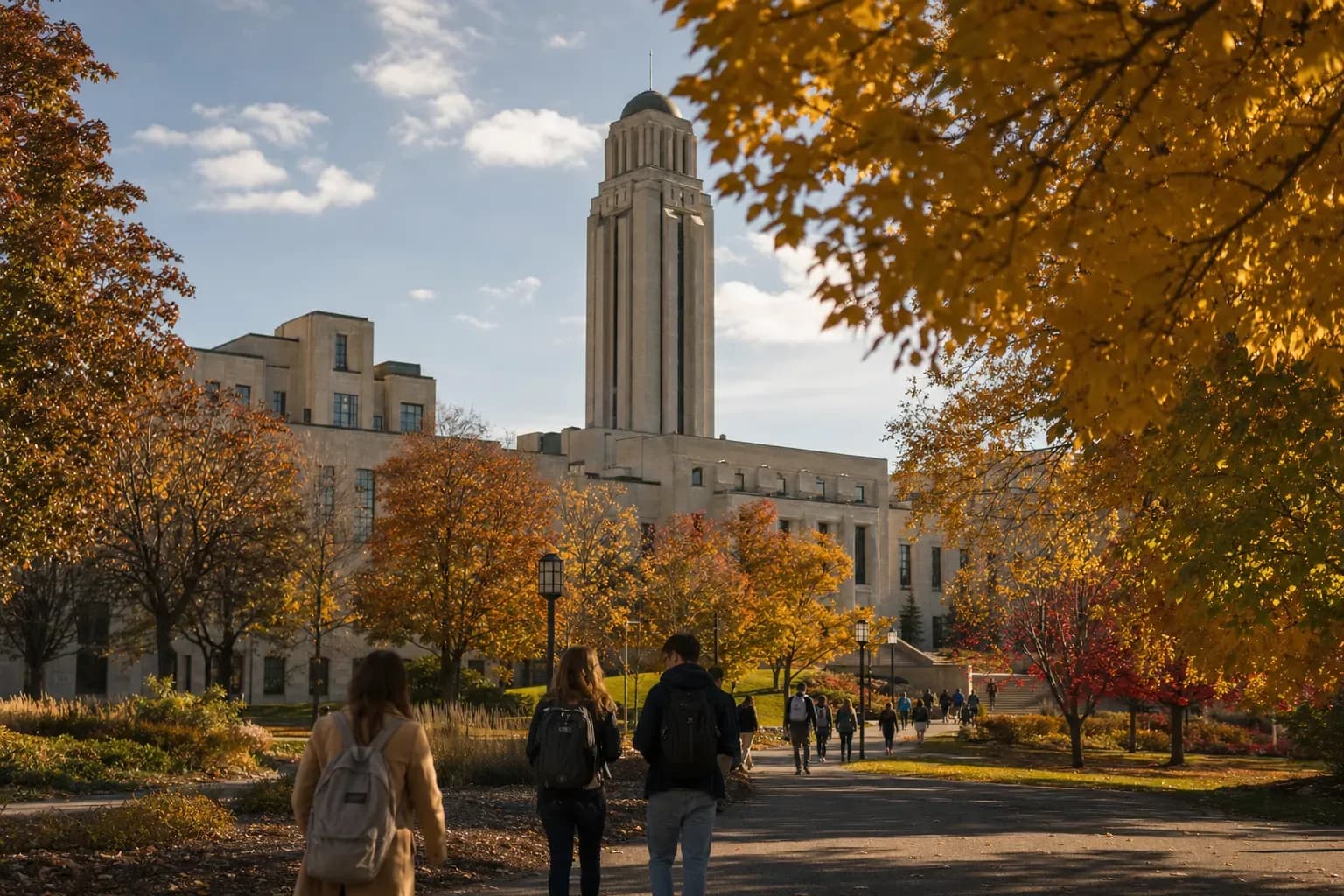
- Pavillon Roger-Gaudry (1943 Art Deco main building, the heart of campus, with a tower that is one of Mont-Royal's landmarks)
- HEC Montréal Côte-Sainte-Catherine building (modern architecture from 2002, with some of the most advanced teaching facilities in Canada)
- Polytechnique Lassonde building
- Stade Saputo (soccer field) + Centre sportif
8. Research and Resources
Libraries
- 20 branches, with 5 million volumes
- Bibliothèque des lettres et sciences humaines is the main library
- HEC Montréal's library is one of Canada's largest business documentation libraries
Notable Research Centers
- Mila (Quebec AI Institute): Led by Yoshua Bengio and jointly built by UdeM, Polytechnique, and McGill; one of the world's Top 3 deep learning research hubs, alongside Stanford SAIL and CMU MLD
- CRCHUM (Centre de recherche du CHUM): A medical research center and the largest in French-speaking Canada
- IVADO (Institut de valorisation des données): A cross-university data science institute
- CIRANO: An economic policy research center
- Goodman Cancer Research Centre (in partnership with McGill)
UdeM has produced 1 Nobel laureate: Rudolph Marcus, the 1992 Nobel Prize winner in Chemistry and an undergraduate alumnus.
9. Notable Alumni
- Politics: Pierre Elliott Trudeau (former Prime Minister of Canada and father of Justin Trudeau, Faculté de droit), Robert Bourassa (former Premier of Quebec), Lucien Bouchard (former Premier of Quebec)
- AI / Technology: Yoshua Bengio (professor, 2018 Turing Award; one of the three giants of deep learning), Hugo Larochelle (Google Brain), Aaron Courville (professor)
- Science: Rudolph Marcus (1992 Nobel Prize in Chemistry)
- Writing / Performing Arts: Mordecai Richler, Pierre Bourgault, Denys Arcand (Academy Award-winning Best Foreign Language Film director)
- Law: Antonio Lamer (Chief Justice of the Supreme Court of Canada, 1990-2000)
10. Lesser-Known Facts About UdeM
- Polytechnique was founded five years before UdeM: It was established in 1873 and became affiliated with UdeM only in 1920. Poly's French-language engineering lineage is therefore even deeper than UdeM's overall history.
- HEC Montréal is the first French-language business school in North America: Founded in 1907 and modeled after HEC Paris, it is now a major MBA training ground for political and business elites from French-speaking African countries.
- Yoshua Bengio turned down high-paying recruitment offers from Google and Facebook: He insisted on staying at UdeM to teach and lead Mila because "Montreal needs a local AI ecosystem." He is regarded as a Quebec national treasure.
- The Pavillon Roger-Gaudry tower is a landmark of French-speaking Montreal: Built in 1943 in Art Deco style, the tower offers views across the city; the tower on UdeM's crest is this building.
- UdeM is one of the birthplaces of Montreal Pride: One of North America's first LGBTQ+ student associations was founded here in 1979; every August, the campus hosts the departure ceremony for the Pride parade.
11. Typical Admitted Student Profile
- High school average (converted): 85-90%+ (IB 30+, top 10-15% in a Taiwanese high school)
- French: DELF B2 or TEF B2 is a hard threshold (without it, students attend École de français)
- English is not required, but IELTS 6.0+ can strengthen master's applications
- HEC / Poly recommend SAT 1400+ or IB 36+
- The application essay (Lettre de motivation) must be written in French, clearly explaining why the applicant chose UdeM / the specific program
- Faculté de médecine is extremely difficult for international students, and most need Quebec PR first
12. What Kind of Student Is UdeM Best For?
✓ Best suited for:
- Students who already have a French foundation (DELF B1 or above) or are willing to spend one year strengthening it
- Families planning to stay long-term in Montreal / Quebec and pursue a French-language immigration pathway
- Students aiming for future careers in Europe, French-speaking Africa, or international organizations
- Students who like a European-style metropolis with literary and artistic character, and do not want an American-style campus
- HEC Montréal MBA applicants seeking triple crown accreditation + French-speaking world resources
- AI / Machine Learning graduate students who want to join the Mila ecosystem
- Families with a budget of CAD $50-70K/year (about 30% cheaper than U of T / McGill)
✗ Not necessarily suited for:
- Students who have no interest in learning French (90% of courses are in French)
- Students seeking an American college experience, Greek life, or a sports-driven campus culture
- Families planning for the student to return directly to Asia after graduation and who do not need Quebec PR
- Students who are afraid of the cold (Montreal winters at -25°C are normal)
- Students expecting professors to provide hands-on advising (UdeM uses large lectures + a hands-off approach)
13. Advantages for Canadian Study + Immigration Pathways
UdeM's value in Canada's immigration pathways is the most underestimated among all U15 universities.
PGWP (Post-Graduation Work Permit)
After completing a UdeM master's program of at least 8 months, graduates can apply for a 3-year Open Work Permit, regardless of field of study. Language requirement: IELTS General CLB 7 or TEF NCLC 7. UdeM's French-speaking graduates usually naturally meet TEF NCLC 7-9, so the "English is not strong enough" concern that Taiwanese parents often worry about is not a problem for UdeM graduates, because French also counts.
Express Entry French Category (UdeM's Biggest Advantage)
This is the "golden pathway" in IRCC's category-based draws launched in June 2023:
- French CLB 7 = eligibility for French category draws
- 2026 Q1 French category cut-offs were only 379-428 (general draws were 530+, a gap of more than 150 points)
- UdeM French-taught graduates usually have CRS scores in the 420-480 range, well above the French category threshold
- In addition, French CLB 7 directly adds CRS +50 points (single) / +25 (married)
For French-speaking UdeM graduates, French category draws are the fastest legal route on earth to Canadian PR.
Quebec PEQ (Programme de l'expérience québécoise)
If you plan to stay in Montreal, you can use Quebec's own provincial selection system:
- International graduates need French CLB 7 (UdeM graduates naturally meet this)
- Before applying, they need to work in Quebec for 1-3 years depending on program category
- Compared with federal EE, PEQ is faster and led by the Quebec government
- PEQ is the most natural pathway for UdeM graduates because the alumni network and employment network are both in Quebec
Quebec PSTQ (Programme de sélection des travailleurs qualifiés)
Starting 2024-11-29, PSTQ replaced the old PRTQ. It has four streams, and all streams require French oral B2 or above. UdeM French-speaking graduates also naturally meet this requirement.
Impact of the 2024-2025 International Student Cap
Because of Bill 96 + tuition reform, Quebec's international student study permit quota was cut by 20%. However, because UdeM is a French-language university and the Quebec government's intent is to protect French-language higher education, UdeM is far less affected than McGill or Concordia. Research master's and doctoral programs are relatively protected.
Cost-Performance Comparison with a Similar U.S. University
| Item | UdeM | Comparable U.S. School (NYU) |
|---|---|---|
| QS 2026 | #150 | NYU #43 |
| Tuition (international undergraduate) | CAD $32K-$46K (USD $24-34K) | USD $66,000+ |
| City positioning | French-speaking metropolitan Montreal | New York City |
| Language environment | Mainly French + bilingual city | Mainly English |
| Post-graduation pathway to stay | 3-year PGWP + French category EE (the sweetest route) | H-1B lottery (30%) |
| International student scholarships | Entrance awards of CAD 5-15K | Usually none |
UdeM's tuition is about one-third of NYU's, and living in a French-speaking metropolis offers unique cross-cultural value. It is a hidden champion option for families who want "a metropolitan degree + a bilingual résumé + Canadian PR."
Conclusion
UdeM is for Taiwanese students who think, "I want a North American metropolitan degree that speaks French, and I want to stay in Montreal or use the French category for fast immigration." It is not for students who only want to speak English. That needs to be clear from the start. But if you are willing to invest 1-2 years to bring your French to B2, UdeM gives you returns other schools cannot: HEC Montréal's triple crown business school reputation, the AI research power of Polytechnique + Mila, the ability to apply for permanent residence through Quebec PEQ within one year, the lowest cost of living among Canada's major cities, and a safe harbor amid the political storm around Bill 96.
From a Taiwanese family perspective, UdeM's greatest value is "French + Canadian PR in one package." When your child graduates, they will have not only a U15 degree, but also a bilingual résumé usable across Europe, French-speaking Africa, and international organizations. French category Express Entry cut-offs are only 379-428, and this sweet spot may disappear once French-language talent demand stabilizes in 2027-2028. Entering now is the last golden window.
Sources
- Université de Montréal — International Admissions (accessed 2026-05-14) https://admission.umontreal.ca/etudes-internationales/
- HEC Montréal — Triple Crown Accreditation (accessed 2026-05-14) https://www.hec.ca/en/about/triple_accreditation.html
- Maclean's University Rankings 2025 (accessed 2026-05-14) https://www.macleans.ca/education/university-rankings/
- QS World University Rankings 2026 (accessed 2026-05-14) https://www.topuniversities.com/world-university-rankings
- Government of Quebec — Programme de l'expérience québécoise (PEQ) Reform 2024 (accessed 2026-05-14) https://www.quebec.ca/en/immigration/permanent/skilled-workers/quebec-experience-program