
UC San Diego: The 7 College System, Biomedical Research, and a La Jolla Oceanfront Campus
Published on October 21, 2025
Ranked tied #29 nationally by US News, third in the UC system (behind only Berkeley and UCLA), world-class in life sciences and oceanography, and located in the same La Jolla biotech corridor as the Salk Institute and Scripps Research Institute, UCSD is the quietest but academically deepest research campus in the UC system. Its Scripps Institution of Oceanography is one of the birthplaces of global oceanography research, and its medical school and biomedical engineering programs rank among the top 10 nationally in NIH funding.
UCSD in one sentence: “A research giant made up of 7 Colleges + an academic monastery by the ocean in La Jolla.” UCSD’s most distinctive structure is its Residential College System: when students enroll, they rank 7 Colleges, each with its own general education requirements, residential area, and academic culture. It is the only UC campus modeled after the collegiate systems of Oxford / Cambridge / Yale. To understand UCSD, start with one point: UCSD does not beat UCLA on campus atmosphere, nor Berkeley on political protest culture. It wins through “research funding + biomedical location + the depth of its College system.”
1. Basic Information
| Item | Details |
|---|---|
| Founded | 1960 (the 7th UC campus) |
| Location | La Jolla, San Diego, California (a coastal community north of San Diego) |
| Campus | About 1,200 acres |
| Undergraduates | ~33,000 |
| Graduate Students | ~9,500 |
| Student-Faculty Ratio | 1:19 |
| Motto | Fiat lux (Let there be light) |
2. Global Rankings
| Ranking | Position |
|---|---|
| US News National Universities 2025 | #29 |
| QS World 2025 | #62 |
| THE World 2025 | #32 |
| US News Public Universities | #6 |
| US News Bioengineering / Biomedical Engineering | Top 5 |
| US News Computer Science | Top 20 |
| Scripps Institution of Oceanography | #1 (global) |
| Rady School of Management (MBA) | Top 50 |
UCSD ranks in the global top 10 in life sciences, neuroscience, oceanography, and biomedical engineering. It is also among the top 10 in the United States for NIH research funding, placing it in the same tier as JHU, UCSF, and Harvard Medical.
3. Admissions Data (Class of 2028)
| Metric | Value |
|---|---|
| Applicants | ~131,000 |
| Admitted Students | ~31,400 |
| Overall Acceptance Rate | About 24% |
| California In-State Acceptance Rate | ~30% |
| OOS Acceptance Rate | ~20% |
| International Acceptance Rate | ~16% |
| Yield Rate | ~22% |
UCSD does not accept the Common App. Applicants must use the UC Application system. There is no ED/EA, only one deadline: 11/30. UCSD is Test-Free and does not accept SAT/ACT scores. Acceptance rates vary dramatically by major: popular majors such as CS, Biology, and Cognitive Science may have acceptance rates of only 10%, while less competitive humanities majors may reach 35%.
SAT/ACT Middle Range
Since 2021, UCSD has been Test-Free: it does not accept standardized test scores at all. This is the shared policy across all 9 UC campuses.
International Students
- International students make up about 19% of the student body (one of the highest shares in the UC system)
- Students come from 90+ countries
- More than 5,000 students are from China
- Around 30-50 students from Taiwan are admitted each year
4. Tuition and Financial Aid
2024-2025 Cost of Attendance
| Item | Amount (OOS / International Students) |
|---|---|
| Tuition | USD $48,500 |
| Housing | USD $13,800 |
| Food | USD $6,500 |
| Personal + Misc | USD $4,500 |
| Total | USD $73,300+ |
| In-State Tuition | USD $16,500 (total cost about $41,000) |
Need-Based Aid
- California residents may apply for Cal Grant / Blue and Gold Opportunity Plan: families with annual income below $80,000 can receive full tuition coverage (California residents only)
- International students are not eligible for any UC system Need-Based Aid
- Regents Scholarship: UC’s Merit Scholarship, awarded to the top 1.5% of students campus-wide, including USD $2,000-7,500/year + privileges such as early course registration (international students are eligible)
- Average aid: USD $20,000/year (California residents)
UCSD offers no Need-Based Aid at all to international students. Taiwanese families should evaluate UCSD as a full-pay option, with only a very small number of Merit Aid awards such as the Regents Scholarship available.
5. Academic Structure / Signature Programs
Main Undergraduate Divisions
- Division of Arts and Humanities
- Division of Biological Sciences
- Division of Physical Sciences
- Division of Social Sciences
- Jacobs School of Engineering: CS, ECE, Bioengineering, Mechanical Engineering
- Herbert Wertheim School of Public Health
- Rady School of Management (undergraduate Business Minor + MBA)
- School of Global Policy and Strategy
7 College Residential System (UCSD’s Most Distinctive Feature)
UCSD assigns students to 7 Colleges, each with about 4,500-5,000 students:
- Revelle College (1964): rigorous traditional general education, strongest fit for sciences
- John Muir College (1967): highly flexible, broad freedom in course selection
- Thurgood Marshall College (1970): social justice oriented
- Earl Warren College (1974): interdisciplinary, with GPA discipline
- Eleanor Roosevelt College (ERC) (1988): global focus, language requirement
- Sixth College (2001): arts + technology + culture
- Seventh College (2020): climate change and global crises
Each College has:
- Its own residential area
- Its own general education requirements
- Its own advisors
- Its own traditions and culture
Choosing a College is more important than choosing a major. The same CS major can feel completely different in Revelle than in Sixth.
Signature Programs
- Bioengineering: Top 5 nationally, sharing a research network with Salk, Scripps Research, and Sanford-Burnham
- Cognitive Science: UCSD is one of the birthplaces of the Cognitive Science discipline
- Computer Science: Top 20, with graduates moving directly into Qualcomm, Google, and Meta
- Scripps Institution of Oceanography: #1 in global oceanography
- MD Program: A medical school integrated with the Skaggs School of Pharmacy
General Education Structure
General education requirements differ by College. This is the biggest structural difference between UCSD and other UC campuses.
6. Campus Culture / Institutional Personality
UCSD’s personality can be summed up in one sentence: “A monastery for Pre-Med students and engineers + academic asceticism by the ocean.” UCSD students tend to be introverted, hardworking, and highly competitive. The Pre-Med intensity here is even higher than at UCLA, and the CS intensity is even higher than at Berkeley. Students complaining that the campus is “too quiet + has no social life” has long been a UCSD meme.
But UCSD has unique advantages: a La Jolla oceanfront setting + 7 College culture + location in the same biotech corridor as Salk / Scripps Research. Juniors and seniors can conduct research at the Salk Institute, a gathering place for Nobel laureates. This is a location advantage other UC campuses do not have.
Greek Life / Student Organizations
- About 12% of students join a Fraternity / Sorority (one of the lowest rates in the UC system)
- Greek Life exists but does not dominate the campus culture
- Signature events: Sun God Festival (spring music festival, 50,000 attendees), Triton Day (admitted student event)
Sports Culture
- Big West Conference (NCAA Division I, moved up to D1 in 2020)
- Signature sports: men’s and women’s basketball, women’s volleyball, men’s tennis
- UCSD does not have American football, which is the biggest cultural difference between UCSD and UCLA / Berkeley
UCSD students are not obsessed with sports. This is another side of UCSD’s “academic monastery” character.
7. Location / Campus Environment
City Positioning
UCSD is located in La Jolla, north of San Diego, one of Southern California’s wealthiest and most beautiful coastal communities. Distance to:
- Downtown San Diego: 15 minutes by car
- Tijuana, Mexico: 30 minutes by car
- LA: 2.5 hours by car
- La Jolla Cove beach: 15 minutes on foot
La Jolla has one of the highest concentrations of biotech startups in the world. Illumina, Qualcomm, and Pfizer R&D are all located here. The Torrey Pines Mesa biotech corridor sits right next to campus.
Climate
- Winter: 10-18°C, almost no rain
- Summer: 18-25°C, cool ocean breezes
- La Jolla has one of the most comfortable climates on Earth, though May-June brings “May Gray, June Gloom” with cloudy mornings
Campus Landmarks
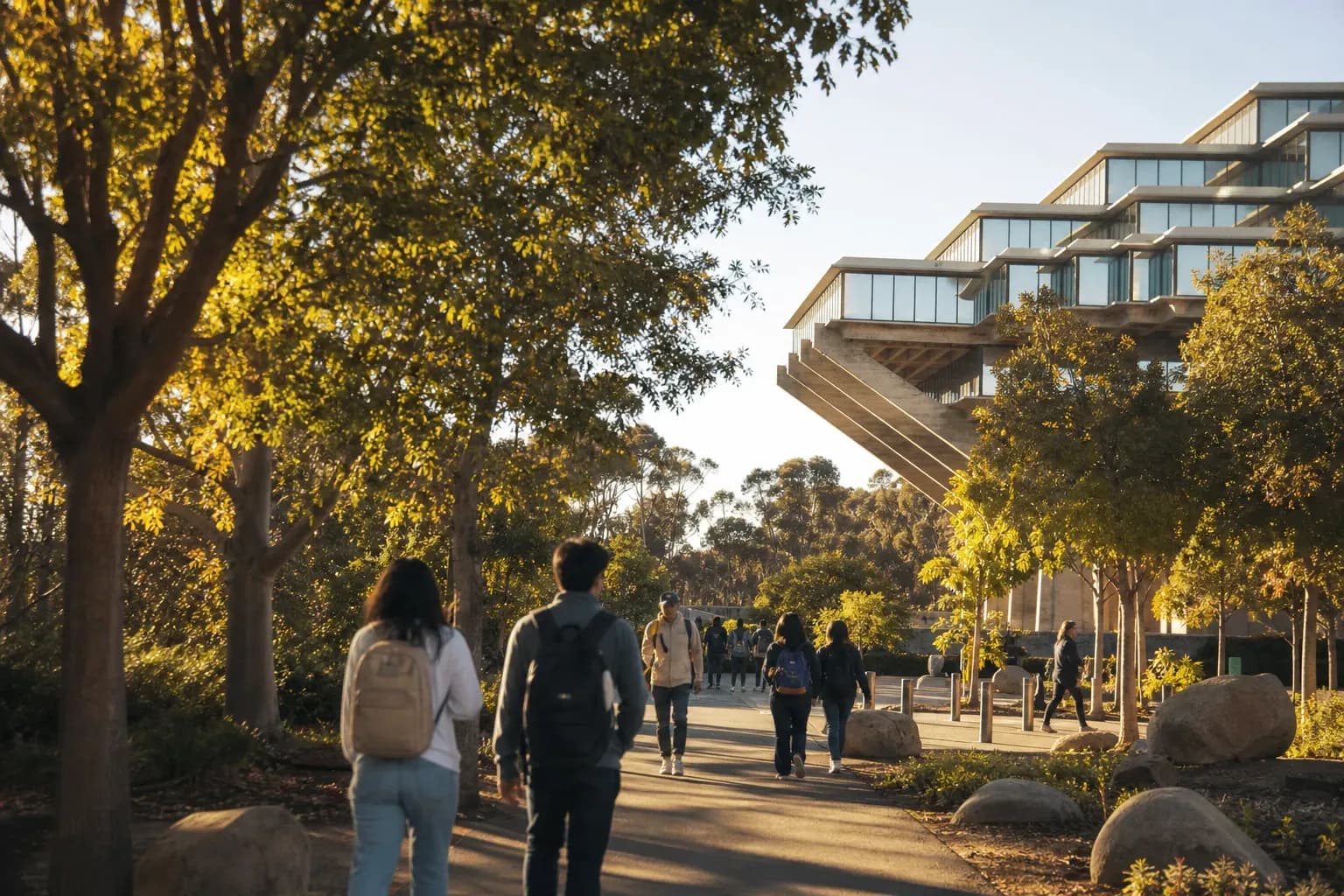
- Geisel Library: A library named after Dr. Seuss (Theodor Geisel), shaped like a spaceship and UCSD’s most famous landmark
- Sun God: A 1983 campus public art piece, a golden winged bird-god sculpture
- The Stuart Collection: 18 campus public art pieces, including the “Snake Path” next to Geisel Library
- Scripps Pier: UCSD’s oceanography research pier extending into the Pacific
- Black's Beach: A La Jolla beach and student surfing destination
8. Research and Resources
Libraries
- Geisel Library (main library)
- 5 libraries across campus, with a total collection of 7 million volumes
- The Scripps Institution of Oceanography archives are the world’s leading oceanography archives
Major Labs / Research Centers
- Scripps Institution of Oceanography: #1 in global oceanography
- Salk Institute for Biological Studies: shares a research network with UCSD (a gathering place for Nobel laureates)
- Sanford Consortium for Regenerative Medicine: stem cell research
- Qualcomm Institute: wireless communications and art technology
- San Diego Supercomputer Center (SDSC): supercomputing center
UCSD is world-class in life sciences, oceanography, neuroscience, and wireless communications.
9. Notable Alumni
- Tech Entrepreneurship: Susan Wojcicki (former YouTube CEO, UCSD master’s), multiple members of Khan Academy’s early engineering team
- Academia / Nobel Prizes: UCSD faculty include 27 Nobel laureates and 8 MacArthur Fellows
- Medicine: Mario Molina (Nobel Prize in Chemistry, climate change research)
- Corporate CEOs: Irwin Jacobs (co-founder of Qualcomm), Joe Tsai (co-founder of Alibaba, UCSD Economics)
- Entertainment: Mike Judge (creator of Beavis and Butt-Head, Physics)
UCSD alumni are relatively “low-key but academically strong,” which stands in sharp contrast to UCLA’s celebrity culture.
10. Little-Known Facts About UCSD
- Geisel Library is named after Dr. Seuss: UCSD’s library is the only major university library in the world named after a children’s picture book author. Dr. Seuss’s real name was Theodor Geisel. He and his wife Audrey were longtime UCSD supporters and donated 8,500 Dr. Seuss original manuscripts.
- The 7 College system is unique within the UC system: UCSD modeled its system after Oxford / Cambridge, but the 7 Colleges are ordered by founding year rather than prestige. Students rank their 7 College preferences when applying.
- Black's Beach is a nude beach: Black's Beach below the UCSD campus cliffs is one of California’s few legal clothing-optional beaches, where UCSD students surf and Salk professors jog.
- The Sun God sculpture has been stolen many times: Since 1983, students have stolen the campus Sun God sculpture multiple times. It is now fixed to its foundation. Sun God Festival is UCSD’s spring music festival with 50,000 attendees.
- UCSD is the “youngest but best-funded academically” UC campus: Founded only in 1960, 41 years after UCLA, UCSD still receives more NIH research funding than UCLA.
11. Typical Admitted Student Profile
- GPA Unweighted ~3.95+ (UC calculates weighted GPA)
- Test-Free (no scores submitted)
- 11-15 UC-approved a-g courses + 4 or more AP/IB courses
- Spike for Bioengineering: research experience, Science Olympiad, research publication
- Spike for CS: USACO, AI projects
- Essays (UC PIQs) showing academic curiosity + community engagement + personal growth
- 4 UC PIQs × 350 words; UCSD values concrete stories of academic interest and leadership
UCSD is one of the Top 30 schools where admissions outcomes differ most by major. With the same academic profile, applying to different majors can produce acceptance rates that differ by a factor of three. Applying as Pre-Major (without selecting a major) can be easier overall, but students who want to enter popular majors such as Bio/CS after enrollment must apply again under the Capped Major system.
12. What Kind of Student Is a Good Fit?
✓ Good Fit:
- Students with a clear direction in Bioengineering / Biology / Neuroscience / Pre-Med
- Students who want biomedical research opportunities and access to Salk / Scripps Research / Illumina
- Students who like a comfortable coastal climate and do not need big-city nightlife
- Students with an independent learning style who do not need an intense social life
- Families whose budget allows USD $73K/year (international students)
- Students interested in the 7 College collegiate system
✗ Not Necessarily a Good Fit:
- Students who want a lively college sports culture or Greek Life-dominated campus (UCSD has no football and is not especially lively)
- Students intimidated by a large campus (33,000 undergraduates)
- Students focused purely on liberal arts / humanities (UCSD is strongest in STEM)
- Students who want to apply ED (UC has no ED, only the 11/30 deadline)
- Students who need Need-Based international student aid (UC provides zero aid to international students)
Conclusion
UCSD is the most underrated research powerhouse in the UC system. It does not have UCLA’s Hollywood glow or Berkeley’s legendary protest culture, but it has the UC system’s deepest research foundation + most distinctive 7 College system + the location advantage of La Jolla, one of the world’s densest biotech hubs.
If you are a student who wants to pursue biomedical research, Pre-Med, Bioengineering, oceanography, or Cognitive Science, UCSD is one of the most irreplaceable places on Earth. Together with the Salk Institute, Scripps Research, and Sanford-Burnham, it forms one of the world’s strongest “campus + biotech research institute” clusters, a rare resource outside Harvard / MIT.
But the most difficult reality for Taiwanese families is that UCSD offers no Need-Based Aid to international students, its student culture is introverted and academically intense, and campus nightlife is far behind UCLA / Berkeley. If what you want is a “lively college experience + college sports + Greek Life,” UCSD will disappoint you. UCSD is a “monastery of the research university” where the right students flourish and the wrong students find it dull. This is the most concrete way Taiwanese families should evaluate UCSD.