
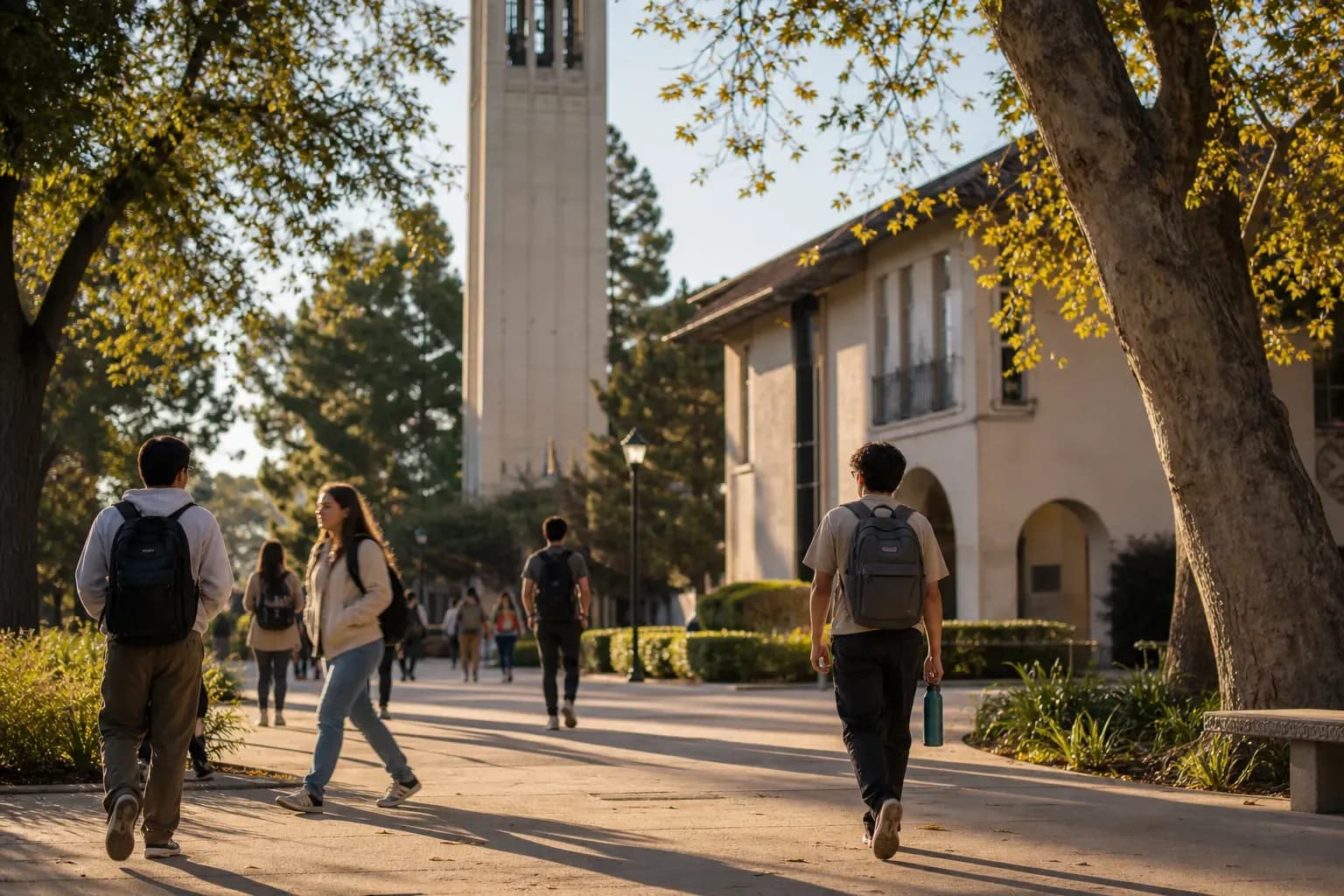
UC Santa Barbara: Top 10 Physics, Kavli Institute, 6 Nobel Laureates, Beachfront Campus
Published on October 11, 2025
Tied for #39 nationally in US News, Top 7 among Public Universities, Top 10 nationally in Physics, Top 5 nationally in Materials Science, 6 current or retired faculty members who have won the Nobel Prize, home to the Kavli Institute for Theoretical Physics, one of the world’s leading centers for theoretical physics, and the only UC campus in California that is literally on the beach: UCSB is one of the most underrated UC flagships, yet world-class in physics and materials science.
UCSB in one sentence: “The UC where you can surf and study physics + a California beach version of Caltech + the global pilgrimage site for theoretical physics through the Kavli Institute.” UCSB’s personality is perfectly contradictory: the campus sits next to the Pacific Ocean, students commute by surfboard, and Isla Vista’s party culture is legendary nationwide, yet this university also has 6 Nobel Prize winners (Walter Kohn, Alan Heeger, Herbert Kroemer, David Gross, Finn Kydland, Shuji Nakamura), with a physics department often mentioned alongside Caltech, MIT, and Stanford. To understand UCSB, start with one idea: it proves that “surfing + Nobel-level physics” can belong on the same campus.
1. Basic Information
| Item | Details |
|---|---|
| Founded | 1909 (joined the UC system in 1944) |
| Location | Goleta / Santa Barbara, California (90 minutes north of Los Angeles by car) |
| Campus | About 1,055 acres (right next to the Pacific beach) |
| Undergraduates | ~23,000 |
| Graduate students | ~3,400 |
| Student-faculty ratio | 1:18 |
| Motto | Fiat Lux (“Let there be light,” shared across the UC system) |
2. World Rankings
| Ranking | Placement |
|---|---|
| US News National Universities 2025 | #39 |
| QS World 2025 | #155 |
| THE World 2025 | #69 |
| US News Public Universities | #7 |
| Physics | Top 10 (U.S.) |
| Materials Science & Engineering | Top 5 |
| Chemical Engineering | Top 10 |
| Engineering (Undergrad) | Top 25 |
| Earth Sciences | Top 10 |
| Marine Biology | Top 5 |
| Geography | Top 5 |
| Bren School of Environmental Science | Top 3 (U.S. environmental schools) |
UCSB’s core strengths are physics + materials + chemical engineering + environmental science + marine biology. In these fields, it stands alongside Caltech, MIT, and Stanford. The Kavli Institute for Theoretical Physics (KITP) is a global pilgrimage site for theoretical physicists, bringing 2,000+ visiting scholars from around the world to UCSB each year for multi-month research programs.
3. Admissions Data (Class of 2028)
| Metric | Value |
|---|---|
| Applicants | ~110,000 |
| Admitted students | ~28,500 |
| Overall acceptance rate | About 26% |
| In-State (CA) acceptance rate | About 31% |
| OOS acceptance rate | About 25% |
| International acceptance rate | About 22% |
| Yield Rate | ~16% |
UCSB’s overall acceptance rate of 26% may look friendly, but admission to specific popular programs is extremely competitive: CS, CCS (Creative Studies), and the Bren School of Environmental Science can fall in the 5-12% range. UCSB’s College of Creative Studies (CCS) is a “college within a college”; with an acceptance rate of ~7%, it is one of the most distinctive undergraduate honors programs in the U.S.
UC uses the UC App as its shared application (deadline: 11/30), with no ED / EA, no recommendation letters, and 4 PIQs.
SAT/ACT Median Scores
| Test | 25th percentile | Median | 75th percentile |
|---|---|---|---|
| SAT | 1280 | 1390 | 1490 |
| ACT | 28 | 32 | 34 |
The UC system is Test-Free for the 2025 application cycle: SAT/ACT scores are not accepted or evaluated.
International Students
- International students make up about 11%
- Students come from 90+ countries
- About 1,500 students from China
- About 15-25 students from Taiwan are admitted each year
4. Tuition and Financial Aid
2024-2025 Cost of Attendance
| Item | Amount |
|---|---|
| In-State Tuition | USD $14,700 |
| OOS / International Tuition | USD $46,400 |
| Housing | USD $17,500 |
| Food | USD $7,500 |
| Personal + Misc | USD $4,500 |
| In-State Total | USD $44,000+ |
| OOS / International Total | USD $76,000+ |
UCSB’s OOS tuition is standardized across the UC system, but housing costs are slightly higher than UCLA and UCSD. Santa Barbara is one of the most expensive housing markets in California, Isla Vista student apartments are packed, and off-campus rent for a one-bedroom apartment can run USD $1,200-1,800 per month.
Need-Based Aid
- Blue & Gold Opportunity Plan: California resident families with annual income under $80,000 receive full tuition coverage
- Middle Class Scholarship: California resident families with annual income under $217,000 receive partial support
- International students are Need-Aware, and aid is extremely limited
- Regents' Scholarship: UCSB’s most prestigious campuswide scholarship (USD $7,500/year) + priority course registration
- Promise Scholars / CCS Scholars: CCS students may apply for special scholarships
- Average Aid: USD $20,000/year (California residents)
UCSB is generous to California residents, but OOS / international students should evaluate it as a self-funded option.
5. Academic Structure / Signature Programs
Main Undergraduate Colleges
- College of Letters and Science (L&S): The largest college, including Bio, Econ, Psych, and CS
- College of Engineering: CS, ECE, ME, CCE, Materials
- College of Creative Studies (CCS): A “college within a college” honors program with 8 interdisciplinary majors and an acceptance rate of ~7%
- Bren School of Environmental Science & Management: Graduate school, but undergraduates may pursue a double major
Signature Programs
- Physics @ College of L&S: On the same tier as Caltech, MIT, and Stanford; students can directly encounter world-leading theoretical physicists through the Kavli Institute
- Materials Science: Top 5 nationally; Shuji Nakamura (2014 Nobel Prize in Physics) invented the blue LED at UCSB
- College of Creative Studies (CCS): UCSB’s most distinctive signature program; students enjoy freedom from “credit pressure + GE requirements,” choose their own research direction, and can select from only 8 majors: Art, Biology, Chemistry & Biochemistry, CS, Literature, Mathematics, Music Composition, Physics
- Marine Biology: UCSB sits directly on the Pacific; the Marine Science Institute conducts world-class marine biology research
- Bren School of Environmental Science: Top 3 nationally among environmental graduate schools
- University Honors Program: An honors track open to all L&S students
- Regents' Scholars Program: The highest-level honor across the UC system
- Faculty Mentor Program: 1-on-1 faculty-guided research for undergraduates
General Education Structure
UCSB uses a GE Pattern covering seven broad areas: writing, quantitative reasoning, foreign language, arts, humanities, social sciences, natural sciences, and more. CCS students are exempt from most GE requirements, which is the greatest flexibility UCSB gives to exceptionally talented students.
6. Campus Culture / School Personality
UCSB’s personality can be summed up in one sentence: “Surfing + parties + Nobel Prize physics = California’s most contradictory campus culture.” UCSB students (who call themselves “Gauchos,” after the Mexican cowboy tradition) are famous for “playing hard but studying hard too.” They may party in Isla Vista on Thursday, surf in the Pacific on Friday morning, and then spend the weekend at the Kavli Institute discussing superstring theory with Nobel laureates.
UCSB’s academic culture is “party hard, work hard, surf harder.” The atmosphere is much more relaxed than UCLA or Berkeley, but academically stronger than UC Davis or Riverside. It is a strange balance of “not hyper-competitive, yet elite.”
Greek Life / Student Organizations
- About 12% of students join a Fraternity / Sorority
- Greek Life plays a major role in Isla Vista party culture
- Signature events: Halloween in Isla Vista (one of the largest college parties in the U.S., once drawing 40,000 people before heavy police controls), Deltopia (large spring Isla Vista party), Floatopia (student beach floating party)
- Adventure Programs are active, including surfing, rock climbing, diving, and hiking
Sports Culture
- Big West Conference (NCAA Division I)
- Signature sports: men’s water polo (consistently Top 5 nationally), men’s basketball, surfing, women’s volleyball
- No American football: UCSB disbanded its football team in 1992
- The “Blue-Green Rivalry” with Cal Poly SLO is a Big West classic
7. Location / Campus Environment
City Positioning
UCSB’s campus is truly on the Pacific beach. West Beach borders the Pacific Ocean, and student housing is a 5-minute walk from the beach. UCSB is one of the few genuine “beach campuses” in the U.S.; other coastal universities, such as UCSD and Pepperdine, are still several miles away from the water.
Distances:
- Santa Barbara Downtown: 10 miles by car
- Los Angeles: 90 minutes by car
- San Francisco: 5 hours by car
- Solvang (Danish-style town): 45 minutes
- Wine Country (Santa Ynez Valley): 30 minutes
- LAX Airport: 90 minutes by car
- Santa Barbara Airport: 5 minutes by car
Isla Vista is UCSB’s “off-campus campus.” This student rental area sits directly next to campus, with 23,000 students plus some local residents packed into 2.5 square miles, making it one of the most densely populated neighborhoods in the U.S. Isla Vista is the main hub for student parties, shopping, restaurants, and bars.
Climate
- Winter: 5-18°C, low rainfall
- Summer: 15-25°C, one of the best climates in the U.S., with cool ocean breezes and no muggy heat
- Spring and fall: sunny, with 280+ days of sunshine per year
- You really do not need a winter coat
Campus Landmarks
- Storke Tower: 175-foot bell tower built in 1969, the heart of campus
- Campus Lagoon: Campus lagoon where students practice kayaking
- Isla Vista Beach Park: Beach area next to campus
- Kavli Institute for Theoretical Physics: Global pilgrimage site for theoretical physics
- Marine Science Institute: Marine research center
- Davidson Library: Main library
- University Center (UCen): Student center
8. Research and Resources
Libraries
- Davidson Library (main library)
- 4 libraries campuswide, with a total collection of 3.2 million volumes
Notable Labs / Research Centers
- Kavli Institute for Theoretical Physics (KITP): A global center for theoretical physics research, with 2,000+ visiting scholars each year
- California NanoSystems Institute (CNSI): Nanotechnology research center (shared with UCLA)
- Materials Research Laboratory: A major hub for materials science
- Marine Science Institute: Marine biology + oceanography
- Earth Research Institute: Earth sciences
- Bren School of Environmental Science: Environmental policy
- Center for Stem Cell Biology and Engineering: Stem cell research
UCSB is world-class in theoretical physics, materials, chemical engineering, environmental science, and marine biology. Shuji Nakamura invented the blue LED at UCSB (2014 Nobel Prize in Physics), a discovery that made LED light bulbs possible worldwide.
9. Notable Alumni
- Nobel Prize faculty: Walter Kohn (Chemistry 1998), Alan Heeger (Chemistry 2000), Herbert Kroemer (Physics 2000), David Gross (Physics 2004), Finn Kydland (Economics 2004), Shuji Nakamura (Physics 2014, inventor of the blue LED)
- Politics: Bill Cosby (attended UCSB), Anthony Pratt (Australian politician)
- Tech entrepreneurship: Reid Hoffman (co-founder of LinkedIn, attended UCSB Symbolic Systems), Jonah Peretti (founder of BuzzFeed), Rob Estes
- Finance / Business: Jack Fitzpatrick (financier)
- Entertainment / Literature: Michael Douglas (actor, Academy Award winner), Carol Vorderman, Gwyneth Paltrow (attended briefly), Maddie Ziegler, Nicole Brown Simpson
- Sports: Multiple Olympic surfers and water polo athletes
UCSB is a hybrid of a theoretical physics Nobel factory + a cradle for Silicon Valley entrepreneurs + a backup roster for Hollywood stars.
10. UCSB Fun Facts
- UCSB is the only research university in the U.S. with a campus directly on the beach: West Beach and Goleta Beach sit right next to campus, so students can leave physics class and head straight into the water with a surfboard. Sands Beach is a well-known surf spot, and UCSB’s surf club is NCAA Top 5 nationally.
- Shuji Nakamura invented the blue LED at UCSB: He first developed the blue LED while working at Nichia in Japan, but the company undervalued him. After leaving, he joined UCSB Materials Science in 2000 and won the Nobel Prize in Physics in 2014. Every LED bulb in the world owes something to Nakamura and UCSB.
- The Kavli Institute is a global pilgrimage site for theoretical physics: Each year, 2,000+ physicists come to UCSB for multi-month “programs.” Stephen Hawking, Edward Witten, and Frank Wilczek have all been frequent visitors. KITP students may have the chance to eat lunch with the world’s leading physicists, which is rare even at Caltech or MIT.
- Isla Vista is one of the most densely populated neighborhoods in the U.S.: 23,000 UCSB students plus residents are packed into 2.5 square miles, making it denser than some parts of Manhattan. Isla Vista party culture / Halloween weekend once drew 40,000 people, requiring major police crowd control.
- The UCSB Gauchos mascot comes from Mexican cowboy culture: Students voted for the Gaucho in 1936, reflecting California’s Spanish cultural roots. At athletic events, you will hear “Olé” cheers.
11. Typical Admitted Student Profile
- GPA Unweighted ~3.85+ (UC weighted GPA 4.10+)
- SAT/ACT not evaluated (UC Test-Free)
- 8-12 AP / Honors courses (Physics, Calc BC, and Chem are popular)
- Physics spike: physics competitions (USAPhO, IPhO), research publications
- CCS spike: art portfolio / research experience / math competitions; CCS applicants must show a distinctive “genius-like” quality
- Marine Bio spike: ocean volunteering, diving certification, marine research
- Engineering spike: FIRST Robotics, Hackathon, research publications
- Essays (PIQ) should show genuine academic passion + a California sensibility
- UC App has no recommendation letters, so storytelling depends entirely on the PIQs
Within the UC system, UCSB is one of the schools that cares most about genuine passion + self-motivation. CCS applicants are especially different: CCS is not looking only at scores; it is asking whether the student truly has an obsession.
12. What Kind of Student Is a Good Fit?
✓ Good fit for:
- Students who want to study Physics / Materials / Chemistry / Marine Biology (UCSB is Top 10 in these fields)
- Students drawn to a balance of “academics + beach + California life”
- Students interested in the CCS college-within-a-college model and academic freedom without GE requirements
- Students who want a UC education without the pressure level of UCLA / Berkeley
- Students who enjoy ocean activities: surfing, diving, kayaking
- Families with a budget of USD $76K/year (OOS / international students)
✗ May not be the best fit for:
- Students who want Power 5 American football culture (UCSB has no football)
- Students uncomfortable with a prominent party culture (Isla Vista is famous)
- Students expecting Top 10-level Engineering (UCSB Engineering is Top 25, not Georgia Tech-level)
- Students who want a traditional urban campus (UCSB is in suburban Goleta)
- International students who need Need-Blind aid
- Students who want to be “close to home and easy for family to visit” (it is a 90-minute drive from LAX)
Conclusion
UCSB is the most underrated, most contradictory, and perhaps happiest public university in the Top 40. It is not Berkeley’s academic myth, nor UCLA’s Hollywood halo, but its Physics is Top 10 nationally, the Kavli Institute is a global leader in theoretical physics, it has 6 Nobel Prize winners, and it is where the blue LED was invented. If your direction is physics, materials, chemical engineering, environmental science, or marine biology, UCSB is one of the strongest choices in the UC system.
If you are a student aiming for physics / materials / environmental science, UCSB offers something UCLA and UCSD cannot: direct exposure to world-leading physicists through the Kavli Institute + perfect weather + a balance of academics and surf life + the academic freedom of the College of Creative Studies, a “college within a college” for highly talented students.
The most concrete advice for Taiwanese families: UCSB is the best choice for families who “want the UC brand + do not want excessive competitive pressure + want a seaside environment + are interested in physics / materials.” Its OOS cost is the same as UCLA / UCSD at USD $76K/year, but the academic atmosphere is much more relaxed, student happiness is much higher, and the California climate is close to perfect. This is a “happy good school.”
But the harshest reality for Taiwanese families: UCSB’s “party reputation” is a double-edged sword. Isla Vista Halloween and Deltopia are nationally known, and many conservative parents object as soon as they hear about them. UCSB students are the kind of kids who can both play and study. If your child has weak self-discipline, the party temptations of Isla Vista could lead them to overdo it and damage their academics. UCSB is not for students who need strict external management; it is for students who can balance work and life on their own. If your child can go to an Isla Vista party and still remember the Nobel lecture at the Kavli Institute, UCSB has no equal on Earth. That is the most practical judgment UCSB offers Taiwanese families.