
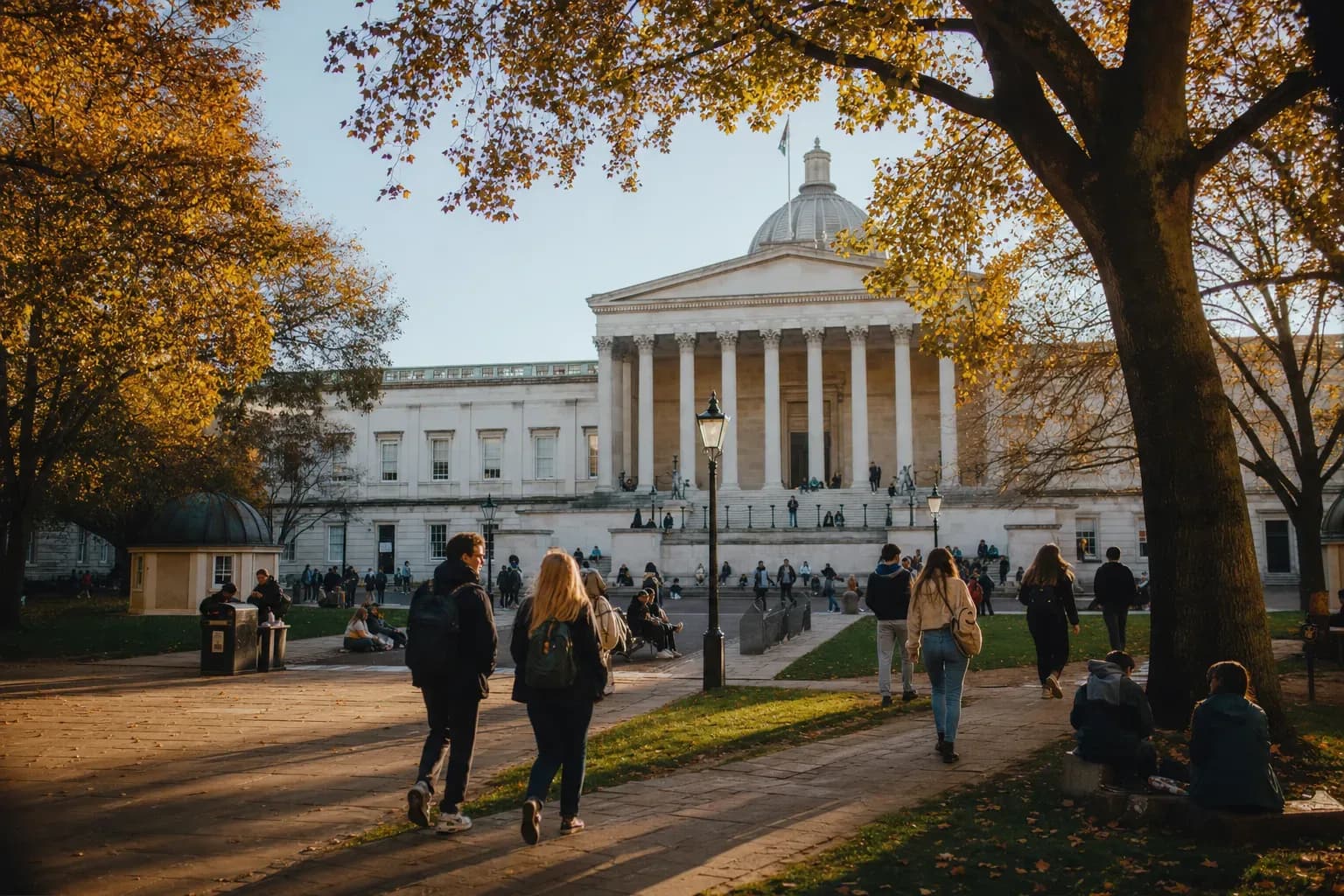
University College London (UCL): The UK’s Largest Russell Group University, Bloomsbury’s Academic Quarter, and 200 Years of Liberal Tradition
Published on December 10, 2025
Ranked 9th globally in QS 2026, with the largest undergraduate population in the UK and one of the largest postgraduate populations in Europe, University College London (UCL) is the top UK university that feels least like a traditional UK university. When it was founded in 1826, UCL was the first university in the UK to admit students regardless of religion, gender, or race. At the time, Oxford and Cambridge still admitted only male members of the Church of England. For that reason, UCL was known at the time as "the godless college on Gower Street".
UCL’s character can be summed up in one sentence: liberal, diverse, huge, and practical. It does not have the collegiate system of Oxbridge, the pure STEM focus of Imperial, or the single business-and-management focus of LSE. UCL is a comprehensive Russell Group university with the largest number of departments in the UK. Here, you can study AI, Medicine, Architecture, where the Bartlett ranks in the global top 3, Slavonic Studies, where Eastern European studies are ranked first in Europe, world-class Egyptology, and Statistical Science, the world’s first statistics department.
1. Basic Information
| Item | Details |
|---|---|
| Founded | 1826 |
| Location | Bloomsbury, London Zone 1 |
| Campus | Bloomsbury main campus + East (QEOP) + Stratford and others |
| Undergraduates | ~22,500 (the most among all Russell Group universities in the UK) |
| Postgraduates | ~25,800 |
| Group affiliation | Russell Group |
| Motto | Cuncti adsint meritaeque expectent praemia palmae (Let all come who by merit deserve the most reward) |
| Founding principle | The UK’s first non-religious university to admit women and ethnic minorities |
2. World Rankings
| Ranking | Position |
|---|---|
| QS World 2026 | #9 |
| THE World 2026 | #22 |
| Complete University Guide 2026 (UK) | #13 |
| Guardian University Guide 2026 (UK) | #11 |
| QS Education | #1 |
| QS Architecture (Bartlett) | #1 |
| QS Anthropology | #5 |
3. Admissions Data (2025 Entry)
| Metric | Figure |
|---|---|
| Applicants | ~70,000 |
| Admitted students | ~7,500 |
| Overall acceptance rate | Around 11% |
| International applicant acceptance rate | ~10% |
| Acceptance rate for popular subjects (CS / Econ / Architecture) | < 10% |
| Medicine acceptance rate | ~8% (including BMAT + interview) |
| Yield Rate | ~50% |
Typical A-Level / IB Offers
| Subject Area | Standard A-Level offer | Standard IB offer |
|---|---|---|
| Computer Science | A*A*A (including Math A*) | 39-40 points (HL 776) |
| Economics | A*A*A (including Math) | 39 points (HL 766 including HL Math) |
| Architecture (Bartlett) | AAB + portfolio | 36 points + portfolio |
| Medicine | A*AA (Chemistry + Biology) + UCAT | 39 points (HL 766) |
| Math | A*A*A (including Math A* + Further Math) | 39 points (HL 776 including HL Math) |
| Humanities | AAA-AAB | 36-38 points |
International Students
- International students make up around 45% of the undergraduate population, the highest proportion in the Russell Group
- Students come from 150+ countries
- Around 30-50 students from Taiwan are admitted each year, mainly for CS, Econ, Architecture, Medicine, and Law
- Applications go through UCAS; most subjects do not require an admissions test, though Math requires STEP and Medicine requires UCAT
4. Tuition Fees and Living Costs
2025-2026 International Tuition Fees
| Subject Area | Tuition fee (per year) |
|---|---|
| Humanities / Arts / Social Sciences | £28,100-32,100 |
| Economics / Management | £35,100 |
| Engineering / CS / Math / NatSci | £38,100 |
| Architecture (Bartlett) | £37,500 |
| Medicine (Pre-clinical) | £42,500 |
| Medicine (Clinical) | £52,800 |
London Living Costs (Very High)
| Item | Amount |
|---|---|
| On-campus / nearby accommodation | £11,000-17,000/year |
| Food + transport + miscellaneous expenses | £8,000-10,000/year |
| Total (including tuition) | Around £50,000-72,000/year |
Graduate Route Visa
After graduation, students can apply for the Graduate Route, which grants 2 years of work permission in the UK for master’s / bachelor’s graduates and 3 years for PhD graduates, with no employer sponsorship required. It is especially convenient for UCL graduates to stay and work in the UK because the main campus is in London Zone 1, within 30 minutes of both Canary Wharf and the City.
Scholarships
- UCL Global Undergraduate Scholarship: £10,000-15,000/year (depending on nationality / family circumstances)
- Denys Holland Scholarship: £9,200/year (international students)
- Chevening / GREAT / Commonwealth: mainly for postgraduate study
5. Program Structure / Signature Programs
Undergraduate Structure (11 Faculties)
UCL is the most comprehensive university in the UK in terms of subject range: Arts & Humanities, Brain Sciences, Built Environment, Engineering, IoE (Education), Laws, Life Sciences, Math & Physical Sciences, Medical Sciences, Population Health, and Social & Historical Sciences.
Signature Programs
- The Bartlett School of Architecture: QS global Architecture #1 for many consecutive years, one of the world’s leading architecture schools
- Computer Science: Top five in the UK for CS, alongside Imperial / Oxbridge. Demis Hassabis, founder of DeepMind, completed his PhD at UCL
- UCL Institute of Education (IoE): QS global Education #1 for 12 consecutive years
- UCL Medical School: One of the UK’s top three medical schools, offering a 6-year MBBS
- UCL Faculty of Laws: UK Law Top 3
- Slade School of Fine Art: One of the UK’s leading fine art schools
- SSEES (Eastern European Studies): Europe’s largest school for Eastern European / Russian / Central Asian studies
- MSci / MEng 4-year programs: Similar to Imperial, engineering and some science subjects offer 4-year integrated master’s programs
Interdisciplinary Programs
- Arts and Sciences (BASc): UCL’s original “humanities + sciences” dual-track degree, launched in 2012
- PPE (Politics, Philosophy & Economics): UCL’s version of PPE, considered alongside Oxford PPE as one of the UK’s top two
Teaching Style
UCL uses a large lecture + small seminar / tutorial model, with 12-15 hours of lectures per week plus 5-8 hours of seminars / labs. There is no Oxbridge-style 1-to-1 tutorial system, though some humanities departments offer essay feedback groups. Research is valued more strongly than teaching, and undergraduate contact with professors is lower than at Oxbridge, but final year projects can involve deep work with research teams.
6. Campus Culture / Institutional Personality
UCL’s character is liberal, international, urban, and left-leaning. Since its founding in 1826, it has rejected religious and gender discrimination, and that DNA remains central to UCL’s culture today.
Jeremy Bentham’s Body
The South Cloister on campus still displays the real preserved body of UCL’s spiritual founder Jeremy Bentham, known as the Auto-Icon. His head has been replaced by a wax model, as the real head was once stolen by students. UCL students joke that "Bentham still attends council meetings".
Students' Union UCL
There are 300+ student societies. Some of the most diverse include Bartlett Society (architecture), UCL UN Society, Indian Society, and Taiwanese Society.
Intercollegiate Rivalries
- UCL vs KCL Varsity: An annual sports rivalry with King's College London, with rugby as the main event
- UCL Boat Race
7. Location / Campus Environment
Urban Position
UCL’s main campus is located in Bloomsbury, London Zone 1, next to the British Museum and a 5-minute walk from Euston / King's Cross / Russell Square Underground stations. This is London’s academic and cultural heart. SOAS, Birkbeck, UCL, the British Library, and the British Museum are all within this one-square-kilometer area.
Campus Structure
- Bloomsbury main campus: All undergraduate faculties + most postgraduate programs
- UCL East (Queen Elizabeth Olympic Park): A new campus opened in 2022, focused on engineering + creative industries
- Stratford / Royal Free / Whittington Hospitals: Clinical bases for the medical school
Climate
- London has a temperate oceanic climate, with winters around 2-8°C and summers around 15-25°C
- Cloudy and rainy throughout the year
Campus Landmarks
- Wilkins Building (1828 neoclassical main building)
- South Cloister (home of the Bentham Auto-Icon)
- Petrie Museum of Egyptian Archaeology (world-class Egyptology collections)
- Grant Museum of Zoology
- Cruciform Building (symbolic building of the medical school)
8. Research and Resources
Libraries
- UCL Main Library: Inside the Wilkins Building, with UCL’s most classical reading rooms
- Science Library / Cruciform Library (medicine) / Bartlett Library (architecture)
- Borrowing access includes University of London Senate House Library (one street away) + British Library (5-minute walk)
Notable Labs / Research Centers
- Birthplace of DeepMind: While completing his PhD in UCL CS, Demis Hassabis founded DeepMind with Shane Legg and Mustafa Suleyman; it was acquired by Google in 2014
- Francis Crick Institute: Europe’s largest biomedical research institute, jointly operated with Imperial / King's
- Bartlett Centre for Advanced Spatial Analysis: A major center for urban data science
- Sainsbury Wellcome Centre: Neuroscience
9. Notable Alumni
- Tech entrepreneurship: Demis Hassabis (DeepMind), Mustafa Suleyman (DeepMind / Inflection AI / Microsoft AI CEO), Shane Legg (DeepMind)
- Politics: Mahatma Gandhi (did not complete his degree), Junichiro Koizumi (former Prime Minister of Japan), Ricardo Lagos (former President of Chile)
- Literature and arts: Christopher Nolan (film director), all four members of Coldplay (Chris Martin, Jonny Buckland, Guy Berryman, and Will Champion are all UCL alumni)
- Science: Alexander Graham Bell (inventor of the telephone), Francis Crick (DNA double helix), Otto Hahn (nuclear fission)
- Entertainment: Ricky Gervais, Derek Jacobi, Jonathan Ross
- Academia: 33 Nobel Laureates
10. Lesser-Known Facts About UCL
- Jeremy Bentham’s “Auto-Icon”: After Bentham, UCL’s spiritual founder, died in 1832, his body was permanently preserved and displayed according to his wishes. Students take photos with him every year on alumni day.
- UCL was the UK’s first university in the modern sense: Before the 19th century, Oxford and Cambridge admitted only members of the Church of England. UCL broke that restriction first in 1826.
- University of London federation: UCL, KCL, LSE, Imperial (which has since left), SOAS, Birkbeck, Queen Mary, and others have all been member institutions of the University of London, though UCL and KCL have long awarded their own degrees independently.
- Bartlett’s architecture school is ranked first globally: It has ranked #1 in QS for many consecutive years, ahead of MIT, Harvard, and ETH.
- Coldplay formed in UCL halls: In 1996, Chris Martin and Jonny Buckland met and formed the band in Ramsay Hall, later joined by Guy Berryman.
- The 2012 London Olympics and UCL East: UCL built its new UCL East campus in Queen Elizabeth Olympic Park. Completed in 2022, it is one of the UK’s largest modern campus expansions.
11. Typical Admitted Student Profile
- A-Level A*A*A or IB 39-40 (including HL 776)
- Math must be A* or HL 7 for STEM / Economics
- Some CS / Math students have STEP / MAT scores, which are not required but can strengthen an application
- Medicine requires UCAT + interview (MMI)
- Architecture requires a portfolio + interview
- Personal Statement within 4,000 characters / 47 lines: 80% academic + 20% extracurricular + international perspective
- UCL favors international outlook and diverse backgrounds, with international students making up 45% of the student body
- No Oxbridge-style interview except for Medicine, Bartlett, Slade, and a few others
12. What Kind of Student Is UCL Best For?
✓ Best suited for:
- Students who want to work, socialize, and live in London
- Students who like a large, international, diverse campus
- Students who want to study distinctive or niche subjects such as Architecture, Education, Egyptology, or Slavonic Studies
- Students with clear academic passion who can self-study without needing 1-to-1 tutorials
- Students who want proximity to the City of London financial district / King's Cross tech cluster
- Students who do not need a collegiate system
✗ Not necessarily suited for:
- Students who want a small-college, tight-knit atmosphere; UCL is very large, with 22,500 undergraduates
- Students drawn to Oxbridge college dinners and tutorial culture; consider Oxbridge / Durham instead
- Students with limited budgets who do not want to bear London’s high living costs
- Students who want hand-holding teaching; UCL’s teaching style is relatively hands-off
- Students who want a classical small-town atmosphere
Conclusion
Among the UK’s Russell Group universities, UCL is the one that feels most like NYU and least like Oxbridge. If you read our NYU profile and thought, “I want an urban university, a diverse community, and direct access to finance / tech / creative industries,” UCL is the UK equivalent, with a much higher QS ranking than NYU.
UCL does not have Oxbridge’s 800 years of ceremony, but it does have Bloomsbury in central London, 200 years of liberal tradition, the world-leading Bartlett School of Architecture, and the technological lineage of DeepMind’s birthplace. If your path is “study in London, stay for work, and build a future in the UK,” UCL can be a more practical choice than Oxbridge because you do not need to move after graduation; you are already in London. The point Taiwanese families most often overlook is that UCL’s undergraduate scale is enormous, with 22,500 undergraduates, so professors pay far less individual attention to undergraduates than they do at Oxbridge. You come to UCL to self-study and to seize London’s opportunities, not to wait for a supervisor to spoon-feed you.
Sources:
- UCL Undergraduate Admissions
- UCL International Students
- UCL Tuition Fees 2025-26
- Retrieved on: 2026-05-14