
University of Tsukuba: The Original G30 Flagship, Tsukuba Science City, and English-Taught Undergraduate Study in Asia's Largest Research Park
Published on December 28, 2025
If you have heard the name "Tsukuba," it is probably because of Tsukuba Science City. Since the 1960s, the Japanese government has developed it as "Asia's largest research park," bringing together more than 30 national research institutions, including JAXA's space headquarters, KEK's high-energy accelerator facilities, and the National Institute of Advanced Industrial Science and Technology (AIST), all inside a planned city 50 kilometers north of Tokyo. The University of Tsukuba is the academic heart of this science city.
The University of Tsukuba is one of the original 13 G30 universities and an SGU Type A Top Global University, standing alongside the University of Tokyo, Kyoto University, Tohoku University, Osaka University, Kyushu University, Hokkaido University, Nagoya University, and Tokyo Tech. Its English-taught undergraduate programs cover three major fields: social sciences (SIS), life and environmental sciences (LIFE), and medical sciences. This portfolio is unusually comprehensive within the G30 system. If you want to study at a top research university in Asia for JPY 535,800 per year, avoid Tokyo's congestion, and still live just a five-minute drive from Japan's largest research park, Tsukuba is the answer.
1. Basic Information
| Item | Details |
|---|---|
| Founded | 1973 (originating from Tokyo Normal School, founded in 1872, with a history traceable back 150 years) |
| Institution type | National university corporation |
| Location | Tennodai, Tsukuba, Ibaraki Prefecture |
| Campus | Approx. 258 hectares (one of Japan's largest single campuses) |
| Undergraduate students | ~9,800 |
| Graduate students | ~6,500 |
| Student-faculty ratio | 1:8 |
| Motto | "Imagine the Future" |
2. World Rankings
| Ranking | Position |
|---|---|
| QS World 2026 | #380 |
| THE World 2026 | #401-500 |
| QS Asia 2026 | #58 |
| THE Asia 2026 | #61 |
| QS Sports-related subjects | #9 (global top 9) |
| QS Sports Science | #1 in Asia |
| THE Japanese National Universities | Top 10 |
Tsukuba is a dual flagship under both G30 and SGU Type A. In sports science, education, and life sciences, Tsukuba is widely recognized as one of Japan's top three universities. It was also Japan's first university to replace traditional faculties with interdisciplinary colleges and schools. This cross-disciplinary design was 30 years ahead of most other Japanese national universities.
3. Admissions Data (2024 Entry)
Tsukuba's G30 undergraduate division has three main programs, all taught 100% in English with no Japanese required for admission.
Bachelor's Program in Social International Studies (SIS)
| Metric | Figure |
|---|---|
| Applicants | ~150-200 |
| Admitted students | ~25-30 |
| Overall acceptance rate | Approx. 15-20% |
| Fields | International relations, sociology, politics, economics, cultural studies |
Bachelor's Program in Life & Environmental Sciences (LIFE)
| Metric | Figure |
|---|---|
| Applicants | ~100-150 |
| Admitted students | ~20-25 |
| Overall acceptance rate | Approx. 18-22% |
| Fields | Biology, biochemistry, agricultural science, forestry, environmental science |
Bachelor's Program in Medical Sciences
| Metric | Figure |
|---|---|
| Applicants | ~80-120 |
| Admitted students | ~12-18 |
| Overall acceptance rate | Approx. 13-16% |
| Fields | Medical sciences (four-year program, not a clinical physician track) |
Application Requirements
| Item | Requirement |
|---|---|
| English proficiency | TOEFL iBT 80+ / IELTS 6.5+ (Medical Sciences applicants are advised to target iBT 90+) |
| Standardized tests | SAT 1250+, ACT 26+, IB 34+, or three A-Level subjects at B or above |
| Japanese | Not required at all for admission; N3 or above is recommended by graduation for employment |
| Recommendation letters | 2 |
| Essay | Statement of Purpose, Study Plan |
| Interview | Online interview (required for most programs) |
International Students
- International students make up around 60-70% of G30 undergraduate programs
- Tsukuba's overall international student ratio is around 18% (top tier among Japanese national universities)
- 2-4 students from Taiwan are admitted each year
4. Tuition and Financial Aid
2025 Tuition (National University Standard)
| Item | Amount (JPY) | Approx. TWD |
|---|---|---|
| Admission fee | 282,000 | ~60,000 |
| Tuition (annual) | 535,800 | ~110,000 |
| Dormitory (student housing, monthly) | 17,000-30,000 | ~3,700-6,500 |
| Living expenses (monthly, Tsukuba) | 60,000-85,000 | ~13,000-19,000 |
| Estimated four-year total cost | Approx. JPY 5.5-7M | ~TWD 1.2-1.5M |
Living costs in Tsukuba are 30-40% lower than in Tokyo. This is one of Tsukuba's most underrated advantages. Dormitories are affordable, meals are cheaper, and the lowest student dormitory rent is JPY 17,000 per month, or roughly TWD 4,000.
MEXT Scholarships
- MEXT Embassy Recommendation Scholarship: full tuition waiver + JPY 117,000 monthly living stipend
- MEXT University Recommendation Scholarship: nominated directly by Tsukuba (G30 program applicants may apply at the same time)
Tsukuba Internal Scholarships
- Tsukuba Scholarship: full tuition waiver + partial living support
- JASSO Honors Scholarship: JPY 48,000-80,000 per month
- Tsukuba Science City corporate-sponsored scholarships: dozens of awards each year in partnership with local companies
5. Academic Structure / Signature Programs
Tsukuba's most distinctive design is its "colleges / schools" system. Instead of traditional faculties, it uses an interdisciplinary structure of 9 colleges and 23 schools. Students can take courses across multiple schools.
Three Main G30 Undergraduate Programs
1. Social International Studies (SIS)
- Four-year, fully English-taught program covering international relations, sociology, economics, and politics
- Integrated with the School of Humanities and Culture and the School of Social and International Studies
- Signature faculty research areas include Asian regional integration and East Asian geopolitics
2. Life & Environmental Sciences (LIFE)
- Four-year, fully English-taught program with dual tracks in biological sciences and environmental sciences
- Students begin laboratory placement from the third year
- Connected to local Tsukuba institutions such as AIST, the Ministry of Agriculture, Forestry and Fisheries, and JAMSTEC
3. Medical Sciences
- Four-year non-clinical track. Graduates can move into research, pharmaceuticals, biotechnology, Medical Tech, and health policy
- Not a clinical medical degree. Students who want to become physicians must pursue the separate six-year Japanese-taught medical program
- Courses are offered in cooperation with the University of Tsukuba's medical and health sciences faculty
Sports Science (Japan's Best)
Although the undergraduate College of Health and Physical Education is mainly taught in Japanese, Tsukuba is Japan's top university for Sport Science. Training science advisors for Shohei Ohtani have come from Tsukuba, and many coaches in the Japanese Olympic Committee are graduates of Tsukuba's sports science programs. If you are interested in sports science, the English-taught G30 master's pathway is worth considering.
Informal Faculty Consent System (Graduate Level)
Graduate applicants to Tsukuba must contact a prospective supervisor and obtain informal consent before applying. Tsukuba professors are more international-student-friendly than the Japanese average, which is one of the advantages of being a G30 flagship university. Many professors hold PhDs from the U.S. or Europe and can discuss research plans in English.
6. Campus Culture / Institutional Personality
Tsukuba's campus character can be summed up in a few words: STEM, research, planned city, bicycles.
- Tsukuba is a planned city: the entire city was built for scientific research. This means the boundary between campus and city is blurry, and students can access national research institutions such as JAXA and AIST with unusual ease
- Bicycles are everywhere on campus: the 258-hectare campus is too large to navigate comfortably on foot, so almost all students cycle, giving rise to memes about Tsukuba's unique bicycle culture
- Japanese is not always necessary: because G30 students and international researchers are highly visible, many convenience stores and restaurants can respond in English
- The STEM atmosphere outweighs the literary one: Tsukuba students tend to be research-oriented, experimental, and science-driven. It suits students with genuine enthusiasm for real research
- Student housing is concentrated: Tsukuba is one of the Japanese national universities that most resembles an American residential college, with more than 90% of first-year students living in dormitories
7. Location / Campus Environment
City Positioning
Tsukuba has a population of about 250,000 and is Japan's youngest planned city.
- Tokyo to Tsukuba: 45 minutes by Tsukuba Express (direct from Akihabara)
- From Narita Airport: 1 hour 20 minutes by highway bus
- Tsukuba Station to campus: 10 minutes by bus / 15 minutes by bicycle
- Tsukuba Science City: 30+ national research institutions, including JAXA, KEK, AIST, the National Research Institute for Earth Science and Disaster Resilience, and the National Agriculture and Food Research Organization
Tsukuba's biggest advantage is that it is "close enough to Tokyo, but not inside Tokyo." Students can take the express train into central Tokyo for leisure, concerts, and internships, while daily life remains based in a quiet research city.
Climate
- Winter: 0-10°C, dry and cold, with little snow
- Summer: 22-32°C, slightly cooler than Tokyo
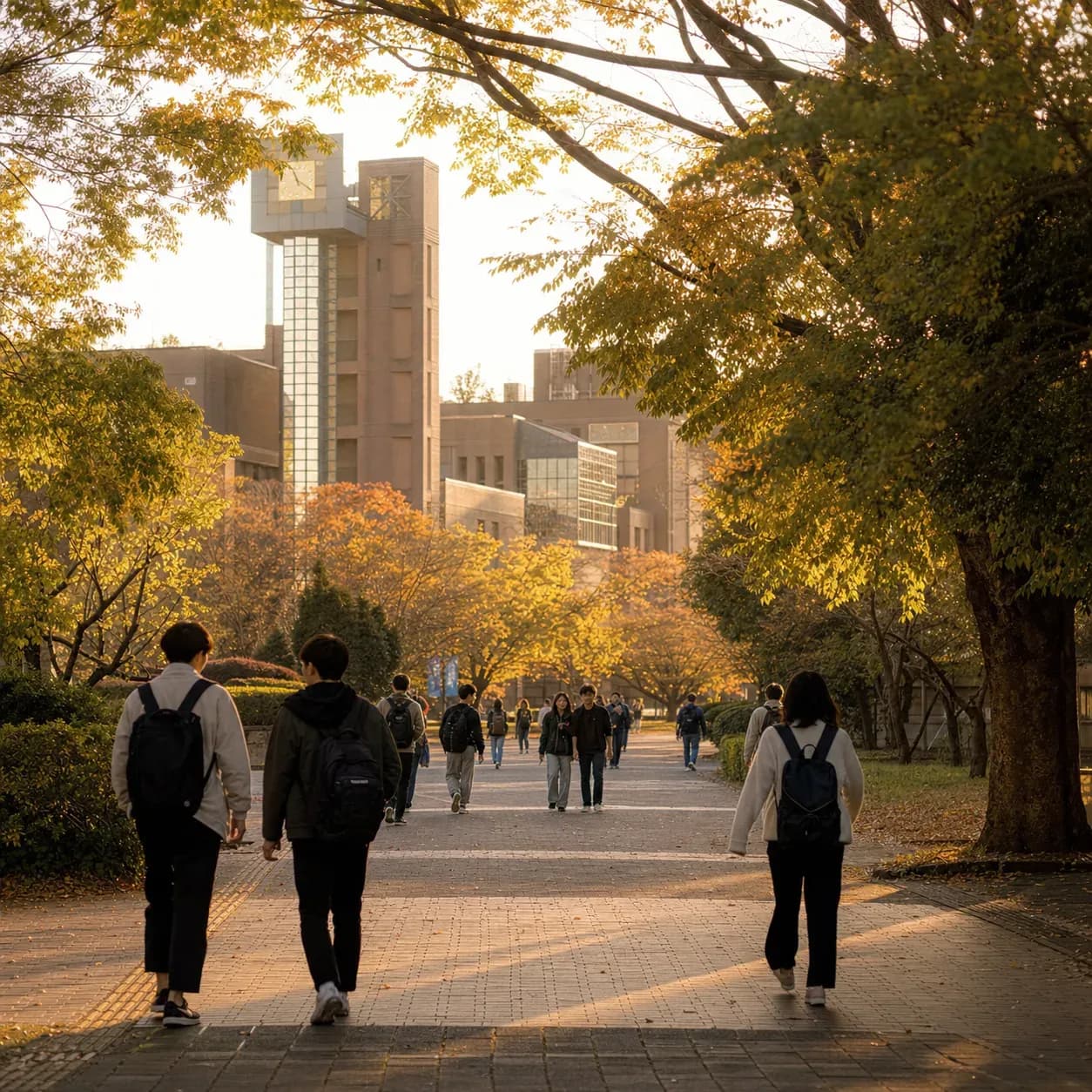
- Spring cherry blossoms and autumn foliage make the campus especially beautiful. Tsukuba's cherry blossom groves are among Ibaraki Prefecture's noted viewing spots
Campus Landmarks
- Central Library: collection of about 2.5 million volumes
- Third Area buildings: main science and engineering complex
- University Hall: student dining, bookstore, and club center
- University Hospital: 900 beds, one of the largest university hospitals in eastern Japan
8. Research and Resources
Libraries
- Central Library + 5 branch libraries: collection of about 2.5 million volumes
- Some areas are open 24 hours
- Comprehensive subscriptions to electronic resources
Notable Research Institutes
- International Institute for Integrative Sleep Medicine (IIIS), University of Tsukuba: one of the world's leading sleep research centers
- Center for Computational Sciences: one of Japan's top five supercomputing centers
- Life Science Center: iPS cells, regenerative medicine, plant science
- Tsukuba Science City collaboration network: students can intern at JAXA, AIST, and KEK
Nobel / National Awards
- 1973 Nobel Prize in Physics: Leo Esaki (a founding figure of Tsukuba)
- Numerous recipients of the Minister of Education, Culture, Sports, Science and Technology Award and the Medal with Purple Ribbon
- Tsukuba has one of Japan's highest concentrations of "Nobel-level research" combined with "national research park" resources
For research-oriented students, the combination of Tsukuba + Tsukuba Science City offers one of the richest research ecosystems in Japan.
9. Notable Alumni
Alumni of Tsukuba and its predecessor, Tokyo University of Education, include:
- Academia / Nobel: Leo Esaki (1973 Physics), Hideki Shirakawa (2000 Chemistry; Tokyo Tech affiliation, but his research was connected to the Tsukuba system)
- Politics: multiple former Ministers of Education, Culture, Sports, Science and Technology and senior figures in education
- Industry: many R&D leaders at Hitachi, Toshiba, Fujitsu, and major pharmaceutical companies
- Sports: 30+ Olympic gold medalists; Tsukuba's sports science programs are a core part of Japan's Olympic training system, with training science advisors for Shohei Ohtani and Yuzuru Hanyu
- Media: multiple anchors and journalists at NHK and The Asahi Shimbun
Tsukuba's alumni profile leans toward research + sports + education, continuing the legacy of its predecessor, Tokyo University of Education.
10. Lesser-Known Facts About the University of Tsukuba
- The University of Tsukuba was Japan's first "faculty-free" university: when it was founded in 1973, it adopted a colleges / schools system, anticipating American-style interdisciplinary design by about 20 years.
- Mount Tsukuba is one of Japan's "100 Famous Mountains": located near campus, it stands 877 meters tall and is one of students' favorite hiking spots.
- The University of Tsukuba is a major training base for Japanese Olympic Committee coaches: among Japan's Olympic teams, about one-third to one-quarter of coaches in each Olympic cycle are graduates of Tsukuba's physical education programs.
- Leo Esaki's "Seven Founding Principles" form Tsukuba's spiritual foundation: interdisciplinary colleges, openness, internationalization, integration of research and education, faculty mobility, student autonomy, and coexistence with Science City. These ideas were radical reforms in the 1970s and are now seen as pioneering steps in the modernization of Japanese higher education.
- The University of Tsukuba has its own Tsukuba Express commuter pass subsidy: because commuting is common, the university works with the railway company to provide students with substantial discounts.
11. Typical Admitted Student Profile (G30 Undergraduate)
- High school GPA of 3.7/4.0 or above
- TOEFL iBT 90+ or IELTS 7.0+
- SAT 1350+, IB 36+, or three A-Level subjects at A or above
- Can clearly explain "why Tsukuba, not the University of Tokyo", usually by focusing on Tsukuba Science City resources, a specific professor, or the interdisciplinary college system
- Laboratory or research experience, science fairs, and conference presentations are major advantages
- Has a realistic view of a research career in Japan, beyond general pop-culture interest
- Recommendation letters from high school science / social science teachers and a research mentor
- Confident about reaching N3 after enrollment
12. What Kind of Student Is a Good Fit?
✓ Good fit:
- Students who want to attend a top research university in Asia at the national university tuition rate of JPY 535,800 per year
- Students with genuine interest in life sciences, environmental science, medical research, or international relations
- Students who want a quiet research environment that is close to Tokyo, but not in Tokyo
- Students interested in sports science, Olympic training, and the sports industry (although the undergraduate physical education program is mainly Japanese-taught, English-taught master's options are available)
- Students willing to ride a bicycle across a 258-hectare campus
- Students considering the HSP Highly Skilled Professional permanent residency pathway (Tsukuba is on the +10 point list)
✗ Not necessarily a good fit:
- Students who want a central Tokyo campus and lively nightlife (Tsukuba is a research city with limited nightlife)
- Students interested in purely literary or purely humanities-oriented study (Tsukuba has a strong STEM identity)
- Students who want clinical medicine (G30 Medical Sciences is a research track, not a physician license pathway)
- Students expecting an American Greek Life campus culture
- Students who are worried about living with only English and basic Japanese (because the international student population is high, Japanese improvement can actually be slower)
13. HSP Highly Skilled Professional Permanent Residency Pathway
The University of Tsukuba is on the HSP Highly Skilled Professional "+10 point bonus" list, which means:
- Master's degree + annual income of JPY 6M -> permanent residency application after 3 years
- PhD + annual income of JPY 8M -> permanent residency application after 1 year
- After obtaining permanent residency, a spouse may work, parents may stay long-term, and children can access Japanese nationality pathways
The most common HSP pathways for Tsukuba graduates are:
- Tsukuba G30 undergraduate -> master's at Tsukuba / University of Tokyo / Kyoto University -> employment in pharmaceuticals (Takeda, Daiichi Sankyo), biotech (Chugai), chemicals (Sumitomo), robotics (FANUC), or trading companies
- STEM PhD -> university faculty / national research institute -> permanent residency after 1 year
- Sports science -> Japanese Olympic Committee / R&D at major sports brands
Because of Tsukuba's dual strengths as a research university with national science city resources, its graduates can accumulate HSP points quickly relative to many other G30 options. For detailed strategy, see Dr. G.'s internal resources, "Post-Graduation Visa Strategy / 05_Japan_Visa_Strategy" and "Master Grad School Database / Japan."
Conclusion
Tsukuba is a paradise for research-focused students. If your favorite things in high school were staying in the lab until 10 p.m., debating a physics problem with your teacher for two hours, or watching JAXA rocket launch livestreams on weekends as if they were movies, Tsukuba may be your natural home. It does not have the University of Tokyo's "Japan's number one" label or Kyoto University's romantic image of intellectual freedom, but it does have Japan's most complete research institution network, one of the country's largest single campuses, and its most progressive interdisciplinary college system.
The main reason Taiwanese families overlook Tsukuba is simple: they have not heard of it. But that is exactly what makes G30 flagship universities interesting. People who truly understand Japan's research system often place Tsukuba after the University of Tokyo and Kyoto University, on a similar tier with Tohoku University and Kyushu University. In one sentence: if what you want is a student entry ticket to Japan's most elite research ecosystem, Tsukuba is one of the highest-value choices available.