
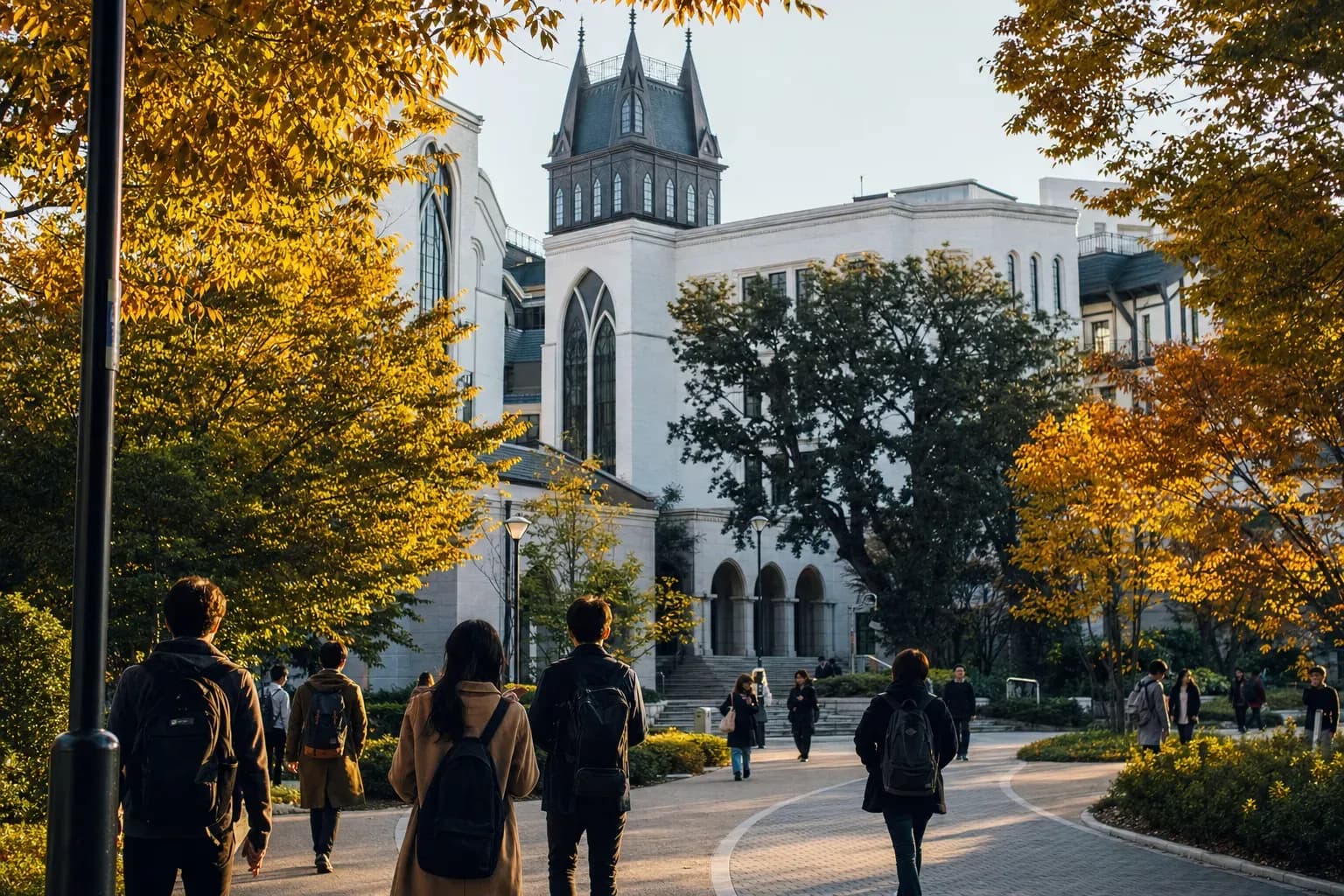
Tokyo University of Science (TUS): A Private STEM Flagship in Kagurazaka, Japan’s Most Affordable Private Science University, with Partial English-Taught Engineering
Published on December 16, 2025
There is a common understanding in Japanese higher education: “If you want to study science or engineering, the best choices are national universities such as UTokyo, Kyoto University, Tokyo Tech, Tohoku University, and Osaka University; if you want science or engineering but cannot enter a flagship national university, the best private option is Tokyo University of Science (TUS).” TUS is Japan’s oldest private science and engineering university. It was founded in 1881 by 21 graduates of the Department of Mathematics and Physics at the University of Tokyo, with the founding mission of “training scientists and engineers for Japan outside the monopoly of government schools.”
Over the past 145 years, TUS has produced or been connected to three Nobel Prize laureates: Satoshi Omura, Takaaki Kajita, and Tasuku Honjo. Takaaki Kajita is a TUS alumnus, while Satoshi Omura and Tasuku Honjo both have teaching or research ties to TUS. In employer preference rankings for STEM recruitment in Japan, TUS engineering and pharmacy have long ranked first among private universities, behind only institutions such as UTokyo, Tokyo Tech, and Kyoto University.
For Taiwanese families, TUS’s core appeal is that it is the best-fit choice for students who “want to study STEM in Japan, cannot enter a flagship national university, have a budget of around JPY 1.2M per year, and want to stay in Tokyo.” Although TUS’s ETP English-taught programs are still expanding and are not as comprehensive as those at flagship national universities, there are already three pathways: partial English-taught Engineering, partial English-taught Pharmacy, and partial English-taught Mathematics.
1. Basic Information
| Item | Details |
|---|---|
| Founded | 1881, originally the Tokyo Academy of Physics |
| Institution type | Private university operated by Tokyo University of Science Educational Foundation |
| Location | Kagurazaka, Shinjuku, Tokyo as the main campus; Katsushika, Noda, and Oshamambe in Hokkaido |
| Campuses | Kagurazaka, Katsushika, Noda, and others |
| Undergraduate students | ~16,000 |
| Graduate students | ~3,500 |
| Student-faculty ratio | 1:18 |
| Motto | "Science and Technology Contribute to Society" |
| Founding spirit | Training “true scientists and engineers” |
2. World Rankings
| Ranking | Position |
|---|---|
| QS World 2026 | #801-850 |
| THE World 2026 | #801-1000 |
| THE Japan University Rankings 2024 | #19 |
| THE Japan research strength category | Top 25 |
| Private STEM ranking in Japan | No. 1 among private universities |
| Japanese employer preference for STEM recruitment | No. 1 private university, overall Top 10 |
TUS is one of the 24 universities selected for SGU Type B, Global Traction Type. Although its QS and THE rankings are somewhat lower than those of national universities, TUS is in the same tier as Tokyo Tech, Kyoto University Faculty of Engineering, and Osaka University Faculty of Engineering in terms of Japanese employer preference for recruiting STEM talent. This is TUS’s real selling point. TUS graduates are highly competitive in Japan’s STEM employment market.
3. Admissions Data for 2024 Entry
International applications to TUS are more complicated than at many other universities because most STEM faculties are primarily Japanese-taught, while English-taught programs are still expanding.
English-based Special Admission for Selected Faculties
| Faculty | Degree of English-taught coursework | Taiwanese admits per year |
|---|---|---|
| Engineering Department, selected departments | 30-60% of courses taught in English | 2-5 students |
| Pharmaceutical Sciences | 40% of courses taught in English | 1-3 students |
| Mathematics | 50% of courses taught in English | 1-2 students |
| Applied Sciences, international program | 40% of courses taught in English | 1-2 students |
Overall Acceptance Rate
| Indicator | Figure |
|---|---|
| Overall acceptance rate for international students | About 30-40% |
| Total Taiwanese admits per year | 5-10 students |
Application Requirements
| Item | Requirement |
|---|---|
| English proficiency | TOEFL iBT 79+ / IELTS 6.0+ / TOEIC 700+ |
| Japanese | JLPT N3 or above, with N2 recommended. This is the biggest difference between TUS and other English-taught undergraduate options |
| Standardized tests | SAT 1200+, ACT 24+, IB 32+, A-Level Mathematics plus Physics / Chemistry at B or above |
| High school GPA | 3.3/4.0 or above |
| Mathematics / Physics / Chemistry | Three years of high school grades are extremely important |
| Recommendation letters | 2 letters, including one from a science teacher |
| Essay | Personal Statement + academic interests + Why TUS |
| Interview | Some applicants must complete an online interview, which may include academic questions |
Note: Among the “English-taught program” options commonly considered by Taiwanese families, TUS is the only school that clearly requires basic Japanese ability. This is because many engineering labs, pharmacy practical classes, and mathematics seminars are still primarily conducted in Japanese.
4. Tuition and Financial Aid
2025 Tuition
| Item | Amount (JPY) | Approx. NTD |
|---|---|---|
| Enrollment fee | 300,000 | ~63,000 |
| Annual tuition | About 1,150,000-1,300,000, depending on faculty | ~240,000-270,000 |
| Laboratory / facility fees | 200,000-400,000 | ~42,000-84,000 |
| Tokyo housing, monthly | 65,000-90,000 | ~14,000-19,000 |
| Tokyo living expenses, monthly | 80,000-100,000 | ~17,000-21,000 |
| Estimated total cost for four years | About JPY 9-11M | ~NTD 1.9-2.3M |
TUS has among the lowest tuition among private STEM universities in Japan. STEM programs are usually 10-30% more expensive than humanities and social science programs, but TUS still keeps tuition around JPY 1.2M. This matters a lot for Taiwanese families.
TUS Scholarships for International Students
- TUS International Student Scholarship: 30-50% tuition reduction
- TUS Entrance Scholarship for Outstanding Academic Performance: 30-100% tuition reduction depending on entrance results
- MEXT Embassy Recommendation Scholarship: available to a small number of international students
- JASSO Honors Scholarship: JPY 48,000 per month
- Science / Engineering scholarships from private foundations: Japan’s science and engineering ecosystem has many corporate-sponsored scholarships, including Toyota, Honda, Panasonic, and others
In practice, TUS scholarships for international students are not as generous as those at Waseda, Keio, Sophia, Rikkyo, or Doshisha. However, because tuition itself is relatively affordable, the overall value remains reasonable.
5. Academic Structure / Signature Programs
TUS has 7 faculties and 26 departments, making it the most comprehensive private STEM university in Japan:
Faculty of Engineering
- Architecture, Applied Chemistry, Mechanical Engineering, Electrical Engineering, Information and Computer Technology
- Some courses are taught in English, and the proportion of English-taught courses is higher at the graduate level
Faculty of Science
- Mathematics, Physics, Chemistry, Applied Mathematics, Applied Physics, Applied Chemistry
- Partial English-taught Mathematics is suitable for Taiwanese students with a strong pure mathematics background
Faculty of Pharmaceutical Sciences
- 4-year program in Pharmaceutical Sciences + 6-year pharmacist track
- Partial English-taught Pharmacy international program
- Top 3 among private pharmacy programs in Japan
Faculty of Industrial Science and Technology, Katsushika Campus
- Applied Electronics, Materials Engineering, Biological Engineering, Mechanical and Aerospace Engineering
- Deep industry collaboration
Faculty of Advanced Engineering, Noda Campus
Faculty of Management, Kagurazaka Campus
- Although not a STEM faculty, it offers a “STEM + business” dual-domain pathway
Faculty of Science Division II, Evening Division
- Japan’s distinctive evening division system, designed for working students
- Less commonly used by international students
6. Campus Culture / Institutional Personality
TUS’s academic culture is: STEM-focused, rigorous, practical, Tokyo-based, not glamorous but genuinely solid.
- Practical learning spirit: Since its founding, TUS has emphasized applying knowledge in real settings, and its curriculum is highly practice-oriented
- High withdrawal and repeat-year rates: Because TUS is demanding, especially in engineering mathematics and physics, it is known as one of the private STEM universities in Japan where students are most likely to repeat a year. This is also part of its identity
- Strong faculty research output: The faculty is largely composed of experimental and technical researchers, with deep corporate collaboration
- Strong alumni and industry connections: Toyota, Honda, Sony, Panasonic, Hitachi, Fujitsu, and other Japanese manufacturing companies have many TUS alumni in R&D roles
- Not as “flashy” as Waseda or Keio: TUS students tend to dress simply, club activities are less dominant, and lab hours are long
TUS is “the private university in Japan most similar to MIT”: not romantic, but genuinely substantial.
7. Location / Campus Environment
Kagurazaka Campus, Main Campus
- Located in Kagurazaka, Shinjuku, a 5-minute walk from JR Iidabashi Station
- Kagurazaka is Tokyo’s most “Parisian” neighborhood, with stone-paved streets, French restaurants, and a blend of Japanese and Western atmosphere
- Home to the Faculty of Management and Faculty of Pharmaceutical Sciences
- 5 minutes by train to Shinjuku Station and 10 minutes to Tokyo Station
Katsushika Campus
- Located in Katsushika, Tokyo, an 8-minute walk from Kanamachi Station on the Keisei Line
- Home to the Faculty of Advanced Engineering and Faculty of Science Division II
- A newer campus opened in 2013, with modern laboratories
Noda Campus, Chiba Prefecture
- Located in Noda, Chiba Prefecture
- Home to the Faculty of Science and Technology and Faculty of Pharmaceutical Sciences
- Large campus with a strong natural environment
- About 1 hour from central Tokyo
- Many international students are primarily based here
Oshamambe Campus, Hokkaido
- Located in Oshamambe, Oshima Subprefecture, Hokkaido
- Special program: all first-year Faculty of Management students are required to live there for one year
- This is TUS’s distinctive design for mandatory rural immersion and group bonding
Tokyo Housing Suggestions
- Katsushika, Senju, Kita-Senju: convenient for commuting to Katsushika / Noda campuses, with rent around JPY 50,000-70,000 per month
- Iidabashi, Kagurazaka, Ichigaya: within walking distance of Kagurazaka Campus, with rent around JPY 70,000-100,000 per month
8. Research and Resources
TUS is a large private research university, with the strongest research output among private universities in Japan:
Libraries
- Three major libraries at Kagurazaka, Katsushika, and Noda, with about 1 million volumes in total
- Extended opening periods during exam seasons, including 24-hour access periods
- Comprehensive electronic resources: IEEE Xplore, ACS, Web of Science, Scopus
Research Institutes
- TUS Research Institute for Science and Technology
- TUS Photocatalysis International Research Center, world-class in photocatalysis research
- TUS Center for Drug Delivery Research
- TUS Center for Quantum Information Theory
- TUS Center for Sustainable Materials
Nobel Prize Connections
- Takaaki Kajita, 2015 Nobel Prize in Physics: TUS alumnus, known for the discovery of neutrino mass
- Satoshi Omura and Tasuku Honjo have taught or conducted research within the TUS system
- Kaoru Yamanouchi and others connected to Nobel-level research systems
Corporate Collaboration
- Joint R&D projects with Toyota, Honda, Sony, Panasonic, and Hitachi
- Required internships for third- and fourth-year undergraduates
- Many research projects receive industry funding
9. Notable Alumni
TUS alumni placement is concentrated in manufacturing, pharmaceuticals, IT, research institutes, and academia:
- Takaaki Kajita, 2015 Nobel Prize in Physics
- Yoshinori Ohsumi, 2016 Nobel Prize in Physiology or Medicine, with teaching ties to the TUS system
- Many presidents and professors at Japanese national universities, including science and engineering departments at UTokyo, Tokyo Tech, and Osaka University
- Engineers and R&D managers at all levels at Toyota Motor, Honda, Sony, Panasonic, Fujitsu, and Hitachi
- Pharmaceutical R&D staff at all levels at Daiichi Sankyo, Takeda Pharmaceutical, Astellas Pharma, and Mitsubishi Tanabe Pharma
- Software engineers at Nintendo, Square Enix, and Konami
- CTOs at major Japanese manufacturing companies
TUS has the strongest private-university placement in Japan’s STEM employment market, especially for job offers from manufacturing companies, and ranks in the overall Top 5.
10. Things Many People Do Not Know About TUS
- TUS is Japan’s only private university with three Nobel Prize connections in science and engineering. Among Japan’s Nobel science laureates, the TUS system has a notable presence.
- TUS has one of the highest repeat-year rates in Japan. The annual repeat-year rate in Physics in the Faculty of Science is around 30%, and around 15% in the Faculty of Engineering. This has become synonymous with TUS’s demanding teaching standards.
- TUS’s Kagurazaka Campus is located in Tokyo’s most “Parisian” neighborhood, with stone-paved streets, Japanese-Western fusion, and one of Tokyo’s most refined undergraduate districts.
- TUS’s mandatory rural residential experience at Oshamambe Campus is a uniquely Japanese design for group bonding and immersion in nature. For Taiwanese city students, it can be a major culture shock.
- TUS’s founding spirit of training “true scientists and engineers” is still alive today. TUS is one of the few private universities in Japan that does not let students graduate through connections alone. Credit requirements are extremely strict.
11. Typical Admitted Student Profile for International Applicants
- Three-year high school GPA of 3.4/4.0 or above, especially in mathematics, physics, and chemistry
- TOEFL iBT 85+ or IELTS 6.5+
- JLPT N3 or above, with N2 recommended. This is a major difference between TUS and other English-taught options
- SAT 1250+, IB 33+, or A-Level Mathematics plus Physics / Chemistry at B or above
- Able to explain clearly “why TUS” and “why this discipline”
- Experience in science competitions, academic awards, or research camps
- Recommendation letters from a science teacher, such as mathematics / physics / chemistry, plus a homeroom teacher
- Clear plans for entering Japanese manufacturing, pharmaceuticals, or research institutions
12. What Kind of Student Is TUS Best For?
✓ Best suited for:
- Students who want to study STEM in Japan but cannot enter a flagship national university, such as UTokyo, Kyoto University, Tokyo Tech, Osaka University, Tohoku University, Kyushu University, or Hokkaido University
- Students with basic Japanese ability, N3 or above, who are willing to continue studying Japanese toward N1
- Families with a budget of about NTD 250,000-300,000 per year, including tuition and living expenses
- Students aiming for Japan’s manufacturing, pharmaceutical, or IT industries
- Students who prefer a rigorous, practical, lab-oriented learning environment
- Students with interest and foundations in mathematics, physics, chemistry, pharmacy, or engineering
- Students who want a learning environment in central Tokyo’s Shinjuku Kagurazaka, depending on faculty
✗ Not necessarily suitable for:
- Students who want pure humanities, social sciences, or Liberal Arts. Consider Rikkyo, Doshisha, or Sophia instead
- Students who do not know Japanese at all and do not want to learn Japanese
- Students who want an easy path to graduation or a relaxed four-year college life, since TUS has high repeat-year rates
- Students who want the brand halo of a QS Top 500 global ranking
- Students who want to maximize points for the HSP Highly Skilled Professional permanent residency pathway, since TUS is not on the +10-point university list
13. HSP Highly Skilled Professional Permanent Residency Pathway
TUS is not on the HSP Highly Skilled Professional “+10 points” bonus list, which is limited to 13 flagship national universities. However, TUS graduates are highly competitive in Japan’s STEM employment market, and HSP point accumulation depends on salary + work experience + academic background + Japanese-English bilingual ability.
The most common HSP pathways for TUS graduates are:
- TUS Engineering / Science / Pharmacy → major Japanese manufacturing / pharmaceutical / IT company with annual salary around JPY 5-8M
- Continue to a master’s program, at TUS / UTokyo / Tokyo Tech, plus doctoral study → major salary jump
- Accumulate 70+ points within 3-5 years → HSP Highly Skilled Professional Type 1
- Apply for permanent residency after 1-3 years
Special advantage: Because TUS graduates combine STEM expertise + strong manufacturing-company recruitment patterns + Japanese ability, they usually perform strongly in HSP categories such as “specific skill-related points” and “company recommendation.” This is much faster than the pathway for many private humanities and social science graduates. If a TUS undergraduate continues to a master’s program at UTokyo, Tokyo Tech, or Osaka University, they can receive the +10-point bonus, reaching 80+ points and potentially qualifying for permanent residency after one year.
For detailed strategies, refer to Dr. G.’s internal guide, Post-Graduation Visa Strategy / 05_Japan_Visa_Strategy. “TUS undergraduate degree → flagship national university master’s → manufacturing employment → HSP permanent residency” is a highly recommended two-step pathway in the Master Grad School Database / Japan section.
Conclusion
TUS is a private university designed for students who want to become true scientists and engineers. It will not give you the “glamorous campus life” of Waseda or Keio, nor the romance of Rikkyo Christmas. What it will give you is four years of exceptionally solid STEM training, a Japanese STEM employment network, and a Nobel tradition.
Taiwanese families often ask: “What is the real difference between TUS and Waseda SILS or Keio PEARL?” The answer is: SILS / PEARL are Liberal Arts / Economics, while TUS is pure STEM. If you want to study science or engineering, cannot enter UTokyo / Kyoto University / Tokyo Tech, have a budget under JPY 1.2M, and already have Japanese at N3 or above, TUS should be your first private-university choice to consider seriously.
In one sentence: TUS is the private university in Japan most similar to MIT, a favorite recruiting ground for manufacturing companies, and a STEM institution with three Nobel Prize connections. If you want to become a true scientist or engineer, this is Japan’s No. 1 private answer.