
Stanford University: Silicon Valley Culture, Spike Culture, and Interdisciplinary Programs
Published on November 15, 2025
Ranked fourth nationally by US News, yet number one in the minds of Silicon Valley founders: that is Stanford’s true position. It does not train politicians the way Harvard does, nor engineers the way MIT does. It cultivates a hybrid: people who can turn engineering into a startup, and research into a company. Google, Yahoo, Instagram, Snapchat, Sun Microsystems, Netflix, PayPal, Nike, HP: the founders of all these companies came from Stanford.
If Harvard is the training ground of East Coast old money, Stanford is the incubator of West Coast new money. Its acceptance rate is lower than Harvard’s (3.7% vs. 3.6%), but its personality is completely different: sunny, pastoral, entrepreneurial, and unembarrassed about building startups. Stanford is not the “Harvard of the West.” It is a top-tier university in a category of its own.
1. Basic Information
| Item | Details |
|---|---|
| Founded | 1885 (in memory of Leland Stanford Jr., who died young) |
| Location | Stanford, California (next to Palo Alto, in the heart of Silicon Valley) |
| Campus | 8,180 acres (one of the largest campuses in the United States) |
| Undergraduates | ~7,800 |
| Graduate students | ~9,300 |
| Student-faculty ratio | 1:5 |
| Motto | Die Luft der Freiheit weht (“The wind of freedom blows,” in German) |
2. World Rankings
| Ranking | Position |
|---|---|
| US News National Universities 2025 | #4 |
| QS World 2025 | #6 |
| THE World 2025 | #3 |
| US News Engineering | #2 |
| US News Computer Science | #1 (tied with MIT) |
| US News Business (Pre-MBA) | #1 |
| US News Education | #1 |
3. Admissions Data (Class of 2028)
| Metric | Value |
|---|---|
| Applicants | ~57,000 |
| Admitted students | ~2,100 |
| Overall acceptance rate | About 3.7% |
| REA acceptance rate | ~7% (estimated; Stanford does not publish separate figures) |
| RD acceptance rate | ~3% |
| Yield Rate | ~82% |
SAT/ACT Median Scores
| Test | 25th percentile | Median | 75th percentile |
|---|---|---|---|
| SAT | 1500 | 1550 | 1580 |
| ACT | 33 | 35 | 35 |
International Students
- International students make up about 11% of the student body
- Students come from 90+ countries
- Around 5-8 students from Taiwan are admitted each year (including ABC students)
4. Tuition and Financial Aid
2024-2025 Cost of Attendance
| Item | Amount |
|---|---|
| Tuition | USD $62,484 |
| Housing | USD $13,500 |
| Food | USD $8,250 |
| Personal + Misc | USD $4,500 |
| Total | USD $88,734+ |
Need-Based Aid
- Family income below $100,000: free tuition + free room and board
- Family income $100,000 - $150,000: full tuition scholarship
- Family income $150,000 - $200,000: substantial aid
- Need-Blind for international students: Yes (alongside Harvard, MIT, Princeton, Yale, and Amherst)
- No-Loan Policy: all aid is grant-based
- Average Aid: USD $70,000/year
- About 58% of undergraduates receive Need-Based Aid
5. Academic Structure / Signature Programs
Undergraduate Majors
- 65+ majors in total
- Top 5 most popular majors:
- Computer Science (about 25% of students)
- Human Biology
- Engineering (including MS&E, ME, EE)
- Symbolic Systems (CS + Linguistics + Psychology + Philosophy)
- Economics
Signature Systems
- CS + X: students can double major in CS and another field (CS + Music, CS + Philosophy, CS + History)
- Symbolic Systems: Stanford’s distinctive interdisciplinary major in “cognition + AI,” which has produced alumni such as Marissa Mayer
- d.school (Hasso Plattner Institute of Design): a center for design thinking
- Stanford Co-Term: complete a bachelor’s degree and master’s degree in 5 years (one of the most popular systems)
General Education Framework
- Thinking Matters requirement (replacing the former Introduction to the Humanities)
- WAYS (Ways of Thinking, Ways of Doing), across 8 areas
- Writing & Rhetoric requirement
6. Campus Culture / Institutional Personality
Stanford’s personality can be summed up in one word: Spike. Students place extreme emphasis on “what I have done,” not “who I am.” On campus, you will see founders in shorts and flip-flops, professors riding skateboards to Nobel Prize talks, and “older students” who have already founded public companies returning to take classes.
Spike Culture (Stanford’s Admissions Philosophy)
Unlike Harvard, Stanford is not looking for “well-rounded” students. It admits people who are extreme in one particular area. You do not need a perfect SAT score, but you must have gone deeper than 99% of your peers in something. This Spike could be:
- An open-source project with 10,000 stars
- A gold medal at an international math, science, or biology olympiad
- A nonprofit you founded yourself that has impacted thousands of people
- A published novel or poetry collection
- A top-three national ranking in a competitive sport
- A real operating company you have launched
Greek Life
- About 25% of students join fraternities or sororities
- The atmosphere is relatively moderate and different from the party-school culture of the American South
- Most activities still take place on campus
Athletics Culture
- Pac-12 (moving to the ACC)
- Signature sports: swimming, tennis, golf, soccer, and football
- #1 U.S. university for Olympic medals: since 1912, Stanford alumni have won 290+ Olympic medals
7. Location / Campus Environment
City Positioning
Stanford is located in Palo Alto, about a one-hour drive from San Francisco, and within 30 minutes of the headquarters of Google, Meta, Apple, and Tesla. The campus is the heart of Silicon Valley. A 10-minute walk from the classroom can take you to Sand Hill Road, the road with the highest concentration of venture capital firms in the world.
Climate
- Mediterranean climate with sunshine year-round
- Winter: 10-15°C, rainy but rarely cold
- Summer: 25-30°C, dry
- No extreme weather, making it the most comfortable climate among the Top 10 universities
Campus Landmarks
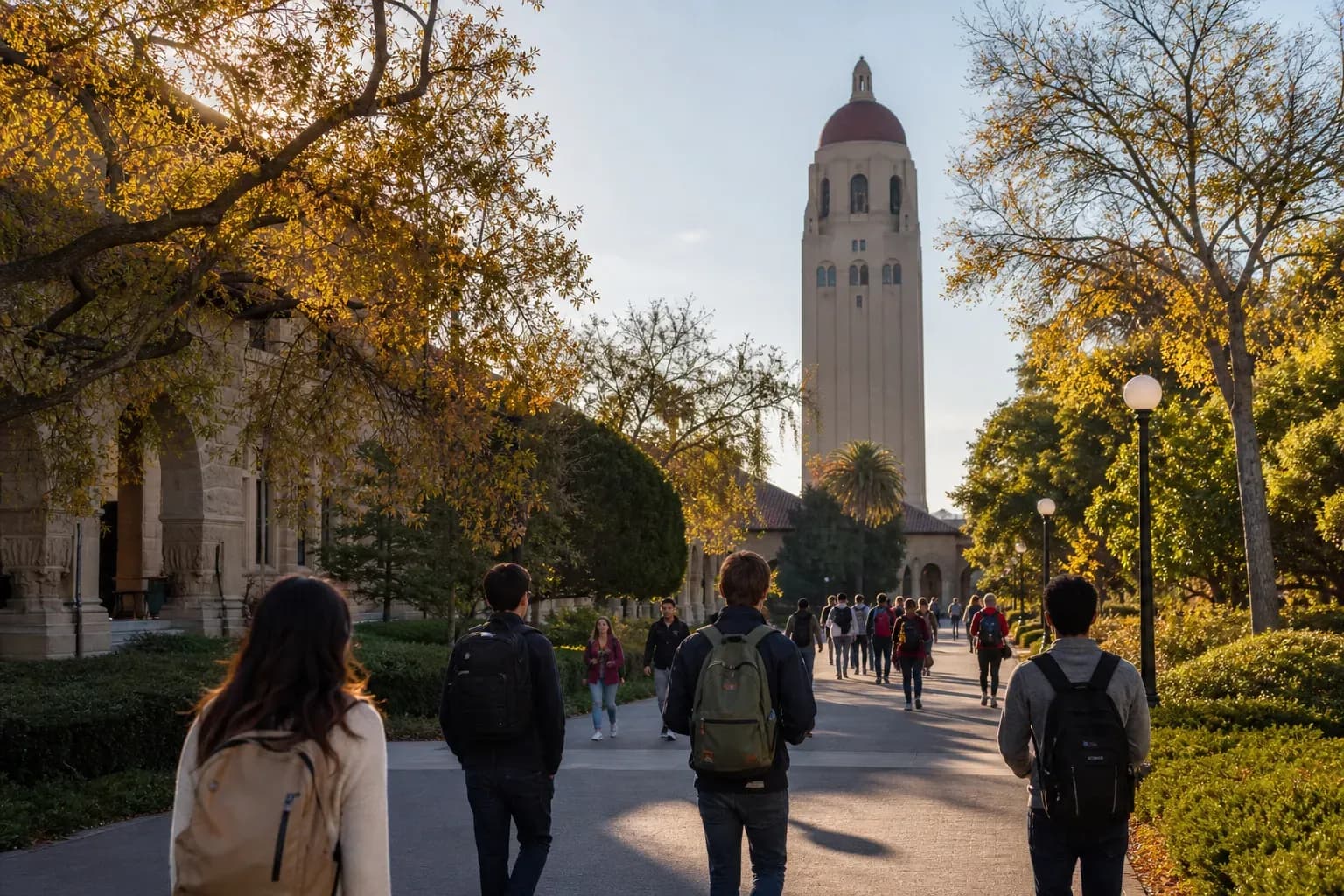
- Hoover Tower (285 feet tall)
- Main Quad + Memorial Church
- Cantor Arts Center (including the Rodin Sculpture Garden)
- The Dish (a hiking trail in the hills behind campus)
- Stanford Stadium
8. Research and Resources
Libraries
- Green Library is the main library, alongside 20+ branch libraries
- 9.5 million volumes across the university
Famous Laboratories / Research Centers
- SLAC National Accelerator Laboratory: a U.S. Department of Energy accelerator laboratory and a cradle of Nobel Prize-winning research
- Stanford AI Lab (SAIL): one of the birthplaces of artificial intelligence
- Hoover Institution: a conservative think tank
- Stanford Linear Collider: high-energy physics
- Bio-X: interdisciplinary biomedicine
- Stanford Cardiovascular Institute
9. Notable Alumni
- Technology entrepreneurship: Larry Page + Sergey Brin (Google), Jerry Yang (Yahoo), Reed Hastings (Netflix), Peter Thiel, Elon Musk (applied before transferring to UPenn), Marissa Mayer, Evan Spiegel (Snapchat), Sundar Pichai (MS)
- Politics: John F. Kennedy (attended briefly), Cory Booker, not Hillary Clinton, but Chelsea Clinton
- Finance: Phil Knight (founder of Nike), Charles Schwab, Mary Barra (GM CEO)
- Academia / Nobel Prizes: more than 80 Nobel laureates and 20+ Turing Award winners in total
- Entertainment: Reese Witherspoon, Sigourney Weaver, Fred Savage
Companies founded by Stanford alumni have a combined market value of more than $3 trillion, higher than the GDP of the United Kingdom.
10. Stanford Fun Facts
- Stanford has its own ZIP code: 94305 is dedicated to Stanford.
- Tree Mascot: Stanford has no official mascot, but the band appears in a “tree” costume, and the student who becomes the tree is selected through an annual student process.
- A memorial to the founders’ son: Stanford commemorates Leland Stanford Jr., the founders’ son who died young, and tributes to Leland Jr. can be seen throughout campus.
- Steve Jobs took wedding photos on campus: many Silicon Valley celebrities have held weddings at Memorial Church.
- The Big Game vs Berkeley: the Stanford vs Cal football rivalry is a century-old matchup. “The Play” in 1982 is one of the most famous lateral-touchdown plays in sports history.
11. Typical Admitted Student Profile
- Unweighted GPA ~3.95+
- SAT 1500+ or ACT 33+
- 8-12 AP courses / full IB HL rigor
- A real Spike: not just “what I can do,” but “how far I have taken this thing”
- Essays that demonstrate intellectual vitality: the Stanford essay specifically asks “what excites you”
- Recommendation letters that can show “this student finds problems independently”
- Stanford likes students who “get things done but stay humble,” and who have major achievements while still feeling like students
12. What Kind of Student Is a Good Fit?
✓ Good fit:
- Students with startup dreams who want to build products
- Students who like interdisciplinary study and do not want to be boxed in by academic departments
- Students who enjoy sunshine, the outdoors, and athletic culture
- Students interested in CS / engineering who also like the humanities and arts
- Students who want proximity to Silicon Valley industry and the venture capital ecosystem
- International students from families with limited income who need generous aid
✗ Not necessarily a good fit:
- Purely academic students who only want to do basic research and pursue a PhD (Princeton may be a better fit)
- Students who want a traditional East Coast Ivy atmosphere
- Students who dislike Spike culture and believe that being “well-rounded” is the only right path
- Students who want a small liberal arts environment
- Students who are afraid of living on the West Coast, or whose families prefer the East Coast
Conclusion
Stanford is not the “Harvard of the West.” That phrase has misled far too many parents. Stanford is a different species. It admits students who have already done real things, and trains people who can turn research into companies. If you dream of Silicon Valley and want to build a startup, Stanford is a dream school. If you simply want to “get into a Top 10” without a strong preference, HYP (Harvard, Yale, Princeton) may actually be more predictable, because their admissions algorithm is easier to read.
Stanford’s “Spike” philosophy means this: you do not need to be well-rounded, but you must have that one thing. Before you are ready to answer “what have you done?”, do not submit the application yet.