
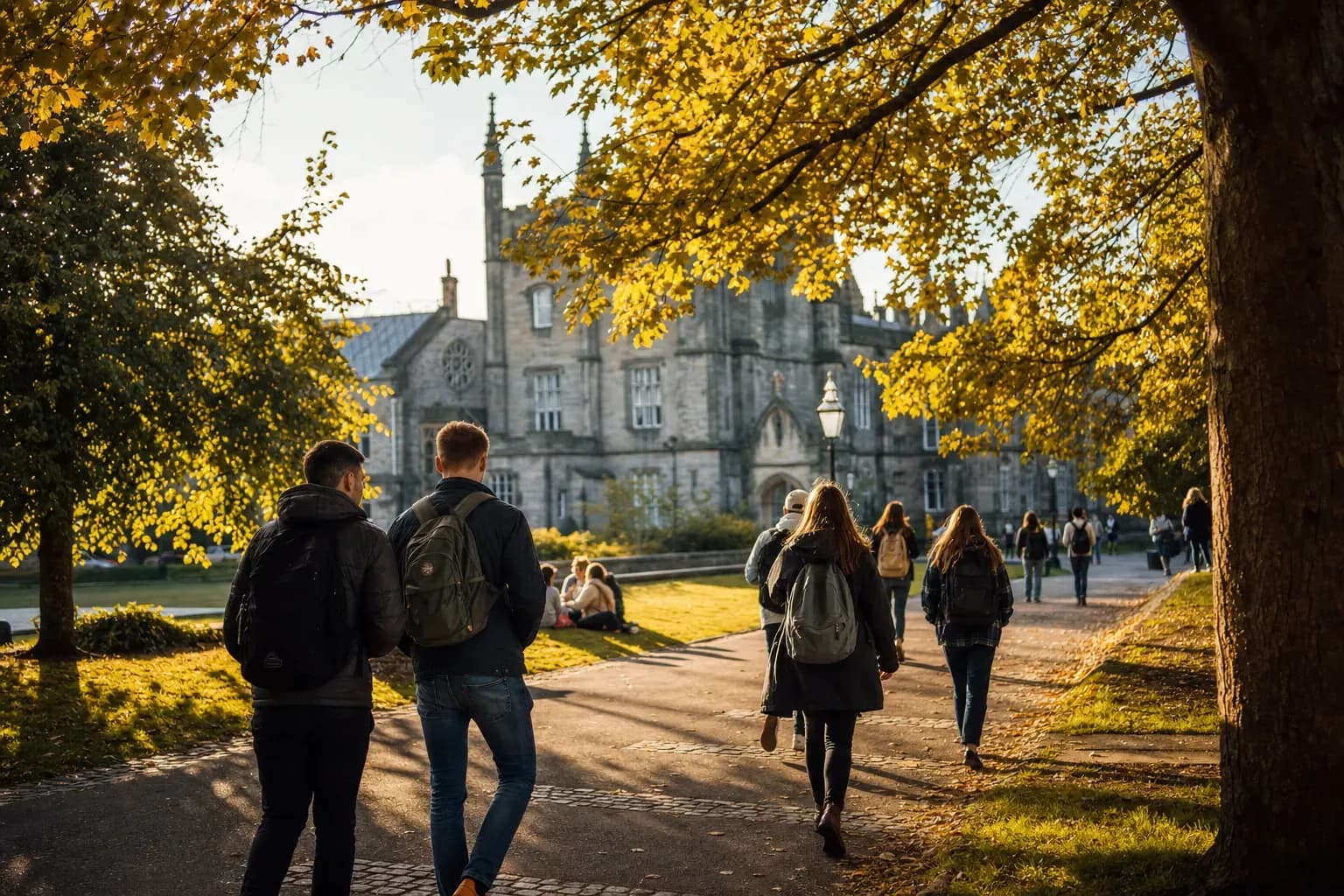
University of St Andrews: Scotland’s Ancient University, Royal Alumni, and a Consistent Complete University Guide Top 5
Published on December 8, 2025
Ranked 4th in the UK by the Complete University Guide, consistently in the Top 5, 3rd by the Guardian, and the third-oldest university in the English-speaking world after Oxford and Cambridge, the University of St Andrews is one of the UK’s most distinctive top universities: a leading institution that feels least like England. It is located in the seaside town of St Andrews in Fife on Scotland’s east coast, with a population of only 17,000, nearly half of whom are students.
St Andrews is relatively understated in Taiwan, but within the UK, the American NESCAC circle, and global royal and aristocratic networks, it is an “open secret”. This is where Prince William and Kate Middleton met while both were studying Art History, and it is also one of the UK universities most favored by royal and aristocratic families. St Andrews can be summed up in one sentence: classical, conservative, seaside, social, and royal.
Unlike the three-year Oxbridge degree structure in England, St Andrews follows the Scottish four-year system for Honours degrees. Students can study broadly across two subjects in their first and second years before deciding on their major in third year. This flexibility makes St Andrews especially attractive to students who are unsure about their major and want a broad liberal arts experience.
1. Basic Information
| Item | Details |
|---|---|
| Founded | 1413, the third-oldest university in the English-speaking world |
| Location | St Andrews, Fife, Scotland, 90 minutes by car northeast of Edinburgh |
| Campus | Seaside town, no centralized campus, academic buildings spread throughout the town |
| Undergraduates | ~9,000 |
| Postgraduates | ~3,000 |
| Institutional category | Ancient University, not Russell Group |
| Motto | Ever to Excel |
| Degree system | Scottish four-year degree |
2. World Rankings
| Ranking | Position |
|---|---|
| QS World 2026 | #95 |
| THE World 2026 | #110 |
| Complete University Guide 2026 (UK) | #4 |
| Guardian University Guide 2026 (UK) | #3 |
| QS Philosophy | Top 30 globally |
| QS International Relations | Top 25 |
| THE Subject Rankings - Arts & Humanities | Top 50 |
3. Admissions Data (2025 Entry)
| Metric | Figure |
|---|---|
| Applicants | ~24,000 |
| Offers/admitted students | ~3,800 |
| Overall acceptance rate | Around 16% |
| International applicant acceptance rate | ~12% |
| Medicine acceptance rate | ~10%, jointly taught with Dundee |
| Yield Rate | ~50% |
| International student proportion | ~45% |
| US student proportion | ~17%, among the highest in the UK |
Typical A-Level / IB Offers
| Subject area | Standard A-Level offer | Standard IB offer |
|---|---|---|
| International Relations / Politics | AAA-AAB | 38 points (HL 666) |
| English / Classics / Art History | AAA-AAB | 38 points (HL 666) |
| Economics & Finance | A*AA including Math | 38 points (HL 766 including HL Math) |
| Math / Physics / CS | A*AA including Math | 38 points (HL 666 including HL Math) |
| Medicine | AAA including Chemistry + one science subject + UCAT | 38 points (HL 666) |
International Students
- International students make up around 45% of undergraduates
- The proportion of US students is extremely high: around 17%, making St Andrews one of the UK universities most favored by American families, particularly those familiar with the NESCAC liberal arts model
- Around 5-15 students from Taiwan are admitted each year, mainly for IR, Econ, Art History, and English
- Applications are submitted through UCAS
4. Tuition and Living Costs
2025-2026 International Tuition Fees
| Subject area | Annual tuition |
|---|---|
| Arts / Humanities / Social Sciences | £30,160 |
| Sciences | £34,790 |
| Medicine | £36,210 |
Living Costs (Moderate, Far Lower Than London)
| Item | Amount |
|---|---|
| On-campus or nearby accommodation | £7,500-11,000/year |
| Food + transport + personal expenses | £6,000-8,000/year |
| Total including tuition | Around £44,000-55,000/year |
Graduate Route Visa
After graduation, students can apply for the Graduate Route, which grants two years of post-study work permission for bachelor’s and master’s graduates and three years for PhD graduates, with no employer sponsorship required. Around 60% of St Andrews graduates remain in the UK, with most moving to London or Edinburgh for work.
Scholarships
- St Andrews Tuition Fee Scholarship: £3,000-7,000/year, mainly for international students
- Wardlaw Scholarship: full tuition waiver, extremely rare
- Bridging Scholarship, international students only
- Scotland's Saltire Scholarship: Scottish Government scholarship, available to selected countries
5. Academic Structure / Signature Programs
Scottish Four-Year Degree + Major Flexibility
The defining feature of St Andrews is its Faculty-based structure: four Faculties, Arts, Science, Divinity, and Medicine. In the first and second years, students can study broadly across three subjects before deciding in third year whether to pursue single honours, joint honours, or a major+minor structure. This flexibility is not available at Oxbridge and resembles the breadth of an American liberal arts education.
Signature Programs
- International Relations: one of the strongest IR programs in the UK, often placed alongside LSE and Oxford. It has a long history and close links with NATO, the United Nations, and the Foreign Office
- Philosophy: UK Top 5, comparable to Oxbridge. “Logic and Philosophy of Science” is a distinctive St Andrews strength
- English / Scottish Literature: UK Top 5 for English literature
- Art History: UK Top 3, and the subject studied by Prince William and Kate
- Economics & Finance: quantitative finance training at undergraduate level, with graduates entering the City of London
- Marine Biology: supported by its coastal location, UK Top 3
- Medicine, jointly with Dundee: three years of BSc Medical Sciences followed by clinical transfer to Dundee, Manchester, or Edinburgh
Honours System
The Scottish four-year degree is an Honours degree, equivalent in level to a three-year BA / BSc in England. Third and fourth year are the Honours years, and students are required to write a dissertation.
Joint Degree
Joint degrees are an extremely popular option at St Andrews. The most popular combinations include IR + Economics, English + Philosophy, and Math + Statistics.
6. Campus Culture / Institutional Personality
St Andrews has a classical, conservative, socially intense, and royal-friendly character. The town has a population of 17,000, while the university has around 12,000 students, which means the entire town is the university.
Academic Family / Family Tree
One of St Andrews’ unique traditions is that new students are assigned an academic father and academic mother, usually second- or third-year students, forming an academic family. The peak of this tradition is Raisin Weekend each year, when academic parents take their academic children through a weekend of social events, parades, and the giving of raisins, historically a token of gratitude.
Pier Walk / May Dip
- Pier Walk: every Sunday morning, students wear red gowns and walk along the St Andrews harbour pier, a tradition dating back to the 1600s
- May Dip: at 5 a.m. on May 1, students collectively run into the North Sea at East Sands
Royal Alumni Connections
Prince William and Kate Middleton both studied Art History. William entered in 2001, Kate entered in 2001, and they began dating in 2004. Members of British and European royal families enroll almost every year. St Andrews is therefore jokingly known as the “Top Match-Making University”, with an alumni pairing rate of around 1 in 10.
Golf
St Andrews is the “home of golf”: The Royal and Ancient Golf Club of St Andrews (R&A) is one of the world’s governing bodies for the rules of golf. The university has its own 18-hole course, and students can play at very low rates.
7. Location / Campus Environment
City Profile
St Andrews is a seaside town in Fife on Scotland’s east coast, with a population of 17,000. It is 90 minutes by car from Edinburgh and two hours from Glasgow. The nearest railway station is Leuchars, 5 km away, with a bus transfer required to reach town.
Campus Structure
- No centralized campus: academic departments, teaching buildings, residence halls, and shops are all spread within a one-square-kilometer town
- United College, also known as Old College: built in 1411 and the core of the main university area
- St Mary's College: the divinity school
- North Haugh: the modern science and technology campus area
Climate
- East coast Scottish climate, 1-7°C in winter and 12-19°C in summer
- Windy and coastal: strong North Sea winds, with possible snow in winter
- Long summer daylight hours, influenced by the northern latitude, so summer nights are not very dark
Campus Landmarks
- St Salvator's Quad, a quadrangle dating from 1450
- Ruins of St Andrews Cathedral, founded in 1158 and destroyed during the Reformation
- St Andrews Castle, dating from the 13th century
- The Old Course, a sacred site in golf
- West Sands, the beach featured in the opening running scene of Chariots of Fire
8. Research and Resources
Libraries
- Main Library: origins dating to 1610, when it was a legal deposit library, a status later withdrawn
- King James Library, housing historical collections
- Martyrs Kirk Research Library, mainly for researchers and postgraduate students
Notable Research Centers
- Centre for Exoplanet Science: planetary science
- Sea Mammal Research Unit: world-class marine mammal research
- Handa Centre for the Study of Terrorism and Political Violence
- Institute of Behavioural and Neural Sciences
9. Notable Alumni
- Royalty / aristocracy: Prince William, Catherine, Princess of Wales, Princess Eugenie of York, though she did not complete her degree
- Politics: Alex Salmond, former First Minister of Scotland; John Stuart Mill, philosopher; James Wilson, US Founding Father
- Science: James Black, Nobel Prize in Medicine and inventor of beta blockers; Alan Borthwick, fiber-optic communications pioneer
- Literature: Fay Weldon, Rudyard Kipling as an honorary alumnus
- Performing arts: Siobhan Redmond, David Tennant, who attended briefly
10. Lesser-Known Facts About St Andrews
- St Andrews is older than Edinburgh: founded in 1413, it is Scotland’s oldest university and the third-oldest in the English-speaking world.
- William and Kate began here: both entered Art History in 2001, lived together in 2003, went public with their relationship in 2004, and married in 2011.
- “Top Match-Making University”: around 1 in 10 St Andrews alumni marry a fellow student.
- Students wear red gowns: undergraduates wear rust-red gowns at formal occasions, a tradition from the 17th century.
- No Russell Group status: St Andrews declined to join the Russell Group, with the reasoning that it is an Ancient university, not a 1994 research group.
- The semesters are called “Martinmas” and “Candlemas”: the autumn and spring terms are named after Christian festivals.
- The town is tiny: students joke that it has “three streets”: North Street, South Street, and Market Street, with almost no other main streets in town.
11. Typical Admitted Student Profile
- A-Level AAA-AAB or IB 38 (HL 666)
- IR / Politics / Art History / English: strong performance in essay-based subjects is preferred
- Economics / Finance: Math must be A or HL 6+
- Medicine: UCAT + interview, in partnership with Dundee
- Quantifiable academic passion: debate, Model United Nations, community service, literary or arts awards
- UCAS Personal Statement of 4,000 characters / 47 lines, with 70% academic content + 30% extracurricular content
- Especially friendly to US applicants: SAT / ACT may substitute for A-Levels in selected departments
- St Andrews tends to prefer well-rounded students with a story, not just high scores
12. What Kind of Student Is St Andrews Right For?
✓ Good fit:
- Students who want to study IR / Politics / Art History / English / Philosophy
- Students who enjoy a small-town, seaside, conservative, and classical atmosphere
- Students who want a four-year Scottish degree and prefer to choose their major later
- Students who can accept windy winters and a relatively remote location, 90 minutes from Edinburgh
- Students who want a NESCAC-style liberal arts experience while staying in the UK
- Students who enjoy traditions such as academic family, Raisin Weekend, and Pier Walk
- Golf enthusiasts
✗ Not necessarily a good fit:
- Students seeking heavy STEM disciplines, since CS and Engineering are smaller and less deep than at Imperial or Oxbridge
- Students who want big-city life, nightlife, and a wide range of social scenes
- Students who want Russell Group status, which St Andrews does not have
- Students on a very tight budget who need major scholarship funding
- Students who want a centralized campus and modern facilities, since many buildings date from the 15th to 19th centuries
- Students who dislike cold weather, wind, or seaside environments
Conclusion
St Andrews is not for students who think, “I wanted Oxbridge but did not get in, so I will go here instead.” St Andrews is for the kind of student who, at age 18, already knows they want to study Art History or IR, wants to spend four serious years reading in a seaside town, and can accept winter days when it gets dark at 4 p.m.
If your intended path is “I might become a diplomat, work as an art dealer, pursue a master’s in museum studies, or work at Sotheby's London,” St Andrews may be a more direct route than Oxbridge in the UK, because its alumni density in IR and Art History is extremely high in those circles. If you want pure STEM leading straight into City of London investment banking, St Andrews is not the right fit. Go to Imperial or LSE.
The point Taiwanese families most often overlook is this: St Andrews is the UK university that feels least like the UK. Around 70% of students are not local Scots; instead, roughly 17% are American, around 20% come from continental European aristocratic backgrounds, and quite a few are from Middle Eastern royal families. In your cohort, you may meet the children of Hollywood actors, heirs to European counts, and Taiwanese classmates reading Hume alongside you. Among the UK’s Top 5 universities, St Andrews has one of the most globally elite alumni networks. Its prestige is not below Oxbridge, but its personality is entirely different.
Sources: