
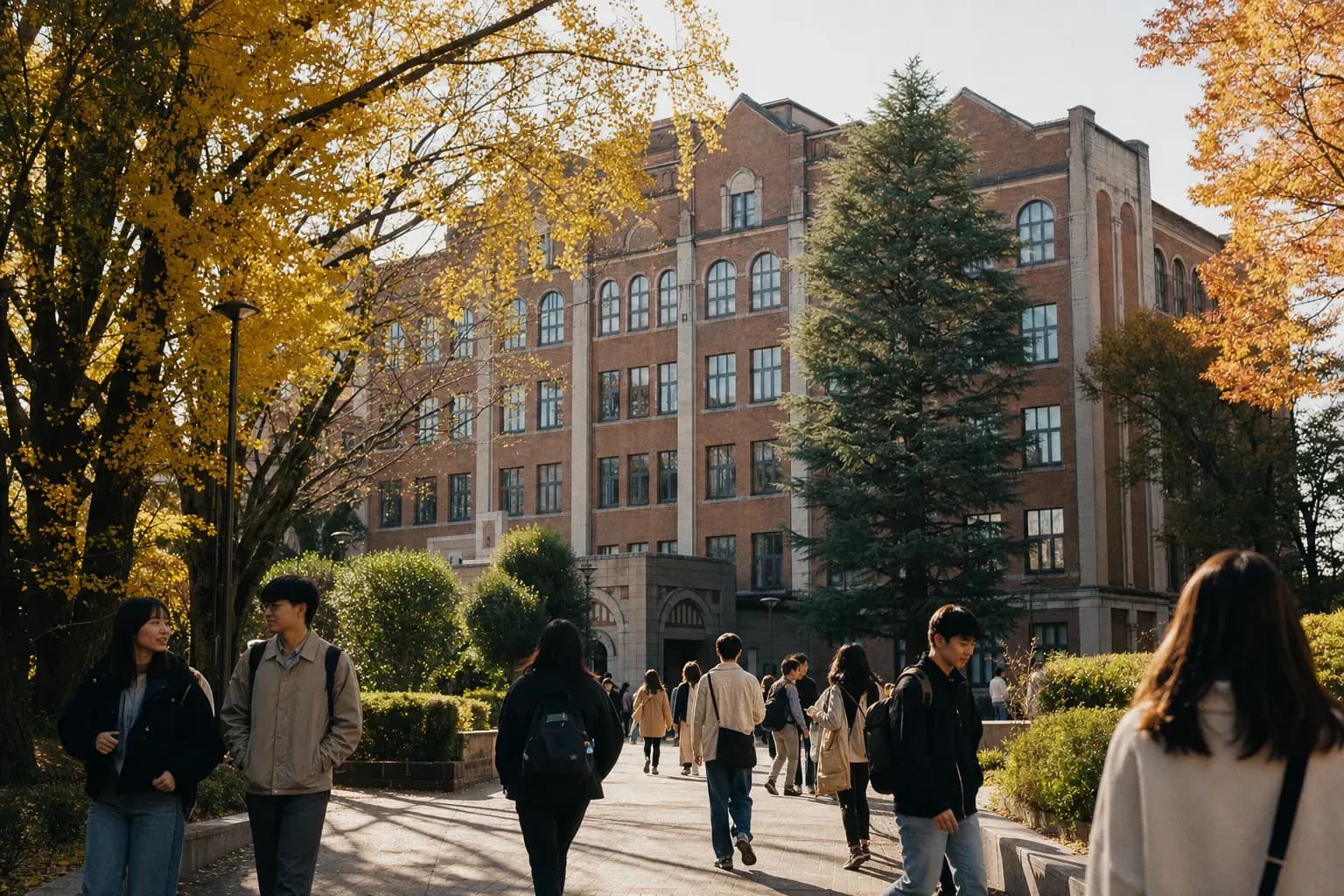
Sophia University: Japan’s Oldest Full English-Taught FLA Since 1949, Jesuit Education, Central Tokyo
Published on December 31, 2025
Ranked QS 2026 #791-800, Sophia University is home to Japan’s oldest full English-taught undergraduate program. Its history of English-medium education began more than 60 years before Japan’s national universities followed. Sophia’s FLA (Faculty of Liberal Arts) has operated fully in English since 1949. At a time when the University of Tokyo, Kyoto University, and Osaka University were still teaching entirely in Japanese, Sophia was already a pioneer in international elite education in Japan.
Sophia’s institutional DNA is Jesuit education. It belongs to the same global Jesuit university network as Georgetown University and Boston College in the United States and Heythrop College in the United Kingdom. This means the legitimacy of Liberal Arts education, intercultural openness, and humanistic concern are not later-added international branding at Sophia. They are part of the university at the DNA level.
Sophia is an SGU Type B Global Traction Type university, listed alongside ICU, Rikkyo, Meiji, and Hitotsubashi. It is not a Type A Top Global University, but that does not affect its status as Japan’s oldest and most complete private university for English-taught Liberal Arts education. Sophia is not included on the HSP +10 bonus university list. This should be made clear in advance, and it is also the biggest difference between Sophia and Waseda / Keio.
1. Basic Information
| Item | Details |
|---|---|
| Founded | 1913 (Taisho 2), founded by Jesuit priests |
| University type | Private university (Jesuit education system) |
| Location | Yotsuya, Chiyoda-ku, Tokyo (main campus); Mejiro Seibo Campus; Hadano Campus |
| Campus | Approximately 8 hectares (main campus, one of Tokyo’s most compact universities) |
| Undergraduate students | ~12,500 |
| Graduate students | ~1,500 |
| Student-faculty ratio | 1:20 |
| Motto | "Men and Women for Others, with Others" |
2. World Rankings
| Ranking | Position |
|---|---|
| QS World 2026 | #791-800 |
| THE World 2026 | #801-1000 |
| QS Asia 2026 | #200-250 |
| THE Asia 2026 | #301-350 |
| QS Theology & Divinity | Global Top 50 (Jesuit tradition) |
| QS Languages | #150-200 |
Sophia’s global ranking numbers are relatively modest, but they do not fully reflect its academic quality. Sophia’s strengths are Liberal Arts teaching quality, language education, and intercultural competence, and these indicators are not easily captured by research-heavy QS / THE rankings. Within Japan, Sophia is regarded as one of the “Top 5 private universities”: Waseda, Keio, Sophia, ICU, and Doshisha.
3. Admissions Data (2024 Entry)
Sophia has 9 faculties. Among them, FLA and SPSF are the main English-taught undergraduate entry points:
FLA (Faculty of Liberal Arts)
| Indicator | Figure |
|---|---|
| Applicants (international student track) | ~600-800 |
| Admitted students (international student track) | ~100-130 |
| Overall acceptance rate | Approximately 15-20% |
| Enrolled students | ~800 (including Japanese + international students) |
SPSF (Sustainable Futures Program)
| Indicator | Figure |
|---|---|
| Applicants | ~150-200 |
| Admitted students | ~30-40 |
| Overall acceptance rate | Approximately 20-25% |
| Focus | Interdisciplinary program in sustainability, environment, and social enterprise |
Application Requirements
| Item | Requirement |
|---|---|
| English proficiency | TOEFL iBT 90+ / IELTS 6.5+ |
| Standardized tests | SAT 1300+, ACT 28+, IB 36+, or 3 A-Level subjects at B or above |
| Japanese | Not required at entry. FLA students may take Japanese as an elective, but it is not mandatory |
| Recommendation letters | 2 letters |
| Essay | Personal Statement + Application Essay |
International Students
- International students account for approximately 35-40% of FLA
- International students account for approximately 50%+ of SPSF
- Sophia has approximately 1,800 international students overall, making it one of Japan’s most deeply internationalized private universities
- Each year, 10-20 Taiwanese students are admitted to Sophia
4. Tuition and Financial Aid
2025 Tuition (Private University)
| Item | Amount (JPY) | Approx. NTD Equivalent |
|---|---|---|
| Admission fee | 200,000 | ~45,000 |
| Tuition (annual, FLA) | ~1,250,000 | ~270,000 |
| Tuition (annual, SPSF) | ~1,300,000 | ~280,000 |
| Facility / miscellaneous fees (annual) | 80,000-200,000 | ~18,000-45,000 |
| Dormitory (Sophia Soshigaya International House, monthly) | 60,000-90,000 | ~13,000-20,000 |
| Living expenses (monthly, Yotsuya) | 90,000-130,000 | ~20,000-30,000 |
| Estimated total cost for four years | Approximately JPY 11-14M | ~NTD 2.45-3.10M |
Sophia’s tuition is slightly lower than Waseda and Keio PEARL, making it a relatively cost-effective choice among Japan’s Top 5 private universities.
MEXT Scholarships
- MEXT Embassy Recommendation Scholarship: available for application
- MEXT University Recommendation: Sophia has a stable nomination quota
Sophia Internal Scholarships
- Sophia University New Students Scholarship: full to partial tuition reduction
- Sophia University Benefactors’ Scholarship: low-interest educational loan support
- Sophia Global Discovery Scholarship: priority for FLA international students, 30-50% tuition reduction
- Jesuit SOPHIA Tuition Reduction: assessed based on family income
In total, approximately 25% of international students at Sophia can receive partial tuition reduction, a proportion comparable to Waseda and Keio.
JASSO
- JASSO Honors Scholarship: JPY 48,000-80,000 per month
5. Program Structure / Signature Programs
FLA (Faculty of Liberal Arts)
Founded in 1949, FLA is Japan’s oldest full English-taught undergraduate program. It follows a 4-year Liberal Arts design:
- Year 1: required general education courses (Humanities, Social Sciences, Natural Sciences, Languages)
- From Year 2 onward: choose a major
- International Business & Economics
- Social Studies
- Comparative Culture
FLA’s defining features:
- Fully English-taught: students can graduate without taking Japanese, though Japanese electives are encouraged
- Small classes: average class size of 20-25 students, far smaller than Waseda and Keio
- Intercultural environment: students come from 60+ countries
- Jesuit educational heritage: emphasis on critical thinking, ethics, and humanistic concern
Differences between FLA and Waseda SILS:
- SILS: larger scale (600 students), mandatory study abroad, richer club scene
- FLA: slightly larger scale (800 students), no mandatory study abroad, more refined teaching, deeper religious / philosophical elements
SPSF (Sustainable Futures Program)
Established in 2020, SPSF is a cross-faculty full English-taught program. It integrates:
- Economics
- Engineering
- Education
- Global Studies
SPSF students choose a primary faculty at entry (one of Economics / Science & Technology / Education / Global Studies), but all specialized courses are taught in English.
Other Undergraduate Faculties (Selected English-Taught Courses)
Sophia’s 9 faculties are Theology, Humanities, Human Sciences, Law, Economics, Foreign Studies, Global Studies, Science and Technology, and Liberal Arts. Outside FLA, other faculties offer some English-taught electives, but the main complete 4-year full English-taught programs are FLA and SPSF.
Informal Professor Consent System (Graduate Level)
Sophia’s graduate schools generally use an informal professor consent model, but it is looser than at national universities. Sophia’s program-based admission, especially in the Graduate School of Global Studies, is less dependent on consent from a single professor.
6. Campus Culture / University Personality
Sophia’s character is international, humanistic, quiet, refined, and interreligious.
Key features of the university culture:
- “Men and Women for Others, with Others”: the core idea of Jesuit education, emphasizing service to others and coexistence with vulnerable communities
- Christian (Catholic) tradition: Sophia is Japan’s only Jesuit university. It has a church, a Faculty of Theology, and regular mass on campus. But students are never required to be religious or participate in religious activities. This is a defining feature of Jesuit education in Japan and reflects the Western Jesuit tradition of inculturation
- Signature language education: Sophia’s Faculty of Foreign Studies offers 8 language majors: English, German, French, Spanish, Portuguese, Russian, Chinese, and Hispanic Studies / area languages. It is one of Japan’s most complete language education systems
- Small, close-knit community: compared with Waseda and Keio, each with 30,000-40,000 students, Sophia’s 12,000-student scale is much smaller, and students are more likely to know one another
Campus culture:
- Sophia Festival: the annual campus festival held every November. Smaller than Waseda and Keio festivals, but more international in atmosphere
- Sports: Sophia is not a major sports powerhouse, but women’s tennis is among the strongest in Japanese university sports
- Music and theater: church choir and sacred music activities rooted in the Jesuit tradition
Sophia’s niche is: “studying refined Liberal Arts in English in central Tokyo, building intercultural friendships, and engaging with religious / humanistic depth.” This is a combination that Waseda, Keio, and ICU do not fully provide.
7. Location / Campus Environment
City Positioning
Sophia’s main campus is located in Yotsuya, Chiyoda-ku, Tokyo, one of the most central locations in the city:
- Yotsuya Station is right at the campus gate, with access to the JR Chuo Line, Marunouchi Line, and Namboku Line
- 5 minutes to Tokyo Station, 7 minutes to Shinjuku, 15 minutes to Shibuya, and 1 stop to Akasaka / Nagatacho
- Nearby landmarks include the Imperial Palace Outer Gardens, Yotsuya Mitsuke, and Akasaka Palace State Guest House, one of Tokyo’s most historic districts
The Yotsuya campus is extremely small at 8 hectares, making it one of Tokyo’s most compact university campuses. This is also why Sophia is sometimes criticized for lacking a true campus vibe. On the other hand, it offers the most central university experience in Tokyo.
Other Campuses
- Mejiro Seibo Campus: nursing and social welfare
- Hadano Campus: Hadano City, Kanagawa Prefecture; selected science and engineering courses
FLA and SPSF students spend the entire program at the Yotsuya campus.
Climate / Environment
- Tokyo climate: dry winters, humid summers
- Monthly rent: JPY 80,000-130,000 for a studio apartment near Yotsuya
- Students commonly live around Yotsuya-sanchome, Shinjuku, Ichigaya, and Kagurazaka
Campus Landmarks
- St. Ignatius Church: a Catholic church next to campus and one of Tokyo’s major cathedrals
- Building No. 2 (Sophia Tower): Sophia’s landmark high-rise campus building
- Kulturheim Chapel: a small on-campus chapel and symbol of Sophia’s religious tradition
8. Research and Resources
Libraries
- Sophia University Central Library: approximately 1.1 million volumes
- Kirishitan Bunko: Japan’s most complete research archive on the history of Kirishitan, or Japanese Christians
- Branch libraries for each faculty
Notable Research Institutes
- Sophia University Institute of Comparative Culture: one of Asia’s leading centers for intercultural research
- Sophia University Center for Global Discovery: research support for FLA / SPSF students
- Iberoamerican Institute: Asia’s leading institute for Spanish- and Portuguese-speaking world studies
- Sophia University SDGs Promotion Office: interdisciplinary research on sustainable development
Faculty Strengths
- Faculty of Foreign Studies: 8 language majors, with many graduates entering diplomacy, trading companies, foreign companies, and media
- Faculty of Law: Sophia law graduates have a distinctive advantage in international law firms because of their command of English and one of French or German
- Faculty of Science and Technology: small but refined, especially in chemistry and biology
- Faculty of Theology: Japan’s only Catholic Faculty of Theology
9. Notable Alumni
- Politics: Seiko Hashimoto (former Minister for the Tokyo Olympic and Paralympic Games, 2020 IOC Vice President), Sadako Ogata (former UNHCR High Commissioner for Refugees). Sadako Ogata represents Japan’s international humanitarian leadership and is one of Sophia’s most important alumni
- Media / entertainment: Mao Asada (figure skating, attended Sophia), Joi Ito (former Director of the MIT Media Lab), Masaaki Sakai, Ritsuko Tanaka
- Business: Kazuo Fujino (Rakuten founding partner), Fujio Mitarai (former President of Canon, attended Sophia)
- Literature: Banana Yoshimoto, Taeko Kono
- Academia: Ikuo Kameyama (former President of Tokyo University of Foreign Studies), Nozomu Hayashi (bibliographer)
Sadako Ogata (1927-2019) is the most internationally influential Sophia alumna. She embodied Sophia’s spirit of “Men and Women for Others, with Others.”
10. Lesser-Known Facts About Sophia
- Sophia FLA is Japan’s oldest full English-taught undergraduate program (1949): 4 years earlier than ICU (1953) and 63 years earlier than UTokyo PEAK (2012).
- The name “Sophia” comes from the Greek word for wisdom (σοφία): this is part of the Jesuit tradition and shares roots with Jesuit universities such as Georgetown and Boston College.
- Sophia’s “Yotsuya Festival” was once one of the earliest university festivals held each year in Japan: due to the small campus, however, its current scale is far smaller than Waseda and Keio festivals.
- Sophia’s “Kirishitan Bunko” collects Japanese Christian documents from the 16th and 17th centuries: it is Japan’s most complete archive of early Christian history, attracting researchers from around the world.
- Women make up approximately 65% of Sophia’s student body: one of the highest proportions among comprehensive universities in Japan. In FLA, the proportion is around 70%.
11. Typical Admitted Student Profile (FLA / SPSF)
- High school GPA of 3.7/4.0 across three years
- TOEFL iBT 100+ or IELTS 7.0+
- SAT 1400+, IB 38+, or 3A or above at A-Level
- Multicultural background: overseas experience, bilingual family, or intercultural high school experience
- Extracurricular activities: MUN, community service, religious / philosophical reading, language competitions, arts
- Essays can explain “why Sophia, not ICU, not Waseda SILS,” usually through Jesuit tradition, language depth, central Tokyo, and humanistic concern
- Resonance with “Men and Women for Others, with Others” is an implicit criterion in Sophia admissions
- Recommendation letters from IB / A-Level / AP teachers, with humanities teachers (philosophy, religion, literature) preferred
12. What Kind of Student Is Sophia Best For?
✓ Good fit:
- Students who want Japan’s oldest and most refined full English-taught Liberal Arts education
- Students with genuine passion for languages, intercultural exchange, the humanities, and sustainable development
- Students attracted to a central Tokyo, small-class, close-knit community campus
- Families that can afford private university annual fees of around JPY 1.3 million
- Students who resonate with Jesuit educational tradition, humanistic concern, and social enterprise
- Students aiming for future pathways in NGOs, the United Nations, diplomacy, and international organizations
✗ Not necessarily a good fit:
- Students seeking an HSP +10 bonus university (Sophia is not on the list; for HSP bonus planning, consider Waseda, Keio, or national university routes)
- Students who want a large campus, Greek Life, or strong sports culture
- Students aiming for a purely research-oriented STEM PhD (IST, UTokyo, and Kyoto are better fits)
- Students aiming for pure business / investment banking prep (Keio PEARL is more direct)
- Students who strongly dislike any religious elements (although Sophia does not impose religion, the religious atmosphere does exist)
13. HSP Highly Skilled Professional Permanent Residency Pathway (Important Notes for Sophia Graduates)
Important note: Sophia is not an HSP +10 bonus university. This means Sophia graduates cannot receive the top-university bonus when applying for HSP-based permanent residency. However, they can still accumulate points through the following:
- Master’s degree: +20 points
- Doctoral degree: +30 points
- Annual salary of JPY 6M+: +10 points
- Age under 30: +10 points
- Japanese N1: +15 points
- Foreign language (English TOEIC 800+): +5 points
Common pathways for Sophia graduates:
- Entering international organizations / NGOs: JICA, UN agencies in Japan, UNHCR Tokyo, Save the Children Japan. Sophia alumni are especially strong in this field
- Foreign companies: Sophia’s language strengths help graduates perform well at Procter & Gamble, Unilever, Bain, and foreign PR firms
- Entering a master’s program at Waseda / Keio / UTokyo / IST before applying for HSP: using the combination of a Sophia undergraduate degree plus a national university master’s degree to compensate for the HSP bonus gap
For detailed strategies, please refer to Dr. G.’s internal documents, “Post-Graduation Visa Strategy / 05_Japan_Visa_Strategy” and “Top30 CP Value Report.”
Conclusion
Sophia is not “Japan’s branch campus of Jesuit education,” nor is it simply “ICU’s competitor.” It is a private university with a complete 75-year history as one of the first institutions in Japan to deliver Liberal Arts education in English. If what you want is the niche of “central Tokyo, small-class Liberal Arts, intercultural life, humanistic depth, and a future in international organizations,” Sophia is the top undergraduate choice in Japan.
But be clear: Sophia is not suitable for the purely utilitarian path of using a diploma to gain HSP bonus points and enter a major Japanese corporation. If your goals are Goldman Sachs Tokyo, Mitsubishi Corporation, or a fast-track permanent residency route, Keio, Waseda, or UTokyo PEAK may be more appropriate. Sophia students typically follow the path of “UN, diplomacy, NGOs, international PR, education, languages, and media.” That is a different life KPI.
In one sentence: Waseda produces presidents, Keio produces directors, and Sophia produces UN representatives. Choose the kind of person you want to become.