
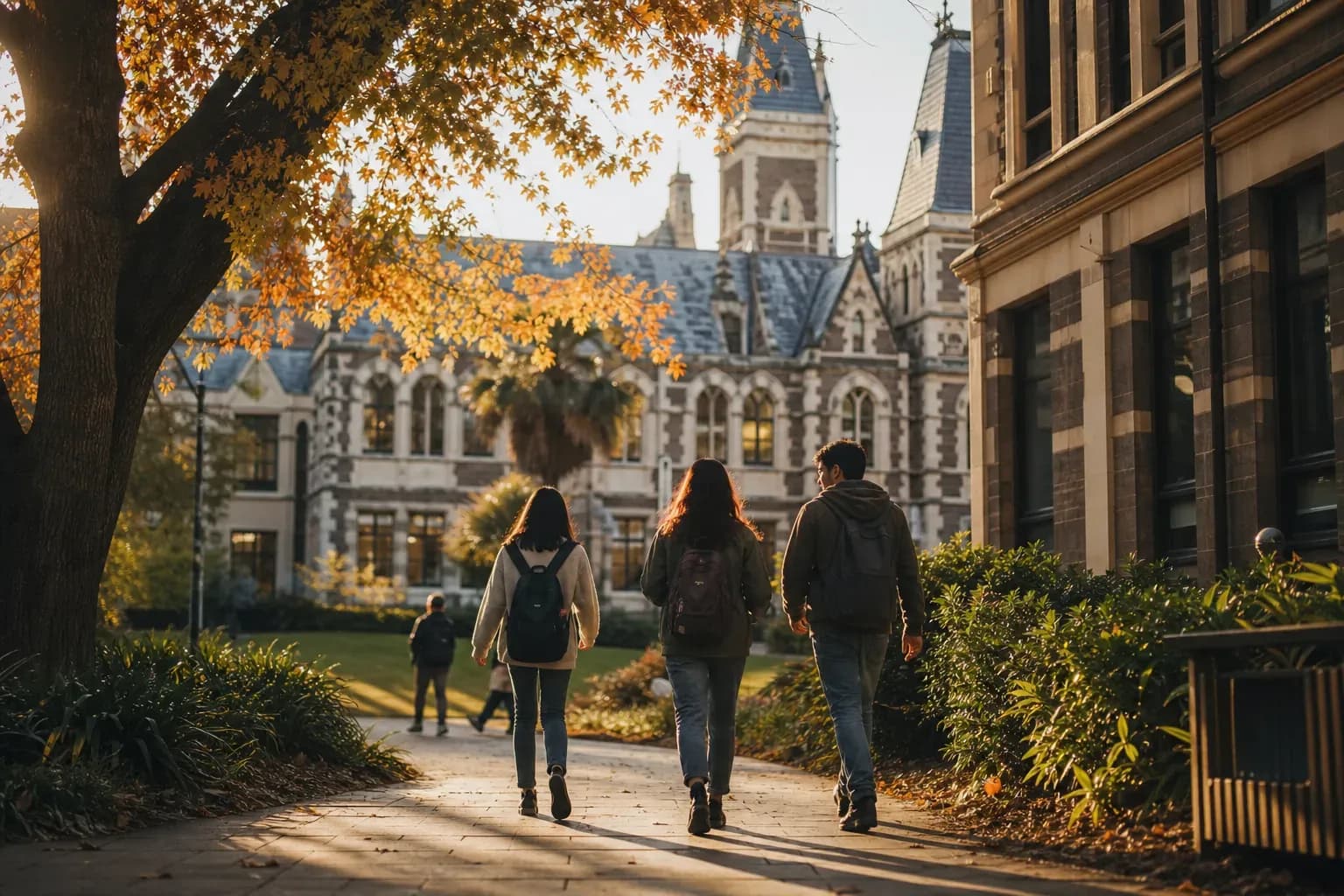
RMIT University: Australia's Design Education Powerhouse, Vietnam Dual-City Campuses, and Melbourne CBD Campus
Published on February 17, 2026
Ranked #125 globally in QS 2026, global Top 15 in QS Art and Design, ahead of every Go8 university including the University of Melbourne and the University of Sydney, and a member of the ATN (Australian Technology Network), RMIT University is usually the first name Taiwanese families hear when they ask about "design schools in Australia." Its full name is Royal Melbourne Institute of Technology. The word "Royal" was granted by Queen Elizabeth II in 1954 to commemorate the institution's 70th anniversary, an honor still held by only four universities in Australia. RMIT is Australia's design education powerhouse. From its beginnings as the Working Men's College in 1887, it has built 140 years of strength in design, architecture, communication, fashion, and animation, and it remains a major talent pipeline for the design industry across the Southern Hemisphere.
But the "design school" label actually understates RMIT. RMIT is one of Australia's few comprehensive technology universities spanning both university degrees and the TAFE vocational system. It also offers programs such as Bachelor of Engineering, Bachelor of Business, and Master of Data Science, with a total student body of more than 90,000 including its overseas campuses in Vietnam. Its CBD campus is effectively an entire stretch of northern Swanston Street in central Melbourne. The way you enter RMIT is by walking into Melbourne's city centre, turning a corner near Melbourne Central Station, and finding yourself on campus. This location fuses RMIT with Melbourne's design industry, creative studios, coffee culture, and street art. For design students who love Melbourne's urban character, RMIT is not about going to Melbourne to study; it is about making Melbourne your campus. This article breaks down RMIT's design reputation, TAFE dual-diploma pathways, and Vietnam dual-city strategy in one place.
1. Basic Information
| Item | Details |
|---|---|
| Founded | 1887 (originally the Working Men's College, a vocational institution founded in the same era as MIT); became a university in 1992 |
| Location | Melbourne, Victoria (City campus on Swanston Street in Melbourne CBD) |
| Campuses | 3 Australian campuses (City, Brunswick, Bundoora) + Vietnam dual-city campuses (Ho Chi Minh City, Hanoi) + Barcelona partner campus in Spain |
| Undergraduate students | ~60,000 (including Vietnam overseas campuses) |
| Graduate students | ~22,000 |
| Total students | Approximately 95,000 (one of Australia's largest universities, second only to Monash) |
| Student-faculty ratio | 1:26 |
| Motto | A skilled hand. A cultivated mind. |
| Institutional group | Member of the ATN (Australian Technology Network) |
RMIT's motto, "A skilled hand. A cultivated mind.", directly expresses its DNA: hands and mind together, with equal emphasis on practice and thinking. This was the educational philosophy of the Working Men's College in 1887, designed for working-class students who worked during the day and studied at night. It has remained unchanged for 140 years.
2. Global Rankings
| Ranking | Position |
|---|---|
| QS World 2026 | #125 |
| THE World 2026 | #251-300 |
| ARWU / Shanghai 2024 | #301-400 |
| QS Art and Design | Global Top 15 (Australia's #1, ahead of every Go8 university) |
| QS Architecture & Built Environment | Global Top 25 |
| QS Communication & Media Studies | Global Top 50 |
| QS Engineering - Civil and Structural | Global Top 50 |
| QS Engineering - Electrical and Electronic | Global Top 100 |
| QS Computer Science | Global Top 150 |
| QS Business and Management | Global Top 200 |
RMIT's QS Art and Design global Top 15 ranking reflects genuine hard strength. It outranks the University of Melbourne, UNSW, Sydney, and every Go8 institution, placing it in the same global top-tier design school group as RCA (Royal College of Art London), Parsons, and Rhode Island School of Design. If your goal is to enter a top global design school, RMIT is the only answer in Australia.
3. Admissions Data (International Students, 2026 Entry)
| Indicator | Value |
|---|---|
| International student ATAR equivalent | 70-90 (depending on program) |
| IB Diploma | 26-36 points |
| Approximate Taiwan high school GPA threshold | Top 20-30% of class + near-perfect grades (portfolio is the main factor for design programs) |
| IELTS requirement | 6.5 (no band below 6.0); Communication and Architecture require 7.0 |
| TOEFL iBT | 79 (including Writing 21) |
| Application fee | AUD 100 (international undergraduate applicants) |
| International student share | Approximately 30% |
| Bachelor of Design (Communication Design / Industrial Design) entry threshold | ATAR 75 / IB 28 + portfolio (most important) |
| Bachelor of Architectural Design entry threshold | ATAR 80 / IB 30 + portfolio |
| Bachelor of Animation and Interactive Media entry threshold | ATAR 75 / IB 28 + portfolio + personal statement |
| Bachelor of Fashion (Design) entry threshold | ATAR 75 / IB 28 + portfolio + interview |
| Bachelor of Engineering entry threshold | ATAR 80 / IB 30 |
International Students
- International students make up approximately 30% of the student body, creating a diverse campus with a balanced mix of Asian and European students
- Students come from 130+ countries
- Around 250-350 Taiwanese students enroll each year across undergraduate and postgraduate programs, mainly in design and engineering. This is the largest Taiwanese cohort among the five ATN universities
- Application feature: for Design, Architecture, Fashion, and Animation, the portfolio carries 60-70% of the weight; academic grades are only the threshold. Your portfolio is the deciding factor in admission
4. Tuition and Financial Aid
2026 International Student Tuition (Annual)
| Program category | Annual tuition in AUD | NTD equivalent (AUD 1 = NTD 22.6) |
|---|---|---|
| Bachelor of Arts | Approximately AUD 36,000 | Approximately NTD 810,000 |
| Bachelor of Business | Approximately AUD 44,000 | Approximately NTD 990,000 |
| Bachelor of Science | Approximately AUD 42,000 | Approximately NTD 950,000 |
| Bachelor of Engineering (Honours) | Approximately AUD 47,000 | Approximately NTD 1.06 million |
| Bachelor of Design (Communication / Industrial / Fashion) | Approximately AUD 42,000 | Approximately NTD 950,000 |
| Bachelor of Architectural Design | Approximately AUD 44,000 | Approximately NTD 990,000 |
| Bachelor of Animation and Interactive Media | Approximately AUD 41,000 | Approximately NTD 930,000 |
| Bachelor of Information Technology | Approximately AUD 44,000 | Approximately NTD 990,000 |
| Master of Design Innovation and Technology | Approximately AUD 42,000 | Approximately NTD 950,000 |
| Master of Information Technology | Approximately AUD 45,000 | Approximately NTD 1.02 million |
| TAFE Diploma (dual-diploma pathway) | Approximately AUD 18,000-24,000 | Approximately NTD 410,000-540,000 |
| Living costs (Melbourne CBD) | Approximately AUD 32,000-40,000 | Approximately NTD 720,000-900,000 |
The total tuition for a four-year Bachelor of Design is approximately AUD 168,000 (NTD 3.8 million), making RMIT's design programs the most affordable option among Australia's "QS Top 15 design schools". Compared with annual tuition of USD 60,000+ at RCA in the UK or Parsons / RISD in the US, RMIT offers clear value for money.
Scholarships and Financial Aid
- RMIT International Excellence Scholarship: 20-50% tuition reduction for undergraduates with strong academic performance
- Vice-Chancellor's International Scholarship: up to full tuition reduction for undergraduates; extremely competitive
- Future Leaders Scholarship: 25% tuition reduction for master's students
- Industry Partner Scholarships: awards supported by industry partners such as Adobe, Autodesk, Toyota, and Ford
- TAFE-to-Bachelor Pathway Scholarship: students who complete a TAFE Diploma before progressing into a Bachelor program may receive credit transfer + tuition support
The most practical point for Taiwanese families: RMIT's TAFE dual-diploma pathway is a cost-saving strategy other universities cannot offer. Students can begin with an RMIT TAFE Diploma (1.5-2 years, tuition AUD 18,000-24,000/year), then progress directly into the second or third year of a Bachelor program, saving AUD 40,000-60,000 in total tuition. This is a major advantage for Taiwanese families with tighter budgets who still want a Bachelor of Design degree.
5. Program Structure: University + TAFE Dual System
Not the Melbourne Model
RMIT uses the traditional British-Australian 3-4 year direct professional degree structure. Students can apply at age 18 directly to Bachelor of Design, Bachelor of Engineering, or Bachelor of IT, then graduate and enter employment after 3-4 years without needing to spend another two years on a master's degree. Engineering is a four-year Honours program, while Design / Business / IT are generally three years.
Signature "Bachelor + TAFE Diploma" Dual-Diploma Pathway
RMIT is one of Australia's few comprehensive education providers offering both university degrees and TAFE vocational diplomas. Its predecessor, the Working Men's College (1887), was originally vocational, and after becoming a university in 1992, RMIT retained the TAFE system, creating a distinctive vertically integrated pathway: "Diploma -> Advanced Diploma -> Bachelor -> Honours -> Master". For Taiwanese students, this creates three strategic options:
- Direct Bachelor entry: traditional pathway, 3-4 years, tuition AUD 42,000-47,000/year
- TAFE Diploma 1.5 years + Bachelor 2 years: lower tuition, lower entry threshold, suitable for design students still preparing their portfolio
- TAFE Advanced Diploma 2 years + Bachelor 1.5 years: lowest-cost pathway, total duration 3.5 years
A TAFE diploma also provides lawful student visa status. Student visa 500 covers TAFE, and some TAFE courses may also qualify for the 485 post-study work visa after graduation. However, PHEW visa restrictions are more complex, so students should consult carefully before choosing this route.
Signature Programs
School of Design (RMIT's true flagship)
- Bachelor of Design (Communication Design): graphic design, branding, typography
- Bachelor of Design (Industrial Design): industrial product design, with partnerships with Toyota, Ford, and Cochlear
- Bachelor of Design (Furniture Design): Australia's only dedicated furniture design program
- Bachelor of Design (Digital Media Design): UI/UX, interaction design
- Bachelor of Fashion (Design): fashion design, connected with Australian Fashion Week
- Bachelor of Fashion (Merchandising): fashion business
- Bachelor of Architectural Design + Master of Architecture: one of Australia's top architecture pathways
- Bachelor of Animation and Interactive Media: animation, game design, interactive media
- Bachelor of Photography: one of Australia's top photography programs
- Bachelor of Communication (Advertising / Public Relations / Journalism): communication studies
Engineering and Technology
- Bachelor of Engineering (Honours): includes Aerospace, Automotive, Mechatronics, Software, Civil
- Bachelor of Information Technology: CS, Software Engineering, Data Science
- Bachelor of Science (Aviation): includes pilot training pathways
- Bachelor of Business: marketing, accounting, finance, entrepreneurship
What This Means for Taiwanese Students
- Best choice for design students: QS Top 15 + Melbourne CBD + lower tuition + TAFE dual-diploma pathway
- Secondary choice for engineering, technology, and business students: rankings are not as strong as Go8, and industry links are not as strong as UTS, but tuition is lower than UTS
- Consultant recommendation: if your goal is to enter a top design school and stay in Melbourne for work or PR, RMIT is the clear choice. If your goal is engineering, IT, or business, UTS (Sydney) or Monash (Melbourne) usually offers better overall value
6. Campus Culture / Institutional Personality
RMIT's personality can be summarized in three words: creative, street-level, and unmistakably Melbourne. It does not have the academic elite atmosphere of the University of Melbourne, the intense engineering and technology competition of Monash, or the Sydney tech-newcomer feel of UTS. It is the official representative of Melbourne street culture. The people you see around the RMIT campus, Melbourne Central, Brunswick Street, and Fitzroy, wearing vintage clothes, tattoos, riding fixies, wearing black-rimmed glasses, carrying portfolios, and walking into independent cafes, heavily overlap.
The campus mix combines Asian international students (China, India, Malaysia, Vietnam, Taiwan, Korea) + Melbourne's local creative class + Southeast Asian students from the Vietnam campuses. There is a very high proportion of first-generation university students and a high proportion of students from non-traditional educational pathways. Many RMIT students have worked for several years before returning to study design, progressed from TAFE, or transferred from the Vietnam campus. This DNA gives RMIT a campus atmosphere that is diverse, age-flexible, project-based, and portfolio-driven. If you are the kind of high school student in Taiwan who does not enjoy chasing GPA, wants to build a portfolio, enter design competitions, and do internships, RMIT is a better fit than Monash or Melbourne.
Student Clubs
- RMIT University Student Union (RUSU) oversees more than 100 clubs
- RMIT Link Arts: student-led curation, performance, and literary communities
- RMIT Fashion Society: the annual fashion show (PIFW Pinnacle) is part of Melbourne Fashion Week
- RMIT Game Developers: connected with the Australian Game Developers Conference
- RMIT Taiwanese Student Association: Taiwanese student association
Sports Culture
- RMIT Sport: smaller in scale than Monash and Melbourne because the CBD campus has limited land
- Mainly participates in inter-university competitions through Australian University Sports (UniSport)
- Off-campus sports are mainly based around gyms and sports clubs in central Melbourne
7. Location / Campus Environment
Urban Positioning
The main City Campus is located on the northern section of Swanston Street in Melbourne CBD. It is a 3-minute walk to Melbourne Central Station, 5 minutes to the State Library of Victoria, 10 minutes to Federation Square, and 15 minutes to Queen Victoria Market. This is one of the most centrally located university campuses in Australia. Your "campus" has no walls; it is the entire Swanston Street + La Trobe Street + Bowen Street precinct in central Melbourne.
Brunswick Campus
6 km from the CBD, this is the specialized campus for fashion and textile design. It is located in Brunswick, one of Melbourne's most artistic inner-city suburbs, similar in feel to Williamsburg in New York or Shimokitazawa in Tokyo.
Bundoora Campus
18 km north of the CBD, this campus focuses on biosciences, health sciences, and ecology.
Vietnam Dual-City Campuses (RMIT Exclusive)
RMIT is the only Australian university with two full campuses in Vietnam:
- RMIT Vietnam - Saigon South Campus (Ho Chi Minh City): opened in 2001, Vietnam's largest international university, with more than 8,000 students
- RMIT Vietnam - Hanoi Campus (Hanoi): opened in 2004
This gives Taiwanese students two strategic options: (1) save 40-50% on tuition by studying at RMIT Vietnam for the first 1-2 years (annual tuition AUD 17,000-22,000), then transferring to Melbourne for the final two years; (2) build a Southeast Asia career network. If your career plan is in Southeast Asia's creative industries, manufacturing, or trade, no Australian university can match the alumni density of RMIT Vietnam.
Barcelona Partner Campus
RMIT has formal exchange partnerships with ISDI business school and Elisava design school in Barcelona, Spain. Students can study one semester of design / urban planning in Barcelona.
City Profile
Melbourne is the capital of Victoria, with a population of 5.1 million, and is Australia's second-largest city. Its key industries include finance, law, health sciences, design, sports, and creative industries. Melbourne is Australia's capital of design and creative industries. The National Gallery of Victoria (NGV), ACMI, the Australian Centre for Contemporary Art (ACCA), and Melbourne Design Week are all concentrated here. RMIT students frequently take part-time jobs and internships at advertising agencies, design studios, publishers, and startups in central Melbourne.
Climate
- Summer (December-February): 18-30°C, with occasional 40°C heatwaves
- Winter (June-August): 6-14°C, no snow but damp and cold
- Melbourne has "four seasons in one day", so always remember to bring an umbrella
Campus Landmarks
- Building 8 (Edmond and Corrigan): a red-brick checkerboard building completed in 1993, now an RMIT icon
- Storey Hall: a deconstructivist building completed in 1995, winner of an Australian Institute of Architects award
- Design Hub: the flagship School of Design building completed in 2012, with an exterior made of 16,000 rotating glass discs
- NAS (New Academic Street): RMIT's 2017 campus redevelopment project, pulling an entire section of Swanston Street into the campus
- RMIT Capitol Theatre: a 1924 work by Walter Burley Griffin, the architect who designed Canberra, restored by RMIT as a lecture theatre
8. Research and Resources
RMIT is an ATN member, with annual research funding of approximately AUD 180 million. Its research strengths are concentrated in design, architecture, engineering, communication, and health sciences.
Key Research Institutes
- RMIT Centre for Innovative Structures and Materials: works with aerospace, automotive, and 3D printing industries
- Australian Centre for Robotic Vision (ACRV): one of Australia's top machine vision research centres
- RMIT Fashion and Textiles: leading fashion design research in Australia
- Centre for Game Design Research: research in game design and interactive media
- RMIT Blockchain Innovation Hub: Australia's first university blockchain research centre
- RMIT Europe (Barcelona): European research collaboration office
- RMIT Vietnam Research Centres: local industry research in Vietnam
Industry Connection
RMIT has very dense industry collaboration in design and engineering:
- Adobe: education partner in Australia, offering students discounts for Adobe Certified Professional certification
- Autodesk: deep collaboration with architecture and industrial design programs
- Toyota Australia / Ford Australia: internships in automotive engineering and industrial design
- Cochlear, CSL, Resmed: medical device design collaborations
- Animal Logic / Luma Pictures / Iloura: animation studio internships (not as deep as the UTS Animal Logic Academy, but still a pipeline)
- NGV / ACMI / ACCA: gallery and museum internships
For students targeting PR, RMIT design and engineering graduates have strong employment outcomes in Melbourne's creative industries, but the PR points pathway is slightly weaker than for Go8 engineering programs. Some design occupations are not on the Skilled Occupation List, so students must check their target occupation carefully in advance.
9. Notable Alumni
- Politics: Joan Kirner (former Premier of Victoria, Australia's first female state premier)
- Architecture: Peter Corrigan (architect and co-designer of RMIT Building 8), Sean Godsell (one of Australia's leading contemporary architects)
- Design: Marc Newson completed part of his studies at RMIT (one of the world's top industrial designers), Akira Isogawa (one of Australia's top fashion designers), Kit Willow (founder of the fashion brand Willow)
- Film and television: Rachel Griffiths (Oscar-nominated actress, star of Six Feet Under), Cate Blanchett (completed part of her pre-acting studies at RMIT, Oscar-winning actress)
- Media: Lee Lin Chin (renowned SBS news anchor), Andrew Denton (one of Australia's leading interview hosts)
- Music: Paul Kelly (Australian national-treasure folk singer)
- Animation: more than 30% of Australia's animation industry practitioners come from RMIT animation programs
- Fashion: more than 40% of main-show designers at Australian Fashion Week are RMIT graduates
RMIT's alumni spectrum has the highest density of creative-industry graduates in Australia. This is something Melbourne, Monash, UNSW, Sydney, and other universities cannot match. If your career is in the creative industries, the RMIT alumni network is a real asset.
10. RMIT Fun Facts
- It was founded as the "Working Men's College": established in 1887 with a £5,000 donation from Melbourne businessman Francis Ormond, with the goal of allowing workers who worked during the day to study at night. It was a product of 19th-century social reform thinking. MIT in Boston was also founded in the same era with a similar spirit. RMIT and MIT have no relationship today, but both were born from the same historical momentum.
- The "Royal" prefix came from Elizabeth II: during the Queen's visit to Australia in 1954, she granted RMIT the "Royal" prefix to commemorate its 70th anniversary. Only four universities in Australia have a "Royal" prefix, including RMIT and the Royal Australian Air Force Academy.
- Australia's first 3D-printed metal aerospace part was made by RMIT: in 2014, RMIT collaborated with GE Aviation to 3D print jet engine components, earning coverage in Nature.
- RMIT Vietnam is Vietnam's largest international university: since opening in 2001, its Ho Chi Minh City and Hanoi campuses now have more than 11,000 students, making it the largest foreign-invested university in Vietnam's education market.
- The "phoenix" in the university crest symbolizes rebirth: RMIT transformed from a vocational institute into a comprehensive university in the 1990s, and the phoenix in its crest symbolizes that institutional transformation.
- Australia's first blockchain research centre: in 2017, RMIT founded the Blockchain Innovation Hub, the first of its kind among Australian universities.
- RMIT Capitol Theatre is a World Heritage candidate: this 1924 Art Deco theatre was designed by Walter Burley Griffin, the architect of Canberra. RMIT completed a AUD 20 million restoration in 2014, and it now serves as one of RMIT's main lecture theatres.
11. Typical Admitted Student Profile
- Taiwanese international school students with IB predicted scores of 28-36, or ATAR equivalent 75-90
- Taiwan high school system: top 20-30% of class (such as Taipei Municipal Jianguo High School, Taipei First Girls High School, Zhongshan Girls High School, The Affiliated Senior High School of National Taiwan Normal University, Wagor, Kang Chiao, Kuei Shan, Fuhsing, Tsai Hsing, Dongshan High School art programs, etc.), with a near-perfect GPA
- Portfolio carries 60-70% of the weight for design programs. Your portfolio is the deciding factor in admission; academic performance is only the threshold
- IELTS 6.5-7.0 or TOEFL iBT 79+ (Communication and Architecture require 7.0+)
- Extracurriculars: design tracks assess portfolio, design competitions (IF Design Award, Red Dot, TGDA, Young Designers' Exhibition), and internships; engineering tracks assess Robotics, Hackathon, and Olympiad experience
- Some Design, Fashion, and Animation programs require interviews (online via Zoom)
- A written Personal Statement is required for most design programs, focusing on why you chose RMIT, why you chose the program, and the conceptual narrative behind your portfolio
12. What Kind of Student Is RMIT Best For?
✓ Best suited for:
- Students who want to study Art, Design, Architecture, Fashion, Animation, or Communication (QS Top 15 design school)
- Taiwanese families who want a world-leading design school but cannot afford RCA, Parsons, or RISD
- Creative students who like Melbourne street culture, coffee, independent music, and tattoos
- Families with tighter budgets who want to save tuition through the TAFE dual-diploma or RMIT Vietnam pathway
- Students who dislike suburban universities and want to live in the CBD within walking distance of campus
- Project-based learners who want to build a portfolio rather than chase GPA
- Students who want to study Engineering (Aerospace / Automotive), IT, or Business but do not have the budget for Go8
✗ Not necessarily suited for:
- Families who care strongly about the "Go8 brand" and need a more recognizable label when returning to Taiwan after graduation (Melbourne and Monash are still safer choices)
- Students planning to enter academia, pursue a PhD, or follow a research track (Go8 research resources are deeper)
- Students who want a "sandstone tower" classical British-style campus (RMIT is a mix of red brick + deconstructivism + rotating glass discs)
- Students who want to study pure humanities, Philosophy, Pure Mathematics, or Economics (Melbourne and ANU are stronger)
- Students applying to design programs with an underprepared portfolio (RMIT design admissions are portfolio-based; high scores alone are not enough)
- Migration-oriented students who choose the wrong major. Some design occupations are not on the Skilled Occupation List, so PR points pathways are weaker. Prioritize IT / Engineering / Architecture
Conclusion
RMIT is the first Australian name on Taiwanese families' "design study abroad" list, not because it is famous in a generic sense, but because its design programs are genuinely global Top 15, Australia's #1, and ahead of every Go8 university. Its signature is not the QS overall ranking of #125, which admittedly looks less impressive next to Go8 institutions. Its real value is the combination of QS Art and Design global Top 15 + Melbourne CBD campus + TAFE dual-diploma pathway + Vietnam dual-city overseas campuses + 140 years of design education heritage. For Taiwanese students who love design, creativity, and Melbourne street culture, RMIT is not a backup option. It is the first choice.
From an immigration strategy perspective, RMIT has four advantages: (1) Bachelor of Design / Architecture / IT direct 3-4 year pathways, allowing students to enter the 485 PHEW countdown 1-2 years earlier than the Melbourne Model; (2) TAFE Diploma + Bachelor dual-diploma pathways can save AUD 40,000-60,000 in tuition, a strategy unavailable at other universities; (3) 485 PHEW Stream provides 2 years after Master Coursework (reduced from 3 years after July 1, 2024), while Master Research or PhD remains 3 years; (4) Architecture, IT, and Engineering are on the Skilled Occupation List, creating smoother PR points pathways.
The most practical PR pathway combinations:
- Design students: RMIT Bachelor of Architectural Design + Master of Architecture (Architect is on the Skilled Occupation List) + PTE 79 + 2 years of Melbourne work experience + NAATI Chinese credential, making it possible to build 85-100 PR points
- STEM students: RMIT Bachelor of Engineering (Honours) or Bachelor of IT + Master of Data Science + PTE 79 + 2 years of Melbourne work experience + NAATI Chinese credential + 189 Skilled Independent, making it possible to build 90-105 PR points
In the master's database at Dr. G. Academy, this pathway appears among the STEM Master Coursework filtered results as the best combination for students with mixed design and engineering backgrounds.
Important warning: some pure design occupations, such as Graphic Designer, Fashion Designer, and Industrial Designer, are on the Skilled Occupation List, while others are not. Before applying, you must confirm whether your target occupation is listed under SOL and ANZSCO. If your goal is PR rather than pure design employment, Architecture, Animation, IT, Engineering, and Built Environment are the more PR-friendly directions.
RMIT is not a substitute for the Go8. It is the provider of design education that the Go8 cannot offer. It will not give you Melbourne's "Australia's #1" label, Monash's engineering industry links, or UTS's Frank Gehry business school. What it will give you is a global Top 15 design credential + central Melbourne campus + TAFE dual-diploma tuition-saving pathway + Vietnam overseas campuses + 140 years of design heritage. For Taiwanese families who love design, want to enter the global creative industries, and know how to calculate total value, RMIT is Australia's most irreplaceable study-abroad option.