
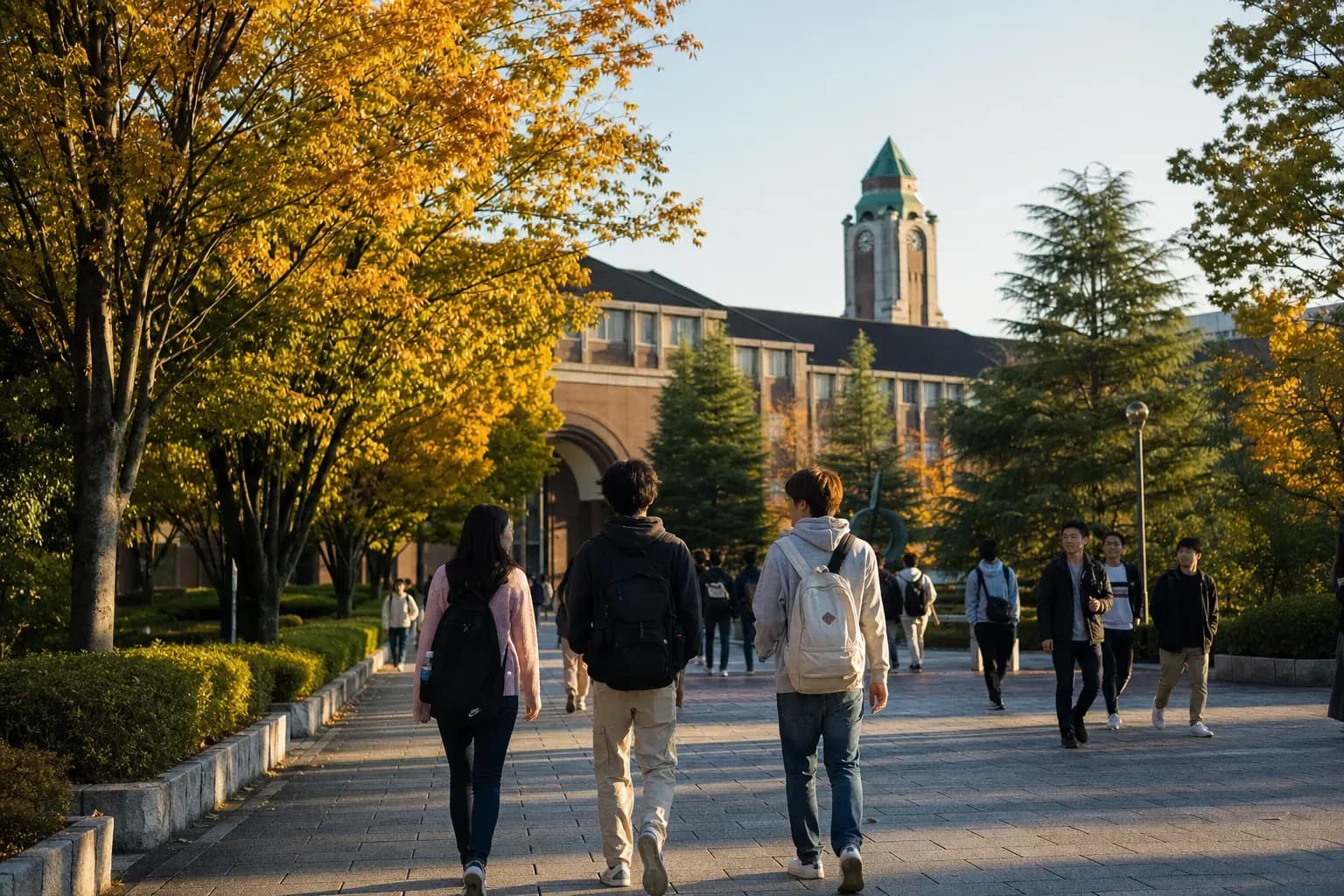
Ritsumeikan University: Kyoto Kinugasa + Osaka Ibaraki, Kansai’s MARCH, GLA and ANU Dual Degree, CRPS International Relations
Published on December 19, 2025
If Doshisha is often seen as “Kansai’s Waseda / Kyoto University,” then Ritsumeikan is “Kansai’s Keio / Osaka University” — the second-strongest name among the four leading Kansai private universities: Kansai University, Kwansei Gakuin University, Doshisha University, and Ritsumeikan University. In terms of English-taught program diversity, depth of international partnerships, and institutional scale of innovation, Ritsumeikan arguably goes even further than Doshisha. Ritsumeikan is not content to remain simply a “Kyoto private university.” In 2015, it made a major move into Osaka with the Osaka Ibaraki Campus, and today it has become a large private university with dual core campuses in Kyoto and Osaka.
What matters even more is how Ritsumeikan has designed its English-taught programs: GLA (Global Liberal Arts) with a dual degree from Australian National University (ANU), CRPS (the English-taught track in the College of International Relations), and IRD (the English-taught track in information systems). These are three distinct English-taught pathways, offering more flexibility than Doshisha’s single ILA route. On top of that, the broader Ritsumeikan Trust also includes APU (Ritsumeikan Asia Pacific University). Choosing Ritsumeikan means entering one of Kansai’s largest private university groups, spanning Kyoto, Osaka, and Beppu.
1. Basic Information
| Item | Details |
|---|---|
| Founded | 1900; its predecessor was the private academy “Ritsumeikan,” founded in 1869 by Kinmochi Saionji |
| Institution type | Private university under the Ritsumeikan Trust |
| Location | Kita Ward, Kyoto City, Kyoto Prefecture (Kinugasa); Ibaraki City, Osaka Prefecture (Osaka Ibaraki); Kusatsu City, Shiga Prefecture (BKC) |
| Campuses | Kinugasa ~16 hectares, BKC ~63 hectares, Osaka Ibaraki ~10 hectares |
| Undergraduates | ~33,000 |
| Graduate students | ~3,000 |
| Student-faculty ratio | 1:32 |
| Motto | "Freedom and Innovation" |
| Founding spirit | Kinmochi Saionji, former Prime Minister of Japan and Meiji-era statesman |
2. World Rankings
| Ranking | Position |
|---|---|
| QS World 2026 | #761-770 |
| THE World 2026 | #601-800 |
| THE Japan University Rankings 2024 | #20 |
| THE Japan “International Outlook” category | Top 25 |
| Japanese private university entrance difficulty ranking | Second among the four leading Kansai private universities; Top 12 private university nationwide |
Ritsumeikan is one of the 24 SGU Type B Global Traction Type universities. Its QS / THE ranking performance is slightly stronger than Doshisha’s, reflecting Ritsumeikan’s lead in international partnerships, including the ANU dual degree and 180+ partner universities, research output, and depth of English-taught programs. For families evaluating Japan options, if you care about global rankings and diversity of English-taught programs, Ritsumeikan is in practice often more advantageous than Doshisha.
3. Admissions Data (2024 Entry)
GLA (Global Liberal Arts) Applications
| Indicator | Figure |
|---|---|
| Applicants | ~200-300 |
| Admitted students | ~50-70 |
| Acceptance rate | Approximately 20-28% |
| Students from Taiwan admitted each year | 3-7 |
CRPS (College of International Relations) Applications
| Indicator | Figure |
|---|---|
| Applicants | ~300-400 |
| Admitted students | ~80-100 |
| Overall acceptance rate | Approximately 25-35% |
| Students from Taiwan admitted each year | 5-10 |
IRD (English-Taught Information Systems Science)
This is one of the most attractive English-taught engineering options for students from Taiwan with STEM backgrounds. It enrolls around ~25-30 students each year, with an acceptance rate of approximately 30%.
Application Requirements (GLA)
| Item | Requirement |
|---|---|
| English proficiency | TOEFL iBT 80+ / IELTS 6.5+; for the GLA-ANU dual degree, iBT 95+ is recommended |
| Standardized testing | SAT 1180+, ACT 24+, IB 30+, or three A-Level subjects at C or above |
| Japanese language | Not required at all |
| High school GPA | 3.2/4.0 or above |
| Recommendation letters | 2 |
| Essays | Personal Statement + Why Ritsumeikan + Why ANU dual degree |
| Interview | Required for GLA; conducted online |
International Students
- International students make up approximately 6% of the university overall; across the Ritsumeikan Trust including APU, APU is around 50% international
- In GLA / CRPS classes, international students account for approximately 40-60%
- The university has 460+ partner institutions; among private universities, this is the highest number, including ANU, Berkeley, National Taiwan University, National Chengchi University, and National Tsing Hua University
4. Tuition and Financial Aid
2025 Tuition (GLA / CRPS)
| Item | Amount (JPY) | Approximate NTD |
|---|---|---|
| Enrollment fee | 300,000 | ~63,000 |
| Tuition (annual) | Approximately 1,300,000-1,500,000 | ~270,000-310,000 |
| Facility / miscellaneous fees | Approximately 200,000 | ~42,000 |
| Dormitory / rent (monthly, Kyoto / Osaka) | 55,000-80,000 | ~12,000-17,000 |
| Living expenses (monthly) | 65,000-85,000 | ~14,000-18,000 |
| Estimated total cost for four years | Approximately JPY 9-11M | ~NTD 1.9-2.3M |
Ritsumeikan International Student Scholarships
- Ritsumeikan International Student Scholarship: 30-100% tuition reduction, based on admissions results
- Saionji Memorial Scholarship, named after the founder: JPY 500,000-1,000,000 per year
- GLA-ANU Dual Degree Scholarship: special scholarship, JPY 500,000-1,000,000 per year
- MEXT Embassy Recommendation Scholarship: available to some international students
- JASSO Student Support Scholarship: JPY 48,000 per month
In practice, Ritsumeikan is relatively generous with scholarships for international students from Asia, and the annual cost for a family from Taiwan can be reduced to around NTD 150,000-200,000.
5. Academic Structure / Signature Programs
GLA (Global Liberal Arts Program) + ANU Dual Degree
Ritsumeikan’s flagship English-taught program:
- Four-year Liberal Arts program taught fully in English
- Dual degree structure with Australian National University (ANU), a QS Top 30 university:
- 2 years at Ritsumeikan in Kyoto + 2 years at ANU in Canberra
- Graduates can receive both a Ritsumeikan BA + ANU BA
- In Japan, this is the only English-taught undergraduate dual degree with a QS Top 30 university
- Major areas: Asia Pacific Studies, Global Studies, Liberal Arts
CRPS (College of International Relations)
- Four-year International Relations college taught fully in English
- Majors: International Relations, Global Studies, Development & Sustainability
- 250+ English-taught courses related to international relations
- Mandatory one-semester overseas exchange, with options such as Berkeley, Sciences Po, KCL, and NUS
IRD (English-Taught Information Systems Science)
- Partially English-taught pathway in Information Systems Science
- Covers AI, software engineering, data science, and cybersecurity
- Located at BKC in Kusatsu, Shiga Prefecture
- Well suited to students from Taiwan with STEM backgrounds who want to study engineering in English
Global Studies Major (GSM) / JDP (Dual Degree)
- Multiple dual degrees with ANU, American University Washington, Università di Bologna, and other institutions
- Ritsumeikan degree + overseas university degree
6. Campus Culture / Institutional Personality
Ritsumeikan’s campus personality can be summed up as: freedom, innovation, scale, strong athletics, and Kansai energy.
- “Freedom and Innovation” motto: Unlike Doshisha’s combination of freedom and Christian tradition, Ritsumeikan’s version of freedom leans more toward secular liberalism and an innovative spirit
- Very strong sports tradition: Ritsumeikan’s rugby, track and field, and basketball teams are all among Japan’s leading university teams
- Student-centered atmosphere: active student organizations, dense club culture, and frequent events
- Three-campus scale: Kyoto Kinugasa for humanities and social sciences, Osaka Ibaraki for business, law, and policy, and Shiga BKC for science, engineering, and life sciences; your campus determines much of your university experience
- Compared with Doshisha: Doshisha feels more refined and gentlemanly; Ritsumeikan feels energetic and outgoing
- Ritsumeikan Trust system: In addition to Ritsumeikan University, the group includes APU in Beppu, Oita Prefecture, Ritsumeikan High School, Ritsumeikan Junior High School, and Ritsumeikan Uji High School, making it one of Japan’s largest private education groups
7. Location / Campus Environment
Kinugasa Campus (Kyoto, Main Campus)
- Located in Kita Ward, Kyoto City, next to Kinkaku-ji, placing it in the Kitayama area of northern Kyoto
- Home to the Colleges of Letters, Law, Social Sciences, International Relations, Image Arts and Sciences, and Policy Science
- The main campus for GLA and CRPS international students
- Approximately 30 minutes by bus from central Kyoto, or 20 minutes by bicycle
- A mix of classical and modern campus architecture, with a moderate overall scale
- Within 1 km: Kinkaku-ji, Ryoan-ji, Ritsumeikan’s College of Image Arts and Sciences, and Kyoto City University of Arts
Osaka Ibaraki Campus (OIC)
- Located in Ibaraki City, Osaka Prefecture, a 5-minute walk from JR Ibaraki Station
- Opened in 2015 and is Ritsumeikan’s most modern campus
- Home to the College of Business Administration, parts of the College of Policy Science, the College of Comprehensive Psychology, and the Global Business program
- 15 minutes to central Osaka and 30 minutes to central Kyoto by commute
- Suitable for students interested in business, policy, and psychology
BKC Campus (Kusatsu, Shiga Prefecture)
- Home to the Colleges of Science and Engineering, Information Science and Engineering, Life Sciences, Pharmaceutical Sciences, Sport and Health Science, and Gastronomy Management
- The main campus for IRD international students
- Spacious campus with modern laboratories
- 30 minutes from central Kyoto and 1 hour from Osaka
8. Research and Resources
Ritsumeikan is a large private research university, with research output in the upper-middle tier among private universities in Japan:
Libraries
- Three main libraries across Kinugasa, Osaka Ibaraki, and BKC, with a total collection of approximately 2.7 million volumes
- Extended 24-hour opening periods during exam season
- Strong electronic resources: JSTOR, ProQuest, Web of Science, IEEE Xplore
Research Institutes
- Ritsumeikan Kinugasa Research Organization for Asia Pacific studies
- Ritsumeikan Global Innovation Research Organization (R-GIRO) for large interdisciplinary projects
- Ritsumeikan AI Research Center at BKC for information science and engineering
- College of Image Arts and Sciences, Japan’s first independent college dedicated to film, animation, games, and related media research
International Exchange Resources
- 460+ partner institutions, the highest number among Japanese private universities
- Dual degree with ANU, plus summer collaborations with Berkeley, UCLA, and UC San Diego
- Shared resources across the Ritsumeikan Trust, including APU’s international network in Oita, where international students make up around 50% of the student body
9. Notable Alumni
Ritsumeikan alumni are widely represented across politics, business, academia, culture, and sports:
- Kinmochi Saionji, former Prime Minister of Japan, founder of Ritsumeikan, and Meiji-era statesman
- Akio Nonaka, collaborator of a Nobel Prize winner in chemistry, associated with Kyoto’s chemistry sector
- Nobuhiko Takada, K-1 / PRIDE combat sports legend
- Yuto Nagatomo, Japan national football team player; played for Inter Milan and Marseille
- Joe Hisaishi, renowned Studio Ghibli composer, also associated with Doshisha
- Takeshi Okada, former head coach of the Japan national football team
- Multiple senior executives at Kyocera, Murata, Wacoal, and long-established Kyoto companies
- Senior officials in Osaka and Kyoto local governments
Ritsumeikan has strong placement in sports, Kyoto-based companies, media, and entertainment, and alumni from the Ritsumeikan rugby program in particular have significant influence in Japanese athletics.
10. Lesser-Known Facts About Ritsumeikan
- Ritsumeikan’s College of Image Arts and Sciences was Japan’s first independent film college, producing a large number of professionals in animation, film, and games, especially in Kyoto’s animation industry.
- Ritsumeikan and APU form one of Japan’s largest cross-campus international student ecosystems: students at the two universities can take courses across institutions, extending APU Beppu’s 50% international student density into the main Ritsumeikan network.
- Ritsumeikan founder Kinmochi Saionji was one of the great Meiji-era statesmen of Japan, alongside Hirobumi Ito and Aritomo Yamagata. He served twice as Prime Minister, and the name “Ritsumeikan” comes from the phrase “the learning of establishing one’s destiny” in Mencius.
- Ritsumeikan’s rugby team is a major force in Japanese university rugby and has won multiple national championships. This is a key source of Ritsumeikan’s reputation as a strong sports university.
- The GLA-ANU dual degree is Japan’s only English-taught undergraduate dual degree with a top Australian Group of Eight university, making the partnership unique in Japanese higher education.
11. Typical Admitted Student Profile (GLA / CRPS International Students)
- High school GPA of 3.3/4.0 or above
- TOEFL iBT 90+ or IELTS 6.5+
- SAT 1200+, IB 31+, or A-Level results around 3B or above
- Able to clearly explain “Why Ritsumeikan?” and “Why the ANU dual degree / International Relations?”
- Interested in humanities, social sciences, international relations, or Asian studies
- Meaningful experience in at least one of the following: overseas experience, Model United Nations, community service, or debate club
- Recommendation letters from an English teacher and homeroom teacher / class advisor
- A plan for employment in Japan, transition to Australia, or entry into Kansai-based companies after graduation
12. What Kind of Student Is Ritsumeikan Best For?
✓ Best suited for:
- Students who want to study an English-taught program at a dual-core Kyoto / Osaka university
- Students interested in international relations, Asian studies, Liberal Arts, business, or information systems
- Students who want the ANU dual degree as a strong addition to their academic profile
- Families willing to pay approximately JPY 1.3-1.5M in private university tuition, with the expectation of receiving a 30-50% tuition reduction
- Students who want a large private university and a 460-institution partner network
- Students who prefer an energetic, outgoing campus culture with active sports clubs
- Students aiming for Kansai-based companies or international organizations
✗ May not be the best fit for:
- Students who want a small, refined Liberal Arts environment; consider Rikkyo GLAP or Sophia FLA instead
- Students who want to study pure medicine; Ritsumeikan has a College of Pharmaceutical Sciences but no medical school
- Students seeking the prestige halo of a QS Top 200 global ranking
- Students trying to maximize bonus points for Japan’s HSP permanent residency pathway; Ritsumeikan is not on the +10 point list
- Families with a very tight budget who cannot afford private university tuition
13. HSP Highly Skilled Professional Permanent Residency Pathway
Ritsumeikan University is not on the HSP Highly Skilled Professional “+10 bonus points” list, which is limited to 13 flagship national universities. However, graduates of the Ritsumeikan GLA-ANU dual degree also hold an Australian degree, which gives them distinctive advantages in HSP point calculations and career flexibility.
The most common HSP pathway for Ritsumeikan graduates:
- Ritsumeikan GLA / CRPS → Kyoto company / Osaka company / major trading company with annual salaries around JPY 5-8M
- Accumulate 70+ points over 3-5 years → HSP Highly Skilled Professional visa category 1
- Apply for permanent residency after 1-3 additional years
Special advantage of the GLA-ANU dual degree: the Australian credential can support an Australian skilled migration route, a later return to Japan for employment, or direct applications to international organization roles in Japan using the dual-degree profile. The flexibility is unusually strong.
For detailed strategy, refer to Dr. G.’s internal guide, “Post-Graduation Visa Strategy / 05_Japan_Visa_Strategy.” For students planning a “Ritsumeikan → Australia / U.S. master’s → return to Japan or stay in Australia” double-step route, the “Master Grad School Database / Japan section” and “Top30 Value Report” provide a complete evaluation.
Conclusion
Ritsumeikan is a university designed for students who want Kansai energy, program diversity, and deep international partnerships. It is not as quietly refined and Kyoto-classical as Doshisha, and it is not as small and Beppu-focused as APU. Ritsumeikan follows a larger platform model: Kyoto Kinugasa + Osaka Ibaraki + Shiga BKC + ANU dual degree + the Ritsumeikan Trust system.
The question families most often ask is: “What is the real difference between Ritsumeikan GLA and Doshisha ILA?” The answer is: Doshisha is a refined, single-core Kyoto option; Ritsumeikan is an energetic, innovative dual-core Kyoto-Osaka option. If you want a small, polished Liberal Arts environment, choose Doshisha. If you want an ANU dual degree, deeper international relations options, larger institutional scale, and broader career pathways, then in one sentence: Ritsumeikan GLA + ANU dual degree is the most distinctive transnational dual-degree option among English-taught undergraduate programs in Japan, and one of the highest-value private university choices in Kansai.