
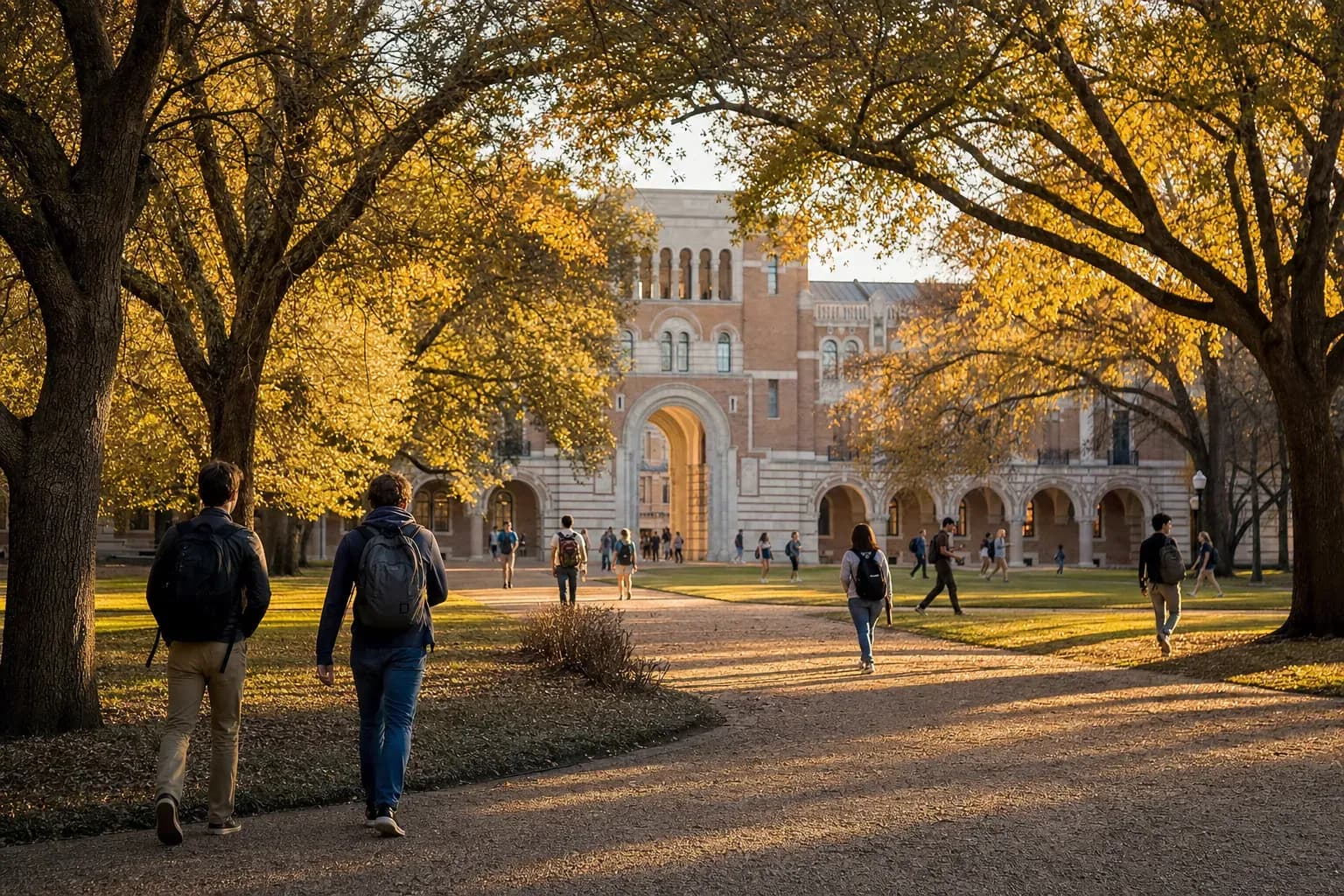
Rice University: Residential Colleges, Houston Campus, and the Ivy of the South
Published on November 1, 2025
Ranked tied #18 nationally by US News, with only 4,500 undergraduates and a location in the urban core of Houston, Texas, Rice is the defining example of the "Ivy of the South" and one of the most overlooked Top 20 universities among Taiwanese families. It has Ivy-level academics, a Caltech-level student-faculty ratio (1:6), a Stanford-like campus atmosphere, tuition lower than East Coast Ivy schools, and weather that is 100 times more comfortable than New England.
Rice in one sentence: "A three-in-one blend of Caltech, Stanford, and the Ivy League in Texas." Its 11 Residential Colleges are the soul of Rice. From your first day, you are assigned to a "college" (yes, like Hogwarts), and then you spend four years in the same college, sharing everything from dinners to Senior Week with your classmates. This design gives Rice one of the deepest student bonding cultures in the Top 20.
1. Basic Information
| Item | Details |
|---|---|
| Founded | 1912 |
| Location | Houston, Texas (heart of the Museum District) |
| Campus | About 300 acres |
| Undergraduates | ~4,500 |
| Graduate students | ~3,800 |
| Student-faculty ratio | 1:6 |
| Motto | Letters, Science, Art (no Latin motto; Rice has its own distinctive tradition) |
2. World Rankings
| Ranking | Position |
|---|---|
| US News National Universities 2025 | #18 |
| QS World 2025 | #145 |
| THE World 2025 | #128 |
| US News Engineering | Top 20 |
| US News Architecture | Top 10 |
| Jones School of Business (MBA) | Top 30 |
Note: Rice is seriously underrated in QS / THE rankings. Like Brown and Dartmouth, Rice is small, and its research output cannot be compared directly with large R1 universities. US News is the more accurate reflection of Rice's real position.
3. Admissions Data (Class of 2028)
| Metric | Value |
|---|---|
| Applicants | ~31,000 |
| Admitted students | ~2,400 |
| Overall acceptance rate | About 7.7% |
| ED acceptance rate | ~16% |
| RD acceptance rate | ~6% |
| Yield Rate | ~42% |
Rice's ED acceptance rate is clearly stronger than RD. Its 42% yield rate is relatively low (compared with 70%+ at Ivy schools), meaning many students admitted to Rice choose an Ivy instead. As a result, Rice can actually be more friendly to applicants who genuinely want Rice.
SAT/ACT Middle Range
| Test | 25th percentile | Median | 75th percentile |
|---|---|---|---|
| SAT | 1500 | 1540 | 1570 |
| ACT | 34 | 35 | 36 |
International Students
- International students make up about 13%
- Students come from 80+ countries
- Around 3-6 students from Taiwan are admitted each year
4. Tuition and Financial Aid
2024-2025 Cost of Attendance
| Item | Amount |
|---|---|
| Tuition | USD $58,856 |
| Housing | USD $11,000 |
| Food | USD $5,750 |
| Personal + Misc | USD $4,000 |
| Total | USD $79,600+ |
Rice has one of the lowest total costs among Top 20 universities, nearly USD $20,000 cheaper than Columbia.
Need-Based Aid ("Rice Investment")
- Family income < $75,000: full tuition + housing + food covered
- Family income < $140,000: full tuition covered
- Family income < $200,000: at least 50% tuition assistance
- International students: Need-Aware (same as Cornell / Caltech)
- Average aid: USD $54,000/year
- No-Loan Policy
Rice is not Need-Blind for international students. However, it still offers substantial support for middle-class families, so Taiwanese families may expect meaningful reductions in cost.
5. Academic Structure / Signature Programs
Schools
- Wiess School of Natural Sciences
- George R. Brown School of Engineering
- School of Architecture: five-year undergraduate BArch
- School of Humanities
- School of Social Sciences
- Jesse H. Jones Graduate School of Business (primarily graduate-level)
- Shepherd School of Music
Undergraduate Majors
- 50+ majors in total
- Top 5 popular majors:
- Computer Science
- Bioengineering
- Chemical Engineering
- Economics
- Psychology
Signature Programs
- Bioengineering: Works closely with Texas Medical Center, the world's largest medical center, allowing undergraduates to participate deeply in research
- Architecture (BArch): Top 10 undergraduate architecture program in the United States
- Shepherd School of Music: Conservatory-level performance training
- Rice/Baylor Medical Scholars Program: eight-year BS/MD dual admission
- Rice Center for Engineering Leadership
General Education Structure
Rice uses Distribution Requirements, requiring students to complete a certain number of credits across Humanities, Social Sciences, and Natural Sciences. It is relatively flexible, sitting somewhere between Brown and Columbia.
6. Campus Culture / Institutional Personality
Rice's personality is Southern hospitality + academic intensity + wonderfully strange traditions. Students are not as politically combative as Berkeley students or as worldly as Harvard students; they are sincere, collaborative, and equipped with a nerdy sense of humor. Among Top 20 universities, Rice has one of the least competitive and most collaborative campus cultures.
Residential College System (the Soul of Rice)
Apart from Yale, Rice is one of the few universities in the United States with a true Residential College system. Each of the 11 Colleges has:
- Its own building, dorms, and dining hall
- Its own Master (a faculty/staff family living inside the College)
- Its own mascot, traditions, and sports teams
- Its own admissions color and slogan
Students are randomly assigned to a College when they enter and stay in the same College for all four years. This is the biggest difference from the Harvard House System, where students are assigned to houses in sophomore year. The 11 Colleges are Baker, Brown, Hanszen, Jones, Lovett, Martel, McMurtry, Sid Richardson, Wiess, Will Rice, and Duncan.
Greek Life
- Rice has no Greek Life; Fraternities / Sororities are not allowed
- The Residential Colleges replace the traditional functions of Greek Life
Sports Culture
- NCAA Division I (American Athletic Conference)
- Standouts: baseball (multiple NCAA championships), football
- "Beer-Bike Day": every spring, students take part in a bicycle + beer relay, Rice's wildest tradition
7. Location / Campus Environment
Urban Positioning
Rice is located in Houston's central Museum District. The Museum of Fine Arts, the natural history museum, Hermann Park, and the Houston Zoo are all within walking distance of campus. Texas Medical Center, the world's largest medical center, is right next to campus, making it a paradise for Rice Bioengineering students.
Houston is the fourth-largest city in the United States (population 2.3 million), a center of the energy industry, Space City (NASA Johnson Space Center is here), and a highly multicultural city with large Asian, Mexican, and Black communities.
Climate
- Winter: 10°C to 18°C, almost no snow
- Summer: 25°C to 35°C, extremely hot and humid, which is Rice's biggest drawback
- Spring and fall are pleasant
Houston's summer "sauna" is real; the feels-like temperature can soar to 40°C. But the fact that it does not snow at all is a major advantage, and East Coast students will be jealous.
Campus Landmarks
- Lovett Hall (century-old landmark and campus entrance)
- Sallyport (the gateway arch students pass through at matriculation and again at graduation)
- Rice Memorial Center
- Brockman Hall for Physics
- Skyspace (James Turrell light installation)
8. Research and Resources
Libraries
- Fondren Library holds 2.5 million volumes
- Six libraries across campus, with 3 million total volumes
Notable Labs / Research Centers
- Rice Quantum Initiative: quantum computing and quantum materials
- Smalley-Curl Institute: nanotechnology (Richard Smalley, a 1996 Nobel Prize winner in Chemistry, discovered C60)
- Baker Institute for Public Policy: public policy think tank
- Ken Kennedy Institute for Information Technology
Rice has extremely high research density in terms of output per person. Despite having only 4,500 undergraduates, it has had Nobel laureates serving as department chairs.
9. Notable Alumni
- Politics / Public Service: Alberto Gonzales (former U.S. Attorney General), John Cornyn (U.S. Senator from Texas)
- Technology / Entrepreneurship: Salman Khan (founder of Khan Academy), Howard Hughes (attended briefly)
- Finance / Business: Fred Smith (founder of FedEx, attended Yale) - wait, that one is Yale. Rice alumni include David Pearce (venture capital) and Linda Lay (wife of former Enron CEO)
- Academia / Nobel Prizes: Robert Curl (Nobel Prize in Chemistry), Richard Smalley (Nobel Prize in Chemistry)
- Arts / Sports: Cliff Stoll (hacker and author), Larry McMurtry (Pulitzer Prize-winning novelist)
Rice alumni are especially known for technology + engineering entrepreneurship. FedEx, Compaq, and Khan Academy all have Rice DNA.
10. Fun Facts About Rice
- You cannot walk through the Sallyport as a freshman: Students pass through the Sallyport only twice, at Matriculation and at graduation. According to campus legend, walking through it in between means you will not graduate.
- Beer-Bike Day: A spring tradition every year, with a women's bicycle relay / men's beer-drinking relay; it is Rice's wildest event.
- Rice Owl mascot Sammy: Based on real owls that appear on campus.
- The campus was designed by Frederick Law Olmsted: The same landscape architect behind New York's Central Park.
- Rice founder William Marsh Rice was murdered by his butler: In 1900, the elder Rice was poisoned by his own butler. Legal disputes over the estate delayed the university, which did not officially open until 1912.
11. Typical Admitted Student Profile
- GPA Unweighted ~3.9+
- SAT 1500+ or ACT 34+
- 6-10 AP courses / strong IB
- Spike tends toward a balance of academics + leadership: science fairs, research publications, student government, orchestra, debate team
- Essays must show specific "Why Rice" reasoning + interest in Residential College culture
- Recommendation letters should demonstrate that "this student is highly collaborative"
- Rice places special emphasis on "The Box", the final Common App question: "Please tell us anything you want us to know." Rice gives 500 words for this, one of the most distinctive designs among Top 20 universities
Rice admits students who can thrive in a collaborative small community.
12. What Kind of Student Is Rice Best For?
✓ Good fit:
- Students interested in Bioengineering, Architecture, Music, or CS
- Students who like collaboration and dislike cut-throat competition
- Students who want a small campus plus big-city resources
- Students interested in Pre-Med (the world's largest medical center is next door)
- Students who are not afraid of heat and can adapt to Houston summers
- Middle-class families seeking meaningful financial aid
✗ Not necessarily a good fit:
- Students drawn to old East Coast architecture / New England tradition
- Students afraid of extreme heat and humidity
- Students who want a Greek Life party culture
- Students with no direction at all regarding major (Rice is small, and every department expects you to have ideas)
- Students who need Need-Blind aid for international applicants
Conclusion
Rice is the most underrated Top 20 university. Taiwanese families have heard of Harvard, Stanford, and MIT, but few put Rice on the dream list, and that is a mistake. Rice offers academic quality on par with Brown and Dartmouth, but with lower tuition, warmer weather, and abundant internship opportunities in Houston's medical and energy industries.
If your child is collaborative, curious, and does not need the vanity of prestige, Rice is one of the most comfortable choices in the Top 20. The Residential College system gives you 350 people who truly know you over four years, which has more value than knowing 50 people among 7,200 at Harvard. Rice may not show off for you on LinkedIn, but it will accompany you through life. That is Rice's promise to Taiwanese families.