
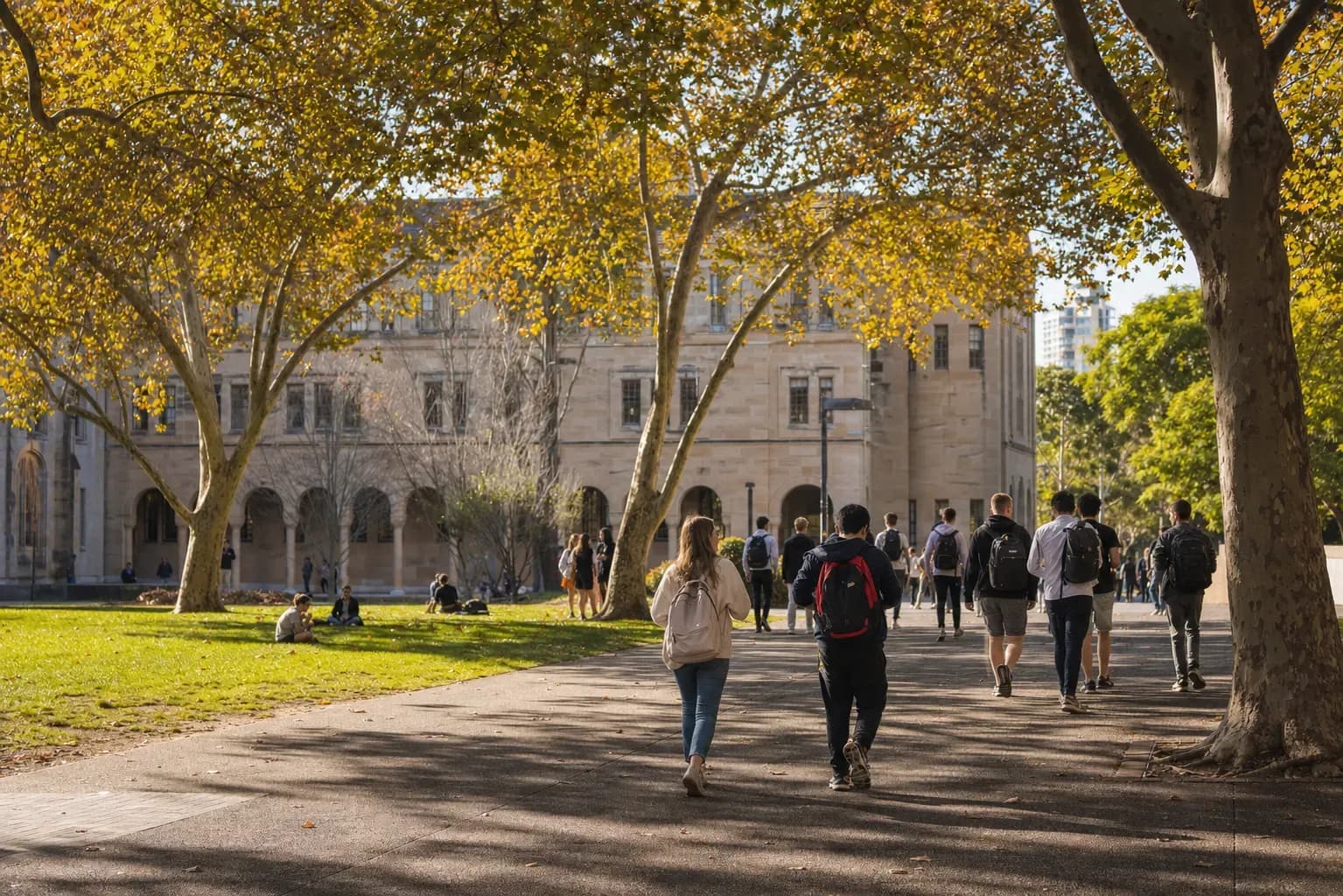
Queensland University of Technology: A University for the Real World, Gardens Point CBD Campus, Triple Crown Business School
Published on February 13, 2026
Ranked #226 globally in QS 2026 and a core member of the ATN (Australian Technology Network), Queensland University of Technology, commonly known as QUT, is the applied-learning flagship among Brisbane’s two major universities. Many Taiwanese parents stop after looking at UQ (University of Queensland), not realizing that QUT is the only university in Australia with an independent Creative Industries Faculty, the only university in Brisbane CBD located right beside State Parliament, one of the very few business schools in Australia with Triple Crown accreditation (AACSB + EQUIS + AMBA), and the ATN institution most deeply connected with industry, government, and the creative economy.
QUT’s visibility is held back by three things: UQ’s Go8 halo, the word “Technology” in its name, which makes parents assume it only teaches engineering and science, and its QS ranking of #226, which Taiwanese families often read as “one tier below the Go8.” All three assumptions are wrong. QUT’s motto, “A University for the Real World,” is not just marketing language. It is the university’s strategic position: QUT deliberately does not compete with UQ on Nature paper output or with ANU on basic research funding. Instead, it specializes in applied programs designed to produce graduates who can move directly into industry. QUT Business School is one of only four business schools in Australia with Triple Crown accreditation, alongside UNSW AGSM, Melbourne Business School, and UQ Business School. In European and American business circles, this accreditation often matters more than a QS ranking. This article explains the real distinction between QUT and UQ, why Creative Industries is a hidden option for Taiwanese design students, and the strategic value of the Gardens Point CBD campus.
1. Basic Information
| Item | Details |
|---|---|
| Founded | 1989 (predecessor Queensland Institute of Technology; roots trace back to 1849) |
| Name origin | Queensland, Australia’s second-largest state |
| Location | Brisbane, Queensland (Gardens Point CBD main campus, Kelvin Grove creative industries campus) |
| Campus | Two main campuses totaling about 80 hectares, plus satellite campuses such as Caboolture and Petrie |
| Undergraduates | ~38,000 |
| Postgraduates | ~14,000 |
| Total enrollment | About 52,000 |
| Student-faculty ratio | 1:22 |
| Motto | A University for the Real World |
| Group affiliation | Core member of ATN (Australian Technology Network) |
QUT’s history traces back to the Brisbane School of Arts, founded in 1849, and it became a university in 1989. The word “Technology” in the name is easy to misread. QUT is not limited to STEM. In the context of Australia’s 1989 higher-education reforms, known as the Dawkins Reforms, “Technology” represented a broader idea: integrating practical disciplines such as craft, design, business, communication, and education into one university. QUT still preserves this practical orientation today, and this is the biggest difference between QUT and UQ’s path as a century-old research university.
2. World Rankings
| Ranking | Position |
|---|---|
| QS World 2026 | #226 (4th among ATN universities) |
| THE World 2026 | #199 |
| ARWU / Shanghai 2024 | #201-300 |
| QS Communication & Media Studies | Global Top 30 |
| QS Education and Training | Global Top 50 |
| QS Nursing | Global Top 50 |
| QS Art and Design | Global Top 100 |
| QS Business and Management Studies | Global Top 200 |
| QS Architecture | Global Top 100 |
QUT does not rank as highly as the Go8 in the overall QS table, but it is globally strong in applied fields such as Communication, Education, Nursing, and Art and Design. Times Higher Education (THE) places QUT at #199, 27 spots higher than QS. This gap reflects THE’s heavier weighting on industry collaboration and citation impact, where QUT’s applied research is recognized more strongly. For Taiwanese students interested in Communication, Design, Business, or Education, QUT’s global subject rankings are higher than UQ’s in several of these areas.
3. Admissions Data (International Students, 2026 Entry)
| Indicator | Value |
|---|---|
| International student ATAR equivalent | 70-90 (depending on program) |
| IB Diploma | 28-36 points |
| Approximate Taiwan high school GPA threshold | Top 20-40% school ranking + upper-mid academic performance |
| IELTS requirement | 6.5 (6.0 in each band); Education, Nursing, and Health Sciences 7.0 |
| TOEFL iBT | 79 (including Writing 21) |
| Application fee | No application fee |
| International student share | About 25% |
| Bachelor of Business entry threshold | ATAR 75 / IB 28 |
| Bachelor of Engineering (Honours) entry threshold | ATAR 80 / IB 30 |
| Bachelor of Creative Industries entry threshold | ATAR 75 / IB 28 + portfolio for some majors |
| Bachelor of Design entry threshold | ATAR 75 / IB 28 + portfolio |
| Bachelor of Information Technology entry threshold | ATAR 75 / IB 28 |
International Students
- International students make up about 25% of the student body, roughly 5-8 percentage points lower than UQ
- Students come from 100+ countries, with the largest groups from China, India, Vietnam, Malaysia, and Indonesia
- About 80-130 Taiwanese students enroll each year across undergraduate and postgraduate levels
- Important: QUT uses direct applications and charges no application fee; Creative Industries and Design-related programs require a portfolio, which can benefit students from Taiwan’s high school system because a strong portfolio can offset differences in ATAR / IB comparisons
- QUT accepts Taiwan high school senior-year grades plus GSAT results, with thresholds that are more flexible than UQ’s
4. Tuition and Financial Aid
2026 International Student Tuition (Annual)
| Program Category | Annual Tuition in AUD | Approx. NTD Conversion (AUD 1 = NTD 22.6) |
|---|---|---|
| Bachelor of Business | About AUD 38,000 | About NTD 860,000 |
| Bachelor of Creative Industries | About AUD 36,000 | About NTD 810,000 |
| Bachelor of Design | About AUD 38,000 | About NTD 860,000 |
| Bachelor of Engineering (Honours) | About AUD 44,000 | About NTD 990,000 |
| Bachelor of Information Technology | About AUD 42,000 | About NTD 950,000 |
| Bachelor of Nursing | About AUD 38,000 | About NTD 860,000 |
| Bachelor of Education | About AUD 33,000 | About NTD 750,000 |
| Bachelor of Health Sciences | About AUD 39,000 | About NTD 880,000 |
| Master of Business Administration (MBA) | About AUD 50,000 | About NTD 1.13 million |
| Master of Information Technology | About AUD 42,000 | About NTD 950,000 |
| Master of Architecture | About AUD 41,000 | About NTD 930,000 |
| Living costs (Brisbane CBD) | About AUD 26,000-34,000 | About NTD 590,000-770,000 |
The total tuition for a 3-year Bachelor of Business is about AUD 114,000 (NTD 2.58 million), around AUD 18,000-25,000 cheaper than comparable programs at UQ. Brisbane’s cost of living is 20-25% lower than Melbourne or Sydney, which can make a 4-year QUT bachelor’s degree NTD 700,000-1,000,000 cheaper than studying at a main campus in Melbourne or Sydney.
Scholarships
- QUT Triple Crown Excellence Scholarship: 25-50% tuition reduction for the Business School, requiring a high ATAR / IB score
- QUT International Merit Scholarship: AUD 5,000-12,000 one-time award
- Creative Industries Excellence Scholarship: For Design, Film, and Animation fields; portfolio required
- STEM Female Excellence Scholarship: Award for female STEM students
- QUT Vice-Chancellor's Scholarship: Full tuition reduction for top applicants
The most practical reminder for Taiwanese families: QUT’s Creative Industries Excellence Scholarship is an advantage other schools cannot easily match. It is assessed primarily through the portfolio. Students from international schools in Taiwan or from public high school art, design, or visual communication tracks with complete portfolios may receive AUD 5,000-15,000 in tuition reduction. This is an opportunity Go8 schools, which filter more heavily through ATAR, often cannot offer.
5. Program Structure: 3-Year Bachelor’s Degrees + Creative Industries Faculty
Not the Melbourne Model
QUT follows the traditional British-Australian 3-year bachelor’s structure. Students can apply directly at age 18 to the Bachelor of Business (3 years), Bachelor of Creative Industries (3 years), or Bachelor of Engineering (Honours, 4 years), then enter the workforce after graduation or progress to a 1-2 year Master Coursework program. Compared with the Melbourne Model, this can start the 485 visa countdown two years earlier.
Signature Strength: Creative Industries Faculty (Australia’s Only One)
QUT established the Creative Industries Faculty in 2001. It was Australia’s first and remains its only independent faculty named for Creative Industries. Creative Industries is not a traditional “arts faculty.” It integrates:
- Film, Screen and Animation: Film, animation, and visual effects
- Communication and Media Studies: Communication and media
- Journalism: Journalism
- Public Relations: Public relations
- Advertising: Advertising
- Music and Sound: Music and sound design
- Drama and Performance: Drama and performance
- Creative Writing: Creative writing
- Visual Arts and Fine Arts: Visual arts
- Fashion: Fashion design
- Dance: Dance
The concept of “Creative Industries” comes from the work of British scholar John Hartley, who moved from Cardiff to QUT in 2001 to establish the faculty. He integrated “art + media + design + cultural industries” into an academic and industry-linked field. Today, the Kelvin Grove Creative Industries Precinct is the core cluster of Brisbane’s creative industries. The faculty includes an independent cinema, recording studios, 3D animation labs, and performance theatres. This scale of integration is difficult to find at other Australian universities, where arts, communication, and design are often divided across separate faculties.
Signature Strength: QUT Business School Triple Crown
QUT Business School is one of only four business schools in Australia with Triple Crown accreditation, holding AACSB, EQUIS, and AMBA. The other three are:
- UNSW AGSM
- Melbourne Business School
- UQ Business School
Only about 1% of business schools worldwide hold Triple Crown accreditation. This credential carries substantial weight in European and American corporate recruiting, elite MBA pathways such as exchanges with Wharton or INSEAD, and international management consulting careers. In these contexts, it can matter more than QS ranking. QUT’s MBA is ranked among the stronger programs in Australia by the Financial Times and is Brisbane’s leading business school.
Signature Programs
- Bachelor of Creative Industries: Australia’s only independent Creative Industries Faculty, integrating 11 creative specializations
- Bachelor of Business: Triple Crown accreditation
- Bachelor of Design: Architecture, product, interaction, and visual design
- Bachelor of Information Technology: Partnerships with Boeing, IBM, and Amazon Web Services
- Bachelor of Engineering (Honours): Civil, Mechanical, Electrical, and Mechatronics tracks
- Bachelor of Nursing: Partnership with Royal Brisbane Hospital
- Bachelor of Education (Primary / Secondary): One of Australia’s top teacher-training pathways
- Bachelor of Health Sciences: Public health, physical therapy, and nutrition
- Master of Architecture: Professional architecture degree
- Master of Information Technology: Strong CS pathway with clear PR routes
- Master of Business Administration (MBA): Triple Crown accredited
What This Means for Taiwanese Students
- Advantages: Shorter 3-year bachelor’s degrees; Australia’s only Creative Industries Faculty; Triple Crown business school; Gardens Point CBD campus means “going to university in the city”
- Drawbacks: Lower overall QS ranking than UQ; weaker brand recognition among Taiwanese parents
- Consultant’s advice: If you want to study Creative Industries, Design, Business, Architecture, Communication, or Nursing, QUT should be compared side by side with UQ by Taiwanese families. Do not skip it just because of the overall QS ranking
6. Campus Culture / Institutional Personality
QUT’s personality can be summarized in three phrases: applied, urban CBD, industry-led. It does not have the European classical atmosphere of UQ’s St Lucia campus, with its century-old red-brick buildings and broad lawns, and it does not have the beachy, artsy character of Griffith’s Gold Coast campus. QUT is an applied university in downtown Brisbane with the feel of “a blazer and a laptop.” Its student body leans toward Queensland middle-class domestic students + international students from China / India / Vietnam + working professionals in business and management + policy postgraduates connected to government agencies.
Brisbane is the capital of Queensland, with a population of 2.7 million, and is Australia’s third-largest city. It does not have Sydney’s financial intensity or Melbourne’s left-leaning arts culture. Brisbane is a mix of subtropical ease, mining wealth, and immigrant-city energy. Average temperatures are 17°C in winter and 30°C in summer, with abundant sunshine year-round. If you are a high school student in Taiwan who dislikes Melbourne’s cold and cloudy weather, wants a warmer climate, and still wants urban convenience, Brisbane is much more comfortable than Melbourne.
QUT’s campus culture is more practical and career-oriented than UQ’s. Students may spend weekends watching live music in Fortitude Valley, going to Riverfest at South Bank, or hiking at Mount Coot-tha, but the more common picture is “doing a group project in a CBD cafe to meet a deadline.” A higher share of QUT graduates stay in Brisbane for work than UQ graduates, which reflects QUT’s applied-learning culture and local industry links.
Student Clubs
- More than 120 clubs under the QUT Student Guild
- QUT Creative Industries Society: One of Australia’s leading student creative-industry societies
- QUT Business Society: Connected with Brisbane’s business community
- QUT Engineering Students' Society (EngSoc)
- Taiwanese Students' Association (QUT TSA)
Sports Culture
- Unlike UQ, QUT does not have a sports industry at an NCAA-like scale
- Mainly competes through Australian University Sports (UniSport) inter-university events
- Signature sports: Australian Rules Football (AFL), Rugby League, Cricket, Rowing (Brisbane River)
- The QUT Sport Precinct at Gardens Point provides Olympic-grade facilities
7. Location / Campus Environment
City Positioning
QUT uses a two-main-campus strategy:
| Campus | Location | Distance from CBD | Features |
|---|---|---|---|
| Gardens Point | Brisbane CBD (beside State Parliament) | Within the CBD | Australia’s only campus “beside Parliament”, Business, Engineering, IT, Law |
| Kelvin Grove | Kelvin Grove, north Brisbane | 2 km / 10 minutes by bus | Creative Industries Precinct, Education, Health, Nursing |
| Caboolture | Caboolture, north of Brisbane | 45 km / 1 hour by train | Satellite campus (regional area) |
| Petrie (Moreton Bay) | Petrie, north of Brisbane | 25 km / 30 minutes by train | Satellite campus (regional area) |
Gardens Point is at the core of Brisbane CBD. The campus boundary blends into the city. It is a 5-minute walk to Queen Street Mall, Brisbane’s largest shopping street; a 3-minute walk to State Parliament, Queensland’s legislature; and a 2-minute walk to the Brisbane River, rowing clubs, and riverside parks. No other Australian university has a campus located directly beside a state parliament. This location gives QUT Law, Public Policy, and Business students especially convenient access to internships and government collaboration. Many Queensland government officials and legislative assistants have worked with QUT students in part-time roles.
Kelvin Grove is the Creative Industries Precinct. The campus is co-developed with Brisbane’s creative-industry policy initiatives. Independent cinemas such as The Loft Cinema, performance venues such as La Boite Theatre, recording studios, 3D animation labs, and creative entrepreneurship incubators such as QUT Creative Enterprise Australia are scattered across and around the campus. For Creative Industries students, the ecosystem feels closer to a creative campus such as NYU Tisch or UAL in London.
Note that Caboolture and Petrie are Regional Designated Areas. Completing at least two years of study at these campuses can provide a +1 year regional extension on the 485 visa, but major choices are limited, mostly Nursing, Education, and community health. For PR strategists, this is QUT’s hidden regional-points pathway.
Climate
- Summer (December-February): 22-31°C, subtropical humidity and afternoon thunderstorms
- Winter (June-August): 11-22°C, dry and comfortable, one of Australia’s most pleasant winters
- Brisbane has an average of 280 sunny days per year, more than Melbourne or Sydney
Campus Landmarks
- Gardens Point Old Government House: Built in 1862, the former Queensland Government House and now a QUT National Trust building
- Gardens Point Z Block (Science and Engineering Centre): Flagship science and engineering building, with aerospace labs connected to Boeing and Airbus
- Kelvin Grove Creative Industries Precinct: Australia’s largest creative-industry cluster
- The Cube: An interactive digital exhibition space at Gardens Point, one of the world’s largest multi-touch screens
- City Botanic Gardens: The “back garden” of the Gardens Point campus, a historic botanical garden in central Brisbane
8. Research and Resources
QUT is one of the ATN flagships, with annual research funding of about AUD 250 million. While this is lower than UQ (AUD 600 million) or Melbourne (AUD 1.1 billion), QUT is globally strong in Creative Industries, Robotics, Health, and Education.
Key Research Institutes
- QUT Centre for Robotics: One of Australia’s leading robotics research centers, with partnerships with Boeing, Caterpillar, and Volkswagen
- QUT Digital Media Research Centre: A national flagship for creative industries and digital media research
- Institute for Health and Biomedical Innovation: Co-developed with Royal Brisbane Hospital
- QUT Centre for Justice: Research center for law and public policy
- QUT Business School Research Centres: Including the Australian Centre for Entrepreneurship Research
- QUT Creative Lab: Cross-disciplinary lab for creative industries and AI
Industry Connection (QUT’s Real Signature Strength)
QUT has one of the highest densities of industry collaboration in Brisbane, which is the true meaning of “A University for the Real World”:
- Queensland Government: With the Gardens Point campus beside State Parliament, QUT students participate extensively in state government internships and policy research
- Boeing, Airbus: Aerospace engineering collaboration through Z Block labs
- CSIRO Robotics: Robotics research collaboration
- ABC, Channel 9, Nine Network: Media and journalism partnerships
- Tourism and Events Queensland, Brisbane City Council: Creative industries and design collaboration
- Royal Brisbane and Women's Hospital: Healthcare and nursing placements
- Suncorp, Bank of Queensland: Finance-sector collaboration
- Microsoft, Amazon Web Services, IBM: IT program partnerships
For students aiming for PR, QUT’s four pipelines in IT + Business + Nursing + Engineering are effectively “degree + half a job offer”. All four are on the MLTSSL skilled occupation list and have strong PR point potential.
9. Notable Alumni
- Politics: Annastacia Palaszczuk, former Premier of Queensland, in office from 2015-2023; multiple Queensland state and federal legislators
- Business: Trevor St Baker, Australian energy magnate and founder of ERM Power; multiple Australian corporate CEOs
- Creative industries / Media: Bill Bennett, well-known Australian director and screenwriter; many Australian TV presenters, ABC and Channel 9 journalists, and Netflix producers
- Design / Architecture: Multiple RAIA (Royal Australian Institute of Architects) award winners and partners at prominent Gold Coast and Brisbane architecture firms
- Academia / Culture: John Hartley, foundational scholar of Creative Industries and now QUT emeritus professor
- Sports: Cameron Smith, NRL star and the highest points scorer in Australian rugby league history, QUT Business School alumnus
The strongest marker of QUT alumni is their deep footing in Brisbane and Queensland’s local industries. The Queensland Government, Brisbane media sector, creative industries, and accounting firms include large numbers of QUT graduates. This industry footprint is an advantage for local employment and PR strategy. UQ alumni are more likely to move into academia or international corporations, while QUT alumni are more likely to stay and work in Brisbane, which can support applications for the 491 regional PR pathway or 190 state nomination.
10. QUT Facts You May Not Know
- The university name comes from the 1989 Dawkins Reforms: QUT became a university in 1989 after upgrading from the Queensland Institute of Technology. At the time, the Australian government consolidated 75 higher-education institutions into 38 universities, and QUT became one of the founding applied-research members of the ATN alliance.
- The global birthplace of the Creative Industries discipline: QUT established the world’s first Creative Industries Faculty in 2001. The Creative Industries concept proposed by Professor John Hartley was later widely adopted in government cultural policy in the United Kingdom, Singapore, Hong Kong, and elsewhere.
- Gardens Point is Brisbane’s oldest European-style campus: Old Government House at Gardens Point, built in 1862, was Queensland’s first Government House. QUT is the only university in Australia that uses a state-government heritage building as part of its campus.
- The Cube is one of the world’s largest interactive touchscreens: The Cube at Gardens Point consists of 48 55-inch touchscreens and offers interactive science and art exhibitions that are free to the public.
- Triple Crown is the “Nobel Prize” of business schools: Among 17,000+ business schools worldwide, only about 100 hold Triple Crown accreditation (AACSB + EQUIS + AMBA). QUT Business School is one of only four in Australia, and this credential carries more weight than QS ranking in European and American corporate recruiting and elite MBA applications.
- QUT Robotics is Boeing’s Southern Hemisphere partner: QUT Centre for Robotics works with Boeing, Caterpillar, and Volkswagen on drones, autonomous machinery, and industrial robotics. This is the strongest industry pipeline of its kind in Australia within the ATN system.
11. Typical Admitted Student Profile
- Taiwanese international school student with an IB predicted score of 28-36, or ATAR equivalent of 70-90
- Taiwan high school system: top 20-40% school ranking, from schools such as Taipei Municipal Jianguo High School, Taipei First Girls High School, Taipei Municipal Zhongshan Girls High School, The Affiliated Senior High School of National Taiwan Normal University, Wego, Kang Chiao, Kuei Shan, or leading public high schools in each city or county; upper-mid GPA or above
- IELTS 6.5-7.0 or TOEFL iBT 79+; Education, Nursing, and Health Sciences require 7.0+
- Extracurriculars: Creative Industries tracks review portfolios in film, animation, design, or writing; Business tracks value business competitions, startup experience, and internships; Engineering / IT tracks value hackathons, Olympiads, and open-source projects
- Most programs do not require interviews; Design, Architecture, and Film require a portfolio
- A Personal Statement is required only for some programs, with the key question being “why QUT rather than UQ”
12. What Kind of Student Is QUT Best For?
✓ Good fit:
- Students who want to study Creative Industries, Film, Animation, Communication, Journalism, PR, Advertising, Music, Drama, or Fashion (Australia’s only independent Creative Industries Faculty)
- Students who want to study Business, MBA, Marketing, Finance, or Accounting (Triple Crown accreditation)
- Students who want to study Architecture, Design, Industrial Design, or Visual Communication
- Students who want to study Engineering, especially Mechanical, Mechatronics, Aerospace, IT, or Robotics
- Students who want to study Nursing, Education, or Health Sciences
- Families who want Brisbane CBD city life with a lower budget than Sydney or Melbourne
- Policy, law, and public administration students who want to be near Queensland Government internship opportunities
- Budget-conscious families, since QUT tuition is about AUD 5,000-8,000 per year cheaper than UQ
- PR strategists who want to use the Caboolture or Petrie campuses for the regional 485 +1 year pathway
✗ Not always the best fit:
- Families who prioritize the “Go8 brand” and need a name that is easier to explain when returning to Taiwan, since UQ is still stronger in QS ranking and Go8 labeling
- Students planning to enter academia, pursue a PhD, or follow a basic research path, since UQ has deeper research resources
- Students who want pure humanities, Philosophy, Classical Studies, or Pure Mathematics, since UQ and Melbourne are stronger in these fields
- Students who want Medicine or Veterinary Science, since UQ is Queensland’s flagship in both fields
- Students who want an American Ivy-style experience with residential life, fraternities, and large stadiums
- Students who want a quiet suburban campus and dislike high-rise CBD environments, since Gardens Point is in the heart of the CBD
Conclusion
QUT is the applied-learning flagship most easily overshadowed by UQ when Taiwanese families look at Brisbane. In reality, QUT is Australia’s only holder of an independent Creative Industries Faculty, a Triple Crown business school, the only Brisbane CBD university beside State Parliament, and a core member of the ATN applied-research alliance. Combined, these strengths give QUT a unique national position in “creative industries + Triple Crown business + CBD applied practice.”
The relationship between UQ and QUT is similar to NTU and NTUST, or UCLA and USC: the former is a century-old research flagship, while the latter is an applied, urban university. But this distinction is not about “better or worse.” It is about positioning. UQ is better suited to students who want Medicine, Veterinary Science, or pure basic research; QUT is better suited to students who want Creative Industries, Business, Design, Architecture, and a direct route into the workforce. The most common mistake Taiwanese families make is skipping QUT after looking only at the QS ranking. But QUT’s global Top 30 ranking in Communication, global Top 50 in Education, and global top 1% Triple Crown business school are indicators UQ does not have.
From an immigration-strategy perspective, QUT has four advantages: (1) 3-year bachelor’s degrees with a shorter timeline, entering the 485 PHEW countdown two years earlier than the Melbourne Model; (2) IT, Business, Nursing, Engineering, and Education are all on the MLTSSL skilled occupation list and sit above the median salary range; (3) the 485 PHEW Stream after Master Coursework is 2 years after July 1, 2024, down from 3 years, while Master Research and PhD remain 3 years; (4) completing 2 years at the Caboolture or Petrie campus can provide a +1 year 485 visa extension, making it 3 years, plus a +5 point advantage toward the 191 regional PR visa. This regional advantage is a hidden benefit that the Gardens Point main campus cannot provide.
The most pragmatic PR pathway combination: QUT Bachelor of Information Technology, Bachelor of Business, or Bachelor of Engineering (Honours) + Master of Information Technology / MBA / Master of Engineering + PTE 79 + two years of Brisbane work experience + NAATI Chinese accreditation + 190 Queensland state nomination. This pathway can build toward 90-105 PR points. If paired with two years at the Caboolture / Petrie regional campus, the PR score can add another 5 points. Creative Industries is one of the most underestimated niche strengths in Dr. G. Academy’s master’s database. It is not as competitive as IT, and its employment outcomes include Netflix, ABC, Channel 9, advertising agencies, design studios, and creative startups. For families that calculate the full picture, it is one of the nontraditional options most worth serious attention.
QUT is not a lesser version of UQ. It supplies what UQ does not give you. It will not give you UQ’s Go8 halo, the European classical feel of the St Lucia campus, or a century-old research brand. But it will give you Australia’s only independent Creative Industries Faculty, a Triple Crown business school, the Gardens Point CBD campus beside State Parliament, and an applied industry pipeline. For Taiwanese families who can calculate the total return and understand why “applied + urban” can beat “ranking + classical,” QUT is the ATN flagship most deeply tied to Brisbane’s future and one of the most important options to evaluate seriously.