
University of Oxford: A 900-Year Collegiate System, One-to-Two Tutorials, and the Origins of British Elite Education
Published on December 12, 2025
Ranked No. 1 globally in THE World 2026, No. 4 in QS, and No. 2 in the Complete University Guide, Oxford is the oldest university in the English-speaking world, without qualification. Counting from its first recorded teaching in 1096, Oxford has been educating students for 930 years. Its 39 colleges, one-to-two tutorial system, and tightly structured three-year degree model form the backbone of an Oxford education, and explain why it stands alongside Cambridge as one of the twin peaks of British elite education.
Oxford and Cambridge are collectively known as Oxbridge. Outsiders often assume the two are similar; people who know them well understand how different they are. Oxford's temperament is "politics, humanities, debate, and power"; Cambridge's is "science, mathematics, and pure research." Of the UK's 57 prime ministers, 30 have been Oxford alumni, including Margaret Thatcher, Tony Blair, David Cameron, Theresa May, Boris Johnson, Liz Truss, Rishi Sunak, and Keir Starmer. Calling Oxford a "factory for Britain's political elite" is no exaggeration.
1. Basic Information
| Item | Details |
|---|---|
| Founded | 1096, based on recorded teaching; formally established in 1167 |
| Location | Oxford, England, about 1 hour northwest of London by train |
| Campus | Colleges spread across the city; no centralized campus |
| Undergraduates | ~12,500 |
| Graduate students | ~13,800 |
| Number of colleges | 39 Colleges + 6 PPHs |
| Affiliation | Russell Group + Ancient University |
| Motto | Dominus Illuminatio Mea, meaning "The Lord is my light" |
2. World Rankings
| Ranking | Position |
|---|---|
| QS World 2026 | #4 |
| THE World 2026 | #1 |
| Complete University Guide 2026 (UK) | #2 |
| Guardian University Guide 2026 (UK) | #2 |
| QS Philosophy | #2 |
| QS English Language & Literature | #1 |
| THE Arts & Humanities | #1 |
3. Admissions Data (2025 Entry)
| Metric | Figure |
|---|---|
| Applicants | ~24,300 |
| Admitted students | ~3,300 |
| Overall acceptance rate | About 14% |
| International applicant admission rate | ~9% |
| Admission rate for popular subjects (PPE / Econ & Management / CS) | < 8% |
| Medicine admission rate | ~10%, including BMAT and interview |
| Yield Rate | ~85% |
Typical A-Level / IB Offers
| Subject category | Standard A-Level offer | Standard IB offer |
|---|---|---|
| Mathematics / Physics / Engineering | A*A*A, with high MAT / PAT scores | 40-42 points (HL 766+) |
| PPE / Economics | AAA, including Math | 39 points (HL 766, including HL Math) |
| Medicine | A*AA (Chemistry + 1 science subject) + BMAT | 39 points (HL 766) |
| Humanities (History / English / Classics) | AAA | 38-39 points |
| Computer Science | A*AA, including Math + MAT | 39 points (HL 766, including HL Math) |
International Students
- International students make up about 22% of the undergraduate population
- Students come from 160+ countries
- About 3-7 students from Taiwan are admitted each year, including local high school, IB, and A-Level pathways
- Applications must go through UCAS, and most subjects also require admissions tests such as MAT, PAT, TSA, BMAT, HAT, LNAT, and CAT
4. Tuition and Living Costs
2025-2026 International Tuition by Subject Band
| Band | Example subjects | Tuition per year |
|---|---|---|
| Band 1 | Classics, History, English, Modern Languages | £35,260 |
| Band 2 | Geography, Music, Theology | £38,550 |
| Band 3 | Math, Stats, Computer Science | £43,670 |
| Band 4 | Engineering, NatSci, Medicine pre-clinical preparation | £48,620 |
| Band 5 | Pre-clinical Medicine | £56,890 |
| Band 6 | Clinical Medicine, after Year 3 | £62,520 |
College Fee (Additional)
| Item | Amount |
|---|---|
| College Fee, paid by international students to the college | £9,560/year |
| Accommodation + meals, within college | £8,500-12,000/year |
| Miscellaneous expenses | £2,500/year |
| Total, including tuition | About £55,000-70,000/year |
Graduate Route Visa
After graduation, students may apply for the Graduate Route, which grants 2 years of work permission in the UK for master's and bachelor's graduates, and 3 years for PhD graduates, with no employer sponsorship required. This is the starting point for many Oxford graduates entering London investment banking, consulting, and the UK civil service.
Scholarships
- Reach Oxford Scholarship: A full undergraduate scholarship for students from developing countries, covering tuition, living costs, and flights
- Rhodes Scholarship: One of the world's most prestigious graduate-level scholarships, with only about 100 awarded each year and places available for Taiwan
- Clarendon Scholarship: A full graduate scholarship awarded to about 200 students globally
- Crankstart Scholarship: Primarily for UK students; international students are not eligible
5. Course Structure / Signature Courses
Course System
Oxford uses a course-based degree system, unlike Cambridge's three-part Tripos system. Students must choose their course before entering Year 1, and switching subjects within the three-year degree is extremely difficult. Each course has its own examination structure, including First Public Examinations at the end of Year 1 and the Final Honour School at the end of Year 3.
Signature Courses
- PPE (Philosophy, Politics, Economics): The cradle of Britain's political elite. More than 10 of the UK's 30 Oxford-educated prime ministers studied PPE. Students study all three subjects in Year 1 and may focus on two subjects from Year 2 onward
- Mathematics & Computer Science: A global Top 10 subject in QS and the training ground of Tim Berners-Lee, inventor of the World Wide Web
- Engineering Science: Oxford's engineering department follows a "general engineering" model. Students do not separate into mechanical, electrical, or civil engineering at the start; they study all areas in Years 1 and 2, then choose a direction in Year 3
- Classics: A four-year course, with Course I covering Greek and Latin and Course II focused on advanced ancient Greek literature. Oxford is one of the world's leading centers for Classics
- Medicine: A six-year course, with 3 pre-clinical years + 3 clinical years, and one of the oldest medical educations in the UK
- Law (Jurisprudence): Oxford's Faculty of Law is an academic center of UK Common Law. The BCL, Oxford's LLM-equivalent degree, is widely recognized as one of the world's top master's degrees in law
Tutorial System (The Essence of an Oxford Education)
Tutorials take place 1-2 times per week in groups of 1 to 2 or 1 to 3 students, led by a fellow, meaning a college tutor. Students write an essay or problem set in advance and submit it to the tutor, then face close questioning line by line during the tutorial. Oxford's tutorial is more typically small-group based than Cambridge's supervision, often 2 to 1, forcing students to defend their arguments in front of another student. Oxford students receive about 80-100 tutorial hours per year, slightly more in total than Cambridge supervision hours.
Collegiate System
When admitted, students are accepted into both a course and a college, chosen from 39 options. The college determines your:
- Accommodation, with most colleges covering Years 1 to 3
- Dining hall / library / Chapel
- Tutor and academic advisor
- Social circle, including college sports, formal dinners, and balls
The 39 colleges differ significantly: Christ Church, the wealthiest and most elite, with 13 prime ministers; Balliol, academically top-tier, with 3 prime ministers; Magdalen, widely regarded as the most beautiful campus and associated with Oscar Wilde and CS Lewis; St John's, the strongest financially; New College, an undergraduate PPE stronghold; Hertford, strong in PPE and political circles and associated with Evelyn Waugh; and Wadham, known for its left-wing tradition and liberal atmosphere.
6. Campus Culture / School Personality
Oxford's temperament can be summarized in one line: debate, power, classicism, and elegance. Cambridge students pursue truth in laboratories; Oxford students practice how to become prime minister at the Union.
Formal Hall
Formal Hall takes place 2-5 times per week, requiring students to wear gowns and serving a formal 3-4 course dinner. Christ Church's Hall became famous through the Harry Potter films, but in reality every college has its own hall culture.
Oxford Union
Founded in 1823, the Oxford Union is a debating society and a training ground for future global politicians. Bill Clinton, Indira Gandhi, Mother Teresa, and the Dalai Lama have all spoken there. For Taiwanese graduates, joining the Union is one of the most direct windows into the British political world.
Boat Race (Rivalry with Cambridge)
Held every March or April on the River Thames, the Boat Race is the oldest rivalry between Oxford and Cambridge and is broadcast worldwide.
May Morning (Early Morning on May 1)
At 6 a.m., the Magdalen College Choir sings Latin verse from the tower to thousands of students gathered on Magdalen Bridge. It is Oxford's most poetic annual tradition.
7. Location / Campus Environment
City Positioning
Oxford is a small city of 160,000 people, about 60-90 minutes by train from London Paddington. The entire city centre is occupied by the university, with colleges spread between the River Cherwell and the River Thames. Oxford is the UK's third-largest technology cluster, including Oxfordshire AI and Oxford Quantum, and is surrounded by Oxford University Press, Oxford Instruments, and the BMW Mini plant.
Climate
- Winter: 1°C to 8°C, with occasional snow
- Summer: 13°C to 23°C, comfortable
- Spring and autumn are rainy; May is the most beautiful month
Campus Landmarks
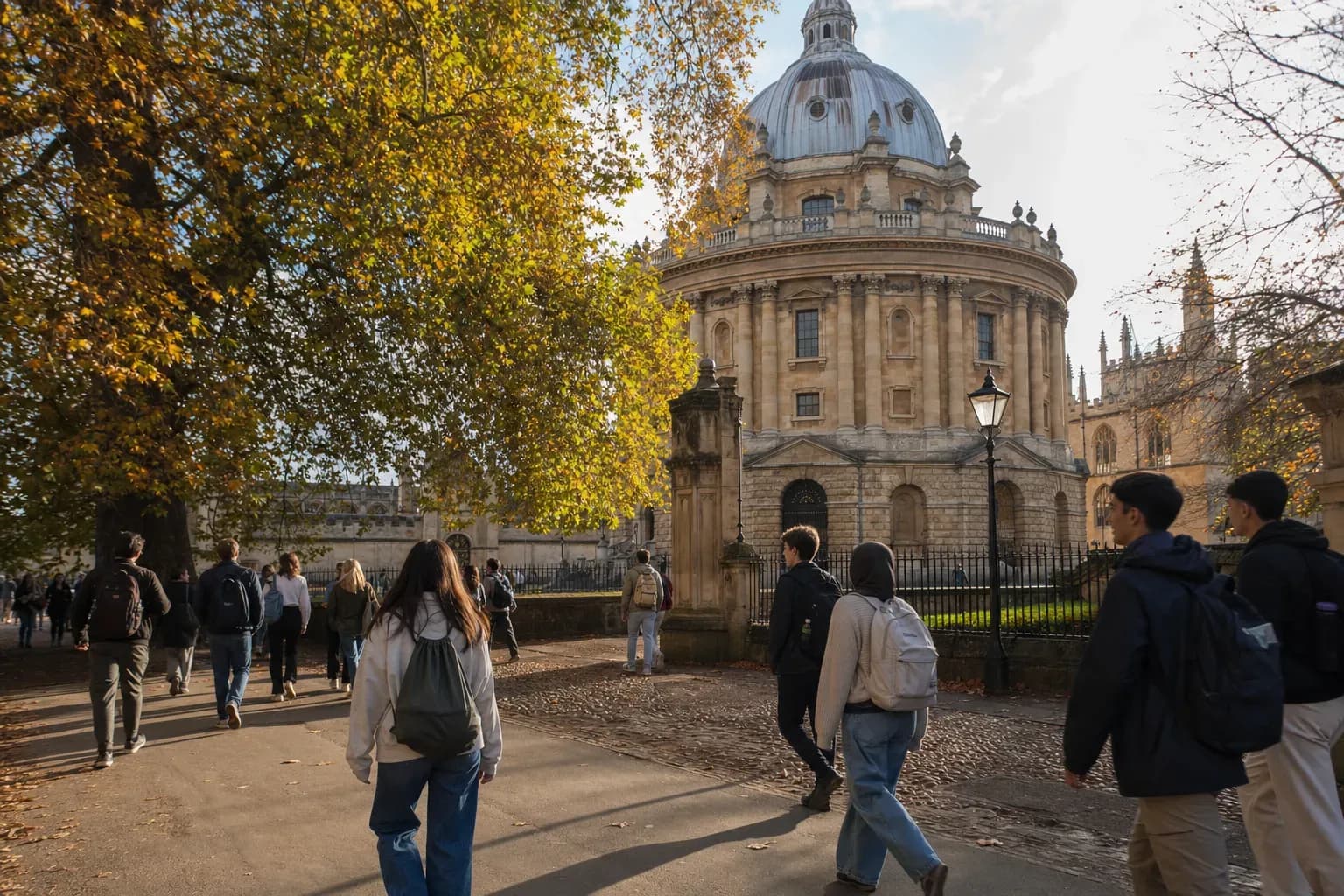
- Radcliffe Camera, a circular library built in 1749
- Bodleian Library, the second-largest library in Europe
- Christ Church Meadow, the birthplace of Alice's Adventures in Wonderland
- All Souls College, a research-only college with no undergraduates
- Sheldonian Theatre, the graduation ceremony venue designed by Wren
8. Research and Resources
Libraries
- Bodleian Library (Bod): The UK's second-largest library, with 13 million volumes, and a legal deposit library
- Every college has its own library, with Christ Church, All Souls, and Codrington all holding world-class collections
- Radcliffe Science Library: Dedicated to science and engineering subjects
Notable Laboratories / Research Centers
- Oxford Internet Institute: A global leader in internet and policy research
- Future of Humanity Institute (now incorporated into a new unit): Founded by Nick Bostrom and a pioneer in AI safety research
- Oxford-AstraZeneca COVID-19 Vaccine: Co-developed in 2020 by the Jenner Institute and AstraZeneca
- Mathematical Institute (Andrew Wiles Building): Home to Andrew Wiles, who proved Fermat's Last Theorem
9. Notable Alumni
- Politics / Prime ministers: Margaret Thatcher, Tony Blair, David Cameron, Theresa May, Boris Johnson, Rishi Sunak, Keir Starmer, among 30 UK prime ministers
- International politics: Bill Clinton (Rhodes Scholar), Aung San Suu Kyi, Indira Gandhi, Manmohan Singh
- Literature / Philosophy: J.R.R. Tolkien, C.S. Lewis, Oscar Wilde, W.H. Auden, Aldous Huxley, Iris Murdoch
- Science: Stephen Hawking, undergraduate at Oxford and PhD at Cambridge; Roger Penrose; Tim Berners-Lee, World Wide Web; Edmund Halley
- Performing arts: Hugh Grant, Rowan Atkinson, Kate Beckinsale, Felicity Jones, Emma Watson, English Lit
- Business: Rupert Murdoch, Larry Ellison, who left before completing his degree
Oxford alumni have received a cumulative 73 Nobel Prizes, second only to Cambridge.
10. Oxford Trivia
- Oxford is more than 100 years older than Cambridge: Oxford had recorded teaching as early as 1096. Cambridge was founded in 1209 after a group of scholars fled there following a conflict.
- The All Souls College entrance exam is considered the hardest in the world: It accepts only 2 Fellows by Examination each year. One famous exam format was a three-hour essay on a single-word prompt, such as "Water."
- Bodleian Library does not lend books: Even King Charles I was refused when he wanted to borrow a book.
- Oxford has no undergraduate "Business" degree: Saïd Business School offers graduate programs only. At undergraduate level, the closest options are Economics & Management or PPE.
- Terms are extremely short: Each term lasts only 8 weeks: Michaelmas, Hilary, and Trinity, just like Cambridge.
- Sub fusc tradition: For examinations and matriculation, students must wear a black suit + black gown + white bow tie for men, or a black ribbon for women. The tradition has remained unchanged for more than 300 years.
11. Typical Admitted Student Profile
- A-Level A*A*A or IB 39-42, including HL 766+
- Math / CS / Engineering applicants must take the MAT (Mathematics Admissions Test)
- Physics applicants must take the PAT
- PPE / E&M / HSPS applicants must take the TSA
- Medicine applicants must take the BMAT
- Law applicants must take the LNAT
- Subject passion must be quantifiable: Olympiad medals, national debating team, published articles, or self-study of advanced textbooks
- The interview is the real battleground: Oxford interviews give students "questions they have never seen before" and assess the thinking process rather than the answer
- In the 4,000-character / 47-line Personal Statement, 80% should be academic, with the remaining 20% for extracurriculars
- College preferences: Hertford, Wadham, and St Hilda's tend to be more open to international students; Christ Church and Magdalen are extremely competitive
12. What Kind of Student Is Oxford Best For?
✓ Best suited for:
- Students who want to pursue academic research and plan to do a PhD
- Students who enjoy writing essays and can still take pleasure in being grilled by a professor in tutorial
- Students with genuine passion for politics, philosophy, law, and the humanities
- Students who enjoy a small town and classical atmosphere, and do not prioritize big-city nightlife
- Students aiming for UK politics, diplomacy, the civil service, top law firms, or investment banking
- Students who accept a strict course system and can handle high-density learning within an 8-week term
✗ Not necessarily suitable for:
- Students who want freedom to switch majors or decide their field late, because Oxford locks in the subject from entry
- Students who long for big-city life and enjoy parties and highly diverse social scenes
- Students who want undergraduate business, which Oxford does not offer except through E&M
- Students who want American-style holistic and broad general education, because Oxford is "narrow and deep"
- Students who dislike writing or resist being questioned one-to-two by a tutor
Conclusion
Oxford is not a destination for students who simply want to "get into any UK Top 5 university." It is for the kind of student who, after eight three-hour essay exams in the Final Honour School at the end of Year 3, is still willing to stake the next stage of life on copying notes inside the Bodleian Library.
If you want to join British political circles by age 25, enter a top law firm, or conduct policy research at LSE or the IMF, Oxford's PPE / Law / Econ route is one of the most direct paths on earth, without qualification. The point Taiwanese families most often overlook is this: Oxford college identity is lifelong. You are not just an Oxford alumnus; you are a Christ Church alumnus, a Balliol alumnus, a Magdalen alumnus. That layer of identity follows you into the Cabinet, the Inns of Court, and Goldman Sachs London. If, after reading this, you feel "a little drawn to it, but still prefer the flexibility of the US," then do not force Oxford. Look at Princeton or Yale first. Oxford is not a place to "experience Britain." Oxford is a place that shapes the trajectory of life after age 25.
Sources: