
OIST Okinawa Institute of Science and Technology Graduate University: A PhD-Only Research Sanctuary, Full Tuition Waiver + Monthly Stipend of JPY 200,000, THE World's No. 10 Small University
Published on December 14, 2025
If you ask Dr. G. which of Japan's 25 English-taught universities is the most distinctive, rarest, and least like a typical Japanese university, the answer is beyond dispute: Okinawa Institute of Science and Technology Graduate University (OIST). OIST is a complete anomaly in the history of Japanese higher education:
- Founded only in 2011 -- Japan's youngest national university
- PhD-only, with no undergraduate school and no master's program -- the five-year PhD program is its only admissions route
- 100% English-taught -- internal documents, meetings, and courses are all in English
- 60% of faculty and staff are international -- no other Japanese university has this ratio
- Full tuition waiver + monthly stipend of JPY 200,000 + health insurance + flight support -- every PhD student receives a full scholarship
- No. 10 in THE small universities ranking and No. 9 worldwide for research paper impact -- figures that shine even brighter than UTokyo's
- Acceptance rate < 10% -- lower than Harvard and MIT
OIST is not an option for high school students -- it does not even admit master's students -- but it is one of the best choices for Taiwanese families who want world-class scientific research, a PhD, and a top national research environment in Japan. For this series aimed at "families planning the transition from high school to university," this article is a strategic read for getting to know a future PhD pathway early.
1. Basic Information
| Item | Details |
|---|---|
| Founded | 2011 -- Japan's youngest national university |
| Institution type | National university (under the Cabinet Office, an independent administrative institution) |
| Location | Onna Village, Kunigami District, Okinawa Prefecture -- on the west coast of central Okinawa Island |
| Campus | About 85 hectares (overlooking the East China Sea, with modern red-tile buildings) |
| Undergraduate students | 0 -- no undergraduate school |
| Master's students | 0 -- no standalone master's program |
| PhD students | ~250-300 |
| International student ratio | About 80-85% -- No. 1 in Japan |
| Faculty and staff nationalities | 60+ countries |
| Foreign faculty ratio | About 60% |
| Faculty-student ratio | 1:1.5 |
| Motto | "Where Science Knows No Boundaries" |
2. Global Rankings
| Ranking | Position |
|---|---|
| QS World 2026 | Not listed (too small, PhD only) |
| THE World 2026 | Not listed (too small) |
| THE Small Universities 2024 | No. 10 worldwide (ranking dedicated to small universities) |
| Nature Index 2023 Research Quality | No. 9 worldwide (research paper impact) |
| Nature Index in Japan | No. 1 (by paper quality per capita) |
| THE Most International Universities | Top 30 globally |
These numbers explain everything: although OIST is extremely small in scale (300 students), its research paper quality, citation rate, and impact are world-class. On "paper quality indicators," it surpasses UTokyo and Kyoto University, making it Japan's most refined research-output institution. For Taiwanese PhD applicants who want to conduct top-tier scientific research and enter an MIT-, Stanford-, or Caltech-level research environment, OIST is Japan's strongest answer.
3. Admissions Data (2024 Entry)
OIST uses an independent admissions system -- the admissions bar is extremely high, and competition is highly international.
PhD Admissions
| Metric | Figure |
|---|---|
| Applicants | ~2,500-3,500 (per year) |
| Admitted students | ~80-100 (two intakes per year, September + January) |
| Overall acceptance rate | < 5-10% |
| Nationalities of admitted students | 40-50 countries (per cohort) |
| Taiwanese students admitted per year | 0-2 students |
OIST's acceptance rate is lower than Harvard University's overall acceptance rate (3-5%) -- and its applicants are already elites who have graduated from top universities worldwide and have research experience. For Taiwanese families, an OIST PhD is a highest-tier target, not a backup option.
Application Requirements
| Item | Requirement |
|---|---|
| Education | Master's degree preferred, or bachelor's degree + strong research experience |
| English proficiency | TOEFL iBT 90+ / IELTS 7.0+ (most admitted students have 100+) |
| Standardized tests | GRE (required by some programs), Subject Test, etc. |
| Japanese | Not required at all |
| High school GPA | University GPA of 3.5/4.0 or above (most admitted students have 3.7+) |
| Recommendation letters | 3 letters -- must come from academic research supervisors |
| Essay | Research Statement + Personal Statement + Why OIST |
| Prior professor contact system | Necessary -- applicants must contact potential supervisors before applying and confirm research fit |
| Interview | Required -- multiple rounds of online interviews + funded on-site visit |
Lab Rotation System
The most distinctive feature of OIST's five-year PhD program is that students must rotate through 3-4 laboratories during the first 8 months. This follows the MIT / Stanford PhD lab rotation model in the United States, and no other Japanese national university does this. After 8 months, students choose their primary supervisor and begin their PhD research.
4. Tuition and Financial Aid
2025 Tuition (Fully Waived)
| Item | Amount (JPY) | Approx. in NTD |
|---|---|---|
| Enrollment fee | 0 (fully waived) | - |
| Tuition (annual) | 0 (fully waived) | - |
| Monthly stipend (Research Support Allowance) | About 200,000 (JPY 2.4M/year) | ~NTD 500,000/year |
| Health insurance | Fully covered by the university | - |
| Flight to Japan | Subsidized by the university | - |
| On-campus housing subsidy | Subsidized by the university | - |
| Estimated total income over 5-year PhD | About JPY 12M+ (with no tuition expense) | ~NTD 2.5 million (net income) |
OIST is the Japanese university that pays PhD students the highest stipend -- this figure is higher than the PhD stipends at top U.S. universities such as Harvard and MIT. All admitted PhD students enter at zero cost and instead earn around NTD 2.5 million over five years.
Additional Scholarships and Support
- OIST International Student Health Insurance: fully covered
- Academic conference travel support: JPY 200,000-500,000 per year
- Research equipment and consumables: fully supported within lab budgets
- Visiting scholar exchange programs: mutual visits with top laboratories such as MIT, Stanford, and Caltech
5. Program Structure / Signature Programs
OIST's PhD is a single interdisciplinary degree: "PhD in Science" -- but its research fields are extremely broad:
Major Research Areas (10+ Units)
- Neuroscience: OIST is globally top-tier in neural circuits and neuronal imaging research
- Marine Science: Okinawa's coral reefs and marine biodiversity offer world-class fieldwork conditions
- Quantum Physics: quantum information, superconductivity, cold atom physics
- Mathematical Sciences: topology, geometry, applied mathematics
- Computational Sciences: AI, machine learning, bioinformatics
- Molecular Sciences: chemistry, biochemistry, drug development
- Cell Biology: developmental biology, stem cells, cancer biology
- Genomics & Bioinformatics
- Ecology & Evolution
- Energy & Materials Sciences
Five-Year PhD Structure
- Year 1: required coursework (core + electives) + 3-4 lab rotations + selection of supervisor
- Year 2: Qualifying Exam + entry into main research phase
- Years 3-4: experiments + dissertation writing
- Year 5: dissertation defense + graduation + job search
Special Advantages
- Lab rotation system: unique among Japanese national universities
- Interdisciplinary research: students can collaborate with multiple Units at the same time
- Flexible prior professor contact: because of lab rotations, students do not need to lock in a supervisor 100% at the application stage
6. Campus Culture / Institutional Personality
OIST's culture can be summed up in a few words: world-class scientific research, international elites, Okinawan nature, and futurism.
- "Science Without Boundaries": international, interdisciplinary, and cross-field work are part of OIST's DNA
- Average student age of 26-30: because most students have a master's degree or research experience
- English as the everyday campus language: OIST is the only Japanese national university where internal documents, all meetings, and all courses are 100% in English
- No undergraduate students = no undergraduate campus life: no undergraduate clubs and no "springtime high school-to-college" atmosphere -- OIST feels entirely like a research institution
- Extremely international faculty: researchers include members of Nobel Prize committees, HHMI Investigators, and Nature / Science / Cell editor-level scholars
- Interdisciplinary collaboration: in the same building, a neuroscientist, quantum physicist, and mathematician might be discussing research in the cafe
OIST is Japan's closest equivalent to a Caltech / Cold Spring Harbor-style sanctuary for scientific research.
7. Location / Campus Environment
Onna Village, Okinawa Island
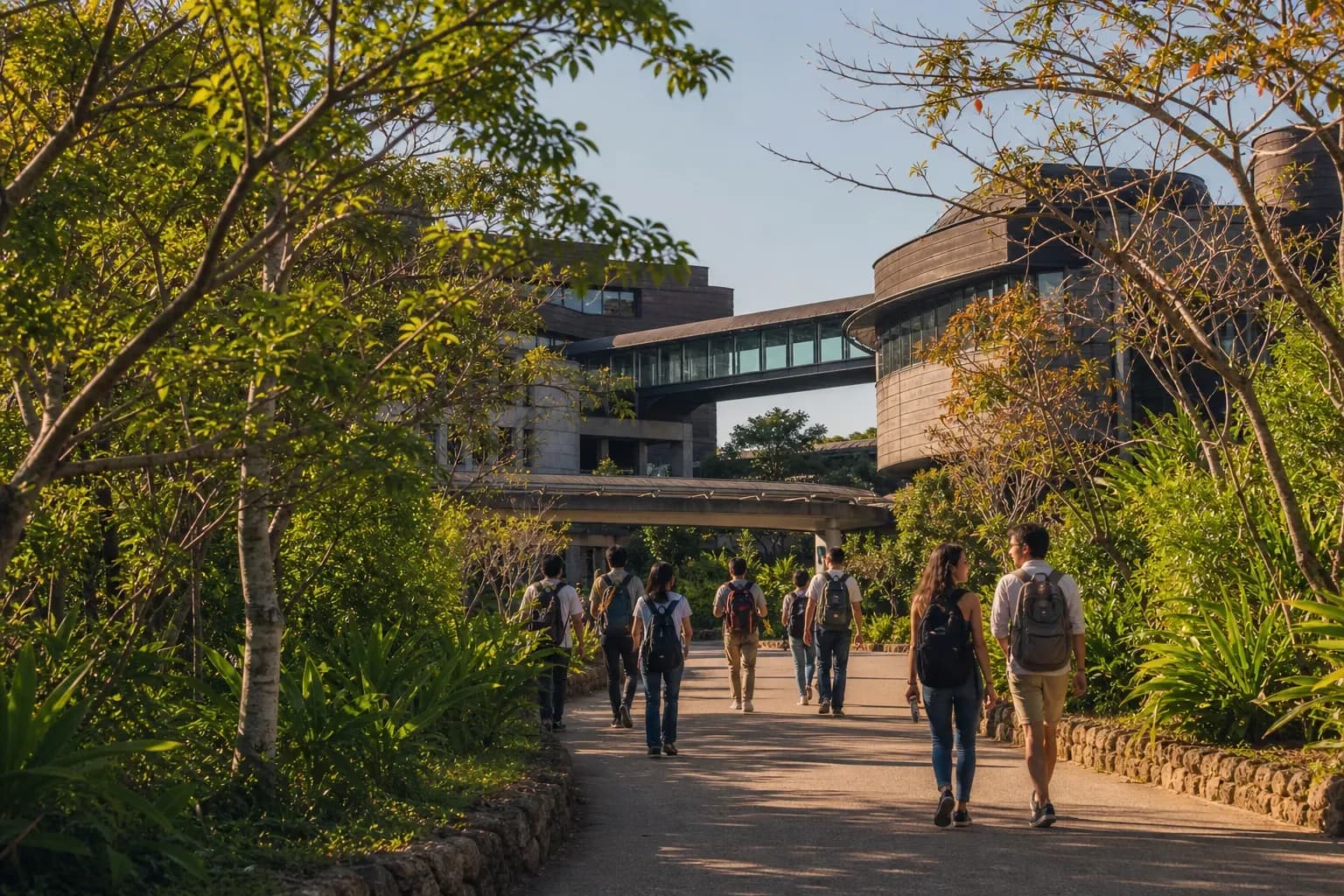
OIST's campus is located in Onna Village, Kunigami District, on the west coast of central Okinawa Island -- one of the most beautiful locations in Japan:
- The campus overlooks the East China Sea and has sunset views
- A 10-minute walk to the beach
- Modern red-tile buildings with futuristic design
- Full on-campus facilities, including gym, indoor pool, daycare center, housing, cafes, and cafeteria
Okinawa Transportation
- Naha Airport -> OIST: 1 hour by car
- Tokyo -> Okinawa: 2.5 hours by plane
- Okinawa has direct flights to Taipei, Hong Kong, Seoul, and Shanghai
- Within Okinawa Island: driving is the main mode of transport, with limited public transportation
Life in Okinawa
- Okinawa climate: average annual temperature of 23°C, 17°C in winter, 30°C in summer -- the warmest in Japan
- Okinawa cost of living: 20-30% cheaper than Tokyo
- Okinawa culture: influenced by mainland Japan, China, Taiwan, Southeast Asia, and the United States (U.S. military bases), making it the most culturally blended region
- Okinawa languages: both Japanese and English are commonly usable because of the U.S. military presence and tourism industry
For Taiwanese families, Okinawa is only 1.5 hours by plane from Taiwan, making it the closest-to-home location among all Japanese universities.
8. Research and Resources
OIST's research resources are among the most advanced, refined, and internationalized of any Japanese national university:
Library
- Digital-first design: about 50,000 physical volumes, with complete electronic resources
- Full journal subscriptions to Nature, Science, Cell, and Lancet
- Comprehensive interdisciplinary research databases
Research Institutes (Units)
OIST uses a "Unit system" (replacing traditional departments) -- each senior professor leads one Unit with 5-20 members:
- Brain Computation Unit
- Quantum Information Unit
- Mathematical Cellular Biology Unit
- Marine Biophysics Unit
- Neural Coding and Brain Computing Unit
- 60+ other interdisciplinary Units
Equipment and Resources
- Japan's most advanced instrumentation among standalone research institutions
- Ultra-high-resolution electron microscopes, cryo-EM, quantum computing laboratories, neuronal optical imaging systems
- Germ-free animal facilities, marine organism collection stations, Marine Science Station
- Research budget from the Cabinet Office + international sponsors (not limited by the general MEXT national university budget)
International Collaboration
- Deep collaborations with top institutions such as MIT, Stanford, Caltech, Cambridge, Oxford, Max Planck, and CNRS
- Highly active visiting scholar system
- Global alumni placement, with many graduates entering top European and U.S. universities or industry R&D
9. Notable Alumni / Faculty
OIST was founded only 15 years ago and has a small alumni base, but its faculty is already world-class:
Faculty
- Sydney Brenner (2002 Nobel Prize in Physiology or Medicine, founder of nematode genetics) -- a key contributor to OIST's founding
- Multiple HHMI Investigators, Max Planck directors, and Nature editor-level professors
- A very high proportion of professors who are Nobel laureates, Wolf Prize winners, or Lasker Award recipients
Alumni Placement (Graduated PhDs)
- Postdocs at top European and U.S. universities: MIT, Stanford, Caltech, Cambridge, Harvard
- Faculty positions at Japanese national universities: UTokyo, Kyoto University, Tokyo Tech, Tohoku, Osaka University
- Global industry R&D: Google, DeepMind, Genentech, AstraZeneca, SoftBank Vision Fund
- Startups: several OIST alumni have founded deep tech startups, especially in quantum computing, neurotechnology, and marine biology
10. OIST Facts You May Not Know
- OIST is Japan's only national university not directly governed by MEXT but by the Cabinet Office -- this gives OIST enormous freedom in budgeting, hiring, and admissions.
- OIST's founding funds came from the Japanese government and an international group of scientists: Nobel laureates such as Sydney Brenner and Jerome Karle participated in the blueprint for building OIST.
- OIST is Japan's No. 1 university for research impact per paper per researcher -- in Nature Index calculations, OIST faculty exceed UTokyo, Kyoto University, and Tokyo Tech in paper quality and citations per capita.
- OIST PhD students receive a higher stipend than students at Harvard and MIT: JPY 200,000/month = about USD 1,400/month, and effectively higher after housing subsidies -- this places OIST in the top 5% globally for PhD benefits.
- OIST's expansion plan for the 2030s: the student body will grow from the current 300 to 600, and the number of research Units will double -- meaning admissions may become "relatively" more accessible over the next 5-10 years.
11. Typical Admitted Student Profile (International PhD Student)
- Master's degree with GPA 3.7/4.0 or above (or top undergraduate background + strong research experience)
- TOEFL iBT 100+ or IELTS 7.5+
- 2-3 first-author papers or strong research experience, especially publications in top journals
- 3 recommendation letters from heavyweight academic research supervisors
- Ability to clearly explain "why OIST, why this Unit, and why this research direction"
- International conference presentations, summer research experience, and interdisciplinary collaboration experience
- Clear post-graduation pathway toward a postdoc at a top European or U.S. institution or industry R&D
Typical Taiwanese pathway: usually NTU / NTHU / NCTU / NYCU science, engineering, or medicine-related undergraduate degree + domestic or overseas master's degree + 1-2 years of research experience (Academia Sinica, TSMC R&D, overseas laboratory) -> OIST PhD
12. What Kind of Student Is OIST Best For?
✓ Best suited for:
- Applicants who already have a master's degree or strong undergraduate research experience
- Students seeking a world-class research environment + fully English-taught education + fully funded PhD
- Students interested in interdisciplinary scientific research (neuroscience + quantum + AI + marine science)
- Students who want Okinawa's natural environment + proximity to Taiwan (1.5-hour flight)
- Students aiming for a postdoc at a top European or U.S. institution or industry R&D after graduation
- Students who like lab rotations, interdisciplinary collaboration, and a purely English-language research environment
- Students planning for permanent residency through Japanese research institutions (Academia Sinica-level institutions)
✗ Not necessarily suited for:
- Students applying from high school to university (OIST has no undergraduate school and does not admit high school students) -- many other schools in this series are your targets
- Students who want to study for a master's degree (OIST has no standalone master's program)
- Students who want clinical medicine, law, or business (OIST offers only natural sciences)
- Students who are unsure whether they want to do research (a five-year PhD is a major commitment)
- Students who want life in the busy downtown area of a major Japanese city
- Students who want to maximize the HSP +10 point bonus (OIST is not on the 13-school list)
13. HSP Highly Skilled Professional Permanent Residency Pathway
OIST is not on the HSP Highly Skilled Professional "+10 point bonus" list (that list is limited to 13 flagship research universities such as UTokyo, Kyoto University, Tokyo Tech, Osaka University, Tohoku, Kyushu, Hokkaido, Nagoya, Tsukuba, Hitotsubashi, Kobe, Waseda, and Keio). However, the route of OIST PhD + high-paying research job -> extremely high HSP score is widely recognized.
The most common HSP pathway for OIST PhD graduates:
- OIST PhD -> assistant professor at a Japanese national university / industry R&D / pharmaceuticals / quantum computing startup (annual salary of JPY 8-15 million)
- PhD degree: +30 HSP points
- 5+ years of research experience: +15-20 points
- Annual salary of JPY 8 million+: +30-35 points
- English-Japanese bilingual ability: +5-15 points
- Usually 80-90+ points in total -> HSP 80 points -> permanent residency in 1 year
In practice: OIST PhD graduation + faculty position at a Japanese national university or R&D role at a major company -> permanent residency is usually achievable within 1-2 years. In the HSP point calculation, although an OIST PhD does not receive the +10 bonus, the degree itself is already a PhD (30 points) + years of research output + high salary -- a combination that surpasses most master's graduates from the "Top 13 +10 point" universities.
For detailed strategy, please refer to Dr. G.'s internal Post-Graduation Visa Strategy / 05_Japan_Visa_Strategy and Master Grad School Database / Japan section -- the OIST pathway is categorized as "the most elite fast-track research-based permanent residency pathway."
Conclusion
OIST is the most distinctive university in the history of Japanese higher education: the youngest, most international, most elite, most interdisciplinary, and most Okinawan. It is not an option for high school students -- but for Taiwanese families, OIST should be one of the ultimate targets when planning for the PhD stage.
If your child is 17 and still in high school, OIST is a possible destination 10 years from now. The reason to read this article and learn about OIST today is that OIST will influence your long-term planning for the Japanese scientific research pathway.
The typical Taiwanese pathway to OIST: NTU / NTHU / NYCU science, engineering, or medicine-related degree (4 years) -> domestic or U.S. master's degree (2 years) -> research experience at Academia Sinica / overseas laboratory (1-2 years) -> OIST PhD (5 years, fully funded) -> top global postdoc -> faculty role at a Japanese university / industry R&D / permanent residency
This is a 15-17 year long-term plan -- but for families aiming at scientific research, it is one of the most worthwhile pathways to plan.
In one sentence: OIST is Japan's sanctuary for scientific research, No. 9 worldwide in Nature Index, a red-tile research city overlooking the East China Sea from Onna Village in Okinawa -- a five-year fully funded PhD + monthly salary of JPY 200,000 + interdisciplinary lab rotations, with no second equivalent anywhere in Japan.