
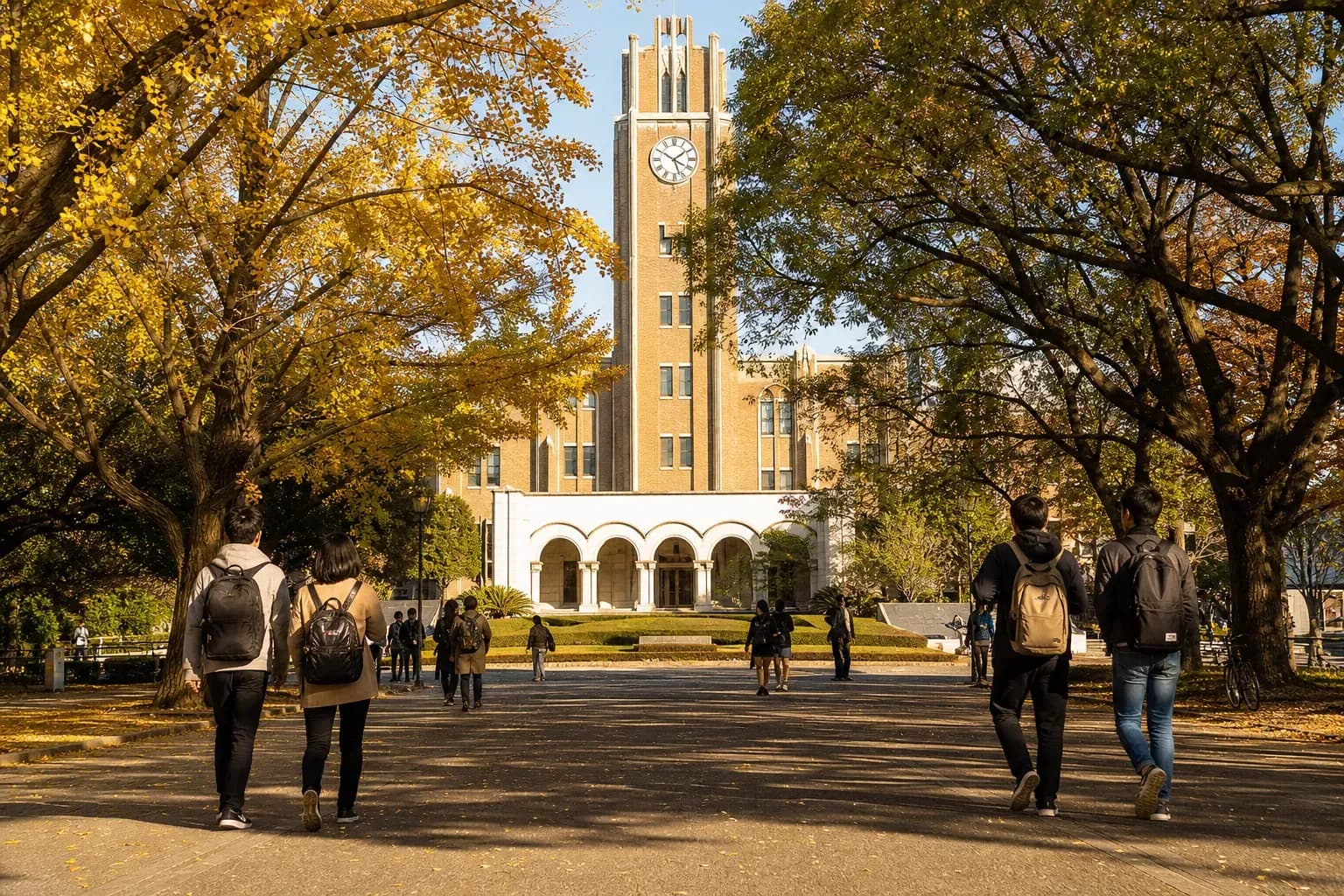
Nagoya University: Seven G30 English-Taught Undergraduate Programs, Six Nobel Laureates, and the Heart of Central Japan's Industrial Belt
Published on December 27, 2025
If you look at Japan's list of Nobel Prize winners over the past 25 years, you will notice something unusual: Nagoya University alone has produced six Nobel laureates. No university in Asia matches that density. Starting with Ryoji Noyori in Chemistry in 2001, Nagoya University went on to produce Nobel laureates in 2008, 2014, 2018, and 2019, to the point that Japanese media began calling it a "Nobel production factory."
But what truly attracts Taiwanese families to Nagoya University is not the Nobel record. It is the university's seven G30 undergraduate programs. Nagoya University is one of the schools in the G30 system with the largest number of English-taught undergraduate programs, covering Automotive Engineering, Chemistry, Physics, Biology, Economics, International Social Sciences, and Japan-in-Asia Cultural Studies. No Japanese is required at admission, all four years are taught in English, and tuition is JPY 535,800 per year. Even UTokyo's PEAK does not offer this breadth of portfolio. Add to that the fact that Nagoya is home to Toyota's headquarters and the heart of Central Japan's industrial belt. What you receive is not just a degree, but a ticket into Japan's strongest manufacturing ecosystem.
1. Basic Information
| Item | Details |
|---|---|
| Founded | 1939 (the seventh Imperial University) |
| University type | National university corporation |
| Location | Chikusa Ward, Nagoya, Aichi Prefecture (primarily Higashiyama Campus) |
| Campus | Approximately 326 hectares across three campuses |
| Undergraduates | ~9,500 |
| Graduate students | ~6,600 |
| Student-faculty ratio | 1:6 |
| Motto | "Courageous Intellectual" |
2. World Rankings
| Ranking | Position |
|---|---|
| QS World 2026 | #152 |
| THE World 2026 | #201-250 |
| QS Asia 2026 | #24 |
| THE Asia 2026 | #28 |
| QS Chemistry | #61 |
| QS Materials Science | #76 |
| QS Physics | #95 |
Nagoya University is a dual G30 + SGU Type A flagship university, standing alongside UTokyo, Kyoto University, Tohoku University, Osaka University, Kyushu University, Hokkaido University, University of Tsukuba, and Tokyo Tech. In Chemistry, Materials, Physics, and Chemical Engineering, Nagoya University ranks among Japan's top three. With six Nobel laureates, it is third in Japan after UTokyo and Kyoto University.
3. Admissions Data (2024 Entry)
Nagoya University's G30 undergraduate offerings include seven programs, all 100% taught in English, with no Japanese required at admission.
Seven G30 Undergraduate Programs
| Program | Field | Approximate annual admits |
|---|---|---|
| Automotive Engineering | Automotive engineering | ~15 |
| Chemistry | Chemistry | ~15 |
| Physics | Physics | ~10-15 |
| Biology | Biology | ~15 |
| Economics | Economics | ~15-20 |
| International Social Sciences | International social sciences | ~15-20 |
| Japan-in-Asia Cultural Studies | Japan / Asian cultural studies | ~10-15 |
Overall Admissions Overview
| Metric | Figure |
|---|---|
| Total applicants | ~700-1,000 |
| Total admitted students | ~95-115 |
| Overall acceptance rate | Approximately 12-15% |
| Taiwanese admits per year | 3-6 students |
Application Requirements
| Item | Requirement |
|---|---|
| English proficiency | TOEFL iBT 79+ / IELTS 6.5+ (iBT 90+ recommended for science and engineering) |
| Standardized tests | SAT 1250+, ACT 26+, IB 32+, or A-Level grades of B or above in three subjects |
| Japanese | Not required at admission |
| Recommendation letters | 2 letters |
| Essay | Statement of Purpose, Study Plan |
| Interview | Online interview for some programs |
| Additional (science and engineering programs) | Strong standardized scores in Physics / Chemistry / Biology are a plus |
International Students
- International students make up approximately 70-80% of G30 undergraduate programs, giving these programs a very high international student density
- Across Nagoya University as a whole, international students account for approximately 12%
- There is a high proportion of students from Taiwan, China, and Southeast Asia
4. Tuition and Financial Aid
2025 Tuition (National University Standard)
| Item | Amount (JPY) | Approximate NTD |
|---|---|---|
| Admission fee | 282,000 | ~60,000 |
| Tuition (annual) | 535,800 | ~110,000 |
| Dormitory (international student dormitory, monthly) | 25,000-45,000 | ~5,500-10,000 |
| Living expenses (monthly, Nagoya) | 65,000-90,000 | ~14,000-20,000 |
| Estimated total cost for four years | Approximately JPY 5.5-7M | ~NTD 1.2-1.5M |
The cost of living in Nagoya is 25-35% lower than in Tokyo. Rent in central Nagoya is nearly half that of Tokyo, and the Motoyama and Kakuozan areas near campus are among the most common places for Nagoya University students to live, with reasonable rental prices.
MEXT Scholarships
- MEXT Embassy Recommendation Scholarship: Full tuition waiver + monthly living stipend of JPY 117,000
- MEXT University Recommendation Scholarship: Directly nominated by Nagoya University (G30 applicants may apply concurrently)
Nagoya University Internal Scholarships
- NUFS Scholarship: Nagoya University Friendship Scholarship, available to G30 undergraduates
- JASSO Honors Scholarship: JPY 48,000 per month
- Toyota / Mitsubishi Heavy Industries / Denso corporate scholarships: Offered in partnership with local companies; generous funding, but usually requires signing a career-intention agreement
5. Academic Structure / Signature Programs
Seven G30 Undergraduate Programs
1. Automotive Engineering
- One of the very few four-year English-taught undergraduate Automotive Engineering programs in the world
- Deep collaboration with major Central Japan automotive companies such as Toyota, Denso, and Aisin
- Curriculum includes engines, chassis, electric vehicles, autonomous driving, and vehicle dynamics
- Nagoya University's vehicle research is Japan's strongest
2. Chemistry
- A Nobel-level strength at Nagoya University: Ryoji Noyori (2001 Chemistry), Osamu Shimomura (2008 Chemistry, research background at Nagoya University), and Toshihide Maskawa (2008, Physics but long based at Nagoya University)
- Organic synthesis and asymmetric catalysis are globally elite
- Integrated with Nagoya University's Institute of Transformative Bio-Molecules (ITbM)
3. Physics
- Connected to the legacy of Makoto Kobayashi and Toshihide Maskawa (2008 Nobel Prize in Physics)
- Strong in high-energy physics and cosmic ray research
- Research collaborations with KEK and JAXA
4. Biology
- Research background connected to Yoshinori Ohsumi (2016 Medicine, PhD from Nagoya University)
- Autophagy, plant biology, neuroscience
5. Economics
- Four-year English-taught economics degree
- Econometrics, development economics, behavioral economics
6. International Social Sciences
- Interdisciplinary program covering politics, sociology, international relations, and media studies
- Suitable for students interested in Asian regional integration and Japanese society
7. Japan-in-Asia Cultural Studies
- A rare English-taught undergraduate program focused on "Japan + Asian culture"
- Literature, intellectual history, religion, art, linguistics
Informal Faculty Consent System (Graduate Level)
For graduate school applications at Nagoya University, applicants usually need to contact a professor in advance and obtain informal faculty consent. Nagoya University professors are highly international-student-friendly. The G30 system has been in place for 15 years, and many professors have PhD backgrounds from the United States or Germany and are used to supervising international students in English.
6. Campus Culture / University Personality
Nagoya University's campus character can be summed up in a few words: science and engineering, practical, Toyota, Nobel.
- Science and engineering at the core: Nagoya University is Japan's national university that most resembles MIT / Caltech, with high research density and many undergraduates entering laboratories early
- Toyota culture runs deep: The atmosphere of Nagoya as "Toyota city" permeates the campus, and student internships, industry-academia collaboration, and employment are closely tied to the automotive industry
- Highly green Higashiyama Campus: The 326-hectare campus includes large wooded areas, and students call it "the neighbor of Higashiyama Zoo and Botanical Gardens" because one of Japan's three major zoos is right next door
- 200+ student clubs: From formal research clubs to anime, space development, and robotics competitions, the overall culture leans science-and-engineering and hands-on
- Tokai regional accents: You will hear Nagoya dialect expressions such as "dagane" and "myaa." Do not worry; students will teach you
Nagoya University's personality is that of "future science-and-engineering researchers, Nobel candidates in training, and Toyota engineers in training." It is the most fitting university in Central Japan.
7. Location / Campus Environment
City Positioning
Nagoya has a population of 2.3 million and is Japan's third-largest metropolitan area and the core of Central Japan's industrial belt.
- Tokyo to Nagoya: 1 hour 40 minutes by Shinkansen
- Osaka to Nagoya: 50 minutes by Shinkansen
- From Chubu Centrair International Airport (NGO): 30 minutes to the city center
- Higashiyama Campus (main campus): Direct access via Nagoya University Station on the Higashiyama subway line
Nagoya University's location offers the best balance in Central Japan. Tokyo, Kyoto-Osaka-Kobe, and Hokuriku are all within about two hours. Mount Fuji is only one hour away, and Ise Jingu is only 1 hour 30 minutes away.
Climate
- Winter: 2-10°C, slightly colder than Tokyo, with little snow
- Summer: 26-35°C; Nagoya summers are humid and hot, placing it alongside Kyoto as one of "Japan's hottest cities"
- Higashiyama Campus is beautiful during cherry blossom and autumn foliage seasons, especially the campus landmark row of double-flowered cherry trees
Campus Landmarks
- Toyoda Auditorium: Built in 1960, designed by Kenzo Tange, donated by the Toyota family, and designated an Important Cultural Property of modern Japanese architecture
- Central Library: Approximately 3.2 million volumes
- Nagoya University Hospital on Higashiyama Campus: 1,080 beds, the largest university hospital in the Tokai region
- Nobel Prize Museum: On-campus exhibition of the achievements of Nagoya University's six Nobel laureates
8. Research and Resources
Libraries
- Central Library + 11 branch libraries: Approximately 3.2 million volumes
- 24-hour study area
- Comprehensive electronic resource subscriptions
Notable Research Institutes
- Institute of Transformative Bio-Molecules (ITbM): An interdisciplinary Chemistry + Biology research center with a high proportion of international teams
- Institute of Materials and Systems for Sustainability (IMaSS): A top center for materials science
- Solar-Terrestrial Environment Laboratory: Cosmic rays and earth science
- Higashiyama animal behavior research: Collaboration with Higashiyama Zoo and Botanical Gardens
Nobel Prize Laureates
Nagoya University is connected to six Nobel laureates (produced continuously from 2001 to 2019):
- Ryoji Noyori (2001 Chemistry) - asymmetric catalysis
- Makoto Kobayashi (2008 Physics) - CP violation
- Toshihide Maskawa (2008 Physics) - CP violation
- Osamu Shimomura (2008 Chemistry) - GFP fluorescent protein
- Isamu Akasaki / Hiroshi Amano (2014 Physics) - blue LED (both from Nagoya University)
- Akira Yoshino (2019 Chemistry) - invention of the lithium-ion battery; Nagoya University Chemistry graduate
The "six-Nobel streak" is a record no other Asian university has matched. Nagoya University's Chemistry Department is at the level where entering the program means having a genuine opportunity to aim for Nobel-level research.
9. Notable Alumni
- Academia / Nobel: The six Nobel laureates listed above + Yoshinori Ohsumi (2016 Medicine, PhD from Nagoya University)
- Politics: Toshiki Kaifu (former Prime Minister), Koichi Kato (LDP Secretary-General)
- Business: Akio Toyoda (Chairman of Toyota), Hiroshi Okuda (former President of Toyota), Soichiro Honda (founder of Honda, research collaboration), Kazuo Inamori (Kyocera, short-term lecturer at Nagoya University)
- Media / Literature: Tomihiko Morimi (Kyoto University graduate, Nagoya native), Shigesato Itoi (advertising creative master)
- Architecture / Art: Kenzo Tange (UTokyo graduate, but Toyoda Auditorium is at Nagoya University)
Nagoya University graduates are highly represented at Toyota, Denso, Mitsubishi Heavy Industries, Aisin, and other major Central Japan automotive manufacturers. This is the most practical reason G30 students choose Nagoya University.
10. Little-Known Facts About Nagoya University
- Nagoya University's "six-Nobel streak" was one of Japanese media's hottest topics in 2019: After Akira Yoshino won the prize, Nagoya University was called a "Nobel Factory." Japan's Ministry of Education, Culture, Sports, Science and Technology even allocated dedicated funding to study "why Nagoya University."
- The bond between the Toyota family and Nagoya University: Sakichi Toyoda and Kiichiro Toyoda, from Toyota's founding family, collaborated with Nagoya University across generations. The "Toyoda" in Toyoda Auditorium comes from the Toyota family's donation.
- Nagoya University's Physics Department is a sacred ground for high-energy physics in Japan: Makoto Kobayashi and Toshihide Maskawa's "KM matrix" is a required chapter in physics textbooks. This theory was born at Nagoya University.
- Higashiyama Zoo and Botanical Gardens next to Higashiyama Campus is one of Japan's three major zoos, alongside Ueno and Oji Park. Students can enter for free with their student ID.
- Nagoya dialect classes: Nagoya University's language center offers Nagoya dialect classes for international students, including expressions such as "dagane" (sentence-ending particle), "myaa" (meow), and "ebifuraiyaa" (Nagoya dialect pronunciation of fried shrimp).
11. Typical Admit Profile (G30 Undergraduate)
- High school GPA of 3.7/4.0 or above
- TOEFL iBT 90+ or IELTS 7.0+
- SAT 1350+, IB 36+, or A-Level 3A or above (science and engineering programs should have A grades in math and science subjects)
- Able to clearly explain "why Nagoya University, not UTokyo", usually through angles such as "Nobel professors," "Toyota industry-academia collaboration," or "Chemistry / Physics research density"
- Laboratory experience, science fair projects, or Math / Science Olympiad achievements are major pluses
- Recommendation letters from high school math, science, or economics teachers
- A concrete vision for employment in Central Japan, especially within the Toyota / Denso / Aisin ecosystem
12. What Kind of Student Is a Good Fit?
✓ Good fit for:
- Students who want to study top-tier Asian Chemistry / Physics / Automotive Engineering for JPY 535,800 per year
- Students with genuine passion for Nobel-level research, especially in Chemistry
- Students aiming to enter major Japanese manufacturers such as Toyota, Denso, Aisin, and Mitsubishi Heavy Industries
- Students who do not mind being outside Tokyo and can accept Nagoya, Japan's third-largest metropolitan area
- Students planning for the HSP highly skilled professional permanent residency pathway (Nagoya University is on the +10-point list)
- Students interested in the diverse G30 portfolio, spanning science and engineering, economics, and culture
✗ Not necessarily a good fit for:
- Students who want pure Medicine or pure Law, as these undergraduate faculties are taught only in Japanese
- Students expecting a central Tokyo lifestyle, with indie cafes and livehouses
- Students with no interest in the automotive industry who want to enter finance / tech (Economics exists, but Nagoya University overall leans toward manufacturing)
- Students expecting an American-style Greek Life campus culture
- Students who cannot tolerate Nagoya's intensely hot and humid summers
13. HSP Highly Skilled Professional Permanent Residency Pathway
Nagoya University is on the HSP highly skilled professional "+10 point bonus" list, which means:
- Master's degree + annual salary of JPY 6 million → permanent residency application after 3 years
- Doctorate + annual salary of JPY 8 million → permanent residency application after 1 year
- After obtaining permanent residency, spouses can work, parents can stay long-term, and children can access Japanese nationality pathways
The most common HSP pathways for Nagoya University graduates are:
- Nagoya University G30 undergraduate degree → Nagoya University master's degree (with faculty consent) → Toyota / Denso / Aisin / Mitsubishi Heavy Industries R&D role (annual salary JPY 6-8 million) → apply for permanent residency within 3 years
- Chemistry / Physics PhD → major chemical manufacturers (Sumitomo Chemical, Mitsui Chemicals, Shin-Etsu Chemical) / pharmaceutical R&D → permanent residency after 1 year
- Automotive Engineering → overseas assignment at Toyota → accumulate international experience → senior management pathway
Nagoya University's HSP advantage lies in the fact that major manufacturers actively hire its graduates. Toyota has 370,000 employees worldwide, with a particularly high proportion of Nagoya University backgrounds. This means stable post-graduation placement and faster accumulation of HSP points. For detailed strategy, refer to Dr. G.'s internal resources, Post-Graduation Visa Strategy / 05_Japan_Visa_Strategy and Master Grad School Database / Japan section.
Conclusion
Nagoya University is a school with a "science-and-engineering mind + Toyota culture." If your favorite things in high school were taking apart mechanical parts, doing organic synthesis, or following news about Tesla and Toyota competing in autonomous driving, then Nagoya University may be where you belong. It does not have UTokyo's "Japan's number one" label or Kyoto University's romantic image of "free-spirited eccentrics," but it does have Asia's densest concentration of Nobel-level Chemistry and Physics research, plus Japan's strongest automotive industry ecosystem.
The reason Taiwanese families most often underestimate Nagoya University is that it is "not in Tokyo / Kyoto-Osaka." But that is exactly what makes a G30 flagship university worth understanding: people who truly understand Japanese manufacturing know that graduating from Nagoya University means a direct route to Toyota / Denso. In one sentence: If you want to become a Nobel-level chemist or a Toyota engineer, Nagoya University is the highest-value choice in Asia.