
McGill University: Canada's Oxford, English-Taught, and Montreal's Long-Standing Medical School Leader
Published on January 31, 2026
McGill University is Canada's highest-ranked university in QS (QS 2026 Global #27, two places above U of T), and ranks first among Medical Doctoral universities in Maclean's, holding the top spot for 19 consecutive years. If you ask Canadian families, "Which university carries the most prestige?", many will say McGill, because it was founded in 1821, 46 years before Canada became a country (Canadian Confederation was established in 1867). It is one of the few old universities in the English-speaking world that can be mentioned alongside Oxford, Cambridge, and Edinburgh.
The media often calls it "Canada's Harvard," but that comparison is not quite accurate. McGill's character is closer to a Canadian version of Oxford: British academic tradition, an urban campus, scholarly authority, and less emphasis on American-style school spirit. It sits at the foot of Mont Royal in downtown Montreal, Quebec. Across the university, 96% of courses are taught in English, making it the most prominent English-language higher education stronghold in the French-speaking province of Quebec. Since 2024, however, the Quebec government's Bill 96 legislation and tuition reforms have created the largest political and financial storm McGill has faced since its founding. We will break down what this means for Taiwanese families in §4 and §13.
1. Basic Information
| Item | Details |
|---|---|
| Founded | 1821 (established through the bequest of James McGill) |
| Location | Montreal, Quebec (downtown + Macdonald Campus in Sainte-Anne-de-Bellevue) |
| Campus | Main campus of about 80 acres, adjacent to Mont Royal Park |
| Undergraduates | ~27,000 |
| Graduate students | ~12,000 |
| Student-faculty ratio | 1:13 |
| Motto | Grandescunt aucta labore (By work, all things increase and grow) |
2. World Rankings
| Ranking | Position |
|---|---|
| QS World 2026 | #27 (Canada's #1) |
| THE World 2025 | #45 |
| US News Global Universities 2024-25 | #41 |
| Maclean's Canadian Medical Doctoral Universities | #1 (19 consecutive years) |
| QS Medicine | #21 globally |
| QS Anatomy & Physiology | #14 globally |
3. Admissions Data (Fall 2024 Entry)
| Metric | Figure |
|---|---|
| Total applicants | ~52,000 |
| Overall acceptance rate (including domestic students) | About 40-46% |
| International student acceptance rate (weighted) | About 30-35% |
| Faculty of Medicine MDCM | 6% (one of the hardest medical schools to enter in Canada) |
| Engineering overall | About 20% |
| Desautels Faculty of Management (undergraduate business) | About 20% |
| Faculty of Arts | About 50% |
| Yield Rate | About 55% |
What makes McGill different from U of T is that admissions are based almost entirely on academic performance, with limited emphasis on essays or extracurricular activities. Canadian high school students with averages of 90%+ can usually enter popular programs, but for Taiwanese students, the university most commonly reviews one of three pathways: IB / A-Level / SAT.
International Student Standards (Direct Undergraduate Entry)
| Test | Recommended Score |
|---|---|
| SAT | 1400+ (1500+ recommended for Engineering / Med) |
| ACT | 31+ |
| IELTS | 6.5 (6.0 in each band) |
| TOEFL iBT | 90+ (100+ recommended) |
| IB | 32-38+ (HL requirements depend on program) |
| A-Level | AAA-AAB (all A+ for Med) |
International Students
- International students make up about 30% of the student body (second-highest in the U15, behind only U of T)
- Students come from 150+ countries
- Around 20-40 Taiwanese students are admitted to undergraduate programs each year
- French is not required: all undergraduate programs and most master's programs are taught in English
4. Tuition and Financial Aid (International Student Perspective)
This has become McGill's most sensitive issue since 2024.
2024-2025 Tuition (CAD/year)
| Item | Amount |
|---|---|
| Tuition - Arts | CAD $30,000-$36,000 |
| Tuition - Science | CAD $50,000-$55,000 |
| Tuition - Engineering | CAD $54,000-$58,000 |
| Tuition - Desautels Management | CAD $65,000+ |
| Tuition - Medicine MDCM (international students) | CAD $55,000+ |
| Housing (on-campus Royal Victoria College / New Residence) | CAD $13,000-$17,000 |
| Food + miscellaneous (Montreal is the cheapest major city in Canada) | CAD $10,000-$13,000 |
| Total | CAD $55,000-$85,000/year |
2024 Quebec Tuition Reform (The Political Context You Need to Know)
In October 2023, the Quebec provincial government (the CAQ government) announced a major tuition policy reform targeting English-language universities:
- Students from other Canadian provinces (out-of-province): undergraduate tuition at English-language universities in Quebec rose from CAD $9,000 to CAD $12,000, a 33% increase.
- Minimum international student tuition: Quebec set a minimum annual tuition of CAD $20,000 for international undergraduates, with the additional revenue redirected to French-language universities.
- TFEE policy (Tuition Fees Exemption for English universities): amid protests, some measures were partially rolled back for 2024-25, but international master's and PhD students are not included in the exemption.
- McGill's response: it launched legal action against the Quebec government (ongoing since 2024) and has considered moving some programs to Ontario.
The direct impact on Taiwanese international students: the total four-year out-of-pocket cost for international undergraduates in Engineering and Management is around CAD $300,000+, but this is still about 25% cheaper than a Top 30 private university in the United States.
Financial Aid for International Students
- Greville Smith Scholarship: McGill's largest award for international students, worth CAD $12,000 per year, awarded to top academic performers.
- McCall MacBain Scholarships: full graduate scholarship, Canada's version of the Rhodes, with only 30 recipients worldwide each year.
- Scholarships for general international undergraduates are limited, mostly CAD $3,000-$10,000 entrance awards.
5. Academic Structure / Signature Programs
Undergraduate Majors
McGill uses a Faculty-based structure (unlike U of T's college system), with 11 Faculties: Arts, Science, Engineering, Management, Music (Schulich School of Music), Medicine, Law, Education, Agricultural & Environmental Sciences (at Macdonald Campus), Dentistry, Religious Studies.
Signature Programs
- Faculty of Medicine MDCM: founded in 1829, the oldest medical school in Canada, and the training ground for Canada's first generation of physicians. International seats are extremely limited (5-8 per year).
- Faculty of Law: Canada's only bijural program, teaching both Common Law and Civil Law in English and French; graduates can practice in both major North American legal systems.
- Desautels Faculty of Management: McGill's undergraduate business school, ranked among Canada's top three alongside U of T Rotman and UBC Sauder.
- Bachelor of Arts & Science (BA&Sc): an interdisciplinary degree, the first of its kind in Canada, allowing students to major in fields that cross the humanities and sciences, such as Cognitive Science, Environment, and Sustainability.
- Schulich School of Music: Canada's top music school and Leonard Cohen's alma mater.
Macdonald Campus
Located 30 minutes west of the main campus by car, Macdonald Campus specializes in agriculture, nutrition, environmental science, and bioresource engineering. The campus has its own farm, vineyard, and apiary.
6. Campus Culture / School Personality
McGill's campus culture is a blend of "cool intellectualism + Montreal arts culture." Students are generally much more relaxed than at U of T. Montreal has lower living costs, a deep bar culture, a legal drinking age of 18 (Ontario is 19, but Quebec is 18), and active underground music and independent film scenes.
Frosh Week
McGill's first-year orientation, Frosh Week, is one of the largest in North America: a full week of parties, Mont Royal hikes, city explorations, and roommate-matching activities. Each Faculty hosts its own version: Engineering Frosh is the wildest, Management Frosh is the most party-heavy, and Arts Frosh is the most artsy.
Sports Culture
- Varsity teams are called the Redbirds (men) / Martlets (women); the men's teams were formerly called the Redmen and were renamed in 2019 due to Indigenous issues
- Main sports: ice hockey, football, rowing
- The sports atmosphere is not as intense as at American public universities, but the McGill-Queen's hockey rivalry is worth experiencing
Student Clubs
- 350+ clubs
- The Taiwanese Students' Association at McGill (TSAM) is active
- McGill Daily campus newspaper (founded in 1911), CKUT campus radio
7. Location / Campus Environment
City Positioning
McGill's main campus is located at the intersection of Sherbrooke Street and McTavish Street in downtown Montreal. The campus entrance, Roddick Gates, is a Montreal landmark. Students can walk 10 minutes to McGill metro station, Eaton Centre, and the Saint-Laurent Boulevard arts district. This is the only university in Canada where the front gate opens directly onto a downtown commercial street. Its atmosphere is somewhat similar to Columbia University's Morningside Heights campus.
Climate
- Winter: -15°C to -5°C, dropping to -25°C in January and February, colder than Toronto but warmer than Edmonton
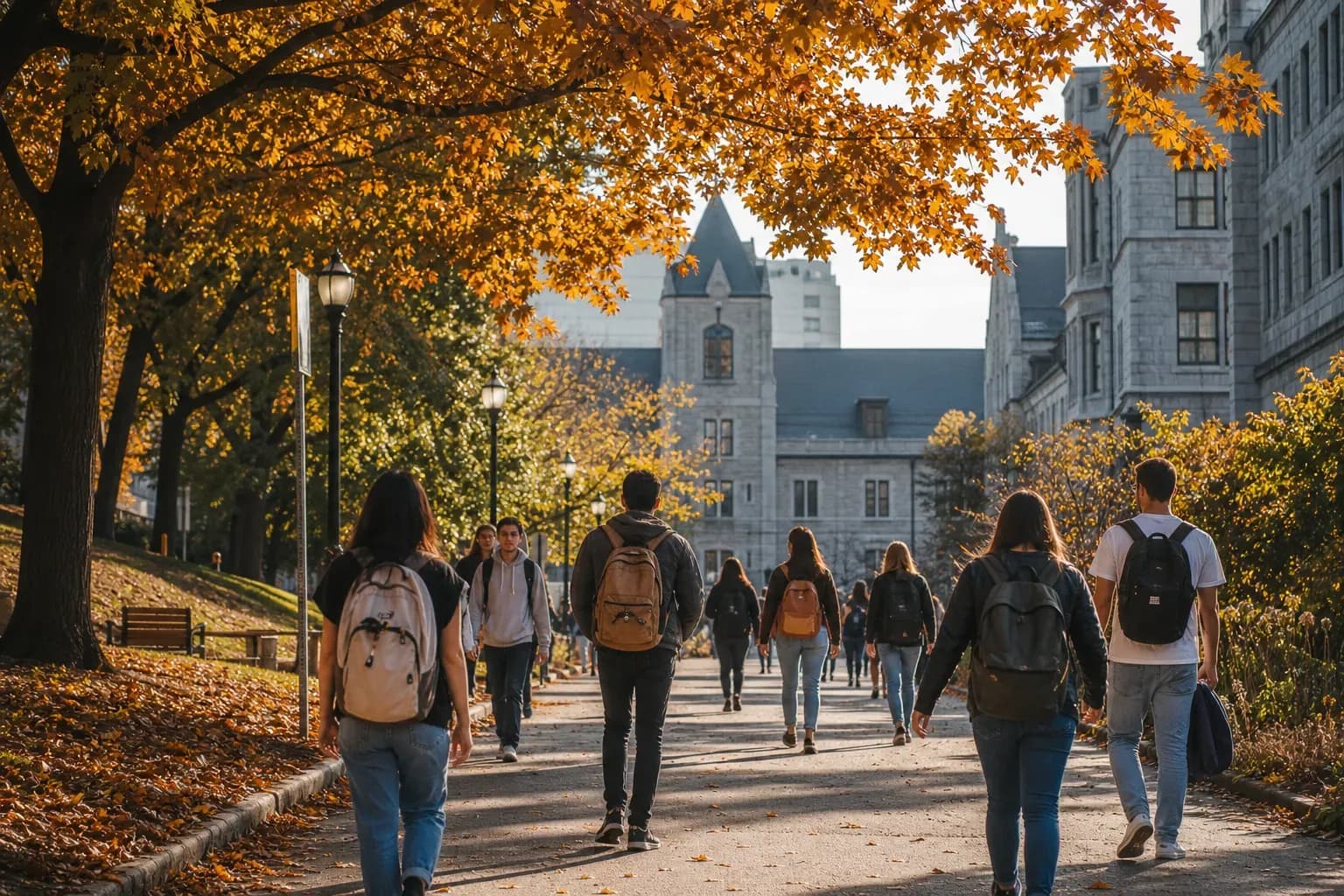
- Spring and fall: 5-15°C, with spectacular maple foliage
- Summer: 22-28°C, humid and pleasant
- Snow stays on the ground for 4-5 months in winter, and McGill has one of North America's most developed underground tunnel systems connecting major campus buildings
Campus Landmarks
- Roddick Gates (built in 1924, the main campus entrance)
- Arts Building (built in 1843, the oldest building on campus)
- Redpath Museum (Canada's first university natural history museum)
- McLennan Library
- Three Bares Fountain
- Mount Royal Park (200 meters behind campus, designed by Olmsted, the same designer as New York's Central Park)
8. Research and Resources
Libraries
- 13 branch libraries, with 6 million volumes
- McLennan Library is the main library
Notable Research Centers
- Montreal Neurological Institute (The Neuro): established in 1934, a global Top 5 neuroscience center and the birthplace of many modern neurosurgical techniques (including Wilder Penfield's famous cortical mapping)
- McGill AI Mila (co-founded with UdeM): led by Yoshua Bengio, one of the three major global birthplaces of deep learning
- Goodman Cancer Research Centre
- Trottier Institute for Science and Public Policy
McGill has a total of 12 Nobel laureates (alumni / faculty), including Ernest Rutherford (who taught at McGill and won the 1908 Nobel Prize in Chemistry) and David Hubel (1981 Nobel Prize in Physiology or Medicine).
9. Notable Alumni
- Politics: Justin Trudeau (former Prime Minister of Canada, BA Literature), John Abbott (Canada's 3rd Prime Minister)
- Business: Lorne Trottier (founder of Matrox), Heather Munroe-Blum (former principal)
- Entertainment: William Shatner (Captain Kirk in Star Trek), Leonard Cohen (poet and singer, BA 1955), Burt Bacharach (composer, 6 Grammy Awards), Mort Sahl
- Science: Ernest Rutherford (Nobel Prize in Chemistry), Charles Saunders (breeder of Marquis wheat)
- Writers: Margaret Atwood (visiting appointment at McGill), Mordecai Richler, Saul Bellow (Nobel Prize in Literature, studied at McGill)
10. McGill Fun Facts
- McGill is 46 years older than Canada itself: it was founded in 1821, while Canadian Confederation was established in 1867. The oldest Arts Building on campus is older than Toronto City Hall.
- Frosh Week is one of the largest first-year orientations in North America: 5-7 consecutive days of activities, with more than 6,000 first-year students participating each year.
- McGill students are said to weigh 10 kilograms less and have GPAs 5 points higher than U of T students: this is an urban legend (with no scientific basis), but it does reflect Montreal's lower cost of living and relatively more generous grading.
- Roddick Gates is not a 19th-century structure: it was built in 1924 in memory of Dr. Thomas Roddick (former dean of McGill's medical school). It is a 1920s imitation of a British-style university gate, but its atmosphere feels very old.
- Canada's first basketball game was invented by a McGill student: more precisely, James Naismith (McGill graduate, BA 1887) invented basketball at the YMCA in Massachusetts in 1891. But the physical education foundation he built at McGill was central to his work.
11. Typical Admitted Student Profile
- High school average (converted): 89-93%+ (IB 36+, A-Level AAA-AAB, top 3-5% in Taiwanese high schools)
- SAT 1450+ (1500+ recommended for Engineering / Management)
- IELTS 6.5-7.0+
- Extensive extracurriculars are not required: McGill has Canada's most academically oriented admissions review
- The written component (Personal Profile) only asks students to explain why they chose McGill / the program; there is no American-style 800-word Common App essay
- Faculty of Medicine is extremely difficult for international students: 5-8 seats per year, MMI interview required, and Canadian high school or IB is strongly recommended
12. What Kind of Student Is McGill Right For?
✓ Good fit:
- Students who want a degree from Canada's most internationally prestigious university
- Students with clear interests in medicine, law, neuroscience, or music
- Students who enjoy bilingual English-French city life, lower living costs, and active nightlife
- Academically oriented students who are not drawn to Greek life / large sports events
- Students who want a "European urban campus" and do not love suburban lawns
- Families with a budget of CAD 60-80K/year (about 15% cheaper than U of T)
✗ Not necessarily a good fit:
- Students who want an American college town environment and four years of dorm culture
- Students who dislike harsh winters (McGill is about 5°C colder than Toronto)
- Students who want no exposure at all to a French-language environment (about 30% of life off campus is still in French)
- Students planning to stay in Quebec for PR after graduation: the Quebec PEQ pathway is complicated for English-language graduates; see §13
- Students who need American-style hands-on advising (McGill's academic culture is very hands-off)
13. Canada Study + Immigration Pathway Advantages
McGill has the most complex immigration pathway among Canada's U15 elite universities because it is located in Quebec, a province with its own independent immigration system.
PGWP (Federal Post-Graduation Work Permit)
Graduates of McGill master's programs (programs of ≥ 8 months) can apply for a 3-year Open Work Permit. This is a federal IRCC policy, and Quebec cannot intervene. The language requirement is IELTS General CLB 7 (6.0 in each band), which Taiwanese students usually meet with IELTS 7.0.
Your Two PR Pathways: Federal vs. Quebec
Pathway A: Federal Express Entry (recommended for most Taiwanese students)
During the PGWP period, students can gain one year of Canadian work experience outside Quebec (for example, by moving to Ontario / BC for work) and then apply through CEC. In Q1 2026, the CEC CRS cut-off was about 521-547, and the STEM category was 481-524. A McGill master's graduate aged 30 with one year of Toronto tech work experience would have a CRS score of about 525-540.
Pathway B: Quebec PEQ (Programme de l'expérience québécoise)
If you plan to stay in Montreal, this is Quebec's system similar to provincial nomination. But reforms since 2024 have made it extremely restrictive:
- International graduates need French CLB 7 (upper-intermediate French, tested through TEFAQ or TCFQ)
- Applicants need 1-3 years of work experience in Quebec before applying (depending on program)
- English-language McGill students effectively need to relearn French to use PEQ
Pathway B+: Quebec Skilled Worker (PSTQ)
This is another route that does not require PEQ, but it also has French requirements. The 2024 revised version is called the Programme de sélection des travailleurs qualifiés (PSTQ) and requires French B2 / CLB 7.
Practical advice for Taiwanese international students at McGill: unless you expect to bring your French to CLB 7, moving to Ontario / BC / Alberta after graduation and pursuing federal immigration + that province's PNP is the more realistic route. A McGill degree carries weight across all of Canada.
Impact of the 2024-2025 International Student Cap (Quebec Exception)
Because of Bill 96 and tuition reform, Quebec's international student study permit allocation fell by 20%, though master's and doctoral students are relatively protected. The TFEE policy means international student tuition at English-language universities will no longer be redirected to French-language universities (still controversial). For McGill, this is a short-term negative (pressure on international recruitment) but a long-term positive (reduced political pressure on tuition).
Value Comparison with Equivalent U.S. Universities
| Item | McGill | Equivalent U.S. universities (Penn / Brown) |
|---|---|---|
| QS 2026 | #27 | Penn #11 / Brown #64 |
| Tuition (international undergraduate) | CAD $30K-$65K (USD $22-48K) | USD $66-68K |
| Post-graduation stay pathway | 3-year PGWP + EE/PNP (recommended to move out of Quebec) | H-1B lottery (30%) |
| International student scholarships | Limited (McCall MacBain full scholarship is graduate-only) | Generally none |
| Campus culture | Cool intellectualism + Montreal arts culture | Old-money Ivy League |
McGill's tuition is only half of Penn's, its international reputation is comparable, and the PR pathway is clear. For Taiwanese families aiming for "an elite European/North American degree + North American permanent residency," McGill is Canada's top alternative.
Conclusion
McGill is right for Taiwanese students who think, "I want an English-language elite university degree with global prestige, I want to experience North America's most European city, and I do not care whether the campus feels like a close-knit American college." It is not Canada's Harvard: its character, scale, and classroom style are all different. It is closer to a North American blend of Edinburgh and Oxford: old, academic, urban, British in tradition, cool and not overly warm.
Choosing McGill means accepting several realities. First, Quebec politics will continue to affect tuition and policy, and the next five years will not be calm. Second, Quebec's PR pathway is not friendly to English-language graduates, and most international McGill graduates eventually move to Ontario / BC to complete PR. Third, McGill offers degree prestige and urban life, not hand-holding education.
But if what you want between ages 18 and 28 is "a European-style city + a bilingual environment + Canadian PR + a lifelong international alumni network," McGill is one of the few universities on earth that can offer all four. Its tuition is about half of the Ivy League, but the doors it opens around the world are nearly as wide. That is McGill's real value in the eyes of Taiwanese families.
Sources
- McGill University — Undergraduate Admissions International (accessed 2026-05-14) https://www.mcgill.ca/undergraduate-admissions/international
- Maclean's University Rankings 2025 (accessed 2026-05-14) https://www.macleans.ca/education/university-rankings/
- QS World University Rankings 2026 (accessed 2026-05-14) https://www.topuniversities.com/world-university-rankings
- Government of Quebec — Programme de l'expérience québécoise (PEQ) Reform 2024 (accessed 2026-05-14) https://www.quebec.ca/en/immigration/permanent/skilled-workers/quebec-experience-program
- Dr. G. Academy internal file 03_Canada_Visa_Strategy.md (2026-05-02)