
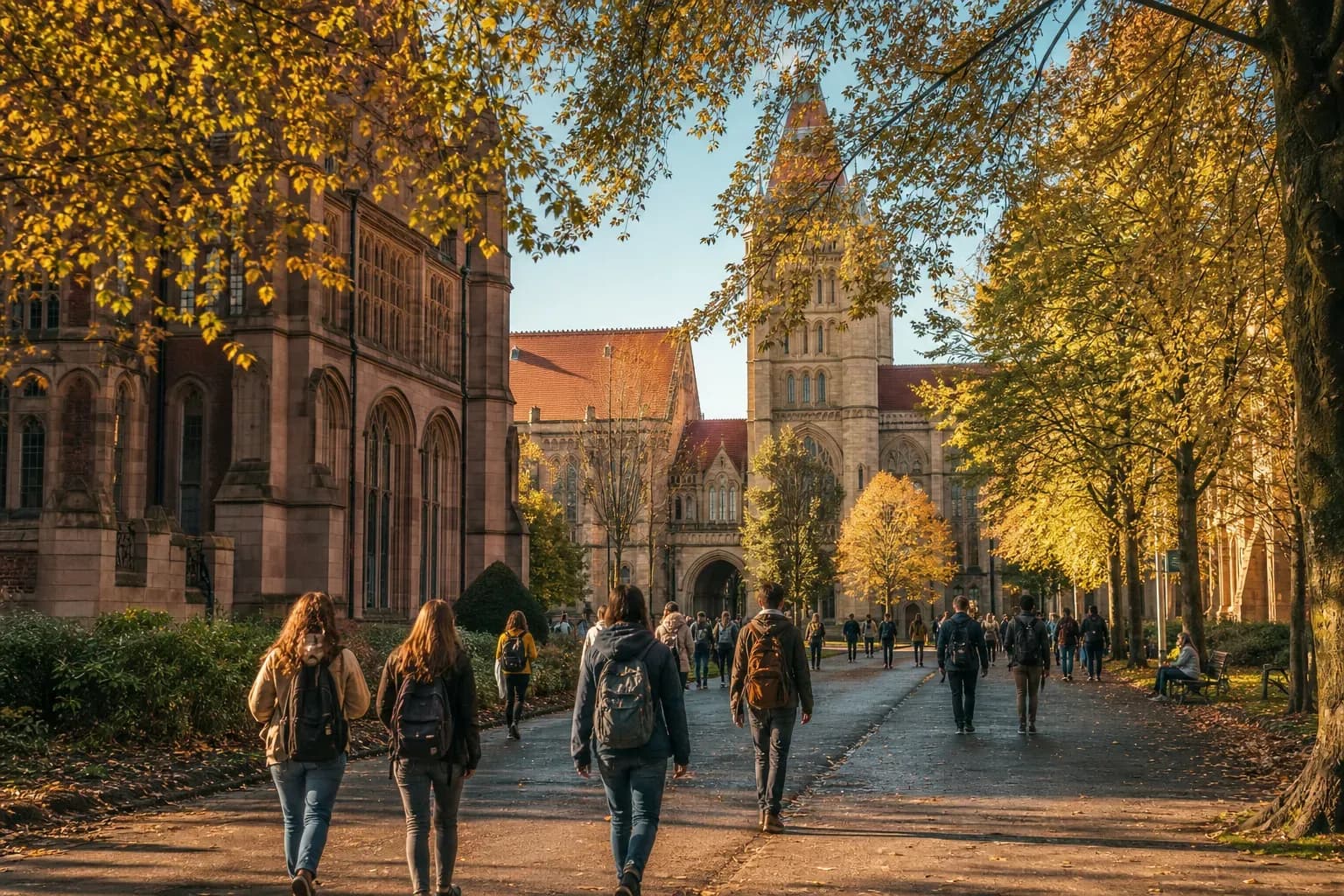
University of Manchester: Northern England's Flagship, the Largest Russell Group University, and 25 Nobel Laureates
Published on December 3, 2025
Ranked #35 globally in QS 2026 and #56 in THE, the University of Manchester is the largest Russell Group university by scale, with more than 40,000 undergraduate and postgraduate students. It is widely seen as "Northern England's best-known comprehensive university." Manchester's history can be traced back to the Mechanics' Institute founded in 1824. In 2004, the Victoria University of Manchester and UMIST merged to form today's University of Manchester, making it one of the largest and most internationally respected of the UK's Red Brick Universities.
Manchester's character can be summed up in one sentence: an industrial city, a red-brick legacy, a Nobel powerhouse, and a student city. The UK's first stored-program computer was born in Manchester in 1948, known as the "Manchester Baby." Graphene was discovered in Manchester in 2004 by Andre Geim and Konstantin Novoselov, who jointly won the Nobel Prize in Physics in 2010. Manchester is the UK's largest student city after London: around 100,000 students, including those at MMU and other institutions, live in a city of about 500,000 people.
1. Basic Information
| Item | Details |
|---|---|
| Founded | Established in 2004 through merger; predecessor founded in 1824 |
| Location | Manchester, North West England |
| Campus | Concentrated campus next to the City Centre |
| Undergraduates | ~28,000 |
| Postgraduates | ~12,000 |
| Institutional identity | Russell Group + Red Brick |
| Motto | Cognitio, sapientia, humanitas (knowledge, wisdom, humanity) |
2. World Rankings
| Ranking | Position |
|---|---|
| QS World 2026 | #35 |
| THE World 2026 | #56 |
| Complete University Guide 2026 (UK) | #28 |
| Guardian University Guide 2026 (UK) | #25 |
| QS Engineering & Technology | Top 30 |
| QS Materials Science | Top 10 |
| QS Education | Top 25 |
| THE Subject Rankings - Life Sciences | Top 50 |
3. Admissions Data (2025 Entry)
| Indicator | Figure |
|---|---|
| Applicants | ~92,000 |
| Admitted students | ~14,000 |
| Overall acceptance rate | Around 15% |
| International applicant acceptance rate | ~13% |
| Medicine acceptance rate | ~10% (UCAT + interview) |
| Yield Rate | ~50% |
| International student proportion | ~30% |
Typical A-Level / IB Offers
| Subject Area | Standard A-Level offer | Standard IB offer |
|---|---|---|
| Medicine (MBChB) | AAA (Chemistry + Biology) + UCAT | 37 points (HL 766) |
| Dentistry | AAA (Chemistry + Biology) + UCAT | 37 points (HL 766) |
| Engineering / CS | AAA (including Math) | 36-37 points (HL 666) |
| Economics | A*AA (including Math) | 37 points (HL 666 including HL Math) |
| Math | A*A*A (Math + Further Math) | 37 points (HL 776 including HL Math) |
| Law (LLB) | AAA + LNAT (some departments) | 37 points (HL 666) |
International Students
- International students make up around 30% of the undergraduate population
- Students come from 160+ countries
- Around 30-50 Taiwanese students are admitted each year, mainly to Engineering, Business, and Medicine
- Applications are submitted through UCAS
4. Tuition and Living Costs
2025-2026 International Tuition Fees
| Subject Area | Tuition (per year) |
|---|---|
| Humanities / Social Sciences | £26,500 |
| Economics / Management | £30,000 |
| Engineering / CS / Math | £32,000 |
| Medicine (Pre-clinical) | £33,500 |
| Medicine (Clinical) | £56,500 |
Living Costs (Low, Far Below London)
| Item | Amount |
|---|---|
| On-campus or nearby accommodation | £6,500-9,500/year |
| Food + transport + miscellaneous expenses | £5,500-7,500/year |
| Total (including tuition) | Around £38,500-50,000/year |
Graduate Route Visa
After graduation, students can apply for the Graduate Route, which grants 2 years of post-study work permission for bachelor's and master's graduates and 3 years for PhD graduates, with no employer sponsorship required. Manchester graduates commonly move into roles in Manchester itself, including at BBC, Co-op, Manchester United / City, and AstraZeneca, as well as in Leeds, Liverpool, and London.
Scholarships
- Manchester Bursary: based on household income
- Manchester Master's Bursary: mainly for postgraduate study
- Equity and Merit Scholarship: for students from developing countries
- Chevening / Commonwealth
5. Academic Structure / Signature Programs
Undergraduate Structure (3 Major Faculties)
- Faculty of Humanities: Law, Business, Education, Social Sciences, Languages
- Faculty of Science and Engineering: Math, Physics, Chemistry, CS, Materials, Engineering
- Faculty of Biology, Medicine and Health: Medicine, Dentistry, Nursing, Pharmacy, Biosciences
Signature Programs
- MBChB Medicine: a UK Top 10 medical school, working closely with the NHS Manchester system
- BSc / MEng Engineering: strong departments across mechanical, chemical, civil, and electrical engineering, with Materials Science ranked global Top 10
- BSc Computer Science: UK Top 10 for CS; Alan Turing wrote programs here after World War II
- Alliance Manchester Business School (AMBS): a UK Top 10 business school
- BSc Economics: UK Top 15
- BSc Pharmacy: one of the UK's leading pharmacy departments
- BA Drama / Music: a strong pillar of the UK's arts and humanities landscape
Teaching Style
Manchester uses a large lecture (150-300 students) + tutorial (10-20 students) + lab / seminar model. Because it is a large university with many undergraduates, teaching tends to be lecture-heavy, and students need to be proactive about attending office hours.
6. Campus Culture / University Personality
Manchester's character is defined by industrial heritage, left-leaning politics, student diversity, football, and music. Manchester is the birthplace of the Industrial Revolution ("Cottonopolis"). Marx and Engels worked in Manchester and observed the working class there, which shaped The Condition of the Working Class in England. The Smiths, Joy Division, Oasis, and Stone Roses all came from Manchester and became rock legends.
Students' Union
One of the largest students' unions in the UK, with 300+ societies. The best-known include Manchester Marxist Society (Marx wrote parts of Das Kapital in Manchester), Manchester Tech Society, and Manchester Investment Society.
Football Culture
Both Manchester United and Manchester City, two major Premier League clubs, are based in Manchester. Buying student season tickets and going to matches is a core part of campus culture.
University Personality
Manchester students are known for two recurring ideas: "Mancunian Pride" and "Anything but London." Manchester is the UK city that is "least like London but has the strongest city identity."
7. Location / Campus Environment
City Positioning
The city of Manchester has a population of 550,000, while Greater Manchester has 2.8 million people. It is 2 hours by train from London Euston, 50 minutes from Leeds, and 50 minutes from Liverpool. Manchester Airport is the UK's third-largest airport, with direct flights worldwide.
Campus Structure
- Oxford Road Corridor: the main campus and the UK's largest "student street," with 80,000 students when including MMU
- South Campus: medical school and business school
- North Campus: former UMIST site, home to engineering departments
Climate
- North West England, with winter temperatures of 1-7°C and summer temperatures of 13-21°C
- Very high rainfall: one of the wettest cities in the UK, with annual rainfall above 800mm
Campus Landmarks
- Whitworth Building: Gothic red-brick building on the main campus
- Alan Turing Building: home to the Department of Mathematics, named after alumnus Alan Turing
- John Rylands Library: neo-Gothic building in the city centre
- Manchester Museum: free on-campus museum
- The Whitworth: art museum
8. Research and Resources
Libraries
- The University of Manchester Library: one of the largest university libraries in the UK, with 4 million volumes
- John Rylands Library: city centre branch, a neo-Gothic library completed in 1900
Notable Research Centres
- National Graphene Institute (NGI): a global centre for graphene research, opened in 2015
- Henry Royce Institute: the UK's national institute for advanced materials research
- Manchester Centre for Synthetic Biology
- Jodrell Bank Observatory (30 km off campus): a major UK centre for astronomy and a World Heritage Site
9. Notable Alumni
- Nobel Prizes: 25 Nobel Laureates, including Andre Geim and Konstantin Novoselov for graphene, Ernest Rutherford for nuclear theory, and Niels Bohr for quantum mechanics
- Science / Mathematics: Alan Turing, who wrote programs in Manchester from 1948 to 1954 after World War II; Tom Kilburn, a pioneer in computer science
- Politics: alumni include 4 UK prime ministers, as well as Bonar Law and Chaim Weizmann, the first president of Israel
- Business: Sir Terry Leahy, former CEO of Tesco; Sir John Bond, former chairman of HSBC
- Music / Performing Arts: Benedict Cumberbatch, who briefly studied there; Anna Friel
- Academia: Friedrich Engels, who did not formally enrol but worked and conducted research in Manchester
10. Manchester Facts
- Graphene was discovered in Manchester: In 2004, Andre Geim and Konstantin Novoselov used adhesive tape to peel a single layer of carbon from graphite. They jointly won the Nobel Prize in Physics in 2010.
- The world's first stored-program computer was in Manchester: The 1948 "Manchester Baby" was the world's first computer to run a stored program. Alan Turing later developed programming languages in Manchester.
- Manchester is the birthplace of the Industrial Revolution: It was a centre of the cotton textile industry in the 18th and 19th centuries, and Marx and Engels wrote The Condition of the Working Class in England based on Manchester.
- 25 Nobel alumni: across science, literature, peace, and other fields.
- John Rylands Library is a neo-Gothic masterpiece: Completed in 1900, it holds some of the earliest medieval manuscripts and printed works.
- Manchester is not just Manchester, but Mancunia: Its ancient Latin name is Mancunium, and alumni call themselves Mancunians.
11. Typical Admitted Student Profile
- A-Level AAA-A*AA or IB 36-37 (HL 666-766)
- Math / Engineering / CS: Math must be at A or HL 6
- Medicine / Dentistry: UCAT + interview + work experience
- Law: some departments require LNAT
- Quantifiable academic passion: subject-related EPQ, internships, community service, Olympiad
- Personal Statement of up to 4,000 characters / 47 lines, with 75% academic content + 25% extracurricular content
- Manchester tends to favour students with "broad academic interest + diverse backgrounds"
12. What Kind of Student Is It Best For?
✓ A good fit for:
- Students who want a comprehensive Russell Group university with a wide range of departments
- Students who want middle-class city life and lower living costs, around 40% cheaper than London
- Students interested in Engineering, Materials, CS, Medicine, or Pharmacy
- Students who enjoy music, football, arts, and culture
- Students who do not need an Oxbridge-style college atmosphere
- Students who can accept the UK's wettest climate
✗ Not necessarily a good fit for:
- Students looking for a small-college, tight-knit environment, as Manchester is very large
- Students attracted to Oxbridge college dinners and tutorial culture
- Students who dislike rain or cloudy weather, as Manchester has around 150 rainy days per year
- Students who want the convenience of London's international metropolis
- Students seeking an ultra-competitive business school atmosphere, who may prefer LSE / Warwick
Conclusion
Manchester is not the only option for students who want a top university in Northern England. Leeds, Sheffield, Newcastle, and Liverpool are all Russell Group universities too. Manchester is for students who, at 18, want a big-city experience but do not want to squeeze into London, want the academic breadth of a comprehensive university, and can accept the UK's wettest climate.
If your trajectory is "I want Engineering / CS / Materials, I want to stay in the UK and work at BBC / AstraZeneca / Manchester United, and I want to experience the rock city of Oasis and Joy Division," Manchester offers one of the best combinations of lower tuition + lower living costs + high Nobel alumni density. If your goal is a direct route into City of London investment banking, Manchester is not the first choice; LSE / Warwick / Oxbridge are more direct.
One point Taiwanese families often overlook is that Manchester's 25 Nobel alumni place it in the UK Top 5, behind only Cambridge, Oxford, UCL, and Imperial. Many people assume Manchester is simply a "solid Northern England Red Brick," but in reality, its research output is comparable to UCL / KCL. Graphene, the first computer, nuclear theory: these scientific milestones all happened in Manchester. If you are willing to accept Manchester's rainy weather and industrial-city character, Manchester is one of the highest-ROI comprehensive Russell Group universities in the UK.
Sources: