
Macquarie University: Australia’s Birthplace of Actuarial Studies, Sydney’s Northern Innovation District, and an IRU Business Flagship
Published on February 16, 2026
Ranked #138 globally in QS 2026, a member of the IRU (Innovative Research Universities), and the birthplace of Actuarial Studies in Australia, Macquarie University is the “third option” that Taiwanese families most often overlook when considering Sydney. After parents compare Sydney, UNSW, and UTS, the shortlist often stops there. What they may not realize is that Macquarie is the origin of actuarial education in Australia, the first university in the world to offer a degree in Actuarial Studies, the starting point where Cochlear implant technology moved from academic research into commercialization, and the only university in Australia whose campus directly sits inside a corporate headquarters district. The Australian headquarters of Optus, Cochlear, Johnson & Johnson, Goodman, and Konica Minolta are all located within the Macquarie Park Innovation District, just a 5-10 minute walk from Macquarie’s main campus.
Macquarie’s visibility is squeezed from three directions: the Go8 halo of Sydney and UNSW, UTS’s story as the “top non-Go8” urban campus, and Macquarie’s location in Sydney’s “northern suburbs” rather than the CBD. When parents hear “northern suburbs,” they often mistake it for “remote.” In reality, Macquarie is located at the heart of Sydney’s affluent North Shore. It is only 25 minutes by Metro to the CBD, 7 minutes to Chatswood, and sits in the quiet, stable middle-class environment of Sydney’s Lower North Shore. It is one of the Sydney areas where study-abroad parents feel most comfortable letting their children live. This article explains Macquarie’s real profile, why actuarial students should seriously consider it, and how to think about PR strategy.
1. Key Facts
| Item | Details |
|---|---|
| Founded | 1964 (Australia’s third modern university, after UNSW and Monash) |
| Location | North Ryde, Sydney, NSW (inside the Macquarie Park corporate district in Sydney’s northern suburbs) |
| Campus | Single green campus of about 126 hectares; the campus itself is part of the Macquarie Park Innovation District |
| Undergraduate students | ~32,000 |
| Postgraduate students | ~12,000 |
| Total students | About 44,000 |
| Student-faculty ratio | 1:22 |
| Motto | And gladly teche (from Chaucer’s The Canterbury Tales) |
| Group identity | Core member of the IRU (Innovative Research Universities) |
Macquarie is Australia’s third modern university. When it was established in 1964, its core idea was to “break down departmental barriers and teach across disciplines,” which was a highly progressive design in 1960s Australia. Its motto is not Latin, but the Middle English phrase “And gladly teche” from Chaucer’s The Canterbury Tales. That alone reflects the university’s DNA: serious about teaching quality, not pretending to be classical, and oriented toward practical outcomes.
2. World Rankings
| Ranking | Position |
|---|---|
| QS World 2026 | #138 (highest-ranked university in the IRU group) |
| THE World 2026 | #178 |
| ARWU / Shanghai 2024 | #201-300 |
| QS Accounting and Finance | Global Top 50 |
| QS Actuarial Studies / Actuarial Science | Global Top 25 (first in Australia, origin school) |
| QS Linguistics | Global Top 50 |
| QS Psychology | Global Top 100 |
| QS Earth and Marine Sciences | Global Top 100 |
| QS Communication & Media Studies | Global Top 100 |
| QS Business and Management Studies | Global Top 100 |
Macquarie does not outrank the Go8 overall in QS, but it has long been world-class in subject rankings such as Actuarial, Linguistics, and Cognitive Science. Macquarie launched Australia’s first Actuarial Studies program in 1968. This is not a department that followed a trend; it is the university that helped define what this field looks like in Australia. For Taiwanese students who are certain they want to pursue actuarial work, Macquarie is an irreplaceable choice.
3. Admissions Data (International Students, 2026 Entry)
| Indicator | Figure |
|---|---|
| International student ATAR equivalent | 75-92 (depending on program) |
| IB Diploma | 28-36 points |
| Approximate Taiwan high school GPA threshold | Top 20-30% of class + near-perfect grades |
| IELTS requirement | 6.5 (6.0 in each band); some programs require 7.0 |
| TOEFL iBT | 83 (including Writing 21) |
| Application fee | AUD 125 (international undergraduate applicants) |
| International student ratio | About 35% |
| Bachelor of Actuarial Studies entry threshold | ATAR 92 / IB 36 (Macquarie’s most competitive program) |
| Bachelor of Commerce entry threshold | ATAR 85 / IB 32 |
| Bachelor of Engineering entry threshold | ATAR 80 / IB 30 |
| Bachelor of Cognitive and Brain Sciences entry threshold | ATAR 85 / IB 32 |
International Students
- International students account for about 35% of the student body, similar to UTS and slightly higher than UNSW (30%)
- Students come from 100+ countries, with Chinese students forming the largest group (Actuarial, Accounting), followed by India (IT, Engineering)
- Around 100-150 Taiwanese students enroll each year (undergraduate and postgraduate combined)
- Important: Macquarie’s Actuarial Studies and Accounting programs are directly accredited for subject exemptions by Actuaries Institute Australia and CPA Australia. Graduates can enter the professional membership pathway without needing extra examinations. Only a small number of Australian universities can offer this.
4. Tuition and Financial Aid
2026 International Student Tuition (Annual)
| Program Category | Annual Tuition in AUD | NTD Equivalent (AUD 1 = NTD 22.6) |
|---|---|---|
| Bachelor of Arts | About AUD 38,000 | About NTD 860,000 |
| Bachelor of Commerce | About AUD 48,000 | About NTD 1.08 million |
| Bachelor of Actuarial Studies | About AUD 50,000 | About NTD 1.13 million |
| Bachelor of Science | About AUD 45,000 | About NTD 1.02 million |
| Bachelor of Engineering (Honours) | About AUD 49,000 | About NTD 1.11 million |
| Bachelor of Information Technology | About AUD 46,000 | About NTD 1.04 million |
| Bachelor of Media and Communications | About AUD 42,000 | About NTD 950,000 |
| Bachelor of Cognitive and Brain Sciences | About AUD 45,000 | About NTD 1.02 million |
| Master of Actuarial Practice | About AUD 50,000 | About NTD 1.13 million |
| Master of Applied Linguistics | About AUD 40,000 | About NTD 900,000 |
| Living costs (North Ryde / Macquarie Park) | About AUD 28,000-36,000 | About NTD 630,000-810,000 |
The total tuition for a 3-year Bachelor of Actuarial Studies is about AUD 150,000 (NTD 3.39 million), roughly AUD 20,000-30,000 cheaper than comparable programs at USYD or UNSW. Living costs are also more favorable. A studio or single-room unit in North Ryde is typically AUD 350-500 per week, around 20-30% cheaper than areas around UTS Ultimo or UNSW Kensington.
Scholarships and Financial Aid
- Vice-Chancellor's International Scholarship: One-time AUD 10,000 tuition reduction for undergraduate students
- Macquarie University International College Scholarship: Tuition reduction options for students progressing from MUIC pathway programs into degrees
- Master of Research Scholarship: Full tuition coverage for the research master’s track + AUD 34,000 stipend
- Cochlear Industry Scholarship: Engineering / biomedical scholarships sponsored by Cochlear
- Faculty of Business and Economics Scholarships: Business school scholarships ranging from AUD 5,000-15,000
The most practical reminder for Taiwanese families: Macquarie’s industry-sponsored scholarships are an advantage the Go8 cannot easily match. Neighboring companies such as Cochlear, Optus, and Johnson & Johnson recruit interns and graduate trainees through Macquarie every year, and some roles come with scholarship support. USYD and UNSW do not have the same density of this channel.
5. Program Structure: 3-Year Bachelor + Professional Master’s Exits
Not the Melbourne Model
Macquarie follows the traditional British-Australian 3-year Bachelor structure. Students can apply directly at age 18 to the Bachelor of Actuarial Studies, Bachelor of Commerce, or Bachelor of Engineering (Honours, 4 years). They can complete a degree in 3 years and move into professional employment, or add 1 year of Honours, without spending another 2 years on a Master’s degree first.
Signature Bachelor of Actuarial Studies with Direct Access to Actuaries Institute Australia
Macquarie’s Bachelor of Actuarial Studies has the highest actuarial subject exemption rate in Australia. When graduates complete the degree, they also receive exemptions for all 8 Part I subjects from Actuaries Institute Australia, which means 8 fewer exams and 2-3 years of self-study saved. If your goal is to become a Fellow of Institute of Actuaries Australia (FIAA), Macquarie is the only Australian university where the degree can directly cover the full Part I set. UNSW is also recognized, but Macquarie is the origin school, and its curriculum alignment with IAA is the strongest.
Signature Programs
- Bachelor of Actuarial Studies: Australia’s first and leading actuarial program, fully aligned with Actuaries Institute Australia
- Bachelor of Commerce: Accounting, Finance, and Economics tracks, with AACSB / EQUIS double-crown accreditation
- Bachelor of Applied Finance: Collaborates with the CFA Institute; one of Australia’s earliest Applied Finance programs
- Bachelor of Cognitive and Brain Sciences: One of Australia’s leading cognitive science programs, supported by Macquarie’s own MEG brain imaging facility
- Bachelor of Engineering (Honours): Mechatronics, Electronic, Software, and Wireless tracks
- Bachelor of Media and Communications: One of Australia’s strongest journalism programs, supported by collaboration with the national broadcaster ABC
- Bachelor of Arts in Linguistics: Global Top 50, a major center for linguistics in Australia
- Master of Applied Linguistics: A flagship program in TESOL and applied linguistics
- Master of Actuarial Practice: A 2-year pathway for students switching into actuarial from a non-actuarial background
What This Means for Taiwanese Students
- Pros: A 3-year Bachelor is 2 years shorter than the Melbourne Model; Actuarial / Accounting programs lead directly into professional accreditation; tuition and living costs are lower than the Go8
- Cons: Pure research-track resources are not as deep as the Go8; academic brand recognition among Taiwanese parents is lower
- Consultant’s advice: If you are 18 and already certain you want actuarial, accounting, or financial engineering, Macquarie is a more practical choice than USYD or UNSW. If you are still undecided, need the Go8 brand on your resume, or plan to pursue a PhD, USYD or UNSW is the steadier choice
6. Campus Culture / Institutional Personality
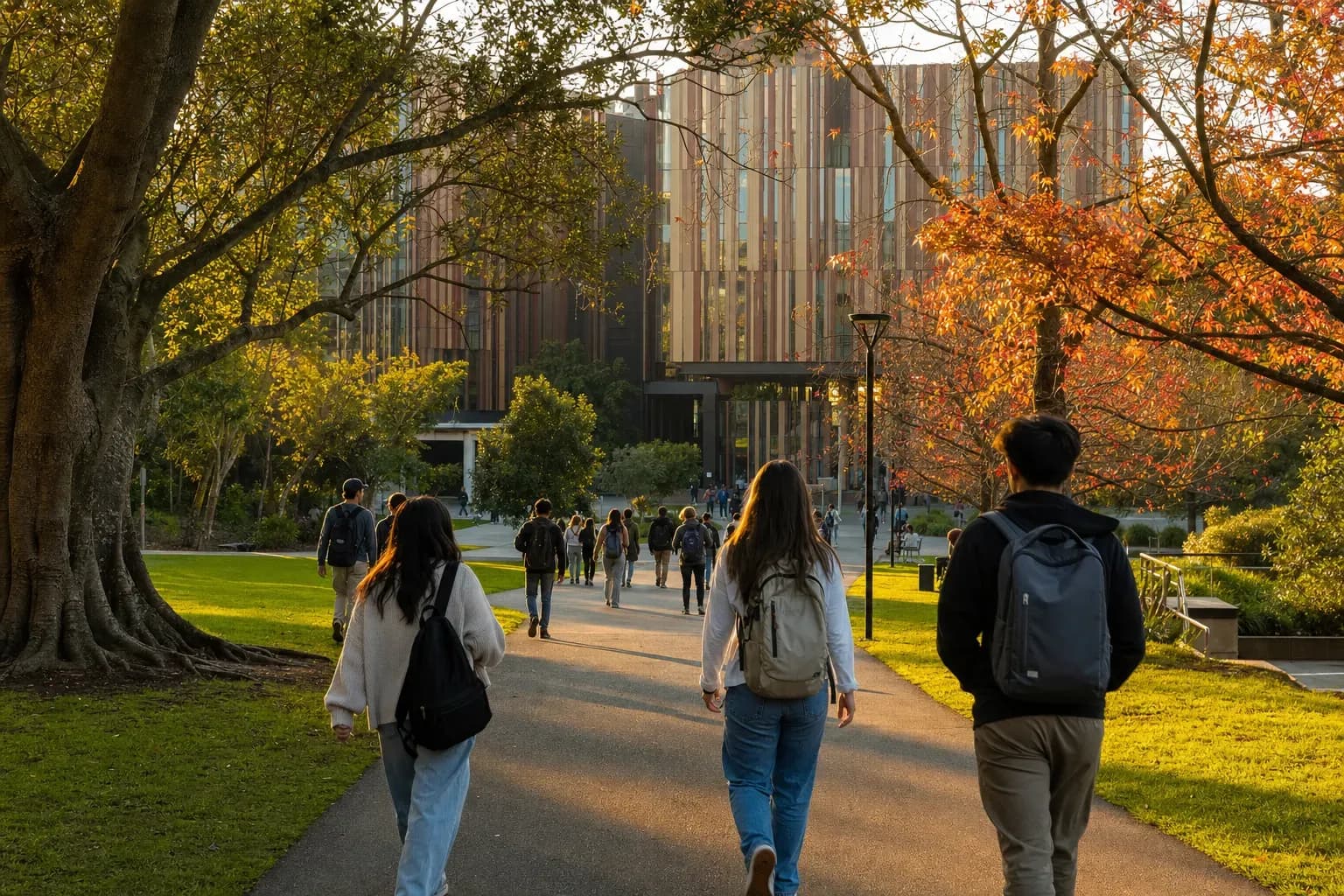
Macquarie’s personality can be summarized in three phrases: calm, career-oriented, and North Shore middle-class. It does not have USYD’s 1850s sandstone-tower tradition, UNSW Kensington’s hard-edged engineering temperament, or UTS Ultimo’s urban modernism. It is a Sydney northern-suburbs university built around a green campus, surrounded by corporate offices, and oriented toward business and professional careers. The first impression many students have on entering Macquarie is, “This feels like a smaller version of a Stanford campus”: lawns, trees, lakes, quiet office buildings, and students in blazers walking to Optus interviews as part of everyday life.
The student mix leans toward Asian international students (China, Taiwan, Hong Kong, Malaysia) + local middle-class white students from Sydney’s northern suburbs + many mature students (aged 25+, returning for professional development). Macquarie has one of the highest postgraduate ratios among major Australian universities. Many working accountants, actuaries, and speech pathologists in Australia return to Macquarie for advanced Master’s study.
This DNA gives Macquarie a campus atmosphere that is practical, career-focused, and quiet. If you are the kind of Taiwanese high school student who does not want beach parties, does not want a hard-core geek competition culture, and wants to focus on actuarial studies or accounting before entering banking, insurance, or consulting, Macquarie may fit you better than USYD or UNSW.
Student Clubs
- Macquarie University Students' Association (MUSA) oversees more than 100 clubs
- Macquarie Actuarial Society: Australia’s oldest student actuarial society, directly connected to IAA
- Macquarie University Indigenous Students' Association
- Taiwanese Students' Association (MUTSA): Taiwanese student society
Sports Culture
- Macquarie University Sport and Aquatic Centre: Olympic-standard swimming pool, gym, and indoor sports courts
- Signature sports: Rugby, Football (soccer), Rowing
- Because it is located in a green northern-suburbs setting, Macquarie has the most complete campus sports facilities among Sydney’s three main universities
7. Location / Campus Environment
Urban Positioning
The main campus is in North Ryde, Sydney, a middle-class residential and corporate district in the Lower North Shore. Macquarie has its own Macquarie University Metro station on campus, one of the key stations when Sydney Metro opened in 2019. By Metro, it is 7 minutes to Chatswood, 25 minutes to Sydney CBD (Martin Place / Barangaroo), and 30 minutes to the Sydney Opera House. It is the only university in Australia with a Metro station on campus offering direct access to the CBD, making it even more convenient than USYD or UNSW in some daily commuting scenarios.
Even more important is Macquarie Park Innovation District. This is the corporate headquarters cluster of Sydney’s northern suburbs, only a 5-10 minute walk from Macquarie’s main campus. The campus boundary is effectively the corporate district boundary. Companies based there include:
| Company | Business | Connection with Macquarie |
|---|---|---|
| Optus | Australia’s second-largest telecommunications company, headquarters | Major internship destination for Engineering and IT |
| Cochlear | Global leader in Cochlear implant technology | Originated from research at Macquarie, with headquarters next door |
| Johnson & Johnson Australia | Medical device headquarters | Major internship destination for biomedical engineering and business |
| Goodman Fielder | Major food company | Business and Marketing internships |
| Konica Minolta Australia | Japanese multinational headquarters | International business internships |
| Foxtel Group | Media giant, partial offices | Media and communications internships |
| Honeywell Australia | Industrial automation headquarters | Engineering internships |
Sydney is the capital of NSW, Australia’s largest city, and home to 5.4 million people. Macquarie’s location lets students balance urban convenience with quiet living: a green campus, Metro access to the CBD, and corporate headquarters at the campus gate. This combination is something neither USYD nor UNSW can offer.
Climate
- Summer (December-February): 20-28°C, humid, frequent thunderstorms
- Winter (June-August): 8-17°C, warmer than Melbourne, no snow
- Sydney’s northern suburbs (North Ryde) are 2-3°C cooler than the CBD. Although the latitude is the same, the northern suburbs have denser tree coverage and sea breezes, making summer more comfortable than in the CBD
Campus Landmarks
- Macquarie University Library: One of Australia’s largest university libraries, with 5 floors and an automated storage and retrieval system (the first robotic book retrieval system introduced by an Australian university)
- MQ Sport and Aquatic Centre: Olympic swimming pool, gym, and climbing wall
- The Hub (Central Courtyard): The campus social center, with student dining and cafes
- Australian Hearing Hub: A world-leading hearing research center jointly built with Cochlear and the National Acoustic Laboratories
- Macquarie University Hospital: Australia’s first full-service private hospital on a university campus (opened in 2010), directly linked with the medical school and biomedical engineering
- Macquarie University Research Park (MURP): A 23-hectare research and industry park on campus
8. Research and Resources
Macquarie is one of the IRU flagships, with annual research funding of about AUD 300 million. While that does not match the Go8 scale (Melbourne AUD 1.1 billion, Sydney AUD 800 million), its research concentration is high and its industry collaboration density is among the strongest in Australia.
Key Research Institutes
- Australian Hearing Hub: Jointly built with Cochlear, the National Acoustic Laboratories, and the Royal Institute for Deaf and Blind Children, extending the legacy of the birthplace of Cochlear implant technology
- ARC Centre of Excellence for Cognition and its Disorders (CCD): A national-level cognitive science research center
- Macquarie University Cyber Security Hub: One of Australia’s leading cybersecurity research centers, collaborating with Australia’s ASD national security agency
- Centre for the Health Economy (MUCHE): Health economics and policy research
- Macquarie University MEG Laboratory: The only MEG (magnetoencephalography) brain imaging facility in the Southern Hemisphere, with only around 100 such systems worldwide
- Australian Astronomical Observatory: Collaboration in astronomical observation equipment
Industry Connection (Macquarie’s Real Signature Strength)
Because the campus itself is inside a corporate district, Macquarie has a distinctive advantage in industry collaboration:
- Cochlear: Its core technology grew out of collaborations involving Graeme Clark and other researchers at Macquarie in the 1970s and 1980s. Today it remains the largest internship destination for Macquarie’s engineering and biomedical faculties
- Optus: A major channel for Engineering, IT, and Business internships and graduate trainee roles
- Johnson & Johnson, Sanofi: Medical device and pharmaceutical collaborations
- CPA Australia / Actuaries Institute Australia: Accounting and actuarial programs are directly accredited
- Australian Broadcasting Corporation ABC: Media and communications internship collaboration
- Australian Department of Foreign Affairs and Trade DFAT: Internship channels for linguistics and international relations students
For students targeting PR, Macquarie’s “campus = corporate district” structure is almost like a degree plus half a job offer. Its conversion rate into industry after graduation is among the strongest of Sydney’s non-Go8 universities.
9. Notable Alumni
- Politics: Joe Hockey (former Australian Treasurer and former Australian Ambassador to the United States)
- Business / Finance: Adrienne Bryson (leading Australian actuary and former IAA president), Tony Goldner (senior World Economic Forum leader), and multiple CFOs and chief actuaries in Australian banking
- Technology / Engineering: Several former Cochlear CTOs and senior engineering executives at Optus / Telstra
- Media: Jana Wendt (legendary Australian news presenter, Channel 9 / SBS), Tracey Spicer (journalist and author)
- Academia / Culture: David Malouf (major Australian literary figure and Booker Prize nominee), Anne Summers (feminist writer and commentator)
- Sports: Ian Thorpe (partial study, multiple Olympic gold medalist in swimming for Australia)
Macquarie’s strongest alumni signature is in finance and actuarial work. Many senior actuarial and risk management leaders at Australia’s Big Four banks (CBA, Westpac, NAB, ANZ) come from Macquarie. Combined with Cochlear’s engineering and medical technology DNA, the university has very concrete career outcomes across the dual tracks of “business + medical technology.”
10. Macquarie Facts You May Not Know
- Cochlear implant technology grew out of research at Macquarie: In 1978, Professor Graeme Clark’s team collaborated with Macquarie’s audiology department on multichannel Cochlear implant technology, which was later commercialized through the establishment of Cochlear. Today, Cochlear is the global leader in the Cochlear implant market, with a market value above AUD 20 billion, and its headquarters are located next to the Macquarie campus in Macquarie Park.
- Australia’s first university with a Metro station on campus: Sydney Metro Northwest opened in 2019, and Macquarie University Station is located on campus. Students can commute from the CBD in 25 minutes by Metro, a level of convenience USYD and UNSW do not have.
- The first Australian university library to introduce a robotic book retrieval system: Macquarie Library’s automated storage system can hold 1 million books. Students request books online, and robots deliver them to the collection desk within 5 minutes. It was the first such system in Australia and opened in 2011.
- The motto comes from Middle English: “And gladly teche” comes from Geoffrey Chaucer’s The Canterbury Tales. Macquarie is the only Australian university whose motto uses Middle English rather than Latin. It means that the priest “gladly taught,” a very forward-looking choice for a newly established university in 1964.
- The only MEG brain imaging facility in the Southern Hemisphere: Macquarie MEG Laboratory has the only magnetoencephalography system in the Southern Hemisphere, and there are only about 100 such systems worldwide. This gives Macquarie’s cognitive science research a distinctive equipment advantage.
- The university is named after Lachlan Macquarie: Governor of the NSW colony from 1810 to 1821, he is often called the “Father of modern Australia.” The name reflects Macquarie’s own positioning around “Australian modernization.”
11. Typical Admitted Student Profile
- Taiwanese international school students with predicted IB scores of 30-36 (36+ required for Actuarial Studies), or ATAR equivalent 80-92
- Taiwan high school system: top 15-25% of class at schools such as Jianguo High School, Taipei First Girls High School, Zhongshan Girls High School, HSNU, Wego, Kang Chiao, and Kuei Shan, with near-perfect GPA
- IELTS 6.5-7.0 or TOEFL iBT 83+
- Extracurriculars: The Actuarial track will consider math competition results such as APMO, AMC, and TRML; the business track values MUN, community leadership, and internships; the cognitive science track values Olympiad and research experience
- Most programs do not require interviews. The application process is relatively mechanical and is decided mainly by grades and English proficiency
- A Personal Statement is required only for selected programs
12. What Kind of Student Is a Good Fit?
✓ Good fit for:
- Students who want to study Actuarial Studies, Accounting, Finance, Applied Finance, or Business
- Students who want Cognitive Science, Linguistics, Speech Pathology, or Audiology
- Students who want a direct 3-year degree and earlier employment, rather than the 5-6 year Melbourne Model
- Families who like a quiet, middle-class green campus in Sydney’s northern suburbs and want their child to live in a safe, calm area
- Students who want internships with Cochlear, Optus, or Johnson & Johnson through Macquarie Park Innovation District
- Families with tighter budgets who still want Sydney (tuition is AUD 8,000-15,000 cheaper than USYD and UNSW, and living costs are 20-30% lower)
- Students who want direct professional accreditation through CPA Australia / Actuaries Institute Australia, with future goals in Big Four accounting firms or the insurance industry
✗ Not necessarily a good fit for:
- Families who care strongly about the “Go8 brand” and need an easier explanation when returning to Taiwan after graduation (Sydney and UNSW are still safer choices)
- Students planning to enter academia, pursue a PhD, or follow a research route (outside cognitive science and linguistics, Go8 research resources are deeper)
- Students who want a “sandstone tower” classical British-style campus (Macquarie is 1960s modernist + green campus, not classical)
- Students who want CBD urban life, nightlife, and restaurants within a 5-minute walk (the northern suburbs are quiet and nightlife is limited)
- Students who want pure humanities, Philosophy, Classical Studies, or Pure Mathematics (USYD is stronger in these areas)
Conclusion
Macquarie is the third option Taiwanese families most easily miss when looking at Sydney. But in reality, Macquarie is the birthplace of actuarial studies in Australia, the origin of Cochlear implant technology, the only Australian university with an on-campus Metro station directly connected to the CBD, and the flagship of an Innovation District surrounded by corporate headquarters. Taken together, these signatures give Macquarie a stronger story than many Go8 universities.
From an immigration strategy perspective, Macquarie has four advantages: (1) a 3-year Bachelor leading directly into actuarial / accounting / business + Honours, entering the 485 PHEW countdown 2 years earlier than the Melbourne Model; (2) Bachelor of Actuarial Studies directly exempts all 8 Part I subjects of Actuaries Institute Australia, which other universities may not fully provide; (3) 2 years under the 485 PHEW Stream after a Master Coursework degree (reduced from 3 years to 2 years after 2024-07-01), while Master Research and PhD pathways remain 3 years; (4) the internship and recruitment pipeline from Cochlear, Optus, and Johnson & Johnson next to campus gives graduates one of the stronger chances in Australia of staying and working locally.
The most practical PR pathway combination: Macquarie Bachelor of Actuarial Studies or Bachelor of Engineering (Software / Mechatronics) + Master of Actuarial Practice or Master of Information Technology + PTE 79 + 2 years of work in Sydney + NAATI Chinese certification + 189 Skilled Independent. This pathway can build toward 90-105 PR points. Actuarial and Engineering are both on the MLTSSL skilled occupation list, and within Dr. G. Academy’s Master’s database, they rank among the STEM / business Master Coursework pathways with the highest PR points and the least mainstream competition. Actuarial is especially PR-friendly as a niche flagship field. It is not as crowded as IT, but its points potential is no weaker than IT, making it a program that families who calculate the full picture should take seriously.
Macquarie is not a substitute for the Go8; it provides what the Go8 will not give you. It will not give you USYD’s century-old sandstone tradition, UNSW’s engineering academic brand, or UTS’s Frank Gehry business school. But it will give you the source of actuarial education in Australia, Cochlear’s technology DNA, the corporate recruitment pipeline of Macquarie Park Innovation District, and the residential comfort of a green northern-suburbs campus + 25-minute Metro access to the CBD. For Taiwanese families who understand the full equation and can see that “career > brand,” Macquarie is the most underrated flagship among the five IRU universities.