
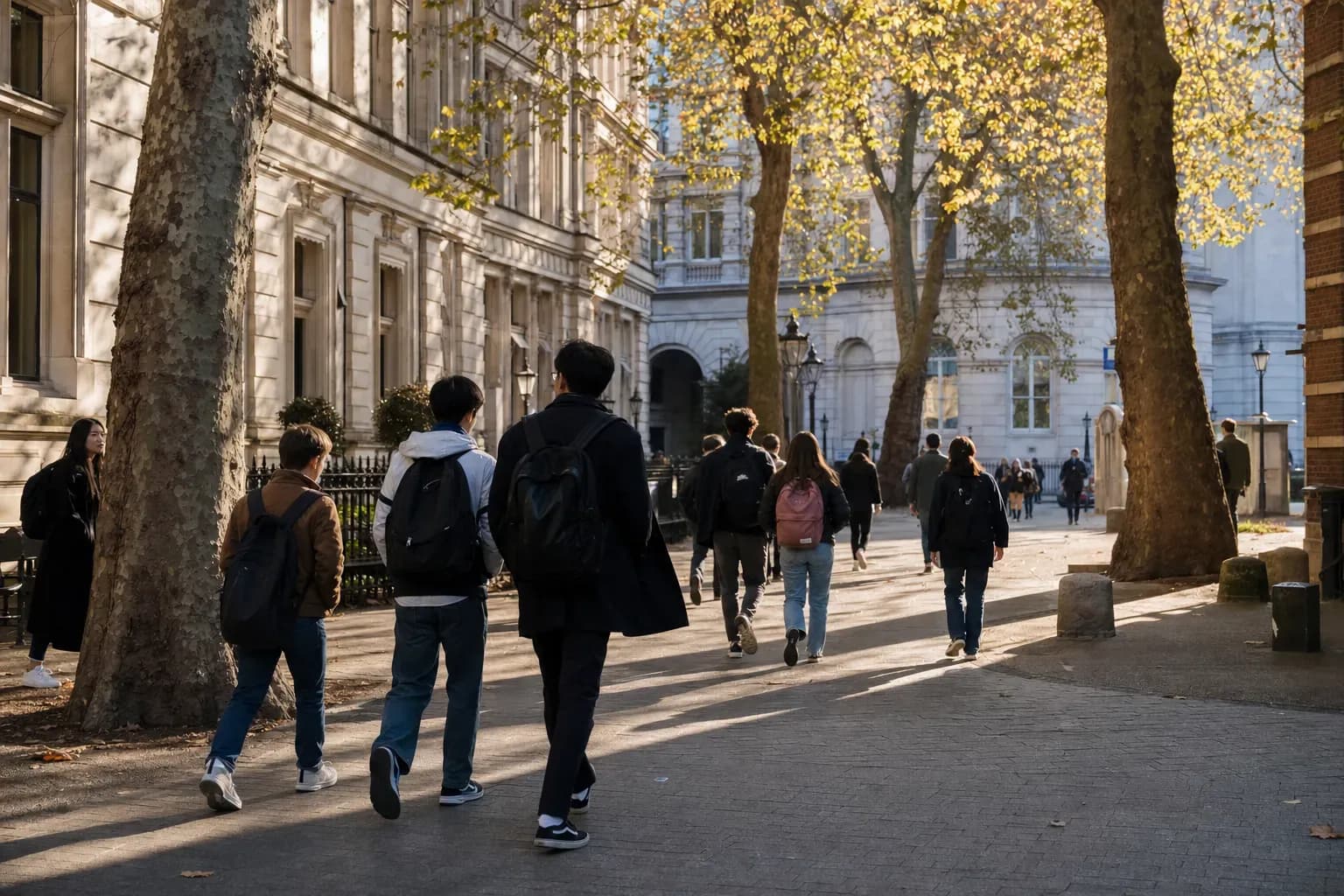
London School of Economics (LSE): The UK’s Leading School for Business, Management, and Social Sciences, and Houghton Street’s Global Finance Elite Training Ground
Published on December 9, 2025
Ranked 3rd in the UK by the Complete University Guide, 2nd globally for social sciences by Times Higher Education, and 56th globally by QS (although QS systematically underrates specialist social science institutions), the London School of Economics (LSE) is one of the UK’s top universities that feels the least like a comprehensive university. It has no STEM, no medicine, no arts, and no humanities. LSE exists to send one clear message: economics, business and management, politics, sociology, law, and international relations are taught at a world-class level; everything else is left aside.
LSE’s character can be summarized in one sentence: global, elite, left-leaning, and finance-oriented. Located on Houghton Street and Aldwych in London Zone 1, it is a 10-minute walk from the City of London and a 15-minute walk from the Westminster Parliament. This location defines LSE’s DNA: students may pass the Goldman Sachs London office on the way to class and meet parliamentary assistants over lunch.
1. Basic Information
| Item | Details |
|---|---|
| Founded | 1895 (founded by the Fabian Society) |
| Location | Houghton Street, London Zone 1 |
| Campus | 30+ buildings concentrated within 1 square kilometer |
| Undergraduates | ~5,200 |
| Postgraduates | ~7,400 |
| Group Affiliation | Russell Group |
| Motto | Rerum cognoscere causas (to understand the causes of things) |
| Academic Composition | 100% social sciences + business and management + law |
2. World Rankings
| Ranking | Position |
|---|---|
| QS World 2026 | #56 |
| THE World 2026 | #52 |
| Complete University Guide 2026 (UK) | #3 |
| Guardian University Guide 2026 (UK) | #5 |
| QS Economics | #5 |
| QS Politics | #2 |
| QS Sociology | #2 |
| QS Accounting & Finance | #4 |
3. Admissions Data (2025 Entry)
| Indicator | Figure |
|---|---|
| Applicants | ~25,000 |
| Admitted Students | ~1,700 |
| Overall Acceptance Rate | around 7% |
| International Applicant Acceptance Rate | ~6% |
| Acceptance Rate for Popular Programs (Econ / Finance / Law) | < 5% |
| Yield Rate | ~70% |
| International Student Ratio | ~70% (the highest in the Russell Group) |
Typical A-Level / IB Offers
| Department Category | Standard A-Level Offer | Standard IB Offer |
|---|---|---|
| Economics / Math & Econ / PPE | A*AA (including A* in Math) | 38 points (HL 766 including HL Math) |
| Finance / Accounting & Finance | A*AA (including Math) | 38 points (HL 766 including HL Math) |
| Law (LLB) | A*AA + LNAT | 38 points (HL 766) |
| Government / IR / Sociology | AAA-AAB | 37 points (HL 666) |
| Math (BSc) | A*A*A (including A in Math + A in Further Math) | 38 points (HL 776 including HL Math) |
International Students
- International students make up around 70% of the undergraduate population, the highest in the Russell Group
- Students come from 140+ countries
- Around 20-40 students from Taiwan are admitted each year, mainly to Econ, Finance, Law, and IR
- Applications go through UCAS; Law requires the LNAT, and PPE requires the TSA for some applicants
4. Tuition and Living Costs
2025-2026 International Tuition
| Department Category | Tuition (per year) |
|---|---|
| BSc Economics / Finance / Accounting | £29,520 |
| LLB Law | £27,720 |
| BSc Math / Stats | £27,720 |
| BSc Government / Sociology / IR | £27,720 |
| BSc Management | £27,720 |
London Living Costs (Extremely High)
| Item | Amount |
|---|---|
| On-campus / nearby accommodation | £11,000-17,000/year |
| Food + transport + miscellaneous expenses | £8,000-10,000/year |
| Total (including tuition) | around £48,000-55,000/year |
Graduate Route Visa
After graduation, students may apply for the Graduate Route, which grants 2 years of post-study work permission for master’s / bachelor’s graduates and 3 years for PhD graduates, with no employer sponsorship required. A very high proportion of LSE graduates stay in the UK because they move directly into the City of London after graduation, especially investment banking, consulting, HF, and PE. Many students already hold graduate offers from Goldman Sachs / J.P. Morgan / McKinsey London by the summer of their third year.
Scholarships
- LSE Undergraduate Support Scheme: £6,000-15,000/year, depending on household circumstances
- Stelios Scholarships: limited to Greek / Cypriot nationals
- Chevening / GREAT: mainly for postgraduate study
- Scholarship funding is relatively limited: LSE does not compete for students through scholarships; it competes through City of London employment outcomes
5. Program Structure / Flagship Programs
Undergraduate Structure (Pure Social Sciences + Business and Management + Law)
LSE does not divide admissions by Faculty. Students apply directly to Departments. There are around 25 departments: Accounting, Anthropology, Economics, Economic History, Finance, Geography, Government, International History, International Relations, Law, Management, Math, Media, Methodology, Philosophy, Psychological & Behavioural Science, Social Policy, Sociology, and Statistics.
Flagship Programs
- BSc Economics: a QS global Top 5 undergraduate economics program, comparable with Harvard / MIT / Stanford. Alumni and faculty include Mervyn King, former Governor of the BoE, as well as many economists at the IMF / World Bank
- BSc Math & Economics: combines pure mathematics and economics, a standard pathway for quantitative traders on Wall Street
- BSc Finance / Accounting & Finance: a direct route into investment banking IBD / S&T divisions
- LLB Law: a UK Top 3 law program, on par with Oxbridge
- BSc Government / International Relations: a UK Top 2 program in politics / international relations
- BSc Philosophy, Politics & Economics (PPE): LSE’s version of PPE, comparable with Oxford
- BSc Anthropology: the flagship anthropology program in the UK
- BSc Sociology: QS global Top 2, and a major center for left-leaning sociology
Teaching Style
LSE uses a large lecture + 10-15 person seminar / class model. Each course usually has one lecture and one class per week. The class is LSE’s core teaching unit: small groups of around 15 students, led by a PhD student or fellow, discuss weekly readings and problem sets, forcing students to speak, argue, and debate. It is not Oxbridge-style one-on-one teaching, but class sizes are much smaller than at UCL.
LSE100
A compulsory interdisciplinary course for all undergraduates, designed to develop critical thinking, quantitative methods, and writing skills. It is the most distinctive “general education” component of an LSE education.
6. Campus Culture / Institutional Personality
LSE’s character is elite, career-driven, left-leaning, and international. On one side, 70% of students are international, many from global finance families. On the other, LSE was founded by the Fabian Society, rooted in a left-wing socialist tradition. This contradiction is the central tension of LSE culture.
Houghton Street Vibes
The LSE campus consists of 30+ buildings packed into 1 square kilometer. There is no quad, no lawn, and no college. There is only the short pedestrian stretch of Houghton Street and the nearby Aldwych roundabout. Most students move between cafes, the library, and SAW, the Saw Swee Hock Student Centre.
LSESU Activities
The student union is highly active, with 200+ societies. The best known include LSESU Finance Society, which runs banking training from the first year, LSESU Investment Society, LSESU Hayek Society, which represents the free-market camp, and LSESU Marxist Society, representing the Marxist camp. The coexistence of left and right is a defining feature of LSE.
LSE Student Newspaper, The Beaver
Founded in 1949, its name comes from LSE’s mascot, the “busy beaver.”
7. Location / Campus Environment
Urban Positioning
LSE is located at Houghton Street, London Zone 1 WC2, between Covent Garden, Holborn, and the City of London. It is a 2-minute walk from the Royal Courts of Justice, a 10-minute walk from the Goldman Sachs London office at Plumtree Court, and a 15-minute walk from Bank Underground Station.
Campus Structure
- Houghton Street main campus: 30+ connected buildings
- No satellite campus, apart from a small number of postgraduate facilities
Climate
- London has a temperate oceanic climate, with winter temperatures of 2-8°C and summer temperatures of 15-25°C
Campus Landmarks
- Old Building (main building from 1922)
- Saw Swee Hock Student Centre (designed by O'Donnell + Tuomey, winner of a RIBA award in 2014)
- LSE Library (British Library of Political and Economic Science, the world’s largest social science library)
- Lionel Robbins Building (library tower)
8. Research and Resources
Library
- British Library of Political and Economic Science (BLPES): founded in 1896, the world’s largest social science library, with 4.8 million volumes plus journals
- The library is open 24 hours and is one of the busiest university libraries in the UK
Notable Research Centers
- Centre for Economic Performance (CEP): Europe’s strongest applied economics research center
- Grantham Research Institute on Climate Change
- LSE Department of Economics: Europe’s top producer of economics research papers
- International Inequalities Institute (founded by Anthony Atkinson)
9. Notable Alumni
- Nobel Prize in Economics: Friedrich Hayek, Arthur Lewis, Christopher Pissarides, George Akerlof, including faculty affiliations
- Political figures: George Soros (Philosophy, later an investor), Mick Jagger (attended before leaving to form the Rolling Stones), John F. Kennedy (attended for one semester), Taro Aso, Kofi Annan, Mohamed ElBaradei
- National leaders: 30+ current / former heads of state or government, including Robert Mugabe and Justin Trudeau’s father, Pierre Trudeau
- Business / Finance: Klaus Schwab (founder of the Davos Forum), Stelios Haji-Ioannou (founder of easyJet)
- Academia: B.R. Ambedkar (father of the Indian Constitution), Anthony Giddens (sociologist), 19 Nobel Laureates
- Media: Cherie Blair, Edwin Hubble (briefly attended)
10. LSE Facts
- LSE degrees are awarded by the University of London (as UCL, KCL, and Imperial were historically, though LSE still displays the University of London degree title).
- The school mascot is the Beaver: it symbolizes being “busy and hardworking.”
- LSE Library is the world’s largest social science library: with 4.8 million volumes, allowing postgraduate and undergraduate students to access almost all UK government documents since 1900.
- LSE contains both left-wing and right-wing traditions: LSE was founded by the Fabian Society on the left, while also becoming a European stronghold for Hayek, Friedman, and the Chicago School.
- The acceptance rate is only 7%: one of the lowest among UK universities, slightly lower than Oxbridge.
- The Beaver student newspaper was founded in 1949: it is published weekly and is one of the oldest student newspapers in the UK.
11. Typical Admitted Student Profile
- A-Level A*AA or IB 38 (HL 766 including HL Math)
- Economics / Finance students must have Math at A* or HL 7
- Law requires the LNAT; some PPE applicants must take the TSA
- Academic passion must be measurable: economics competitions, debate, Model United Nations, internships, including high-school investment banking / consulting internships
- Within the 4,000 characters / 47 lines of the Personal Statement, 90% should focus on academics + international perspective
- Math grades and quantitative ability matter enormously: Economics admits almost all have HL Math 7 or A* + Further Math
- No Oxbridge-style interview, except for a small number of departments such as PPE and Math
12. What Kind of Student Is LSE Best For?
✓ Best suited for:
- Students who are 100% certain they want to major in Econ / Finance / Law / IR / Sociology
- Students aiming directly for City of London investment banking / consulting / HF / PE
- Students comfortable with metropolitan London life and a diverse international community
- Students who accept a narrowly focused university with “no STEM, no humanities, no arts”
- Students aiming for a master’s or PhD and an academic route, since LSE PhD training is world-class
- Students interested in quantitative analysis and economic models
✗ Not necessarily suited for:
- Students who want Engineering, CS, or Medicine, none of which LSE offers
- Students seeking broad liberal arts or wanting to take arts and humanities courses alongside their major
- Students drawn to a classical small-town atmosphere and college dinners, who may prefer Durham / St Andrews
- Students who want a collegiate system and strong sports culture
- Students who dislike an ultra-competitive campus atmosphere, as LSE students are famously grade-conscious
Conclusion
LSE is not the right choice for students who “think they might want to do something in business or management.” LSE is for the kind of student who was reading Krugman at 16, debating monetary policy with IMF economists on Twitter, and already knows the application timelines for Goldman Sachs and J.P. Morgan IBD summer internships.
If your life trajectory is to “graduate at 22 and go straight into the City of London, become an Associate by 25, and launch an HF in Mayfair by 30,” LSE is the only UK university that beats Oxbridge across all three dimensions: location (Houghton Street is within walking distance of the City), alumni network (every IB partner has LSE alumni), and academic depth (QS Top 5 in economics).
But if you are still wondering whether you might take a literature class to relax, LSE is not the right fit. That option does not exist here. One point Taiwanese families most often overlook is that 70% of LSE students are international, so you will find that the cohort consists heavily of Middle Eastern royalty and elite families from China / India / Korea. LSE is not just a degree. It is a membership card into the global finance elite network. In terms of density and value, this network stands alongside the Oxbridge political circle and the Imperial technology circle as one of Britain’s three great elite networks.
Sources:
- LSE Undergraduate Admissions
- LSE International Students
- LSE Tuition Fees 2025-26
- Retrieved on: 2026-05-14