
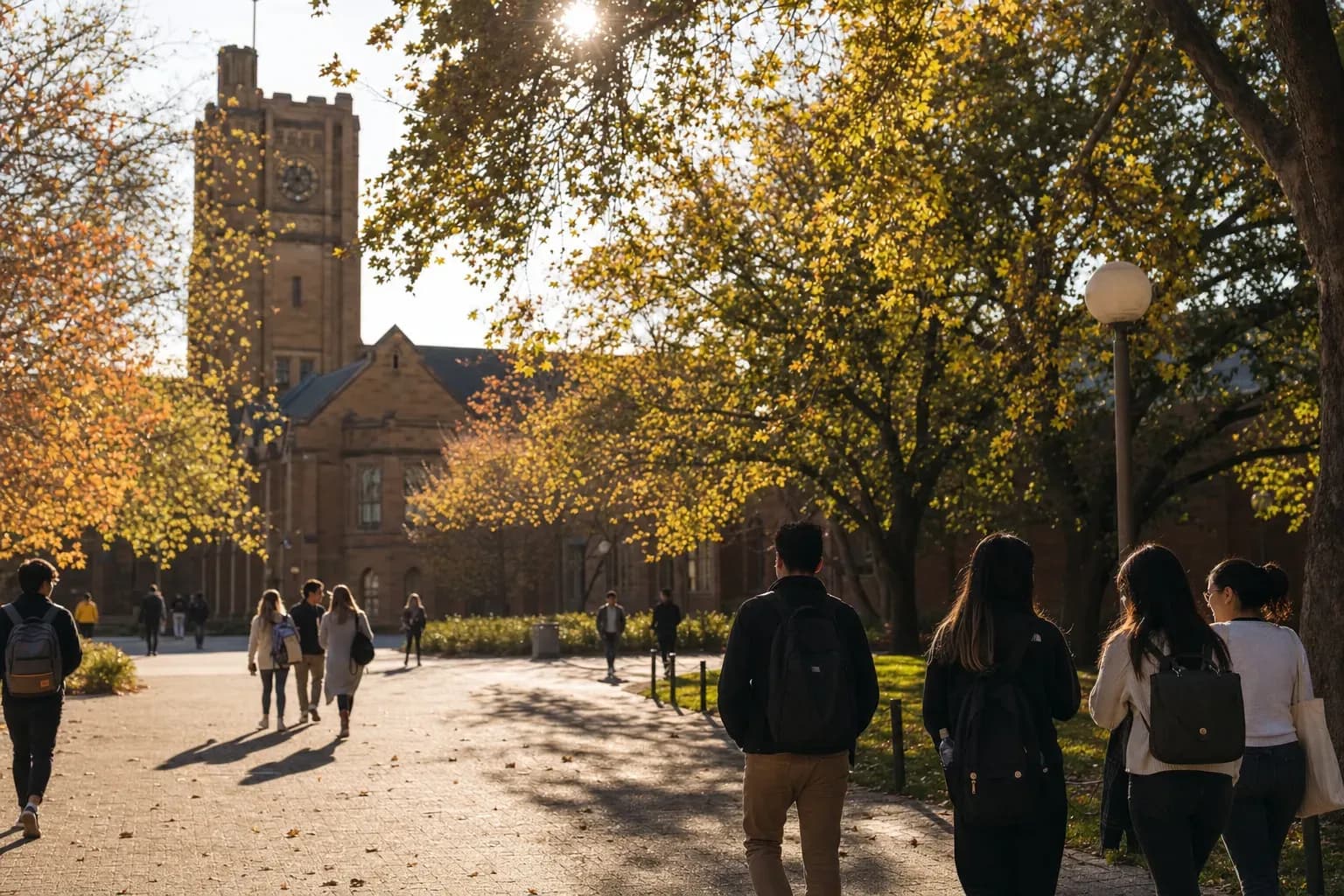
La Trobe University: Melbourne's Largest Green Campus, Strengths in Nursing and Biomedicine, and a Bendigo Regional Points Strategy
Published on February 10, 2026
La Trobe University, ranked around #290 globally in QS 2026 and a member of the IRU (Innovative Research Universities) network, is often placed by Taiwanese families into the "third tier of Melbourne universities" when building a school list: Melbourne first, Monash second, with RMIT and La Trobe roughly side by side. That classification is not wrong, but it underestimates one of La Trobe's most important advantages for PR strategy: within Victoria, it has Australia's most complete dual-track structure of a metropolitan main campus plus multiple regional campuses. Its 235-hectare Bundoora main campus is the largest green campus in all of Melbourne, 14 km from the CBD and directly connected by tram. At the same time, all four regional campuses, Bendigo, Albury-Wodonga, Shepparton, and Mildura, are on the Designated Regional Area list. This means Taiwanese students aiming for the +1 year regional extension on the 485 visa, or the +5 points for regional PR through 491 / 191, can move between "metropolitan + regional" options within the La Trobe system, something that Monash, RMIT, and Deakin cannot offer in the same way.
La Trobe's strategic value is often hidden by three factors: first, the Go8 aura of Melbourne / Monash; second, the unfamiliar sound of the Chinese transliteration "La Trobe" (it is in fact the surname of Charles La Trobe, Victoria's first Lieutenant Governor); and third, Taiwanese parents' weaker geographic sense of Melbourne's northern suburbs. But La Trobe's true signature strengths, Nursing, Biomedicine, Public Health, Cybersecurity, Education, and AgriBio agricultural biotechnology, are almost all ranked in the global Top 200-300 in QS subject rankings, with some subjects entering the Top 100. For Taiwanese families interested in nursing, biomedical science, public health, and education, La Trobe's combination of tuition level, regional points, and signature programs offers stronger value than most people expect. This article explains La Trobe's real profile, the differences between Bundoora and the regional campuses, and how it truly differs from Monash / Deakin / RMIT.
1. Basic Information
| Item | Details |
|---|---|
| Founded | 1967 (Melbourne's third university, after Melbourne and Monash) |
| Named after | Charles Joseph La Trobe (Victoria's first Lieutenant Governor, 1851-1854) |
| Locations | Bundoora (main campus in Melbourne's northern suburbs), Bendigo, Albury-Wodonga, Shepparton, Mildura, Melbourne CBD, Sydney |
| Campus | 235-hectare Bundoora main campus, Melbourne's largest green campus |
| Undergraduates | ~26,000 |
| Postgraduates | ~10,000 |
| Total students | Around 38,000 (including regional campuses) |
| Student-faculty ratio | 1:22 |
| Motto | Qui Cherche Trouve (French: "Whoever seeks shall find," from the La Trobe family crest) |
| Institutional identity | IRU (Innovative Research Universities) + four Designated Regional campuses in Victoria (Bendigo, Albury-Wodonga, Shepparton, Mildura) |
La Trobe is the third university established in Victoria. The Victorian government legislated its creation in 1964, and it officially opened in 1967. Charles La Trobe was the first Lieutenant Governor when Victoria separated from New South Wales in 1851. His tenure coincided with the Victorian gold rush, when Melbourne's population surged from 29,000 to 123,000, making him one of the key founding figures of Victoria. The motto on the university crest, "Qui Cherche Trouve" ("Whoever seeks shall find"), comes from the La Trobe family's Latin/French maxim. The motto itself gives La Trobe a spirit of exploration, which is also why Victoria chose to name this new university La Trobe in the 1960s.
2. World Rankings
| Ranking | Position |
|---|---|
| QS World 2026 | Around #290 |
| THE World 2026 | #251-300 |
| ARWU / Shanghai 2024 | #301-400 |
| QS Nursing | Global Top 100 |
| QS Biological Sciences | Global Top 200 |
| QS Education | Global Top 150 |
| QS Sports-related Subjects | Global Top 100 |
| QS Public Health | Global Top 150 |
| QS Linguistics | Global Top 150 |
La Trobe sits behind the Go8 in overall QS ranking, but Nursing and Sports-related Subjects both reach the global Top 100. This means that if your goal is "a nursing degree + Australian employment + PR," La Trobe Nursing belongs to the same academic tier as USyd and UoM. THE 2026 places La Trobe at #251-300, slightly higher than QS. THE gives more weight to research citations and international collaboration, and La Trobe's research output in life sciences and health sciences is among the strongest in the IRU network. For Taiwanese students targeting a Health Sciences pathway, La Trobe's global standing in these subjects is comparable to, or higher than, Monash and Deakin in specific areas.
3. Admission Data (International Students, 2026 Application Year)
| Indicator | Value |
|---|---|
| International student ATAR equivalent | 65-85 (depending on program) |
| IB Diploma | 24-32 points |
| Approximate Taiwan high school GPA threshold | Top 40-60% of class + above-average performance |
| IELTS requirement | 6.0 (no band below 5.5); Nursing, Education, Health 7.0 |
| TOEFL iBT | 64-78 (depending on program) |
| Application fee | No application fee |
| International student ratio | Around 25% |
| Bachelor of Nursing entry threshold | ATAR 75 / IB 28 + IELTS 7.0 |
| Bachelor of Biomedical Science entry threshold | ATAR 75 / IB 28 |
| Bachelor of Cybersecurity entry threshold | ATAR 70 / IB 26 |
| Bachelor of Education entry threshold | ATAR 70 / IB 26 + IELTS 7.5 |
| Bachelor of Business entry threshold | ATAR 65 / IB 24 |
International Students
- International students make up around 25% of the student body, slightly lower than Monash, and the campus atmosphere is not as internationalized as RMIT
- Students come from 100+ countries, with the largest groups from India, China, Vietnam, Nepal, and Malaysia
- Around 50-80 Taiwanese students enroll each year (including undergraduate and postgraduate students, and regional campuses)
- Important: La Trobe uses direct applications with no application fee; IELTS thresholds are more flexible than Go8 universities (Business pathway starts at 6.0), making it friendly to Taiwanese students
- La Trobe accepts Taiwan high school Grade 12 school results + GSAT scores, with thresholds much more flexible than Melbourne / Monash
4. Tuition and Financial Aid
2026 International Student Tuition (Annual)
| Program Category | Annual Tuition in AUD | NTD Equivalent (AUD 1 = NTD 22.6) |
|---|---|---|
| Bachelor of Arts | Around AUD 35,000 | Around NTD 790,000 |
| Bachelor of Business | Around AUD 38,000 | Around NTD 860,000 |
| Bachelor of Biomedical Science | Around AUD 42,000 | Around NTD 950,000 |
| Bachelor of Nursing | Around AUD 40,000 | Around NTD 900,000 |
| Bachelor of Cybersecurity | Around AUD 40,000 | Around NTD 900,000 |
| Bachelor of Education | Around AUD 33,000 | Around NTD 750,000 |
| Bachelor of Science | Around AUD 40,000 | Around NTD 900,000 |
| Master of Public Health | Around AUD 38,000 | Around NTD 860,000 |
| Master of Cybersecurity | Around AUD 42,000 | Around NTD 950,000 |
| Master of Nursing | Around AUD 38,000 | Around NTD 860,000 |
| Living costs (Bundoora / Melbourne) | Around AUD 28,000-36,000 | Around NTD 630,000-810,000 |
| Living costs (Bendigo / regional campuses) | Around AUD 20,000-26,000 | Around NTD 450,000-590,000 |
The total tuition for a 3-year Bachelor of Biomedical Science is around AUD 126,000 (NTD 2.85 million), about AUD 50,000-60,000 cheaper than an equivalent program at Melbourne. Choosing the Bendigo campus can reduce living costs by another 30%. The total cost of a 3-year Bachelor's degree at Bendigo can fall below NTD 2.5 million, making it a genuine sweet spot for middle-class Taiwanese families seeking "an Australian nursing or biomedical degree + PR."
Scholarships and Financial Aid
- La Trobe Academic Excellence Scholarship: 15-25% tuition reduction for undergraduate students, requiring a high ATAR / IB score
- La Trobe Regional Scholarship: additional AUD 5,000-15,000 reduction for international students choosing Bendigo / Albury-Wodonga / Shepparton / Mildura campuses
- AgriBio Industry Scholarship: agricultural biotechnology scholarship in partnership with the Victorian Government's AgriBio centre
- Nursing Industry Partnership Scholarship: nursing scholarship in partnership with Northern Health and Austin Health
- La Trobe Asia Scholarship: one-off AUD 5,000 scholarship for students from Asia
The most practical reminder for Taiwanese families: La Trobe's "Regional Scholarship" is the cost-saving tool Taiwanese parents most often overlook. Choosing Bendigo or Albury-Wodonga can bring AUD 5,000-15,000 in tuition reduction + another 30% saving on living costs, plus regional PR points. The full calculation becomes a double advantage: saving money + gaining points. This structure is something Melbourne and Monash cannot offer through their metropolitan Melbourne campuses.
5. Program Structure: 3-Year Bachelor's Degree + Victorian Regional Points
Not the Melbourne Model
La Trobe uses the traditional British-Australian 3-year Bachelor's degree structure. Students can apply at age 18 for Bachelor of Nursing (3 years), Bachelor of Biomedical Science (3 years), Bachelor of Cybersecurity (3 years), Bachelor of Education (4 years), and Bachelor of Business (3 years), then enter employment after graduation or continue into a 1-2 year Master Coursework program. Compared with the Melbourne Model's 3+2 structure, this allows students to enter the 485 visa countdown 2 years earlier.
Signature Advantage: Four Designated Regional Campuses in Victoria (The Advantage Taiwanese Families Should Remember Most)
La Trobe is one of the few universities in Victoria with both a metropolitan flagship campus and multiple regional campuses. The Bundoora main campus is in Melbourne's northern suburbs (not regional), but Bendigo, Albury-Wodonga, Shepparton, and Mildura are all on the Designated Regional Area list. This is critical for PR strategy:
- International students who complete at least 2 years of study in Bendigo / Albury-Wodonga / Shepparton / Mildura may apply after graduation for:
- 485 visa regional extension +1 year (a standard 2-year Master Coursework stay becomes 3 years; a Bachelor's holder's 2 years becomes 3 years)
- 191 regional PR visa: after completing a regional graduate visa and regional work, students can apply for permanent residency, with +5 migration points
- 491 Skilled Work Regional visa: through Victorian government nomination for a regional skilled visa, with +15 points, an even higher points boost than the 189 PR pathway
- Bendigo is not remote outback. It is Victoria's fourth-largest city, with a population of 100,000, 150 km from Melbourne, 2 hours by train to Southern Cross, and complete access to hospitals, shopping centres, and Bendigo Art Gallery (one of Australia's leading regional galleries)
- Victorian state nomination through 190 / 491 is highly friendly to La Trobe regional campus graduates. To balance concentration in metropolitan Melbourne, the Victorian government actively encourages international students to remain and work in regional cities
Signature Advantage: Bundoora's 235-Hectare Green Campus
The Bundoora main campus covers 235 hectares, making it the largest green campus in all of Melbourne (Monash Clayton is around 130 hectares, while Melbourne Parkville is only 22 hectares). The campus includes native bushland, lakes, and a wildlife corridor, and students can see kangaroos on campus (really, not just tourism marketing). This campus scale gives students an experience similar to a U.S. Big Ten public university: large, green, quiet, and suitable for walking and cycling.
Signature Advantage: AgriBio as a National Flagship in Agricultural Biotechnology
The AgriBio Centre for AgriBioscience, established by La Trobe in partnership with the Victorian Government Department of Agriculture, is Victoria's national-level agricultural biotechnology research centre. It studies food security, plant pathology, animal health, and the impact of climate change on agriculture. AgriBio integrates research capacity from the Victorian government, CSIRO, and La Trobe, making it one of Australia's Top 3 agricultural biotechnology hubs. For students interested in agricultural biotechnology, plant science, and food technology, this facility is something Monash and RMIT cannot offer in the same way.
Signature Advantage: ANSTO Nuclear Medicine Research Collaboration
La Trobe has a long-term partnership with ANSTO (Australian Nuclear Science and Technology Organisation), jointly developing nuclear medicine imaging, radioisotope labelling, and radiotherapy technologies for cancer treatment. La Trobe's Bundoora campus has dedicated nuclear medicine laboratories regulated by ARPANSA, a resource available in Victoria only at La Trobe + Monash. For students interested in nuclear medicine, medical physics, and radiation therapy, La Trobe is one of the few viable options.
Signature Programs
- Bachelor of Nursing: in partnership with Northern Health, Austin Health, and Mercy Health; one of Australia's leading nursing schools
- Bachelor of Biomedical Science: connects to Medicine pathway, Pharmacy, and Physiotherapy
- Bachelor of Cybersecurity: alongside Deakin as one of Victoria's stronger options, with Australian CSIRO and government collaboration
- Bachelor of Education: one of Australia's leading teacher education programs
- Bachelor of Public Health: QS Public Health global Top 150
- Bachelor of Agricultural Sciences (Bundoora + AgriBio): one of Australia's few complete agricultural biotechnology programs
- Bachelor of Speech Pathology: in partnership with Royal Children's Hospital
- Master of Public Health: connects to WHO and the Australian Department of Health
- Master of Cybersecurity: in partnership with CISCO and Microsoft
Meaning for Taiwanese Students
- Advantages: shorter 3-year Bachelor's timeline; Bendigo / Albury-Wodonga and other regional campuses provide 485 +1 year and 491/191 PR +5 points; tuition is AUD 8,000-12,000/year cheaper than Monash; Nursing and Public Health are among Australia's stronger programs
- Disadvantages: overall QS ranking is below the Go8; brand recognition among Taiwanese parents is lower than Monash and RMIT
- Consultant's advice: if you want to study Nursing, Biomedicine, Public Health, Cybersecurity, or Education and care about PR strategy, La Trobe should be compared seriously alongside Monash, Deakin, and RMIT by Taiwanese families, especially for Nursing, where La Trobe and Monash are in the same tier.
6. Campus Culture / University Personality
La Trobe's personality can be summarized in three phrases: green and relaxed, health sciences, regional community. It does not have Melbourne's Victorian classicism, Monash's research institute feel, or RMIT's industrial-design coolness. It is a comprehensive university in Melbourne's northern suburbs defined by green space, nursing uniforms, and public health fieldwork. The student body leans toward middle-class white students from the northern suburbs + international students from India / Vietnam / China + local Victorian students at the regional campuses.
Melbourne's northern suburbs, where Bundoora is located, are traditionally working-class and migrant communities. Greek, Italian, Vietnamese, and Indian populations are strongly represented, and multiculturalism is deeply rooted. Within 5 km of campus, students have access to Westfield Plenty Valley, Northland Shopping Centre, and several hospitals (Northern Hospital and Austin Hospital are major placement sites for La Trobe Nursing), so the daily living infrastructure is stronger than expected.
La Trobe's campus culture has more of a "community and family" feel than Melbourne / Monash. Students here spend weekends cycling in Bundoora Park, hiking in the Yarra Valley, or driving to the Mornington Peninsula coast. If you are the kind of high school student in Taiwan who wants health sciences + outdoor activities + little concern for metropolitan nightlife, La Trobe is much more comfortable than a Melbourne CBD campus.
Student Clubs
- More than 80 clubs under the La Trobe Student Union (LTSU)
- La Trobe Nursing Students Association: the main club for nursing students
- La Trobe Asian Students Association
- Taiwanese Students' Association (La Trobe TSA)
- La Trobe Outdoor Adventure Club: bush walking, surfing, skiing
Sports Culture
- Mainly participates in inter-university competitions through Australian University Sports (UniSport)
- Signature sports: Australian Rules Football (AFL), Cricket, Soccer, Netball
- La Trobe Sports Park: one of Australia's leading university sports facilities and the training base for AFL club Carlton
- La Trobe Sport and Exercise Science combines Sports Park resources with one of Australia's stronger programs
7. Location / Campus Environment
Campus Comparison Table
| Campus | Location | Distance from Melbourne CBD | Regional Points | Features |
|---|---|---|---|---|
| Bundoora (main campus) | Melbourne's northern suburbs | 14 km / 1 hour by tram | ✗ Not regional | 235 hectares of green space, Nursing, Biomedicine, AgriBio |
| Bendigo | Central Victoria | 150 km / 2 hours by train | ✓ Regional +5 PR | Victoria's fourth-largest city, Nursing, Education, Business |
| Albury-Wodonga | Victoria/NSW border | 320 km / 3.5 hours by train | ✓ Regional +5 PR | Twin-city cross-state campus, Business, Education |
| Shepparton | Northern Victoria | 180 km / 2.5 hours by train | ✓ Regional +5 PR | Agricultural hub, Nursing, Allied Health |
| Mildura | Northwestern Victoria | 540 km / 1 hour by plane | ✓ Regional +5 PR | Riverside city, Nursing, social work |
| Melbourne CBD | Melbourne city centre | Inside CBD | ✗ Not regional | Advanced business, Law (not eligible for regional points) |
| Sydney | Sydney | – | ✗ Not regional | Advanced programs, ICT |
Important reminder: La Trobe's Bundoora main campus, Melbourne CBD campus, and Sydney campus are not in a Designated Regional Area. Studying at these three campuses does not qualify for the regional 485 +1 year extension or 491/191 +5 PR points. To obtain regional points, students must complete at least 2 years of study at Bendigo, Albury-Wodonga, Shepparton, or Mildura. This is the trap Taiwanese students most often fall into, so always confirm the campus of admission.
Climate
- Summer (December-February): 18-30°C; Melbourne's northern suburbs are slightly drier than the CBD
- Winter (June-August): 5-14°C; Bendigo / Albury are colder in winter (close to 0°C)
- Bendigo has Victoria's inland climate: hotter summers and colder winters, but its dryness is similar to Taiwan's high mountain climate, making it relatively manageable for Taiwanese students
Campus Landmarks (Bundoora)
- Agora central plaza: student gathering and activity centre
- AgriBio Centre: agricultural biotechnology research building in partnership with the Victorian government
- John Scott Meeting House: La Trobe's iconic circular building
- University Sports Park: Carlton AFL training base
- Bundoora Park Wildlife Corridor: on-campus wildlife conservation area
8. Research and Resources
La Trobe is a member of the IRU network, with annual research funding of around AUD 120 million. Although it is not at Go8 scale, it is globally strong in Health Sciences, Biomedicine, AgriBio, Sports Science, and Cybersecurity.
Key Research Institutes
- AgriBio Centre for AgriBioscience: national agricultural biotechnology flagship in partnership with the Victorian government
- La Trobe Institute for Molecular Science (LIMS): molecular science and drug development
- Olga Tennison Autism Research Centre: national-level autism research centre
- John Richards Centre for Rural Ageing Research (Albury-Wodonga): research on ageing care in regional and rural communities
- Centre for Sport and Social Impact: sports sociology and psychology research
- Cisco Centre for Cybersecurity Research: cybersecurity research centre in partnership with Cisco
Industry Connection
- Northern Health, Austin Health, Mercy Health: main placement pathways for nursing / public health
- Royal Children's Hospital: Speech Pathology and Allied Health collaboration
- CSIRO: agricultural biotechnology and life sciences collaboration
- ANSTO (Australian Nuclear Science and Technology Organisation): nuclear medicine research collaboration
- Cisco, Microsoft, IBM: Cybersecurity program partnerships
- Carlton Football Club (AFL): Sports Science training collaboration
9. Notable Alumni
- Politics: Brendan O'Connor (former Australian Minister for Immigration, federal Labor Party), Jenny Macklin (former Minister for Families and Community Services), and multiple Victorian state MPs
- Business: Cherie Blair (wife of former UK Prime Minister Tony Blair, studied Law at La Trobe), and multiple Australian health industry CEOs
- Academia / Culture: Robyn Williams (ABC science program host), John Bell (major Australian theatre figure)
- Media: Carrie Bickmore (Australian television presenter, The Project), and multiple ABC presenters
- Sports: multiple AFL and Cricket national team players
The strongest mark of La Trobe alumni is their grounding in Health Sciences + public service. Many senior officials in the Australian Department of Health and family services agencies came from La Trobe Nursing or Public Health. This trajectory proves that although La Trobe is not in the Go8, career ceilings in "social service + public health + policy" are not lower than Melbourne.
10. La Trobe Facts You May Not Know
- The red and blue on the crest come from the Charles La Trobe family: The La Trobe family were originally Swiss-French Protestants (Huguenots) who fled to England and later served the British royal household. The university crest colours match the family crest.
- There really are kangaroos on campus: The 235-hectare Bundoora campus preserves native wildlife corridors, and wild kangaroo groups can be seen at the campus edges around dusk (not a zoo).
- AgriBio is Victoria's only national flagship in agricultural biotechnology: It is co-built directly with the Victorian Government Department of Agriculture and has annual research funding exceeding AUD 100 million.
- La Trobe was Australia's first university to offer "Iranian Studies": During the wave of Iranian migration to Victoria in the 1970s, La Trobe was the first to establish a Persian studies centre, which remains the only one of its kind in the Southern Hemisphere.
- John Scott Meeting House is an Australian architecture award winner: The iconic circular building was completed in 1973 and won an award from the Royal Australian Institute of Architects.
- The Bendigo campus originated as Bendigo Institute of Technology: It merged into La Trobe in 1991, laying the foundation for La Trobe's multi-campus structure.
11. Typical Admitted Student Profile
- Taiwanese international school students with predicted IB scores of 24-32, or ATAR equivalent 65-85
- Taiwan high school system: top 40-60% of class (Taipei Municipal Jianguo High School, Taipei First Girls High School, Zhongshan Girls High School, The Affiliated Senior High School of National Taiwan Normal University, Wego, Kang Chiao, and leading public high schools across counties and cities), with above-average GPA
- IELTS 6.0-7.5 (Nursing and Education require 7.0+; some Education programs require 7.5)
- Extracurriculars: Nursing pathway looks at hospital volunteering and long-term care service; Biomedicine pathway looks at Olympiad and lab experience; Cybersecurity pathway looks at CTF competitions and open-source projects
- Most programs have no interview (some Nursing programs may require an online Casper test); the application process is relatively simple (direct application, no application fee)
- Personal Statement is required only for some Nursing and Education programs
12. What Kind of Student Is It Best For?
✓ Best suited for:
- Students who want to study Nursing (one of Australia's leading nursing schools)
- Students interested in Biomedicine, Public Health, Pharmacy, and Allied Health pathways, with future plans to connect to Medicine or enter the healthcare system
- Students who want to study Cybersecurity, IT, or Computer Science and care about the employment pipeline
- Students who want to study Education and plan to obtain teacher registration in Australia
- PR strategists who want to use Bendigo / Albury-Wodonga / Shepparton / Mildura regional campuses to obtain a 485 +1 year extension and 491/191 PR +5 points
- Families with tighter budgets, since La Trobe tuition is AUD 8,000-12,000/year cheaper than Monash, and Bendigo living costs are another 30% lower
- Students who want a green campus, a health sciences atmosphere, and are not concerned about the Go8 brand
✗ Not necessarily suited for:
- Families focused on the "Go8 brand" and post-graduation recognition in Taiwan for parents' peace of mind (Melbourne and Monash remain more stable choices)
- Students who want pure basic research, an academic career, or to remain in academia after a PhD (Melbourne and Monash have greater research depth)
- Students who want Law, Architecture, or Medicine (La Trobe does not have an independent medical school, and the BMed pathway has more limitations)
- Students who want Melbourne CBD urban life, cafes, and indie bands within a 5-minute walk
- Students who want an American Ivy-style "small classes + one-on-one professor access" experience (La Trobe is a large IRU public university)
Conclusion
La Trobe is one of the strategic choices Taiwanese families should evaluate most seriously for "PR-friendly + signature Health Sciences" pathways. In reality, La Trobe is an IRU member, the only university in Victoria with both a metropolitan flagship campus and four regional campuses, the academic partner of Australia's national agricultural biotechnology flagship AgriBio, and a collaborator in ANSTO nuclear medicine research. Together, these strengths give La Trobe a rare position in Australia around "Nursing + Biomedicine + regional PR + controlled cost."
The relationship between La Trobe and Monash is similar to NCU and NTHU: the former is a comprehensive regional-style flagship in health sciences, while the latter is a metropolitan research university with higher research density. But this distinction is not about "better or worse"; it is about strategic choice. Monash suits families who want a Go8 brand and do not care about PR points; La Trobe suits families who value Nursing / Biomedicine / public health + PR friendliness + budget control + green-campus living. The most common mistake Taiwanese families make is treating La Trobe as a second-tier alternative to Monash. From a PR strategy perspective, however, La Trobe's Bendigo / Albury-Wodonga regional campuses are the model of "saving money + gaining points": lower tuition, lower living costs, Nursing ranking that does not lose to Monash, and an extra 5-15 PR points.
From an immigration strategy perspective, La Trobe has five advantages: (1) a shorter 3-year Bachelor's timeline, entering the 485 PHEW countdown 2 years earlier than the Melbourne Model; (2) Nursing, Biomedicine, Cybersecurity, Education, and Public Health are all on the MLTSSL skilled occupation list and lead to mid-range or higher salaries; (3) after Master Coursework, the 485 PHEW Stream is 2 years (reduced from 3 years after 2024-07-01), while Master Research or PhD remains 3 years; (4) completing 2 years in Bendigo / Albury-Wodonga / Shepparton / Mildura can provide a 485 visa +1 year extension (becoming 3 years) + 491/191 regional PR +5 points; (5) Victorian state nomination through 190 / 491 is highly friendly to La Trobe regional campus graduates. The 491 regional skilled visa gives +15 points, a higher points boost than the standard 189 PR pathway.
The most practical PR pathway combination: La Trobe Bachelor of Nursing or Biomedical Science or Cybersecurity (preferably directly at the Bendigo campus) + Master of Public Health / Cybersecurity / Nursing + PTE 79 + 2 years of work in Bendigo or regional Victoria + NAATI Chinese certification + 491 Victorian state-nominated regional visa. This pathway can build to 100-115 PR points, about 10-20 points higher than the standard Monash + Melbourne CBD work pathway. Nursing and Public Health programs are the signature options PR strategists should pay closest attention to in the Dr. G. Academy master's database. Their long-term demand on the MLTSSL skilled occupation list is stable, and employment pathways lead to Northern Health, Austin Health, Royal Children's Hospital, and the Victorian Department of Health. These are the options families who calculate total value should examine seriously.
La Trobe is not an inferior version of Monash; it supplies what Monash will not give you. It will not give you Monash's Go8 aura, Melbourne's Victorian classical architecture, or RMIT's design-scene coolness, but it will give you regional PR points in Victoria, a 235-hectare green campus, a global Top 100 Nursing degree, AgriBio national flagship research, and the double advantage of 30% lower Bendigo living costs plus regional points. For Taiwanese families who understand the full calculation and can see why "PR + Nursing + regional > brand + metropolitan," La Trobe is the PR-strategy flagship within Victoria's IRU network that deserves the most serious evaluation.