
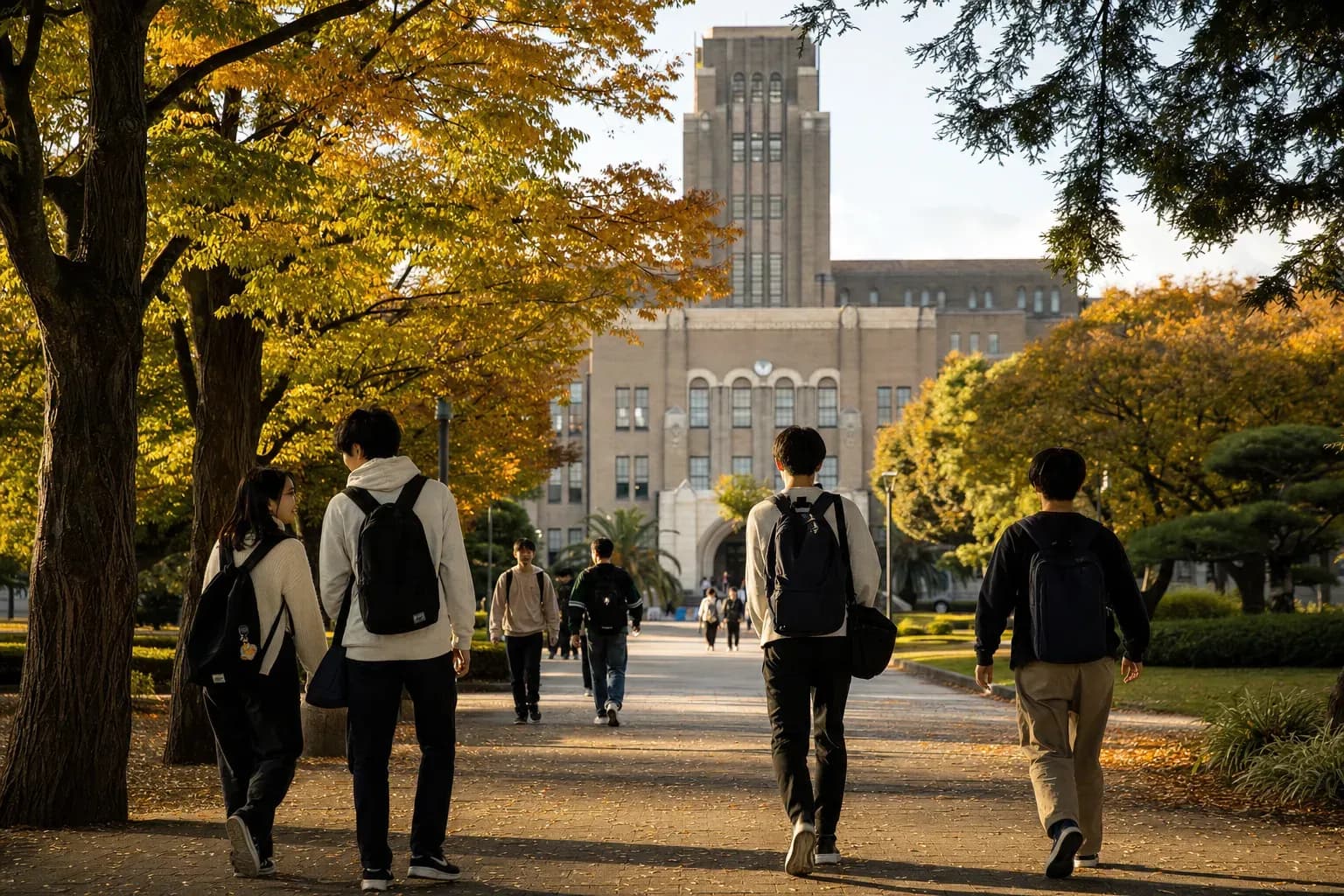
Kyushu University: A G30 Flagship, IUPE English-Taught Engineering, and Fukuoka, Asia's Most Underrated City
Published on December 26, 2025
If you have only seen Tokyo, Kyoto, and Osaka, you have not yet seen Japan. Fukuoka City, in southwestern Japan, is a regular presence on lists of the "Top 10 Most Livable Cities in Asia" (including recurring appearances in Monocle and Mercer surveys): population 1.6 million, coastal, Japan's highest sushi-restaurant density per capita, 11 minutes by subway from the airport to the city center, and living costs roughly 40% lower than Tokyo. Kyushu University is the academic heart of this city.
Kyushu University is one of the original 13 G30 universities and an SGU Type A top-tier institution. Its undergraduate G30 English-taught programs cover IUPE (International Undergraduate Programs in Engineering) with five major engineering fields, IPS (International Program in Pharmacy and Sciences), Bio-Resource Sciences, and Engineering G30. This is the most complete portfolio in Japan's Kyushu / Okinawa region. For Taiwanese families, Kyushu University's hidden advantage is that it is the top Japanese university closest to Taiwan: direct flights from Fukuoka to Taipei take two hours, and tickets often cost TWD 5,000-8,000, cheaper than flying from Taipei to most other Japanese cities.
1. Basic Information
| Item | Details |
|---|---|
| Founded | 1911 (Japan's fourth Imperial University) |
| Institution type | National university corporation |
| Location | Nishi Ward, Fukuoka City, Fukuoka Prefecture (mainly Ito Campus; headquarters relocated) |
| Campus | Approximately 275 hectares (Ito Campus, one of Asia's largest single campuses) |
| Undergraduate students | ~12,000 |
| Graduate students | ~6,500 |
| Student-faculty ratio | 1:7 |
| Motto | "Universitas in Asia" |
2. World Rankings
| Ranking | Position |
|---|---|
| QS World 2026 | #164 |
| THE World 2026 | #201-250 |
| QS Asia 2026 | #28 |
| THE Asia 2026 | #30 |
| QS Chemistry | #79 |
| QS Engineering - Mechanical | #95 |
| QS Chemical Engineering | #71 |
Kyushu University is a G30 + SGU Type A dual flagship university, alongside the University of Tokyo, Kyoto University, Tohoku University, Osaka University, Nagoya University, Hokkaido University, University of Tsukuba, and IST. In applied chemistry, energy, pharmacy, and agriculture, Kyushu University ranks among Japan's top five. Kyushu University is also Japan's flagship national university closest to the Asian continent. This geographic advantage translates into one of Japan's top five international student ratios, with international students accounting for over 22%.
3. Admissions Data (2024 Entry)
Kyushu University's G30 undergraduate programs span engineering, science, agriculture, pharmacy, and other faculties. All are taught 100% in English, and Japanese is not required at all for admission.
IUPE (International Undergraduate Programs in Engineering)
The five major fields under Kyushu University's G30 School of Engineering:
| Major | Field | Approximate annual admits |
|---|---|---|
| Civil Engineering | Civil engineering | ~10 |
| Mechanical and Aerospace Engineering | Mechanical and aerospace | ~12-15 |
| Electrical Engineering and Computer Science | Electrical engineering / computer science | ~15-18 |
| Applied Chemistry | Applied chemistry | ~10-12 |
| Earth Resources Engineering | Earth resources engineering | ~8-10 |
IPS (International Program in Pharmacy and Sciences)
| Metric | Figure |
|---|---|
| Applicants | ~80-120 |
| Admits | ~10-15 |
| Overall acceptance rate | Approximately 12-15% |
| Field | Pharmaceutical sciences (four-year research track, not a pharmacist licensure pathway) |
Bachelor's Program in Bio-Resource Sciences (School of Agriculture G30)
| Metric | Figure |
|---|---|
| Applicants | ~60-90 |
| Admits | ~10-12 |
| Field | Bio-resources, agriculture, food science, forestry |
Overall Admissions Overview
| Metric | Figure |
|---|---|
| Total G30 applications | ~600-800 |
| Total admits | ~75-100 |
| Overall acceptance rate | Approximately 13-17% |
| Taiwanese admits per year | 3-6 students |
Application Requirements
| Item | Requirement |
|---|---|
| English proficiency | TOEFL iBT 80+ / IELTS 6.5+ (IUPE recommends iBT 90+) |
| Standardized tests | SAT 1250+, ACT 26+, IB 32+, A-Level three subjects at B or above (A in math/science for STEM) |
| Japanese | Not required at all at the time of admission |
| Recommendation letters | 2 |
| Essay | Statement of Purpose, Study Plan |
| Interview | Required for some programs |
International Students
- International students account for approximately 75-85% of G30 undergraduates
- Kyushu University's overall international student ratio is approximately 22% (top five in Japan)
- Highest density of Asian students, especially from Korea, China, and Southeast Asia
4. Tuition and Financial Aid
2025 Tuition (Standard National University Fees)
| Item | Amount (JPY) | Approximate TWD equivalent |
|---|---|---|
| Admission fee | 282,000 | ~60,000 |
| Annual tuition | 535,800 | ~110,000 |
| Dormitory (Ito dorms, monthly) | 12,000-30,000 | ~2,600-6,500 |
| Living expenses (monthly, Fukuoka) | 55,000-80,000 | ~12,000-18,000 |
| Estimated total four-year cost | Approximately JPY 5-6.5M | ~TWD 1.1-1.4M |
Living costs in Fukuoka are 40-50% lower than in Tokyo. This is Kyushu University's most underrated advantage. Student dormitories on Ito Campus start at JPY 12,000 per month (about TWD 2,600), making them among the cheapest national university dormitories in Japan. Ramen in Fukuoka costs around JPY 600, udon around JPY 400, and set meals at student cafeterias around JPY 350. The cost of living is about half of Tokyo's.
MEXT Scholarships
- MEXT Embassy Recommendation Scholarship: full tuition waiver + JPY 117,000 per month
- MEXT University Recommendation Scholarship: nominated directly by Kyushu University
Kyushu University Internal Scholarships
- Kyushu University Scholarship: full / partial tuition waiver
- JASSO Honors Scholarship: JPY 48,000-80,000 per month
- TOTO / Kirin / Yaskawa corporate scholarships: partnerships with Kyushu-based companies
5. Program Structure / Signature Programs
IUPE (International Undergraduate Programs in Engineering)
Kyushu University's G30 School of Engineering has five major fields, making it the most complete English-taught engineering program within Japan's G30 system.
1. Civil Engineering
- Civil engineering, disaster prevention, transportation, urban planning
- Collaboration with local Kyushu infrastructure companies such as Nishitetsu and Kyudenko
2. Mechanical and Aerospace Engineering
- Mechanical engineering, aerospace, fluid dynamics, thermal fluids
- Geographic connection with JAXA's Tanegashima Space Center
- Suitable for students interested in aerospace, mechanical engineering, and robotics
3. Electrical Engineering and Computer Science
- Integrated electrical engineering + computer science
- Semiconductors, AI, communications, embedded systems
- Geographic connection with TSMC's Kyushu plant in Kumamoto, a major advantage after 2024
4. Applied Chemistry
- Chemical engineering, materials, energy chemistry
- Kyushu University's chemistry ranks among Japan's top five
5. Earth Resources Engineering
- Earth resources, mining, energy, geothermal studies
- A specialized field rarely found in Japan
IPS (International Program in Pharmacy and Sciences)
- Four-year pharmaceutical sciences degree, a research pathway rather than a pharmacist licensure route
- Suitable for students aiming for pharmaceutical R&D, biotech, healthcare policy, or academia
- Kyushu University's Faculty of Pharmaceutical Sciences is one of Japan's top five
Bachelor's Program in Bio-Resource Sciences
- English-taught G30 program in the School of Agriculture
- Food, agriculture, forestry, fisheries, life sciences
- Kyushu is known as "Japan's food warehouse" (Kagoshima black pork, Miyazaki beef, Hakata wagyu, Saga rice), creating a high density of university-industry research
Informal Professor Consent System (Graduate Level)
Applicants to Kyushu University's graduate schools generally need to contact a professor first and secure informal consent. Kyushu University faculty are relatively international-student-friendly. The combination of G30 and a 22% international student ratio means the campus is already accustomed to working in English.
6. Campus Culture / Institutional Personality
Kyushu University's campus character can be summed up in a few words: STEM, Asia, openness, Hakata.
- Asia-oriented: Kyushu University's motto, "Universitas in Asia," is not just marketing. It is reflected in the reality that 22% of students are international, mostly from Asia
- New Ito Campus (full relocation completed in 2018): one of Japan's newest main university campuses, with 21st-century architecture, facilities, and dormitories
- Hakata culture: Fukuoka City's historic name is Hakata, known for ramen, mentaiko, yatai food stalls, and the Hakata Gion Yamakasa festival. Kyushu University student dining culture is deeply shaped by Hakata elements
- Close ties with Korea: Fukuoka is closer to Seoul than to Tokyo. Kyushu University hosts many Korean exchange students and collaborative research projects every year
- 200+ student clubs: STEM-leaning, strong in sports such as kendo and judo, with many Kyushu folk cultural activities
Kyushu University's identity is that of Japan's flagship university closest to Asia, a position that makes it distinctive within the G30 system.
7. Location / Campus Environment
City Positioning
Fukuoka City has a population of 1.6 million. It is Japan's sixth-largest city and the absolute core of the Kyushu / Okinawa region.
- Direct flights from Taipei to Fukuoka: 2 hours, with tickets often around TWD 5,000-8,000
- From Fukuoka Airport to the city center: 11 minutes by subway, Japan's most convenient airport connection
- From central Fukuoka to Ito Campus: 50 minutes by JR + bus (Kyushu University's only major drawback is that the campus is relatively far out)
- Fukuoka to Seoul: 1 hour 20 minutes by plane, closer than Tokyo
Climate
- Winter: 4-12°C, warmer than Tokyo with little snow
- Summer: 26-33°C, humid but with sea breezes
- Spring and autumn are pleasant; cherry blossoms bloom around late March, earlier than Tokyo
- Typhoons pass through, typically 1-2 per year
Campus Landmarks
- Ito Campus: Japan's largest single university campus, facing the sea, with forests and a lake
- Shiiki Hall: Ito Campus landmark and modern architectural icon
- Ohori Park: a lake park in central Fukuoka and a favorite weekend spot for students
- Canal City Hakata: shopping + entertainment, one of the most common student hangouts
- Dazaifu Tenmangu: shrine to the deity of learning, a classic place for Kyushu University freshmen to pray for academic success
8. Research and Resources
Library
- Ito Central Library: approximately 4.1 million volumes
- Some areas open 24 hours
- Complete electronic resources
Notable Research Institutes
- International Institute for Carbon-Neutral Energy Research (I2CNER): Japan's leading university for hydrogen energy research
- Research Institute for Applied Mechanics: fluids, energy, ocean engineering
- Overseas offices in Malaysia and Thailand: Kyushu University has a high density of Southeast Asia research
- Collaboration with TSMC Kumamoto plant: industry-academia cooperation has accelerated since 2024
Nobel Prize Winners and Major Research
- Kyushu University itself has fewer Nobel Prize laureates, but many recipients of national-level honors such as the Kyoto Prize, Medal with Purple Ribbon, and Order of Culture
- Globally leading in hydrogen energy, renewable energy, and applied chemistry
The triangle of Asia orientation + applied chemistry + energy defines Kyushu University's research profile and sets it apart from the University of Tokyo and Kyoto University. This is a key point for Taiwanese families weighing "practical research vs. pure basic research."
9. Notable Alumni
- Academia: Leo Esaki (associated with Tsukuba, but with a Kyushu University research background), and multiple members of the Japan Academy
- Politics: multiple former Ministers of Education, Culture, Sports, Science and Technology, and major political figures in the Kyushu region
- Business: TOTO founder Kazuchika Okura, Kirin Beer R&D executives, Yaskawa Electric (major robotics manufacturer), and leadership across the Fukuoka Financial Group ecosystem
- Media: multiple anchors from NHK Fukuoka and Nishinippon Shimbun
- Sports: many athletes and management figures connected to J-League Fukuoka
Kyushu University graduates have enormous influence across Kyushu and western Japanese companies. TOTO, Kirin, Yaskawa, and the Fukuoka banking system all depend heavily on Kyushu University alumni.
10. Lesser-Known Facts About Kyushu University
- Kyushu University's Ito Campus is a candidate for "Japan's most beautiful university campus": completed in 2018, facing the sea, with forests, and once covered by Architectural Record.
- Kyushu University and TSMC's Kumamoto plant: after TSMC opened its Kumamoto plant in 2024, Kyushu University's electrical engineering and applied chemistry departments became the nearest flagship Japanese university programs. This is one of the most important advantages Taiwanese families should know.
- The "nine"-shaped roof of Kyushu University's Shiiki Hall: the building was designed in the shape of the number nine, visible only from the air.
- Kyushu University's annual Kyudai Festival is the largest university festival in Kyushu, drawing 50,000 visitors over three days, with families from across Fukuoka attending.
- Kyushu University dormitory rent starts at JPY 12,000: among the cheapest dormitories at any national university in Japan, even cheaper than University of Tokyo Komaba dorms and Kyoto University Yoshida dorms.
11. Typical Admitted Student Profile (G30 Undergraduate)
- Three-year high school GPA of 3.6/4.0 or above
- TOEFL iBT 90+ or IELTS 7.0+
- SAT 1300+, IB 35+, or A-Level 3A or above (A in math/science for STEM)
- Can clearly explain "why Kyushu University, not Nagoya University / Osaka University", usually through angles such as "Asia orientation," "TSMC Kumamoto connection," "hydrogen energy research," or "Fukuoka living costs"
- STEM competitions, lab experience, or coding projects for computer science programs
- Recommendation letters from high school math/science teachers and a homeroom teacher
- A clear vision for a "southwestern Japan + Asia cross-border career," such as joining TSMC Kumamoto, TOTO overseas operations, or a Japanese company in Korea
12. What Kind of Student Is It Right For?
✓ Good fit for students who:
- Want to study engineering / chemistry / pharmacy / agriculture at an Asian top-tier level for JPY 535,800 per year
- Want to be close to Taiwan (Fukuoka ↔ Taipei in 2 hours, with affordable flights)
- Are interested in TSMC Kumamoto / the semiconductor industry
- Have genuine passion for hydrogen energy, renewable energy, and applied chemistry
- Want low living costs (Fukuoka is 40-50% cheaper than Tokyo)
- Want to pursue the HSP highly skilled professional permanent residency pathway (Kyushu University is on the +10 point list)
- Can imagine a "Japan + Asia cross-border career"
✗ Not necessarily a good fit for students who:
- Want a central Tokyo campus and need high-density urban culture (Fukuoka has the feel of a mid-sized Asian city)
- Want to study pure medicine or pure law (these faculties are taught only in Japanese)
- Expect American-style campus Greek Life culture
- Dislike island climates, including humidity and typhoons
- Want a QS Top 100 credential halo (Kyushu University sits in the Top 200 range)
13. HSP Highly Skilled Professional Permanent Residency Pathway
Kyushu University is on the HSP highly skilled professional "+10 point bonus" list, which means:
- Master's degree + annual salary of JPY 6 million → permanent residency application after 3 years
- PhD + annual salary of JPY 8 million → permanent residency application after 1 year
- After permanent residency, spouses may work, parents may stay long-term, and children can access Japanese nationality
The most common HSP pathways for Kyushu University graduates are:
- Kyushu University IUPE → Kyushu University master's → TSMC Kumamoto / Sony Semiconductor / Yaskawa / Kirin / TOTO
- PhD in applied chemistry → Mitsui Chemicals / Sumitomo Chemical / Asahi Kasei R&D → permanent residency after 1 year
- Cross-border pathway: Kyushu University → overseas assignment with a Fukuoka-based Japanese company (Korea / Taiwan / Southeast Asia) → international work experience bonus
Kyushu University is especially suitable for Taiwanese students who want an Asia cross-border career. You may hold Japanese permanent residency while working in Fukuoka, Kumamoto, Seoul, or Taiwan. This flexibility is less common at other G30 flagship universities. For detailed strategies, refer to Dr. G.'s internal resources, "Post-Graduation Visa Strategy / 05_Japan_Visa_Strategy" and "Master Grad School Database / Japan."
Conclusion
Kyushu University is Japan's flagship university closest to Asia. If you are a Taiwanese family hoping your child can earn a top Japanese degree while staying close to home, keeping flight costs low, and reducing living expenses, Kyushu University is one of the most underrated choices. It does not carry the "Japan's number one" label of the University of Tokyo or the Nobel-and-Fields aura of Kyoto University, but it does offer Japan's most complete G30 engineering portfolio, some of the cheapest student dormitories, the most convenient Taiwan connection, and the strongest geographic advantage relative to TSMC Kumamoto.
The reason Taiwanese families most often overlook Kyushu University is that it is "in Kyushu, so it feels far away." But that distance is an illusion. Taipei to Fukuoka is one hour faster than Taipei to Tokyo, and tickets are about half the price. In one sentence: if you want a Japanese flagship-level degree plus practical access for a Taiwanese family support system, Kyushu University is the highest-value G30 option.