
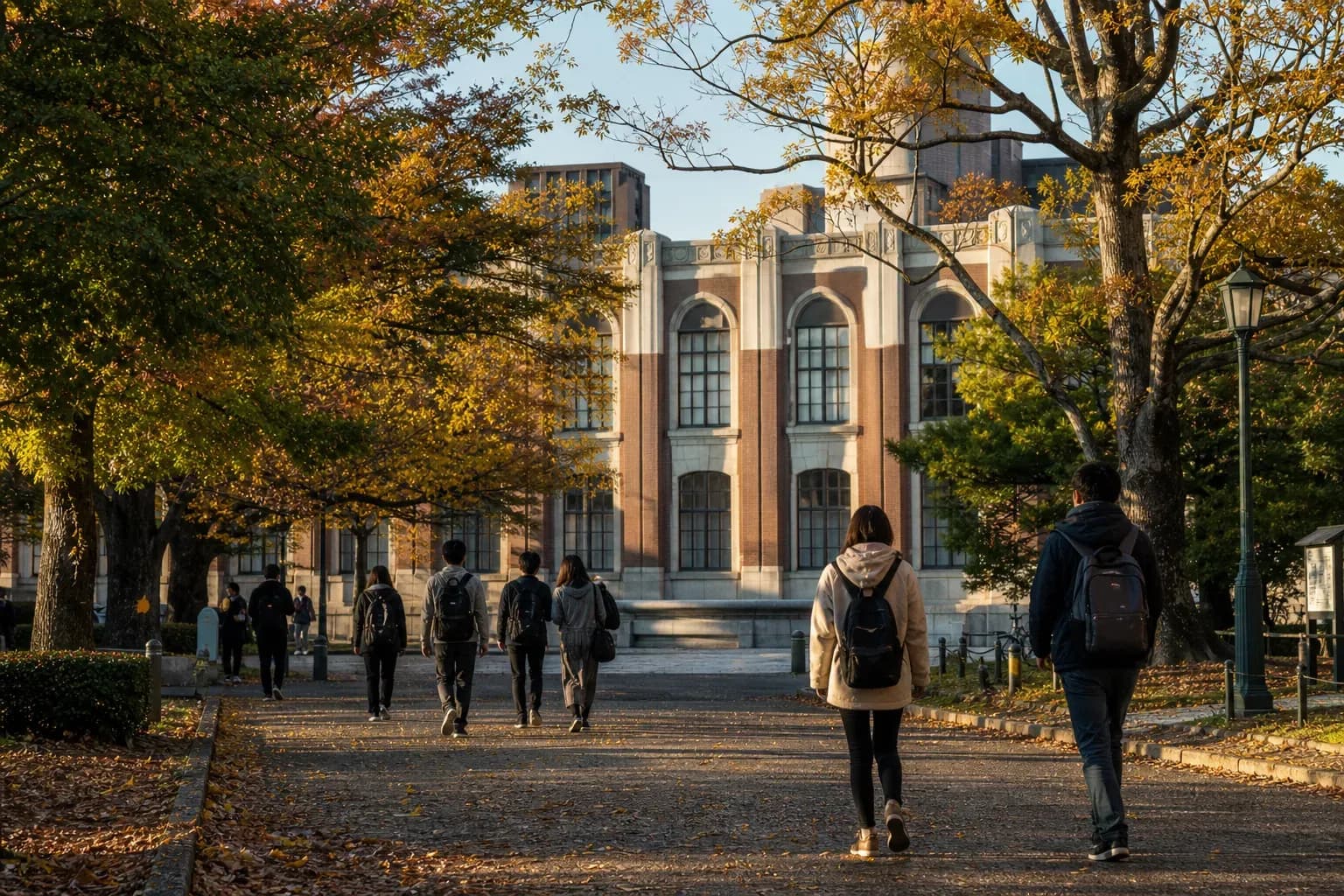
Kyoto University: iUP English-Taught Bachelor’s, Academic Freedom, and a Nobel Prize Powerhouse
Published on January 6, 2026
Ranked #54 globally in QS 2026, #55 in THE 2026, and firmly within Asia’s top 10, Kyoto University (“Kyodai”) is the only Japanese national university that can stand toe to toe with the University of Tokyo. “Academic freedom” is not a marketing slogan here; it is the living DNA of Kyoto University, carried forward since its founding in 1897. If the University of Tokyo represents “the cultivation of national elites after the Meiji Restoration,” Kyoto University represents “giving every brilliant eccentric the soil to grow freely in Kyoto, a thousand-year-old capital.”
Kyoto University’s flagship pathway, iUP (Kyoto iUP, International Undergraduate Program), is one of the most open undergraduate entry routes for international students among Japan’s national universities: no Japanese is required at the time of admission, and students complete a regular Japanese undergraduate degree within four years in one of the faculties of Letters, Law, Economics, Education, Science, Engineering, Agriculture, or Pharmaceutical Sciences. If you want one of Japan’s most prestigious degrees but do not want to be crushed by a Japanese-language entrance exam, Kyoto iUP is an option you need to take seriously.
1. Basic Information
| Item | Details |
|---|---|
| Founded | 1897 (Meiji 30), Japan’s second Imperial University |
| Institution type | National university |
| Location | Sakyo Ward, Kyoto City, Kyoto Prefecture (Yoshida, Uji, and Katsura campuses) |
| Campus | About 213 hectares |
| Undergraduates | ~13,000 |
| Graduate students | ~9,200 |
| Student-faculty ratio | 1:7 |
| Motto | “Academic freedom” (Jiyu no Gakufu) |
2. World Rankings
| Ranking | Position |
|---|---|
| QS World 2026 | #54 |
| THE World 2026 | #55 |
| QS Asia 2026 | #11 |
| THE Asia 2026 | #8 |
| US News Global Universities | #112 |
| QS Chemistry | #17 |
| QS Physics | #34 |
| QS Biological Sciences | #38 |
Kyoto University is one of the original 13 G30 universities and an SGU Type A top-tier institution. This means Japan’s Ministry of Education, Culture, Sports, Science and Technology places it alongside the University of Tokyo, Osaka University, Tohoku University, IST, Kyushu University, Hokkaido University, and Nagoya University as a flagship university most worth national investment in internationalization.
3. Admissions Data (2024 Entry)
There are two main undergraduate routes at Kyoto University:
- Regular Japanese entrance exam: a fully Japanese-language secondary exam route, rarely chosen by Taiwanese students
- iUP (Kyoto iUP): the focus of this article and the main route for Taiwanese students
iUP (International Undergraduate Program)
| Metric | Figure |
|---|---|
| Applicants | ~300-400 |
| Admitted students | ~25-30 |
| Overall acceptance rate | About 7-9% |
| Eligible faculties | Letters, Education, Law, Economics, Science, Engineering, Agriculture, Pharmaceutical Sciences (8 total) |
Application Requirements (iUP)
| Item | Requirement |
|---|---|
| English proficiency | TOEFL iBT 79+ / IELTS 6.5+ (90+ / 7.0+ recommended for science and engineering) |
| Standardized tests | One of the following: SAT 1300+, ACT 28+, IB 36+, or three A-Level subjects at B or above |
| Japanese | Not required at all upon admission |
| Japanese progress | Students must reach N2 within the first year after enrollment (this is a hard condition built into iUP) |
| Recommendation letters | 2 letters |
| Essay | Statement of Purpose, Study Plan |
| Interview | Two-stage process: Skype/Zoom interview after passing document screening |
International Students
- iUP international student proportion: about 100%
- Overall Kyoto University international student proportion: about 10%
- Taiwanese students admitted to iUP each year: 2-4
4. Tuition and Financial Aid
2025 Tuition (Uniform National University Rate)
| Item | Amount (JPY) | Approx. NTD |
|---|---|---|
| Admission fee | 282,000 | ~60,000 |
| Tuition (annual) | 535,800 | ~110,000 |
| Dormitory (Yoshida Dormitory / Kumano Dormitory, monthly) | 4,300-20,000 | ~1,000-4,000 |
| Living expenses (monthly, Kyoto) | 70,000-100,000 | ~15,000-22,000 |
| Estimated four-year total cost | About JPY 6-8M | ~NT$1.3-1.7M |
Living costs in Kyoto are 20-30% lower than in Tokyo. This is one of Kyoto University’s hidden advantages. Rent, eating out, and transportation are all cheaper than in Tokyo, and the savings over four years could amount to the cost of a car.
MEXT Scholarship
- MEXT Embassy Recommendation Scholarship: iUP students may apply at the same time; full tuition waiver + JPY 117,000 monthly living stipend
- MEXT University Recommendation Scholarship: students are nominated directly by Kyoto University
Kyoto University Internal Scholarships
- iUP Scholarship: admitted iUP students may apply for a full tuition waiver + monthly living stipend
- Kyoto University International Exchange Scholarship: one of the main sources for privately funded students
- JASSO Honors Scholarship: JPY 48,000-80,000 per month
5. Program Structure / Signature Programs
iUP (Kyoto iUP)
This is Kyoto University’s most important English-taught undergraduate entry route. The four-year program structure:
- Year 1: Intensive Japanese in the iUP Preparatory Program (target: N2) + liberal arts
- Years 2-4: Students enter regular courses in their assigned faculty (most courses shift to Japanese instruction)
iUP’s defining feature is “English-taught admission + Japanese-language graduation.” You will not have a separate English-taught community in the way students do in PEAK. Starting from Year 2, you will attend classes alongside Japanese students. The advantage of this design is that, after four years, your Japanese will be close to native level and employment in Japan will have zero language barrier; the downside is that the first year is extremely intense, and failing to reach N2 can derail the entire plan.
E-courses (English-Taught Undergraduate Electives)
Some Kyoto University faculties offer advanced electives taught fully in English, such as Economics and International Civil Engineering, for iUP students and exchange students.
Regular Undergraduate Programs
Kyoto University does not use the University of Tokyo’s later faculty-placement system. Students choose their faculty directly upon admission: Letters, Education, Law, Economics, Science, Engineering, Agriculture, Pharmaceutical Sciences, or Medicine. This gives students an earlier sense of academic identity, but it also means applicants need to be clear about what they want to study by Grade 12.
Informal Faculty Consent System (Graduate Level)
As with the University of Tokyo, applicants to Kyoto University graduate schools must first contact a prospective supervisor and obtain informal consent. Kyoto University professors are generally more “free style” than University of Tokyo professors. A higher proportion are willing to accept international students and communicate in English, but they also care more about whether the student truly has an independent research idea.
6. Campus Culture / Institutional Personality
Kyoto University’s culture can be summed up in four ideas: freedom, eccentrics, rebelliousness, and Nobel. If University of Tokyo students feel like “the next generation of bureaucrats in training,” Kyoto University students feel like “future Nobel Prize candidates plus literary oddballs.”
The university’s most famous traditions include:
- Professor Orita statue cosplay: On Kyoto University’s Yoshida Campus, there is a bronze statue of Orita Hikoichi. Every year, students spontaneously dress the statue as different characters, such as Gundam, Pikachu, and Hatsune Miku. This has become a signature meme of Kyoto University’s “academic freedom”
- Kumano Dormitory / Yoshida Dormitory: Among Japan’s last remaining “student self-governed” dormitories, where students decide who can live there and manage the dorms themselves. Yoshida Dormitory’s wooden buildings are more than 100 years old
- Kyoto University Press: Edited by students and willing to publish articles criticizing the university administration
- Kyoto University clubs and societies: More than 200 clubs, ranging from Go to theater, mountaineering, and DIY computing
Kyoto University’s personality is “give a genius a room and let them research on their own.” This is also why Kyoto University has produced Nobel Prize laureates at a level tied for first in Japan: 11 laureates, tied with the University of Tokyo.
7. Location / Campus Environment
City Profile
Kyoto City has a population of only 1.4 million. This is the biggest personality difference between Kyoto University and the University of Tokyo.
- Yoshida Campus (main campus): Kyoto University’s core campus, home to Letters, Law, Economics, Science, Engineering, Medicine, and Pharmaceutical Sciences. It is near Kyoto University Kumano Dormitory, Ginkaku-ji, and the Philosopher’s Path
- Uji Campus: Institute for Chemical Research and Graduate School of Energy Science
- Katsura Campus: Some programs in the Graduate School of Engineering
iUP students spend most of their time on Yoshida Campus. From the campus gate, it is a 15-minute walk to the Kamo River, 20 minutes to Gion, and 30 minutes to Kiyomizu-dera. Your university life becomes “class, then walking through a thousand-year-old capital.”
Climate
- Winter: 1-9°C. Kyoto sits in a basin, so its dry cold feels sharper than Tokyo’s
- Summer: 26-37°C. Kyoto summers are humid, heavy, and among the hottest on Japan’s main island
- During cherry blossom season in spring and maple season in autumn, Kyoto fills with tourists, but students have Kyoto University-only spots where they can avoid the crowds
Campus Landmarks
- Clock Tower: Yoshida Campus landmark, built in 1925
- Hyakumanben Intersection: The crossroads at Kyoto University’s main gate, one of Kyoto’s most student-centered corners
- Faculty of Law and Economics Main Building, Rakuyu Kaikan: Part of Kyoto University’s historic literary and cultural architecture
8. Research and Resources
Libraries
- Kyoto University Library: About 7.6 million volumes, the third-largest university library collection in Japan
- 30 faculty branch libraries, with the Faculties of Science, Engineering, and Letters each maintaining large independent stacks
Renowned Research Institutes
- Center for iPS Cell Research and Application (CiRA), Kyoto University: Led by Shinya Yamanaka, associated with the 2012 Nobel Prize in Physiology or Medicine, and a global center for iPS cell research
- Research Institute for Mathematical Sciences (RIMS), Kyoto University: Japan’s strongest institute for pure mathematics and the birthplace of Shinichi Mochizuki’s IUT theory
- Yukawa Institute for Theoretical Physics (YITP): Founded by Hideki Yukawa, Japan’s first Nobel laureate
- Primate Research Institute: A major center for animal behavior research in Japan, known for Tetsuro Matsuzawa’s chimpanzee research
Nobel and Fields
- Kyoto University Nobel laureates: 11 (tied with the University of Tokyo for first in Japan)
- Fields Medalists: 3 (Kunihiko Kodaira, Heisuke Hironaka, Shigefumi Mori), an area where Kyoto University far outpaces the University of Tokyo
For students oriented toward pure research, Kyoto University’s academic freedom and density of resources are unmatched anywhere else in Japan.
9. Notable Alumni
- Academia / Nobel: Hideki Yukawa (1949 Physics), Shinichiro Tomonaga (1965 Physics), Kenichi Fukui (1981 Chemistry), Susumu Tonegawa (1987 Physiology or Medicine, formerly researched at Kyoto University), Ryoji Noyori (2001 Chemistry), Toshihide Maskawa (2008 Physics), Shinya Yamanaka (2012 Physiology or Medicine), Tasuku Honjo (2018 Physiology or Medicine), Akira Yoshino (2019 Chemistry)
- Politics: Hitoshi Ashida (postwar prime minister), Nobusuke Kishi (postwar prime minister), Fumimaro Konoe (prewar prime minister), and multiple current Japanese political leaders with Kyoto University backgrounds
- Business: Kazuo Inamori (founder of Kyocera and KDDI), Konosuke Matsushita (studied at Kyoto University)
- Literature: Tomihiko Morimi, Yutaka Yukawa
- Film / Art: Hideaki Anno (studied at Kyoto University), Hayao Miyazaki (a Gakushuin graduate, but deeply influenced by Kyoto University culture)
What stands out is that Kyoto University graduates carry far more weight in academia than in the corporate world. If you want to become a PI (Principal Investigator), enter Academia Sinica, or pursue the professor track, Kyoto University is a better fit than the University of Tokyo.
10. Kyoto University Trivia
- Kyoto University unexpectedly benefited during the University of Tokyo unrest in 1969: That year, the University of Tokyo suspended its entrance exam, so many applicants who had originally targeted Tokyo shifted to Kyoto University instead. It became the strongest Kyoto University entrance exam cohort in history.
- Kyoto University does not stage formal graduation certificate photos: Students may wear any cosplay outfit when receiving their diplomas on stage. This is the most direct embodiment of “academic freedom.” Past examples have included full-body Pikachu costumes, One Piece outfits, and groom suits.
- Kyoto University’s baseball team once reached Tokyo Big6 Baseball, but the team belongs to the Kansai Big6 Baseball League: Kyoto University is part of the Kansai university sports system, separate from the Waseda-Keio baseball league.
- Yoshida Dormitory is older than Kyoto University itself in spirit: Yoshida Dormitory’s wooden buildings were completed in 1913, older than the current president’s office. Student self-governance and related disputes have continued into the 2020s.
- Among Kyoto University graduates, the total number of winners of major science prizes including the Nobel, Fields, and Lasker awards is the highest of any university in Asia.
11. Typical Admitted Student Profile (iUP)
- High school GPA of 3.9/4.0
- TOEFL iBT 95+ or IELTS 7.0+
- SAT 1450+, IB 38+, or A-Level 3A or above
- Genuine passion for Japanese culture and a specific academic field (not a vague “I like anime” essay)
- Essays that clearly explain “why Kyoto University, not the University of Tokyo or Osaka University”, usually framed through “academic freedom” plus the research direction of a specific professor
- Confidence in reaching N2 within one year, ideally with an N4-N3 foundation already built in high school
- Recommendation letters from IB / A-Level / AP teachers, ideally with one from a research mentor
12. What Kind of Student Is a Good Fit?
✓ Good fit:
- Students who want to attend a top Asian university for JPY 535,800 per year
- Students with real passion for basic science, pure mathematics, and Nobel-level research
- Students who like a “free-spirited eccentric” culture and do not need a highly structured campus life
- Students willing to move to Kyoto, a 1,400-year-old ancient capital, for four years
- Students with the discipline to push their Japanese to N2 within the first year
- Students interested in the HSP Highly Skilled Professional permanent residency path (master’s + annual income of JPY 6M -> permanent residency in 3 years)
✗ Not necessarily a good fit:
- Students who want to study in the “busiest and most exciting city” (Kyoto is not Tokyo)
- Students with no interest in Japanese who want to get by in English for four years (most iUP courses shift to Japanese from Year 2)
- Students who want undergraduate business school (Kyoto University does not have an undergraduate business faculty)
- Students who want medicine (Kyoto University’s Faculty of Medicine is taught only in Japanese, and the six-year medical route is available only to Japanese nationals)
- Students expecting an American-style campus and Greek Life
- Families that strongly hope their child will work in Taiwan after graduation (Kyoto University’s name recognition in Taiwan is lower than the University of Tokyo’s)
13. HSP Highly Skilled Professional Permanent Residency Path (A Unique Advantage for Kyoto University Graduates)
Kyoto University, along with the University of Tokyo, Osaka University, Tohoku University, and IST, is one of the Japanese institutions eligible for a +10 point bonus under Japan’s HSP Highly Skilled Professional system:
- Master’s + annual income of JPY 6M -> permanent residency application after 3 years
- PhD + annual income of JPY 8M -> permanent residency application after 1 year
- After permanent residency, spouses may work, parents may stay long term, and children may enjoy Japanese nationality-related advantages
The route especially suited to Kyoto University is: Kyoto iUP (undergraduate) -> Kyoto University master’s (with informal supervisor consent) -> employment at Kansai-area companies such as Kyocera, Murata, Horiba, and Nintendo, or a major Tokyo firm -> permanent residency within 3 years. This path can secure long-term status by age 25, while Kansai living costs are 30% lower than Tokyo’s.
For detailed strategy, refer to Dr. G.’s internal guide, “Post-Graduation Visa Strategy / 05_Japan_Visa_Strategy.” For master’s applications and informal supervisor consent strategy, see “Master Grad School Database / Japan.”
Conclusion
Kyoto University is not “the backup choice to the University of Tokyo.” It is for students who pace in front of a blackboard at 3 a.m. over a mathematical proof and imagine themselves becoming the next Hideki Yukawa or Shinya Yamanaka. If the image you long for is “standing beside the Kamo River in a thousand-year-old capital, thinking about how to improve iPS cell reprogramming tomorrow,” then Kyoto University may be the most fitting place on earth.
The most common mistake Taiwanese families make is treating Kyoto University as “Japan’s number two.” But in academia, especially in basic science, Kyoto University’s reputation is almost equal to the University of Tokyo’s, and in Fields Medals it far surpasses Tokyo. If your goal is academia, research, or free creation, rather than Goldman Sachs Tokyo or McKinsey, Kyoto University is the answer. In one sentence: go to the University of Tokyo if you want to become a bureaucrat; go to Kyoto University if you want to become a Nobel candidate.