
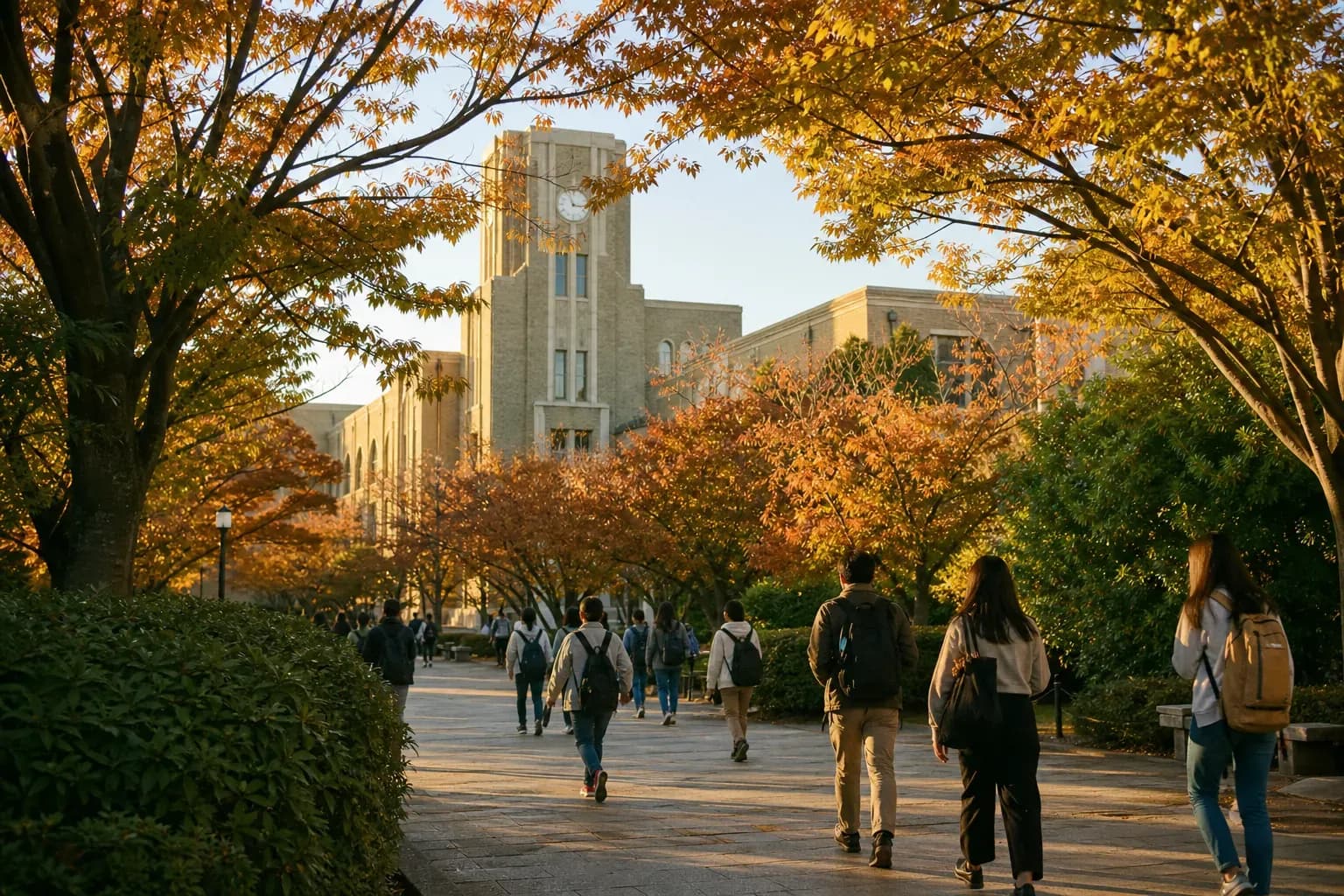
Kobe University: KIBER International Business, a Harbor Campus Beneath Mount Rokko, and Kansai's Underrated Flagship
Published on December 23, 2025
If you have only heard of the three major Kansai universities, "Kyodai, Handai, and Kobe" - Kyoto University and Osaka University are both G30 + Type A flagships, but Kobe University ("Kobe U," also known as "Shindai") is in fact seriously underestimated by Taiwanese families. Kobe University was not one of the original 13 G30 universities, but it is an SGU Type B Global Traction Type university and an HSP Highly Skilled Professional +10 point bonus university. Taken together, these statuses place Kobe University on the same level as Tohoku University, Kyushu University, and Hokkaido University in terms of practical career outcomes and permanent residency pathways.
Kobe University's signature strength is its reputation as one of Japan's "Big Four" business schools - alongside Hitotsubashi, the University of Tokyo Economics, and Keio Business and Commerce. KIBER (Kobe University International Bachelor of Economics in Economics and Business) is one of the rare fully English-taught national university undergraduate economics programs in Japan. The number of applicants is not even one-third of Hitotsubashi HGP's applicant pool, yet admitted students are comparable in caliber to Hitotsubashi students. Add to that the city of Kobe itself: the European architecture of Kitano Ijinkan, a harbor town beneath Mount Rokko, Kobe beef, Nada sake, and the Takarazuka Revue. Kobe is one of Japan's most genuinely international, cosmopolitan cities.
For Taiwanese families, Kobe University is a hidden sweet spot: easier to enter than Hitotsubashi, deeper in business strength than Osaka University's business programs, and eligible for the HSP +10 point bonus.
1. Basic Information
| Item | Details |
|---|---|
| Founded | 1902 (originally Kobe Higher Commercial School) |
| University type | National university corporation |
| Location | Rokkodai, Nada-ku, Kobe, Hyogo Prefecture |
| Campus | Approx. 81 hectares (multiple campuses including Rokkodai, Tsurukabuto, and Kusunoki) |
| Undergraduates | ~11,500 |
| Graduate students | ~4,800 |
| Student-faculty ratio | 1:8 |
| Motto | "Truth, Justice, Wisdom" |
2. World Rankings
| Ranking | Position |
|---|---|
| QS World 2026 | #501-510 |
| THE World 2026 | #401-500 |
| QS Asia 2026 | #80 |
| THE Asia 2026 | #85 |
| QS Business & Management | #101-150 (top-tier business in Asia) |
| QS Economics | #151-200 |
| THE Japan University Rankings 2024 | #15 |
Kobe University is one of the 24 SGU Type B Global Traction Type universities. Although it is not a Type A flagship, it ranks among Japan's top 10 and Asia's top 50 in business, economics, maritime sciences, and agricultural bioscience. SGU Type B is positioned as "the next wave of flagship candidates" - which means the Japanese government is actively investing in Kobe University's internationalization.
3. Admissions Data (2024 Entry)
KIBER (Kobe University International Bachelor in Economics and Business)
| Metric | Figure |
|---|---|
| Applicants | ~50-80 |
| Admitted students | ~10-15 |
| Overall acceptance rate | Approx. 15-25% |
| Field | Fully English-taught undergraduate economics + business program (4 years) |
| Taiwanese admits per year | 1-2 students |
Application Requirements (KIBER)
| Item | Requirement |
|---|---|
| English proficiency | TOEFL iBT 80+ / IELTS 6.5+ (iBT 90+ recommended) |
| Standardized tests | SAT 1300+, ACT 26+, IB 34+, or A-Level 3 subjects at B or above |
| Japanese | Not required at all upon enrollment |
| Recommendation letters | 2 letters |
| Essay | Statement of Purpose, Personal Statement |
| Interview | Online interview (conducted in English) |
GMAP (Global Master of Arts Program)
An English-taught graduate program suitable for students who want to continue after completing an undergraduate degree:
- Fields: law, politics, sociology, and interdisciplinary humanities and social sciences
- Fully English-taught 2-year MA
- International student ratio above 80%
International Students
- KIBER international student ratio: approx. 95-100%
- Overall international student ratio at Kobe University: approx. 10%
- Main origins: Asia (China, Taiwan, Korea, Southeast Asia) plus some students from Europe and North America
4. Tuition and Financial Aid
2025 Tuition (Standard National University Fees)
| Item | Amount (JPY) | Approx. NTD |
|---|---|---|
| Admission fee | 282,000 | ~60,000 |
| Annual tuition | 535,800 | ~110,000 |
| Dormitory (international student dormitory, monthly) | 25,000-50,000 | ~5,500-11,000 |
| Living expenses (monthly, Kobe) | 65,000-90,000 | ~14,000-20,000 |
| Estimated total cost for four years | Approx. JPY 5.5-7M | ~NTD 1.2-1.5M |
Kobe's cost of living is slightly higher than Osaka's but 20-25% lower than Tokyo's. Because of Kobe's distinctive geography - a narrow coastal strip beneath Mount Rokko - rent is slightly higher than central Osaka, but still much cheaper than Tokyo.
MEXT Scholarships
- MEXT Embassy Recommendation Scholarship: full tuition waiver + JPY 117,000 per month
- MEXT University Recommendation Scholarship: direct nomination by Kobe University
Kobe University Internal Scholarships
- Kobe University Scholarship: full or half tuition waiver
- JASSO Honors Scholarship: JPY 48,000-80,000 per month
- Ryosokai (Kobe University Alumni Association) Scholarship: sponsored by the business school alumni association, with generous amounts
- Local corporate scholarships from companies such as P&G and Sysmex: partnerships with Kobe-based companies
5. Program Structure / Signature Programs
KIBER (International Bachelor in Economics and Business)
KIBER is the most important English-taught undergraduate entry point at Kobe University. It is a 4-year fully English-taught program:
- Years 1-2: foundations in economics, foundations in business, Liberal Arts, and English enhancement
- Years 3-4: choose a specialization:
- Economics track: theoretical economics, econometrics, applied economics
- Business track: business strategy, marketing, finance, accounting, organizations
- Japanese minor: students are encouraged to reach N3-N2 before graduation, but it is not compulsory
KIBER's key appeal is that it is easier to enter than Hitotsubashi HGP, comparable in business faculty strength, and highly respected among Kansai employers. Within the G30 / SGU ecosystem, this is an overlooked niche.
GMAP (Global Master of Arts Program)
- Fully English-taught 2-year MA
- Law, politics, sociology, and interdisciplinary fields
- Suitable for students without a business undergraduate background who want to earn an English-taught master's degree in Japan
Other English-Taught Graduate Programs at Kobe University
- Kobe MBA (Kobe University MBA, Japan's oldest): established in 1989, Japan's first formal MBA program, partly English-taught
- Graduate School of Law LL.M.: partly English-taught international law and commercial law
- Graduate School of Maritime Sciences: Japan's only English-taught maritime program, covering ocean transportation, maritime law, and ports
Kobe University's Strong Japanese-Taught Faculties
- Faculty of Maritime Sciences: Japan's only maritime faculty, located on the Fukae Campus, with the training ship "Fukae Maru"
- Faculty of Agriculture: the academic backbone for research related to Kobe beef, Nada sake, and Japanese cuisine
- School of Medicine: affiliated hospital with 934 beds and a central role in the Kobe Medical Cluster
Professor Pre-Approval System (Graduate Level)
Applications to Kobe University's graduate schools require contacting professors in advance to obtain informal acceptance. Professors in the Graduate School of Business Administration and Graduate School of Economics are highly friendly toward international students. The KIBER + GMAP + MBA ecosystem has been built over more than 20 years.
6. Campus Culture / University Personality
Kobe University's character can be summed up in a few words: elite, business-oriented, cosmopolitan, and Mount Rokko.
- Elite business DNA: Since the founding of Kobe Higher Commercial School in 1902, Kobe University has represented "Japan's second-oldest business education" after Hitotsubashi. Alumni are highly concentrated in the Kansai business world
- Mountain views from Rokkodai Campus: The main campus for business and economics, "Rokkodai," sits halfway up Mount Rokko. Students have to commute uphill, but the sea views are unbeatable
- Ryosokai (alumni association): Kobe University's business school alumni association, Ryosokai, has a network density in Kansai business comparable to Hitotsubashi's Josuikai
- International atmosphere: Kobe Port opened in 1868 and was one of Japan's earliest gateways to the West. That historical character permeates the campus
- 150+ student clubs: leaning toward intellectual and athletic activities - debate club, finance club, mountaineering club (Mount Rokko is right next door), and maritime club (Kobe Port)
- Cafeteria and co-op: the Rokkodai cafeteria and student co-op cafe are everyday gathering points for students
Kobe University's atmosphere is "Kansai's Hitotsubashi with an international harbor sensibility" - a rare combination in Japan.
7. Location / Campus Environment
City Positioning
Kobe City has a population of 1.5 million. It is Japan's seventh-largest city and Kansai's representative cosmopolitan city.
- Osaka to Kobe: 25 minutes by JR Kobe Line
- Kyoto to Kobe: 1 hour by JR / Hankyu
- Kansai International Airport (KIX) to Kobe: 30 minutes by high-speed ferry / 1 hour by bus
- Kobe Sannomiya Station to Rokkodai Campus: 30 minutes by JR + bus / 35 minutes by Hankyu + walking
Kobe sits at the heart of the Keihanshin metropolitan area. Students can take the train to Osaka for internships, visit Kyoto, or travel overseas from Kansai International Airport at any time. This triangular resource base is something other Kansai universities cannot match.
Climate
- Winter: 3-10°C, warmer than Kyoto with little snow
- Summer: 26-33°C, humid but with sea breezes
- Comfortable cherry blossom season in spring and autumn foliage season
- Mount Rokko itself gets snow (931 meters above sea level), and the temperature difference between the upper and lower campus areas can be significant
Campus Landmarks
- Rokkodai Campus: main campus for the faculties of business administration, economics, law, agriculture, humanities, and intercultural studies, with sea views
- Central Library: collection of approx. 3.5 million volumes
- Ryosokai Hall: business school alumni association building
- Fukae Maru: training ship of the Faculty of Maritime Sciences, moored at Fukae Campus
Advantages of Kobe City
- Kitano Ijinkan: a 19th-century cluster of former British, German, and American consular residences, symbolizing Kobe's international history
- Motomachi Chinatown: one of Japan's three major Chinatowns
- Kobe Harbor Land: shopping + views, with Kobe's night view considered one of Japan's three best
- Rokko Mountain Pasture and Arima Onsen: popular student weekend destinations
8. Research and Resources
Libraries
- Central Library + multiple branch libraries: approx. 3.5 million volumes
- Business, economics, and maritime science collections are among Japan's leading holdings
- Complete electronic resource subscriptions
Notable Research Institutes
- Research Institute for Economics and Business Administration: one of Japan's oldest research institutes in economics and business administration (since 1919), supported by Kobe University's Ryosokai foundation
- Graduate School of Maritime Sciences: Japan's only maritime program, with ocean research collaborations with JAMSTEC
- Bioresource Center: interdisciplinary agriculture + life sciences
- Research Center for Urban Safety and Security: established after the 1995 Great Hanshin Earthquake and considered Japan's leader in disaster management
Notable Professors and Research
- Nobuo Okishio (economics): a leading authority in Japanese Marxian economics
- Tadao Kagono (business administration): an authority in Japanese strategic management
- Kobe University's business school has produced one of Japan's largest groups of CEOs at major trading companies and banks
9. Notable Alumni
Kobe University alumni are known collectively as "Ryosokai":
- Politics: numerous former ministers of education, economy and industry, and land, infrastructure and transport
- Major corporations: Akira Murata, founder of Murata Manufacturing; Mamoru Ieki, founder of Sysmex; successive presidents of Kawasaki Heavy Industries and Kobe Steel; senior executives at Kawasaki Kisen, Mitsui O.S.K. Lines, and other shipping and shipbuilding companies
- Finance: multiple directors at Sumitomo Mitsui Banking Corporation, as well as senior executives at Nomura and Daiwa Securities
- Academia: Nobel Prize in Physics laureate Ryoji Noyori (a Nagoya University graduate, but with research ties to Kobe University)
- Media / literature: Haruki Murakami (a Kobe University graduate!), Tomoko Kano (writer)
- Sports: management figures connected to Kobe's local J-League club, Vissel Kobe
Haruki Murakami graduated from Kobe University's Faculty of Business Administration - the university's most literary hidden gem.
10. Interesting Facts About Kobe University
- Haruki Murakami studied at Kobe University: He entered Kobe University's Faculty of Letters in 1968 (later transferring to Waseda, though official records retain his early enrollment at Kobe University). He is the most famous literary alumnus in Kobe University's history.
- The name "Ryosokai": It comes from the phrase "overcoming frost and enduring snow," symbolizing Kobe University alumni's resilience in the face of difficulty. This alumni association has the strongest density in the Kansai business world after Hitotsubashi's Josuikai.
- The "century-old ginkgo" on Kobe University's Rokkodai Campus: It was planted when Kobe Higher Commercial School was founded in 1902 - even older than Kobe University's current institutional history. It turns golden in autumn.
- Kobe University launched Japan's first formal MBA program (1989): earlier than the University of Tokyo, Kyoto University, Hitotsubashi, and Keio. This reflects the historical standing of Kobe University's business school.
- Kobe University Hospital was rebuilt after the 1995 Great Hanshin Earthquake: It became the academic backbone of the Kobe Medical Cluster, a biomedical industry hub. Clinical iPS cell research and regenerative medicine are heavily concentrated in Kobe.
11. Typical Admitted Student Profile (KIBER)
- High school GPA of 3.6/4.0 or above across three years
- TOEFL iBT 90+ or IELTS 7.0+
- SAT 1300+, IB 34+, or A-Level 3B+ or above
- Able to clearly explain "why Kobe University, not Osaka University / Kyoto University / Hitotsubashi" - usually through angles such as the Ryosokai alumni network, Kobe's cosmopolitan environment, business + international harbor context, and KIBER's smaller scale and therefore stronger student-faculty interaction
- Experience in business competitions, Model United Nations, debate, or student council leadership
- Recommendation letters from social studies / economics / English teachers
- A concrete imagination of the "Kansai business ecosystem" (Kobe Port, Murata, Sysmex, Kawasaki Heavy Industries)
12. What Kind of Student Is Kobe University Best For?
✓ Suitable for:
- Students who want to study at a Top 5 Japanese business school for JPY 535,800 per year
- Students with genuine passion for business, economics, maritime affairs, and port logistics
- Students for whom Hitotsubashi HGP is too competitive and who want access to top-tier business education with a more reasonable admissions pressure
- Students who like the combination of "harbor city + mountain-view campus"
- Students interested in the Kansai business ecosystem (Murata, Sysmex, Kawasaki Heavy Industries, Kobe Steel)
- Students planning for the HSP Highly Skilled Professional permanent residency pathway (Kobe University is on the +10 point list)
- Students looking for a sweet spot that is easier to enter than Osaka University / Kyoto University but offers comparable placement
✗ Not necessarily suitable for:
- Students who want pure engineering or pure sciences (Kobe University's science and engineering are not in the top tier)
- Students who want the branding halo of a QS Top 200 university (Kobe University is Top 500)
- Students expecting "central Tokyo life" (Kobe is in Kansai)
- Students who are not interested in business or social sciences (Kobe University's strengths are concentrated here)
- Students who cannot tolerate uphill commuting (Rokkodai Campus requires climbing)
13. HSP Highly Skilled Professional Permanent Residency Pathway
Kobe University is on the HSP Highly Skilled Professional "+10 point bonus" list. This is Kobe University's biggest hidden advantage relative to other SGU Type B universities. It means:
- Master's degree + annual salary of JPY 6 million -> permanent residency application after 3 years
- Doctorate + annual salary of JPY 8 million -> permanent residency application after 1 year
- After obtaining permanent residency, spouses may work, parents may stay long-term, and children can access Japanese nationality
The most common HSP pathways for Kobe University graduates:
- Kobe University KIBER -> Kobe MBA / GMAP -> entry into major Kansai companies (Murata, Sysmex, Kawasaki Heavy Industries, Kobe Steel, Kawasaki Kisen) / Kansai branches of major trading companies -> apply for permanent residency within 3 years
- Doctorate in Maritime Sciences -> JAMSTEC, Mitsui O.S.K. Lines, Kawasaki Kisen, maritime administration -> permanent residency in 1 year
- Business school -> foreign firms' Osaka / Kobe offices (McK, BCG, Goldman Sachs Osaka) -> accumulate HSP points through high salary
- Agriculture / life sciences -> biotech related to the Kobe Medical Cluster (iPS, regenerative medicine) -> permanent residency
Kobe University is especially suitable for Taiwanese students who want to stay in Kansai rather than fight through the Tokyo crowd. Kansai offers a high quality of life, a strong corporate ecosystem, and a clear permanent residency pathway. For detailed strategy, see Dr. G.'s internal guides, "Post-Graduation Visa Strategy / 05_Japan_Visa_Strategy" and "Master Grad School Database / Japan."
Conclusion
Kobe University is a seriously underrated Kansai flagship. If you want to study business, avoid competing with the top 5% of Hitotsubashi applicants, and live a cosmopolitan life in Kansai, Kobe University is one of the best value-for-money choices in Asia. It does not have Osaka University's "G30 Type A" label or Kyoto University's "Nobel + freedom" aura, but it does have Top 5 Japanese business faculty strength, the dense Ryosokai alumni network, HSP +10 points, and a harbor campus beneath Mount Rokko.
The reason Taiwanese families most often overlook Kobe University is that it was not part of G30. But that is ranking superstition. In terms of the combined score of business employment placement, HSP bonus points, and quality of life, Kobe University is on the same level as Tohoku, Kyushu, and Hokkaido. In one sentence: if you want to enter Japanese business, stay in Kansai, obtain permanent residency, and avoid being crushed by Hitotsubashi's 15% acceptance rate, Kobe University is the right answer.