
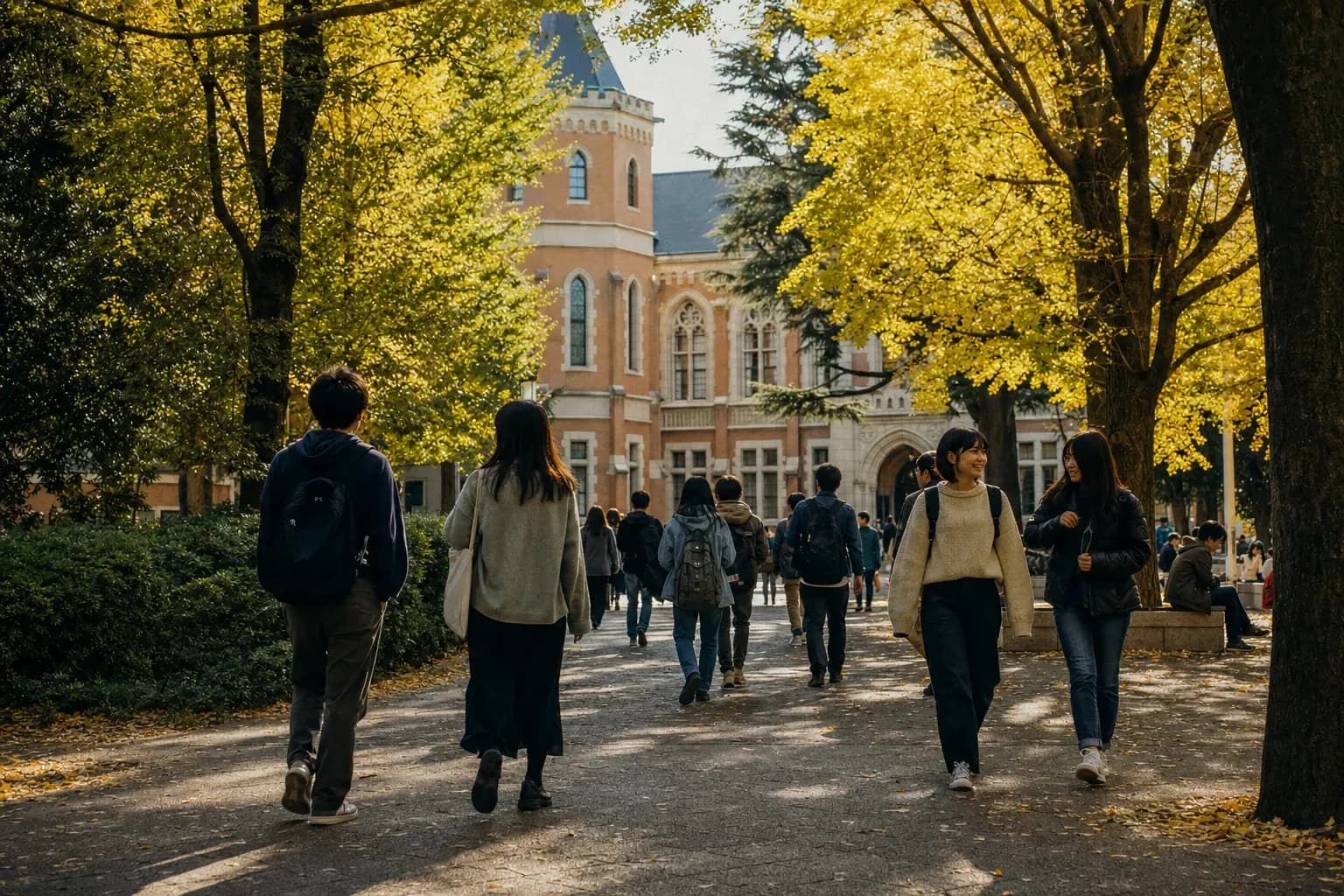
Keio University: PEARL Economics, GIGA, and Japan's Oldest Private University
Published on January 1, 2026
Ranked QS 2026 #205, Japan's oldest private university (founded in 1858 by Yukichi Fukuzawa), and the university with the highest concentration of alumni in Japan's business and finance circles, Keio University ("Keio") is Waseda's twin rival and home to Japan's strongest corporate alumni network.
Keio's two major English-taught undergraduate programs, PEARL (Programme in Economics for Alliances, Research and Leadership, the fully English-taught program in the Faculty of Economics) and GIGA (Global Information and Governance Academic Program, the fully English-taught program at SFC), are among the most refined English-taught programs at Japanese private universities for future business leaders.
If Waseda's spirit is "independent, free, and eclectic," Keio's is "independence and self-respect, corporate elites, and social capital." In the proportion of presidents of listed Japanese companies, Keio ranks first among all universities in Japan, ahead of the University of Tokyo.
Keio is also an SGU Type A top-tier university (selected alongside Waseda as one of the two leading private universities in Type A) and an HSP +10 bonus university.
1. Basic Information
| Item | Details |
|---|---|
| Founded | 1858 (Ansei 5), when Yukichi Fukuzawa founded a Dutch studies school; officially named Keio Gijuku in 1868 |
| Institution type | Private university (Japan's oldest) |
| Location | Six campuses, including Mita and Shinanomachi in Minato, Yotsuya in Shinjuku, and SFC in Fujisawa, Kanagawa |
| Campus | Approximately 86 hectares |
| Undergraduates | ~28,500 |
| Graduate students | ~5,000 |
| Student-faculty ratio | 1:28 |
| Motto | "Independence and Self-Respect" (proposed by Yukichi Fukuzawa) |
2. World Rankings
| Ranking | Position |
|---|---|
| QS World 2026 | #205 |
| THE World 2026 | #301-350 |
| QS Asia 2026 | #33 |
| THE Asia 2026 | #48 |
| US News Global Universities | #515 |
| QS Economics | #50-100 |
| QS Business & Management | #100-150 |
Keio is one of the 13 SGU Type A top-tier universities, a G30 university, and ranks alongside Waseda as Japan's leading private university. In indicators such as the number of CEOs in Japanese companies and the proportion of directors at listed companies, Keio surpasses the University of Tokyo and ranks first in Japan.
3. Admissions Data (2024 Entry)
Keio has 10 undergraduate faculties, with the main English-taught entry points for Taiwanese students concentrated in:
PEARL (Fully English-Taught Program in the Faculty of Economics)
| Metric | Figure |
|---|---|
| Applicants | ~400-500 |
| Admitted students | ~60-80 |
| Overall acceptance rate | Approximately 15-20% |
| Major | Economics (single major, with clusters such as finance, policy, and development) |
GIGA (Fully English-Taught Program at SFC)
| Metric | Figure |
|---|---|
| Applicants | ~300-400 |
| Admitted students | ~50-70 |
| Overall acceptance rate | Approximately 15-20% |
| Faculties | Faculty of Policy Management + Faculty of Environment and Information Studies |
Application Requirements
| Item | Requirement |
|---|---|
| English proficiency | TOEFL iBT 95+ / IELTS 7.0+ |
| Standardized testing | SAT 1400+, ACT 30+, IB 38+, or A-Level 3A or above |
| Japanese language | Not required at entry; PEARL requires some Japanese coursework, while GIGA has no Japanese requirement |
| Recommendation letters | 1-2 letters |
| Essay | Personal Statement + Reason for Application |
| Interview | PEARL may require an online interview |
International Students
- International students make up approximately 50% of PEARL (the rest are Japanese students and returnee Japanese students)
- International students make up approximately 40% of GIGA
- Keio has approximately 2,000 international students overall
- Each year, 15-25 students from Taiwan are admitted to Keio (across all faculties)
4. Tuition and Financial Aid
2025 Tuition (Private University)
| Item | Amount (JPY) | Approx. NTD |
|---|---|---|
| Enrollment fee | 200,000 | ~45,000 |
| Tuition (annual, PEARL Economics) | ~1,500,000 | ~330,000 |
| Tuition (annual, GIGA SFC) | ~1,400,000 | ~300,000 |
| Tuition (annual, School of Medicine) | ~3,750,000 | ~800,000 |
| Facility fees / miscellaneous fees (annual) | 100,000-300,000 | ~20,000-70,000 |
| Dormitory (Keio international dormitory, monthly) | 70,000-110,000 | ~15,000-24,000 |
| Living expenses (monthly, Minato / Fujisawa) | 90,000-130,000 | ~20,000-30,000 |
| Estimated total PEARL cost for four years | Approximately JPY 14-17M | ~NTD 3.1-3.8M |
Keio PEARL is one of the most expensive English-taught undergraduate programs for international students in Japan (annual tuition of JPY 1.5 million), but it still costs less than one-third of a Top 30 private university in the United States, where annual costs often exceed USD 70,000.
MEXT Scholarships
- MEXT Embassy Recommendation Scholarship: Applications possible
- MEXT University Recommendation: Keio has a sufficient nomination quota
Keio Internal Scholarships
- Gakumon no Susume Scholarship: Commemorates Yukichi Fukuzawa's famous work An Encouragement of Learning; full or half tuition reduction
- Keio University Scholarship for International Students: JPY 50,000-500,000 per year
- Shinzo Koizumi Memorial Scholarship: For outstanding students in the Faculty of Economics
- Jukuseikai Scholarship: Financial support for enrolled students
Keio has the second-largest total scholarship budget among Japanese private universities (after Waseda), and approximately 20-30% of international students receive partial tuition reductions.
JASSO
- JASSO Honors Scholarship: JPY 48,000-80,000 per month
5. Program Structure / Signature Programs
PEARL (Programme in Economics for Alliances, Research and Leadership)
Established in 2016, PEARL is the fully English-taught program in Keio's Faculty of Economics. It is a four-year, fully English-taught undergraduate economics program:
- Year 1: Mathematics for Economics, Intro Macro/Micro, Statistics
- Years 2-3: Intermediate Macro/Micro, Econometrics, cluster courses (Finance, Development, Public Policy, etc.)
- Year 4: Senior Thesis, internships, exchange
PEARL is Japan's only fully English-taught four-year undergraduate program in an economics faculty. After graduation, students can proceed directly to graduate programs in English-speaking countries or to master's programs in Japan.
GIGA (Fully English-Taught Program at SFC)
GIGA is a fully English-taught program offered at Shonan Fujisawa Campus (SFC), integrating:
- Faculty of Policy Management
- Faculty of Environment and Information Studies
Key features of GIGA:
- SFC's interdisciplinary culture: Students freely design their majors, with no clear departmental boundaries
- A comprehensive education combining entrepreneurship + tech policy + design thinking
- AIRS-Lab (Artificial Intelligence Research Center) and the quantum computing research center are located at SFC
GIGA's student body is diverse: approximately 40% international students, 30% returnee Japanese students, and 30% locally educated Japanese students.
School of Medicine (Japanese-Taught, For Reference Only)
Keio's School of Medicine was founded in 1873. It is Japan's oldest private medical school and has a powerful professional alumni presence. Only Japanese nationals may apply, and instruction is entirely in Japanese.
Other Undergraduate Faculties
- Faculty of Law, Faculty of Business and Commerce, Faculty of Letters, Faculty of Economics (Japanese track), Faculty of Science and Technology, Faculty of Policy Management, Faculty of Environment and Information Studies, Faculty of Nursing and Medical Care, School of Medicine, and Faculty of Pharmacy
- Keio SFC (Fujisawa Campus): Policy Management + Environment and Information Studies + Nursing and Medical Care
- Keio Hiyoshi Campus: First and second years for all faculties
6. Campus Culture / Institutional Personality
Keio's character: independence and self-respect, social polish, corporate elites, and elegance.
Core features of its culture:
- "Independence and Self-Respect": Proposed by Yukichi Fukuzawa, it emphasizes individual autonomy and not relying on authority. In Keio's evolution, however, this "independence" has become a kind of elite social independence
- Students call themselves "jukusei": Keio students refer to one another as "jukusei," faculty and staff are called "jukuin," and the institution as a whole is called "Keio Gijuku." This creates a sense of ritual unique to Keio
- Waseda-Keio matches: Baseball and rugby rivalries with Waseda, including the Tokyo Big6 Baseball League
- Mita-kai: Keio's alumni association, one of Japan's strongest private university alumni networks, with 330,000 alumni worldwide and 760+ chapters
Club culture:
- Keio Cheerleading Team: A signature example of Japanese university cheer culture
- Mita Festival (November): Keio's school festival, one of Tokyo's two major university festivals alongside the Waseda Festival
- Keio University Athletic Association: One of the most complete university sports systems in Japan, covering everything from American football to equestrian sports
Differences in character between Keio and Waseda:
- Waseda: Independent, free, eclectic, northern in temperament
- Keio: Elite, social, business-oriented, southern (Kanagawa) in temperament
The term "Keio boy / girl" has a special meaning in Japanese society. It usually suggests an image of someone from a well-off family, socially adept, and likely to enter a major corporation in the future.
7. Location / Campus Environment
Urban Positioning
Keio's six main campuses:
- Mita Campus (main campus): Mita, Minato; 10 minutes from Tokyo Station and 5 minutes from Shinagawa. Hosts third- and fourth-year students in the Faculty of Law, Faculty of Business and Commerce, Faculty of Letters, and Faculty of Economics
- Hiyoshi Campus: Kohoku, Yokohama; first and second years for all faculties + athletic facilities
- Shonan Fujisawa Campus (SFC, where GIGA is located): Fujisawa, Kanagawa; one hour from Tokyo. Hosts Policy Management, Environment and Information Studies, and Nursing and Medical Care
- Shinanomachi Campus: Shinanomachi, Shinjuku; School of Medicine
- Yagami Campus: Hiyoshi, Yokohama; third and fourth years for the Faculty of Science and Technology
- Shiba Kyoritsu Campus: Shibakoen, Minato; Faculty of Pharmacy
PEARL students spend their first and second years at Hiyoshi, then their third and fourth years at Mita. These are Keio's two campuses with the strongest "elite student" atmosphere. GIGA students spend all four years at SFC. SFC is a different world: away from the city, free, and interdisciplinary.
Minato / Mita
- One of Tokyo's most upscale residential areas
- Surrounded by embassies and dense with multinational corporate headquarters
- Monthly rent: JPY 80,000-150,000 (studio apartment)
Shonan Fujisawa (SFC)
- Located in Kanagawa, one hour from Tokyo and 15 minutes from the Shonan coast
- Very large campus (33 hectares), with a strong "student village" feel
- Monthly rent: JPY 50,000-80,000 (much more affordable)
Climate
- Mita / Hiyoshi: Same as Tokyo
- SFC: Coastal climate, cooler summers and mild winters
8. Research and Resources
Libraries
- Keio University Library (Mita): Approximately 5.1 million volumes, second among private universities
- Old University Library (built in 1912): Designated an Important Cultural Property of Japan
- SFC Media Center: Interdisciplinary digital resources
Notable Research Institutes
- Keio Business School (KBS): Japan's oldest MBA program and one of Asia's leading MBA programs
- SFC Research Institute: Research in the internet era, AI, and open source
- Keio iPS Cell and Regenerative Medicine Research Center: Collaborates with Kyoto University's CiRA
- Shin-Kawasaki K2 Town Campus: Industry-academia collaboration
Faculty Strengths
- Faculty of Economics / Faculty of Business and Commerce: Among Japan's strongest economics, business, and finance faculties, producing many presidents of listed companies
- School of Medicine: Japan's oldest private medical school; Keio University Hospital is among Japan's top hospitals
- Faculty of Law: Japan's earliest private legal education institution
- SFC: A pioneer of interdisciplinary and entrepreneurship education in Japan
9. Notable Alumni
- Politics: Ryutaro Hashimoto, Junichiro Koizumi (prime ministers), Shinjiro Koizumi (former Minister of the Environment)
- Corporate founders / CEOs (Keio's signature strength):
- Shintaro Abe (former Minister for Foreign Affairs)
- Hiroshi Mikitani (founder of Rakuten) -- later attended Hitotsubashi; still identified as a Keio alumnus
- Taizo Son (founder of Mistletoe and younger brother of Masayoshi Son)
- Takuhiro Nishiyama, Daisuke Gomi (multiple listed companies)
- Among presidents of listed Japanese companies, Keio alumni rank first in Japan at approximately 12%
- Academia / Nobel: Shibasaburo Kitasato (founder of Keio's School of Medicine, infectious disease scholar, and Nobel candidate)
- Literature / Entertainment: Kaori Ekuni, Hideo Yokoyama, Masaharu Fukuyama, Hiroshi Tamaki, Genki Sudo
- Sports: Yoshinobu Takahashi (former manager of the Yomiuri Giants)
- Political dynasties: The Koizumi family, parts of the Abe family, and the Hashimoto family. Many of Japan's hereditary politicians come from Keio
The power of Mita-kai: Keio alumni have a very high presence at Mitsubishi UFJ, Mitsui Sumitomo, trading companies, the Big 4, and foreign investment banks. The "Keio + Mita-kai" label is extremely helpful for employment.
10. Keio Facts
- Keio was founded 10 years before the Meiji Restoration (1868): Yukichi Fukuzawa started it as a Dutch studies school in 1858, making it one of the origins of Western-style higher education in Japan.
- The meaning of "Gijuku" in Keio Gijuku: It comes from Yukichi Fukuzawa's concept of "gijuku = public school," emphasizing both the character of a private academy and the spirit of public education.
- Keio School of Medicine costs JPY 3.75 million per year: It is one of Japan's most expensive private medical schools, but still only about one-eighth of the cost of a U.S. medical school.
- The cheerleading battle at Waseda-Keio matches: During festival season, Waseda and Keio cheer squads perform school songs at the stadium, with 50,000 spectators singing together. It is one of Tokyo's grand traditional cultural rituals.
- Keio's emblem is the "Pen Mark": Two crossed pens symbolize "freedom of speech + academic independence" and have been used since 1885.
11. Typical Admitted Student Profile (PEARL / GIGA)
- Three-year high school GPA of 3.8/4.0
- TOEFL iBT 105+ or IELTS 7.5+
- SAT 1500+, IB 40+, or A-Level 3A* or above
- PEARL applicants: Clear interest in Economics, Finance, and Public Policy; participation in NEC (National Economics Challenge) or Model United Nations finance committees
- GIGA applicants: Strong interdisciplinary profile, startup experience, a tech-policy combination, and design thinking
- Essays answer "Why Keio, not Waseda?" and usually build from "independence and self-respect," business elites, or SFC's interdisciplinary model
- Recommendation letters from IB / A-Level / AP teachers
12. What Kind of Student Is a Good Fit?
✓ Good fit:
- Students who want to study Japan's strongest private Economics / interdisciplinary program
- Students with clear career goals in Finance, Consulting, foreign investment banking, or trading companies
- Students who want to join Japan's strongest private university alumni network (Mita-kai)
- Families with a budget that can cover private university annual costs of JPY 1.4-1.7 million
- Students drawn to the refined campus life of Minato / Mita / SFC
- Students aiming for the HSP highly skilled professional permanent residency route + entry into major Japanese corporations
✗ Not necessarily a good fit:
- Students with extremely tight budgets (without scholarships, four years at Keio costs approximately NTD 3.8 million)
- Students seeking a "free-spirited eccentric" atmosphere (that is Kyoto University, not Keio)
- Students who want pure humanities / pure literature (Keio's Faculty of Letters is smaller and not its strongest area)
- Students aiming for a pure research-oriented science and engineering PhD path (IST, the University of Tokyo, or Kyoto University would be better fits)
- Students who do not want any exposure to Japanese social culture or participation in the jukuin community
13. HSP Highly Skilled Professional Permanent Residency Route (Exclusive Advantages for Keio Graduates)
Keio is an HSP +10 point bonus university, alongside Waseda among private universities:
- Master's degree + annual salary of JPY 6 million -> permanent residency application after 3 years
- Doctorate + annual salary of JPY 8 million -> permanent residency application after 1 year
Keio's distinctive advantage routes:
- Foreign investment banking / Consulting: Goldman Sachs Tokyo, Morgan Stanley, McKinsey Japan, BCG Tokyo. Keio PEARL is one of the most direct undergraduate credentials in Japan for entering these companies
- Major Japanese corporations: Mitsubishi Corporation, Mitsui & Co., Itochu, Marubeni, Sumitomo Corporation. Mita-kai alumni representation is exceptionally strong
- Finance: MUFG, SMBC, Mizuho, Nomura Securities. Many CEOs in Japan's financial sector are Keio alumni
- Entrepreneurship / VC: Keio ranks among Japan's top three universities by density of entrepreneur alumni
"PEARL -> foreign investment bank / trading company -> annual salary of JPY 8-15 million -> HSP permanent residency within 3 years" is one of Japan's highest-paid undergraduate pathways.
For detailed strategy, refer to Dr. G.'s internal Master Grad School Database / Japan section and Post-Graduation Visa Strategy / 05_Japan_Visa_Strategy. For families with middle school students who want to plan a direct Keio pathway (such as Keio Shonan Fujisawa Junior High School, Keio Girls Senior High School, and related routes), refer to Japan International Schools K12.
Conclusion
Keio is not "Japan's Harvard Business School." It predates HBS by more than 130 years and is one of the origins of business and finance elite education in Asia. If what you want is to become a future president of a listed Japanese company, enter the elite Mita-kai network, and use the Japanese credential with the strongest social capital to open career doors, Keio PEARL is the top undergraduate choice in Japan.
The difference between PEARL and GIGA must be considered carefully: PEARL is designed to produce business elites, while GIGA is designed to produce interdisciplinary entrepreneurs. If you are the type who wants to use Economics to enter foreign investment banking, choose PEARL. If you want to combine tech, policy, and creativity to build a startup, choose GIGA. In one sentence: Waseda is the free opposition party; Keio is the polished ruling party. Choose the side you want to join.