
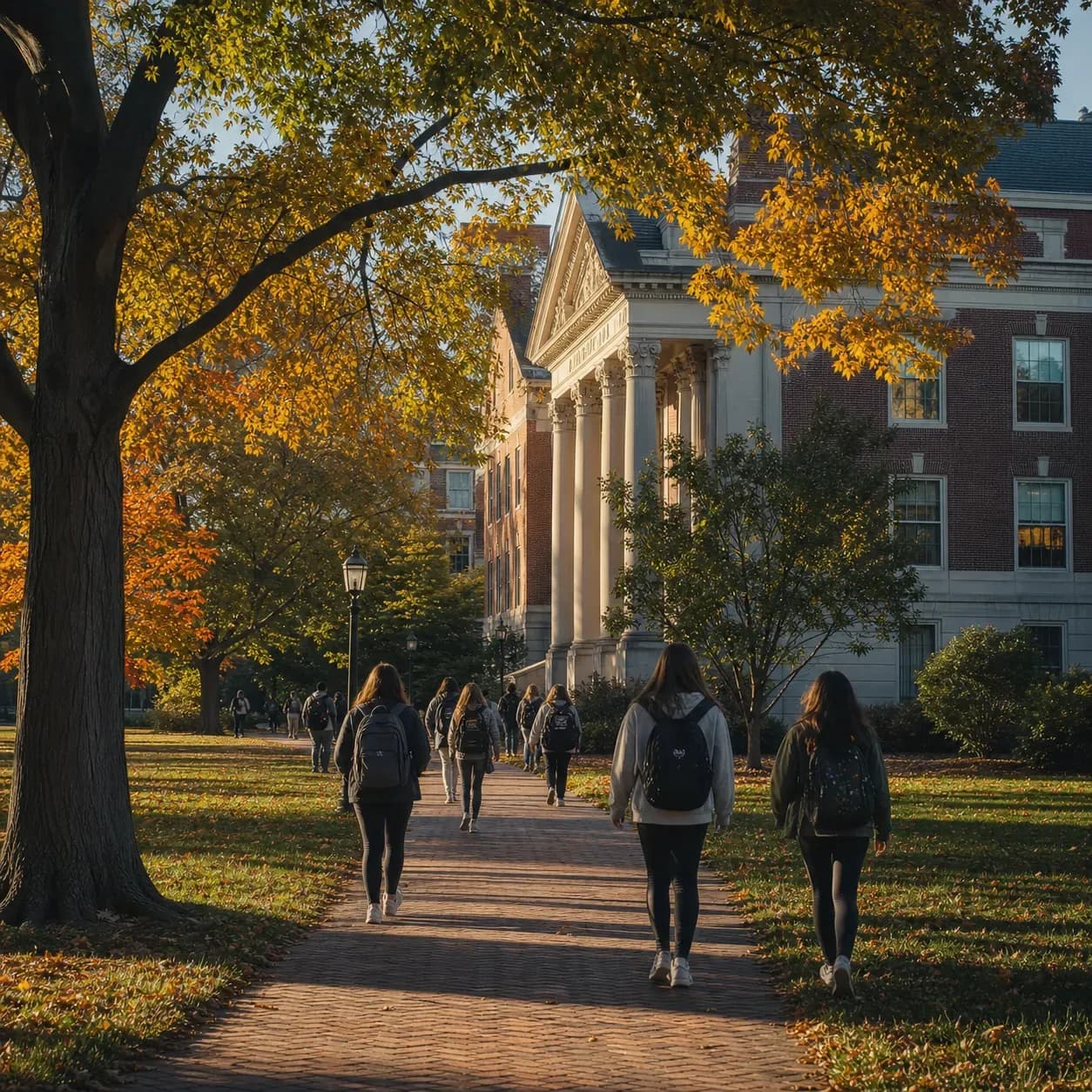
Johns Hopkins University: America’s First Research University, King of BME, and a Medical Powerhouse
Published on November 11, 2025
US News ranks Johns Hopkins tied at #6 nationally, but for medicine, biomedical engineering, and public health, JHU is world number one. No other university is quite comparable. The JHU Bloomberg School of Public Health became a global information hub during COVID-19; JHU Hospital held the #1 spot in the US News hospital rankings for more than 20 consecutive years; and JHU Biomedical Engineering has held the #1 undergraduate and graduate ranking for many years.
JHU is America’s first “research university”. When it was founded in 1876, it was modeled on German research universities, fundamentally different from schools like Harvard and Yale that began with a teaching-centered tradition. Its DNA is research, research, and more research. If your child wants to attend medical school, pursue biomedical engineering, or intern at a world-class hospital, JHU is the most direct path on earth.
1. Basic Information
| Item | Details |
|---|---|
| Founded | 1876 (America’s first research university) |
| Location | Baltimore, Maryland (1 hour north of Washington, DC) |
| Campus | 140 acres (Homewood main campus) |
| Undergraduates | ~6,000 |
| Graduate students | ~24,000 (across all schools) |
| Student-faculty ratio | 1:7 |
| Motto | Veritas vos liberabit (The truth will set you free) |
2. World Rankings
| Ranking | Placement |
|---|---|
| US News National Universities 2025 | #6 (tie) |
| QS World 2025 | #28 |
| THE World 2025 | #15 |
| US News Biomedical Engineering (undergraduate + graduate) | #1 |
| US News Public Health | #1 |
| US News Medicine (Research) | #2 |
| US News International Relations (SAIS) | #2 |
3. Admissions Data (Class of 2028)
| Metric | Value |
|---|---|
| Applicants | ~38,000 |
| Admitted students | ~2,500 |
| Overall acceptance rate | About 6.5% |
| ED acceptance rate | ~19% |
| RD acceptance rate | ~4.5% |
| Yield Rate | ~50% |
SAT/ACT Midranges
| Test | 25th percentile | Median | 75th percentile |
|---|---|---|---|
| SAT | 1500 | 1540 | 1560 |
| ACT | 34 | 35 | 35 |
International Students
- International students make up about 12%
- Students come from 70+ countries
- About 4-7 students from Taiwan are admitted each year
4. Tuition and Financial Aid
2024-2025 Costs
| Item | Amount |
|---|---|
| Tuition | USD $65,046 |
| Housing | USD $11,890 |
| Food | USD $7,560 |
| Personal + Misc | USD $4,350 |
| Total | USD $88,846+ |
Need-Based Aid (Need-Blind for U.S. students since 2018)
- U.S. students are reviewed need-blind (supported by Bloomberg’s USD $1.8 billion donation)
- International students: Need-Aware
- Family income under $80,000: usually full coverage
- Average aid: USD $58,000/year
- About 50% of U.S. undergraduates receive need-based aid
5. Academic Structure / Signature Programs
Undergraduate Majors
- 50+ majors in total
- Top 5 popular majors:
- Public Health Studies
- Biomedical Engineering (#1 in the U.S.)
- Neuroscience
- Computer Science
- International Studies
Signature Systems
- BME (Biomedical Engineering): World number one; students can conduct clinical research at Hopkins Hospital as early as sophomore year
- Pre-Med Track: JHU has strong medical school placement outcomes (but students need an excellent GPA)
- Public Health Studies: Backed by the Bloomberg School of Public Health
- SAIS (School of Advanced International Studies): DC campus; international relations master’s program ranked #2 in the U.S. (undergraduates can choose IR)
- Peabody Conservatory: A world-class music conservatory under JHU
General Education Structure
- Distribution requirements: humanities, social sciences, natural sciences, quantitative studies
- No Core Curriculum: Students have considerable flexibility, which is relatively open among Top 10 universities
6. Campus Culture / Institutional Personality
JHU’s personality is “intense pre-med competition + research obsession + urban energy.” Its dense pre-med population once gave JHU the reputation that “Hopkins kids are the most stressed among the Top 10.” In recent years, the university has strongly promoted “Wellness” reforms, including covered grading for the first semester of freshman year, similar to P/F.
Greek Life
- About 25% participation
- It is not the dominant culture; academics are
Sports Culture
- Mostly NCAA Division III, but men’s Lacrosse is Division I. JHU men’s lacrosse is one of the strongest programs in the country, with 9 national championships
- Basketball, swimming, and football are also present
Spring Fair
- An annual campus carnival held every April, attracting people from across Baltimore
- It is the one week when JHU students “finally do not have to study”
7. Location / Campus Environment
City Positioning
Baltimore is an important East Coast port city, one hour by train from Washington, DC. The city itself has income disparities. North Baltimore is safe, while some areas are not recommended at night. The Homewood campus and Hopkins Hospital campus are both in safe areas.
Climate
- Mid-Atlantic climate, milder than the northern U.S.
- Winter: -2°C to 8°C, with occasional snow
- Summer: 28-32°C, humid
Campus Landmarks
- Gilman Hall (the central Bell Tower building)
- Mason Hall
- Brody Learning Commons
- Hopkins Hospital (in East Baltimore, reachable by student shuttle)
- Peabody Conservatory (music conservatory, in Mount Vernon)
8. Research and Resources
Libraries
- Milton S. Eisenhower Library as the main library
- Total university holdings of 3.6 million volumes
Notable Labs / Research Centers
- Applied Physics Laboratory (APL): One of the major U.S. defense / space research centers; participated in the New Horizons mission
- Bloomberg School of Public Health: #1 in global public health
- Johns Hopkins Hospital: Held the #1 US News hospital ranking for more than 20 consecutive years
- Kavli Neuroscience Discovery Institute
- Whiting School of Engineering BME labs
- Carey Business School
JHU receives the most research funding of any university in the United States, at more than USD $3 billion per year, exceeding MIT.
9. Notable Alumni
- Politics: Michael Bloomberg (New York City mayor, undergraduate), Woodrow Wilson (academic appointment, 28th U.S. president), Madeleine Albright
- Academia / Nobel Prizes: 39 Nobel laureates in total
- Medicine: Vivek Murthy (U.S. Surgeon General), and countless top American physicians
- Tech entrepreneurship: Bill Coleman (BEA), Jeong Kim
- Film / Writing: Wes Craven (director of A Nightmare on Elm Street), Russell Baker
10. Johns Hopkins Fun Facts
- John or Johns?: The university founder’s name was Johns Hopkins, with an s (the family surname was Johns). It is “Johns Hopkins,” not “John Hopkins.” Do not spell it wrong.
- Bloomberg has donated USD $3.5 billion to JHU: Michael Bloomberg has given more than USD $3.5 billion to JHU in total, making him the largest individual donor in university history.
- The mascot is the Blue Jay: Since Baltimore’s baseball team, the Orioles, had already claimed a Baltimore bird, JHU chose the Blue Jay.
- A temple of Lacrosse: JHU men’s Lacrosse has won 9 national championships.
- Tylenol was invented at JHU: Scientists at JHU School of Medicine synthesized acetaminophen, the main ingredient in Tylenol, in 1898.
11. Typical Admitted Student Profile
- GPA Unweighted ~3.93+
- SAT 1500+ or ACT 34+
- 8-12 AP courses (including AP Bio, Chem, Calc BC)
- Spike is often “deep STEM + medical relevance”: hospital shadowing, research lab summers, ISEF awards
- Essays show genuine passion for medicine / health / research
- Recommendation letters from research mentors
- ED is an effective strategy: JHU’s ED acceptance rate is about 19%
12. What Kind of Student Is a Good Fit?
✓ Good fit:
- Pre-med students (one of the most direct routes to medical school)
- Engineering students interested in BME / Biotech / biomedical engineering
- Students interested in public health, epidemiology, and policy
- Students who like an urban environment but still want a campus
- Students who want a very large number of research opportunities
- Students with a research spike who want to produce real papers
✗ Not necessarily a good fit:
- Pure humanities / arts students (JHU’s strengths are STEM + Health)
- Students seeking work-life balance (the pre-med environment is highly competitive)
- Students drawn to southern sunshine / West Coast vibes
- Students who do not like city environments
- Students who need generous aid as international applicants (Need-Aware)
Conclusion
JHU is not the right place for a student who “wants to attend a good school but does not know what to study.” It is the place for students who say, “I want to become a doctor,” “I want to do BME,” “I want to work in public health,” “I want to win a Nobel Prize.” Its career focus, sense of purpose, and research intensity are among the clearest in the Top 10.
Taiwanese parents often ask: “JHU or Cornell?” The answer is: if your child’s goal is medical / biomedical, JHU is the more direct path. If you still want liberal arts breadth and want to keep options open, Cornell may offer more room. But if your child is already certain that “I want to dedicate my life to medicine,” JHU offers the strongest undergraduate + hospital + public health trifecta on earth.