
International Christian University (ICU): Japan’s Purest Liberal Arts College, Bilingual Education, and a University Favored by the Imperial Family
Published on December 30, 2025
QS 2026 #1001-1200. That ranking number can mislead you. International Christian University (“ICU”) is not a comprehensive university built around research output. It is Japan’s only higher education institution that has fully transplanted the American Liberal Arts College model, and one of the very few Liberal Arts Colleges in Asia comparable in spirit to Williams College or Amherst College.
ICU holds a special place in Japanese society: Empress Masako, a former diplomat, is an ICU alumna, which makes ICU one of Japan’s universities with Imperial Family connections. In Liberal Arts teaching quality, language education, and intercultural depth, ICU sits at the top of the quality pyramid for Japanese undergraduate education. At the same time, it is also one of Japan’s most “aristocratic” universities in atmosphere.
ICU’s academic system is bilingual. Each student is placed according to their English and Japanese proficiency upon entry, and all first-year students are required to take ELA (English for Liberal Arts) and JLP (Japanese Language Programs). Over four years, students develop genuine bilingual ability. This is the biggest difference between ICU and Waseda SILS, Sophia FLA, or Keio PEARL: ICU is not an “English-taught undergraduate program”; it is a “bilingual undergraduate program.”
ICU is also an SGU Type B Global Traction Type university. ICU is not included on the HSP +10 bonus university list. This point should be made clear from the beginning.
1. Basic Information
| Item | Details |
|---|---|
| Founded | 1953 (Showa 28), jointly founded by Japan’s Christian community and American associations |
| Institution type | Private university (Christian educational system) |
| Location | Osawa, Mitaka City, Tokyo |
| Campus | Approximately 62 hectares (one of the largest campuses outside Tokyo’s 23 wards) |
| Undergraduate students | ~2,800 |
| Graduate students | ~250 |
| Student-faculty ratio | 1:11 |
| Motto | "True Knowledge Will Set You Free" |
2. World Rankings
| Ranking | Position |
|---|---|
| QS World 2026 | #1001-1200 |
| THE World 2026 | #1001+ |
| THE Japan University Rankings | Consistently top 15 |
| THE Japan Teaching Score | Consistently top 5 |
| QS Teaching Index | Top 20 in Japan |
ICU should not be evaluated by QS / THE international rankings alone. Its teaching quality, student outcomes, and intercultural training often place it in Japan’s top 15 domestically and top 5 for teaching scores. In Japanese corporate recruitment, foreign companies, the United Nations system, and diplomatic circles, an ICU degree is far more recognizable than its global ranking number suggests.
3. Admissions Data (2024 Entry)
ICU has only one undergraduate college: the College of Liberal Arts. International students mainly enter through two routes:
Programs A & B (April / September Entry)
| Metric | Figure |
|---|---|
| Applicants (international student track) | ~400-600 |
| Admitted students (international student track) | ~80-120 |
| Overall acceptance rate | Approximately 20-25% |
| Total enrolled students | ~2,800 |
Application Requirements
| Item | Requirement |
|---|---|
| English proficiency test | TOEFL iBT 79+ / IELTS 6.5+ |
| Standardized tests | SAT 1300+, ACT 28+, IB 36+, or 3 A-Level subjects at B or above |
| Japanese | Not required at entry, but all students must take JLP (Japanese) for at least 1-2 years after enrollment |
| Recommendation letters | 2 letters |
| Essay | Personal Statement + Reasons for Application |
31 Majors (Students Choose at the End of Sophomore Year)
ICU does not divide students by “faculty / department.” All students enter the College of Liberal Arts and choose 1-2 of the 31 majors at the end of their sophomore year. Double majors and major-minor combinations are possible:
- Asian Studies, Biology, Business, Chemistry, Christianity & Culture, Comparative Religion, Computer Science, Development Studies, Economics, Education, Educational Studies, Environmental Studies, Gender & Sexuality Studies, General Education, Global Studies, History, Information Science, International Relations, Japan Studies, Language Education, Linguistics, Literature, Media Communication & Culture, Music, Natural Sciences, Peace Studies, Philosophy & Religion, Physics, Political Science, Psychology, Public Policy & Social Research, Sociology & Anthropology
International Students
- International students make up approximately 13% of the student body (around 360 students)
- Student composition is diverse: roughly one-third returnee Japanese students, plus fully international students and domestic Japanese students
- Each year, 5-10 students from Taiwan are admitted to ICU
4. Tuition and Financial Aid
2025 Tuition (Private University)
| Item | Amount (JPY) | Approx. in NTD |
|---|---|---|
| Enrollment fee | 300,000 | ~65,000 |
| Tuition (annual) | ~1,180,000 | ~260,000 |
| Facility / miscellaneous fees (annual) | Approx. 200,000 | ~45,000 |
| Dormitory (ICU residence halls, monthly) | 50,000-90,000 | ~11,000-20,000 |
| Living expenses (monthly, Mitaka) | 70,000-100,000 | ~15,000-22,000 |
| Estimated total cost for four years | Approx. JPY 10-12M | ~NTD 2.2-2.65M |
ICU’s tuition is slightly lower than Waseda and Keio, and living costs in Mitaka are 20-30% lower than in Yotsuya / Mita. Among Japan’s top private universities, it is one of the lowest in total cost.
MEXT Scholarships
- MEXT Embassy Recommendation Scholarship: available for application
- MEXT University Recommendation: ICU has a stable nomination quota
ICU Internal Scholarships (Very Generous)
- ICU Peace Bell Scholarship: full tuition waiver for four years, with priority for top international students
- ICU Educational Scholarships: 50-100% tuition reduction
- Honjo International Scholarship Foundation: collaborates with ICU
- Christian Education Scholarships: available to Christian students
Approximately 40% of ICU international students receive tuition reductions of 50% or more. This is the highest proportion among Japan’s top 5 private universities.
JASSO
- JASSO Student Exchange Support Program scholarship: JPY 48,000-80,000 per month
5. Academic Structure / Signature Programs
Bilingual Core
The core of ICU is “bilingual Liberal Arts”:
ELA (English for Liberal Arts)
- Students are placed into 4 streams after enrollment based on English proficiency
- Stream 1 (highest): students proceed directly into regular courses
- Streams 2-4: 6-8 hours per week of intensive English for the full first year
- Goal: all students reach academic-level English within four years
JLP (Japanese Language Programs)
- Students are placed into 6 levels (J1-J6) after enrollment based on Japanese proficiency
- No Japanese at all → J1 (starting from kana)
- N1 level → J6 (directly taking Japanese literature courses)
- All international students must take at least 1-2 years of JLP
Main Curriculum
- First year: General Education (Humanities, Social Sciences, Natural Sciences, Languages) + ELA + JLP
- End of sophomore year: choose a major (1-2 from 31 options)
- Junior and senior years: deeper major coursework
ICU’s 31 majors cover STEM, social sciences, humanities, arts, and religion. This is true Liberal Arts: students can double major across disciplines, such as Physics + Music or Computer Science + Peace Studies.
Study Abroad
Approximately 50% of ICU students study abroad at partner institutions for one semester or one year in their junior year. ICU has 80+ partner schools worldwide, including UC Berkeley, UCLA, Yale, Princeton, Oxford, and Cambridge. Admission is not guaranteed, but the partnership channels exist.
Informal Advisor Consent System (Graduate Level)
ICU’s graduate school is small, with around 250 students, and focuses mainly on Peace Studies, Education, and Comparative Culture. International applicants should contact a prospective advisor, but the process is more flexible than at national universities.
6. Campus Culture / Institutional Personality
ICU’s character is quiet, reflective, humanistic, aristocratic, intercultural, and Christian.
Key aspects of the school culture:
- Christian educational tradition: ICU was jointly founded after World War II by Japanese Christians and American associations, and emphasizes international peace, human dignity, and interreligious dialogue. Unlike Sophia’s Jesuit tradition, ICU has a Protestant + interdenominational background, with a more open atmosphere closer to the secularized Christian elements of an American Liberal Arts College
- “True Knowledge Will Set You Free”: derived from John 8:32, but ICU emphasizes critical thinking rather than doctrine
- Small-scale community (2,800 students): only 2,800 students on a 62-hectare forest campus, giving ICU one of the lowest student densities in Japan
- Imperial Family connection: Empress Masako is an ICU alumna; she studied there after entering the diplomatic track, which gives ICU a distinctive position in Japan’s upper social circles
- Egalitarianism: ICU has no rigid club hierarchy, no strong senpai-kohai culture, and professors and students often address each other on a first-name basis
Campus culture:
- ICU Festival: held every October; small in scale but refined in atmosphere
- Church activities: optional, not compulsory
- Student self-governance: ICU’s student government is relatively mature by Japanese university standards
- No baseball team, no American football team: ICU does not emphasize spectator sports; athletics are more focused on individual activities
ICU’s sense of quality, humanistic depth, and intercultural seriousness is unmatched in Japanese undergraduate education. At the same time, it is also the most niche choice and the least suitable for students who simply want a “normal university” experience.
7. Location / Campus Environment
City Positioning
ICU’s main campus is located in Osawa, Mitaka City, Tokyo:
- 12 minutes by bus from JR Mitaka Station
- 30 minutes by car from Shinjuku
- Nogawa Park is east of campus, the National Astronomical Observatory of Japan is to the north, and the Tamagawa River is to the south
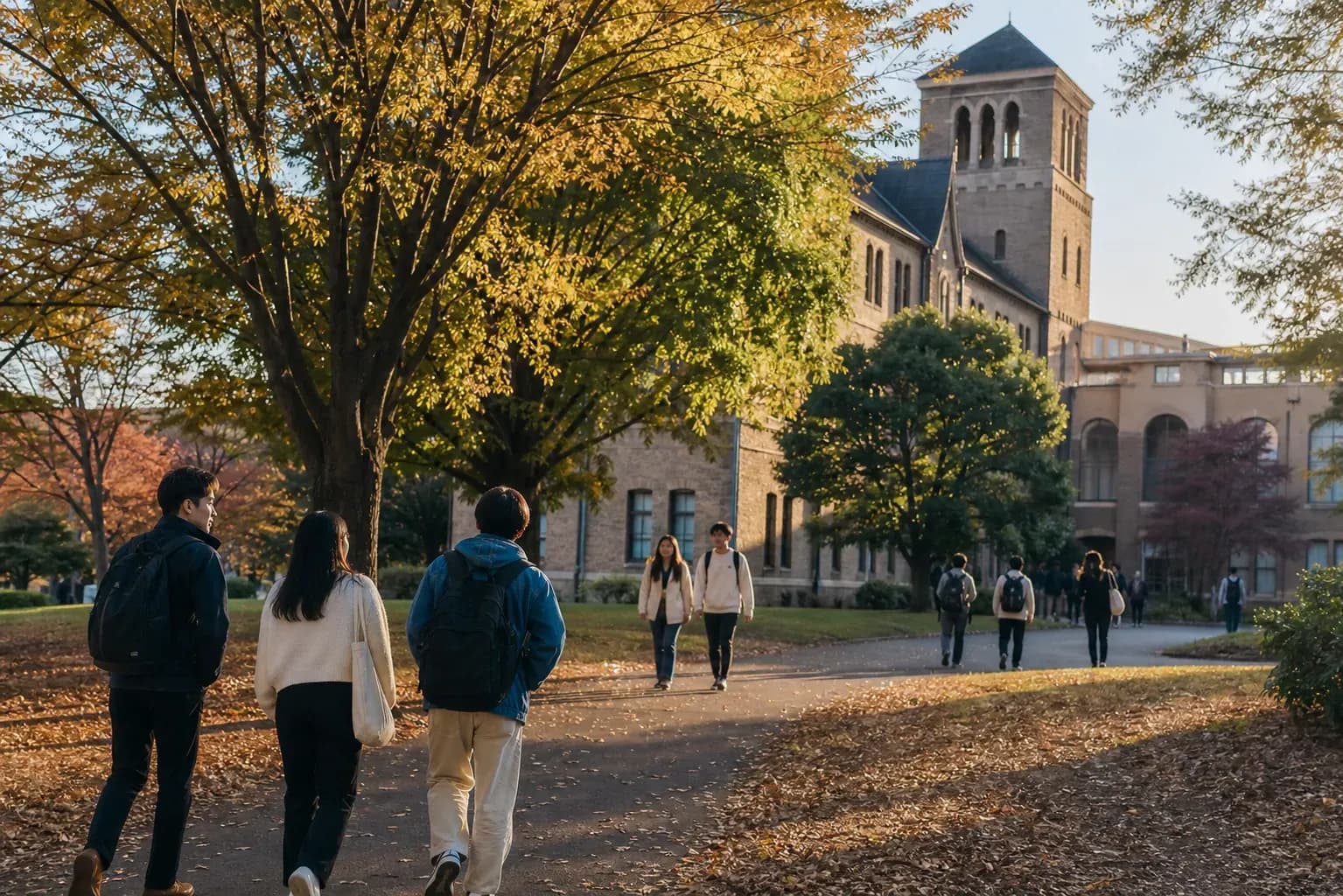
The ICU campus is 62 hectares and surrounded by forest. It has the most “American Liberal Arts College” campus vibe in Tokyo: broad lawns, red-brick buildings, cherry blossom paths, and student dormitories scattered across campus.
Mitaka / Musashino
- A residential and educational district in western suburban Tokyo, with good safety and complete daily amenities
- Monthly rent: JPY 60,000-90,000 for a studio apartment
- 30 minutes from Inokashira Park and Kichijoji, one of Tokyo’s best-known cultural neighborhoods
- 15 minutes from Hayao Miyazaki’s Ghibli Museum
Climate
- Western suburban Tokyo is slightly cooler than the central 23 wards
- The campus is especially beautiful during cherry blossom season in spring and autumn foliage season
Campus Landmarks
- University Hall: built in 1953 and registered as a national Tangible Cultural Property
- ICU Church: campus chapel, with optional Sunday services
- ICU Library: 750,000 volumes, including rare Christian historical materials
- Magnolia Avenue: a tree-lined magnolia path along the campus axis
- Nogawa River: a small river running south of campus and a favorite student walking area
8. Research and Resources
Library
- ICU Library: approximately 750,000 volumes
- Christian history / theology collections: among the most complete in Japan
- Peace Studies collections: one of the most important archives for postwar Japanese peace studies
Notable Research Institutes
- ICU Peace Research Institute: one of Japan’s earliest Peace Studies institutions
- ICU Center for Gender Studies: Japan’s first Gender Studies research center
- ICU Institute for the Study of Christianity and Culture / Comparative Religion: a leading Asian center for interreligious dialogue
Undergraduate Strengths
- Peace Studies, Religious Studies, and Comparative Religion are among the strongest in Japan
- Language education (ELA + JLP) is a benchmark for language teaching at Japanese universities
- Small classes and discussion-based learning are ICU’s teaching signature
9. Notable Alumni
- Imperial Family: Empress Masako (lived in the United States + studied International Relations at ICU + Ministry of Foreign Affairs)
- Politics / diplomacy: Rintaro Ogata (former House of Representatives member, son of Sadako Ogata), Yoriko Kawaguchi (former Minister for Foreign Affairs)
- Media: Akira Ikegami (NHK journalist and widely known commentator), Yoshiko Sakurai (journalist)
- Entertainment: Ryoko Yonekura, Aya Hirano, Keigo Oyamada
- Academia: Researchers of the 1860 Japanese Embassy to the United States, and numerous Japanese Christian theologians
- Business: Tomitaro Anzai (Empress Masako’s father, former Vice Minister for Foreign Affairs), Morio Ikeda (former president of Shiseido)
The fact that Empress Masako is an ICU alumna gives ICU a distinctive link to Japanese social capital and elite alumni circles.
10. ICU Facts Few People Know
- ICU is Japan’s first four-year bilingual Liberal Arts College (1953): It was founded four years after Sophia FLA, but its teaching model is more “American,” smaller in scale, and more purely Liberal Arts.
- Empress Masako’s ICU enrollment story: Masako enrolled in 1981 under the name “Masako Owada,” majored in Economics, and later went on to Harvard and Oxford.
- ICU has no “faculties” or “departments”: All students belong to the College of Liberal Arts and choose from 31 majors after enrollment. This academic structure is unique in Japan.
- ICU does not have partner-school relationships with Peking University, Seoul National University, or National Taiwan University: ICU’s partner network leans toward American Liberal Arts Colleges such as Williams, Wellesley, and Pomona, as well as European institutions such as Oxford and Cambridge.
- Bicycles are prohibited on the ICU campus: On a 62-hectare campus, everyone walks. This is a concrete expression of ICU’s philosophy of “slow living and deep thinking.”
11. Typical Admitted Student Profile
- Three-year high school GPA of 3.7/4.0
- TOEFL iBT 95+ or IELTS 7.0+
- SAT 1400+, IB 38+, or 3 A-Level subjects at A or above
- Intercultural background: overseas experience, bilingual family, or international school
- Depth of thought: able to show genuine reflection on philosophy, religion, and social issues in application essays
- Extracurricular activities: reading, writing, arts, community service, intercultural exchange
- Essays can explain “why ICU, not Sophia, not Waseda SILS,” usually through the angles of true Liberal Arts, bilingual education, a small community, and 31 interdisciplinary majors
- Resonance with the spirit of “True Knowledge Will Set You Free”
- Recommendation letters from IB / A-Level / AP teachers, with humanities teachers such as philosophy, literature, or history teachers preferred
12. What Type of Student Is ICU Best For?
✓ Suitable for:
- Students who want to attend Japan’s purest American-style Liberal Arts College
- “Renaissance-type” students who are interested in multiple fields and do not want to be restricted by faculty boundaries
- Students who want a learning style built around a small community, deep discussion, and direct professor interaction
- Students willing to study Japanese seriously after enrollment (JLP is required)
- Students attracted to a forest campus in western suburban Tokyo rather than downtown high-rises
- Families who can afford private university annual costs of around JPY 1.2M (which may drop to JPY 600,000-800,000 after scholarships)
- Students planning future paths in academia, diplomacy, NGOs, education, or international organizations
✗ Not necessarily suitable for:
- Students who want an HSP +10 bonus university (ICU is not on the list)
- Students who want a pure STEM research undergraduate program (IST, the University of Tokyo, or Kyoto University would be more suitable)
- Students who want a pure business / investment banking prep track (Keio PEARL is more direct)
- Students who want a lively campus, Greek Life, or sports culture
- Students who want the convenience of central Tokyo (ICU is in the western suburbs and relatively remote)
- Students who strongly dislike any Christian elements (although ICU does not impose them, the atmosphere exists)
- Students who want the lowest-cost route to a Japanese degree (national university FGL programs or AIU are more cost-effective)
13. HSP Highly Skilled Professional Permanent Residency Pathway (Notes for ICU Graduates)
Important note: ICU is not an HSP +10 bonus university. Common strategies for ICU graduates applying for HSP permanent residency include:
- Enter an HSP bonus university for a master’s degree: ICU undergraduate → master’s at the University of Tokyo, Kyoto University, IST, or Hitotsubashi → obtain the bonus
- Accumulate points through salary + age:
- Master’s degree: +20 points
- Annual salary of JPY 8M+: +15 points
- Under age 30: +10 points
- Japanese N1: +15 points (ICU’s bilingual system makes this easier to achieve)
- Foreign language TOEIC 800+: +5 points
- Enter international organizations / foreign companies: UN agencies in Japan, UNESCO, JICA, and foreign companies. ICU’s alumni network is extremely strong in this area
ICU graduates have very strong placement in the United Nations system, foreign companies, academia, and diplomatic circles. This is where ICU’s true value lies, not in HSP bonus points.
For detailed strategy, please refer to Dr. G.’s internal guide, “Post-Graduation Visa Strategy / 05_Japan_Visa_Strategy.”
Conclusion
ICU is not “Japan’s Williams College.” It is postwar Japan’s greatest experiment in educational self-reconstruction, jointly founded by Japanese Christians and American associations to cultivate “intercultural thinkers” through the American Liberal Arts model. For 70 years, ICU has produced figures of the caliber of Empress Masako, Akira Ikegami, and Yoriko Kawaguchi, while keeping its total student body at around 2,800. This is deliberate small scale and deliberate refinement.
If what you want is “I want to enter a major corporation,” “I want a fast HSP permanent residency path,” or “I want brand-name prestige,” then ICU is not the most suitable choice. But if what you want is true Liberal Arts, bilingual ability, deep thinking, and a future path toward the UN / NGOs / academia / diplomacy, then ICU is one of the only options in Asia. There is no second choice quite like it.
In one sentence: Waseda produces presidents, Keio produces board directors, Sophia produces UN representatives, and ICU produces Empress Masako. Choose the kind of person you want to become.