
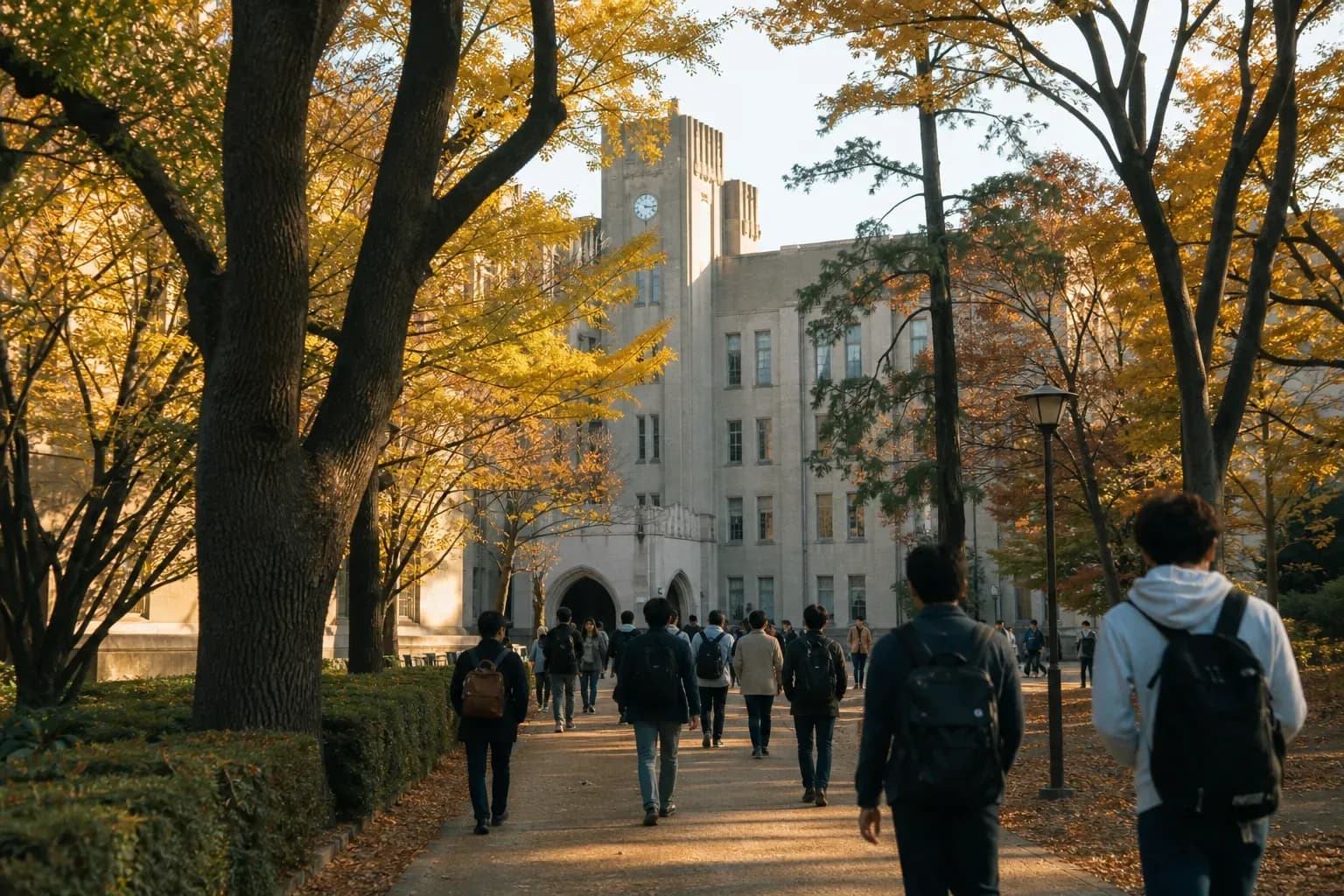
Institute of Science Tokyo: A New University Formed by the 2024 Merger, IGP English-Taught Master’s and Doctoral Programs, and Integrated Science, Engineering, Medicine, and Dentistry
Published on January 4, 2026
On October 1, 2024, Japan’s science and engineering higher education landscape underwent its largest restructuring in 70 years: Tokyo Institute of Technology (Tokyo Tech) and Tokyo Medical and Dental University (TMDU) officially merged to create the Institute of Science Tokyo (IST, commonly called Science Tokyo in English). This was not a simple name change. It was a full merger of two Designated National Universities, bringing “Japan’s strongest science and engineering university” and “Japan’s strongest medical and dental university” under one emblem.
IST is a G30 / SGU Type A Top Global University institution inherited from Tokyo Tech, an HSP +10 bonus university, and Tokyo Tech ranked #84 in QS 2026 before the merger, with post-merger rankings expected to rise further. Its International Graduate Program (IGP) is one of Japan’s most open and comprehensive English-taught flagship pathways for science and engineering master’s and doctoral applicants. For most master’s applicants, Japanese is not required for application, enrollment, or graduation.
If your goal is “Japan’s strongest science and engineering graduate education, without being blocked by Japanese-language entrance exams, and with a future pathway toward HSP permanent residency in Japan,” IST is one of the most important options to examine seriously for the 2026 application cycle.
1. Basic Information
| Item | Details |
|---|---|
| Founded | October 2024 (merger of Tokyo Tech, founded 1881, and Tokyo Medical and Dental University, founded 1928) |
| University type | National university (Designated National University) |
| Location | Ookayama, Meguro-ku, Tokyo (former Tokyo Tech main campus); Yushima, Bunkyo-ku, Tokyo (former TMDU) |
| Campuses | 5 major campuses: Ookayama, Yushima, Surugadai, Suzukakedai, Tamachi |
| Undergraduate students | ~5,000 |
| Graduate students | ~7,000 |
| Student-faculty ratio | 1:7 |
| Motto | “Contributing to human welfare through the fusion of science, technology, and medicine” |
2. World Rankings
| Ranking | Position (pre-merger Tokyo Tech data) |
|---|---|
| QS World 2026 | #84 (expected to rise after the merger) |
| THE World 2026 | #130 |
| QS Asia 2026 | #17 |
| THE Asia 2026 | #15 |
| QS Engineering & Technology | #21 |
| QS Chemical Engineering | #16 |
| QS Materials Science | #13 |
| QS Dentistry (new after merger) | Estimated #25-50 |
IST inherits Tokyo Tech’s dual identity as one of the original G30 13 universities and one of the SGU Type A 13 top universities, placing it among the highest-tier internationalization universities recognized by Japan’s Ministry of Education, Culture, Sports, Science and Technology. After the merger, IST is the only national university in Japan with both top-tier science and engineering plus top-tier medicine and dentistry. This unique positioning is rare even across Asia.
3. Admissions Data (2024-2025 Transition Period)
Important context: 2024-2026 is a merger transition period. International student applications still operate through the former Tokyo Tech and former TMDU systems, with integration into a single system expected from 2027 onward. This article focuses mainly on science and engineering (the former Tokyo Tech side), because this is the primary entry route for students from Taiwan.
IGP (International Graduate Program) — Master’s
| Indicator | Figure |
|---|---|
| Applicants | ~600-800 (science and engineering master’s programs across the university) |
| Admitted students | ~150-200 |
| Overall acceptance rate | Approximately 20-25% (varies significantly by graduate school) |
| Main graduate schools | School of Science, School of Engineering, School of Materials and Chemical Technology, School of Computing, School of Life Science and Technology, School of Environment and Society |
IGP — Doctoral
| Indicator | Figure |
|---|---|
| Applicants | ~300-400 |
| Admitted students | ~100-150 |
| Overall acceptance rate | Approximately 30-40% |
GSEP (Global Scientists and Engineers Program) — Undergraduate
| Indicator | Figure |
|---|---|
| Applicants | ~150-200 |
| Admitted students | ~10-15 |
| Overall acceptance rate | Approximately 7-10% |
| Major | Engineering Sciences |
Application Requirements (IGP Master’s)
| Item | Requirement |
|---|---|
| English proficiency | TOEFL iBT 80+ / IELTS 6.5+ |
| Academic background | 16 years of formal education (bachelor’s degree completed) |
| GPA | 3.3/4.0 or above |
| Japanese | Not required at all |
| Recommendation letters | 2 letters |
| Essay | Research Proposal (the most important component) |
| Professor pre-approval | Strongly recommended to contact a prospective supervisor 6 months before applying |
International Students
- IGP international student ratio is close to 100%
- Overall IST international student ratio is approximately 17% (pre-merger Tokyo Tech was 16%; TMDU was lower)
- Each year, IST admits 15-30 students from Taiwan to master’s and doctoral programs, including those admitted through professor pre-approval routes
4. Tuition and Financial Aid
2025 Tuition (Standard National University Rate)
| Item | Amount (JPY) | Approx. NTD |
|---|---|---|
| Enrollment fee | 282,000 | ~60,000 |
| Tuition (annual) | 535,800 | ~110,000 |
| Dormitory (Ookayama International House, monthly) | 20,000-45,000 | ~4,000-9,000 |
| Living expenses (monthly, Meguro-ku, Tokyo) | 90,000-130,000 | ~20,000-30,000 |
| Estimated total cost for a two-year master’s | Approx. JPY 3.5-4.5M | ~NTD 750,000-950,000 |
For master’s study, IST’s total two-year cost is roughly half of one year of tuition for a STEM master’s program in the United States. This is the core competitiveness of Japan’s national universities.
MEXT Scholarships
- MEXT Embassy Recommendation Scholarship (Research Students): Full tuition waiver for master’s and doctoral students + monthly living stipend of JPY 144,000-145,000
- MEXT University Recommendation Scholarship: IST has a meaningful quota each year to nominate students directly
IST Internal Scholarships
- GSEP Scholarship: Full tuition reduction for international undergraduate students + partial living expenses
- IST Scholarship for Excellent Students: For outstanding master’s and doctoral students
- JASSO Honors Scholarship: JPY 48,000-80,000 per month
TA / RA System
IST science and engineering laboratories commonly offer TA / RA opportunities, allowing master’s and doctoral students to earn an additional JPY 30,000-100,000 per month. Strong doctoral students can reach a state where they effectively self-fund almost none of their living expenses.
5. Program Structure / Flagship Programs
IGP (International Graduate Program)
IST’s flagship English-taught pathway for master’s and doctoral students. It covers 6 major schools (schools integrating undergraduate and graduate education):
- School of Science: Mathematics, physics, chemistry, earth and planetary sciences
- School of Engineering: Mechanical engineering, electrical and electronic engineering, civil and environmental engineering, systems and control engineering
- School of Materials and Chemical Technology: Materials, applied chemistry, chemical engineering
- School of Computing: CS, AI, Mathematical & Computing Science
- School of Life Science and Technology: Biological sciences, life science and technology
- School of Environment and Society: Architecture, civil engineering, social engineering
IGP students can choose English-taught course combinations to satisfy graduation credits. In theory, students can graduate without taking Japanese-taught courses.
Integrated Medicine and Dentistry (New After the Merger)
After the merger, IST retains the following at the Yushima Campus (former TMDU):
- Medicine (Faculty of Medicine + graduate medical programs)
- Dentistry (Faculty of Dentistry + graduate dental programs)
Important: undergraduate medicine and dentistry currently remain limited to Japanese nationals and are taught entirely in Japanese. However, at the graduate level, the Graduate School of Medical and Dental Sciences is open to international applicants, and some labs can conduct research in English.
GSEP (Undergraduate)
The only fully English-taught undergraduate program, a four-year integrated science and engineering program. Graduates can progress into IGP master’s programs. This is IST’s undergraduate entry route for international high school students, admitting only 10-15 students per year.
Professor Pre-Approval System (Extremely Important)
IST graduate applications essentially require pre-approval from a prospective supervisor:
- Start emailing professors 6-12 months before applying
- Pre-approval means the professor verbally or formally agrees to supervise you
- Applications without pre-approval are rejected almost 100% of the time
- IST professors are generally friendly toward students from Taiwan, with higher response rates than professors at the University of Tokyo and Kyoto University
6. Campus Culture / University Personality
IST’s atmosphere is: science-and-engineering oriented, low-key, research-first, and free of old-campus social baggage. The former Tokyo Tech was Japan’s most “STEM-heavy” university. About 80% of its students were male (estimated to fall to 70% after the merger), there was very little sports culture on campus, and many student clubs focused on Go, custom-built PCs, and Robocon robotics competitions.
After the merger, IST has gained a medical and dental culture. This is an interesting chemical reaction: the former Tokyo Tech culture of “hackers + engineers” is being combined with the refined culture of “physicians + dentists,” gradually redefining the personality of the new university.
Key campus culture points:
- Tokyo Tech Festival (still using this name during the transition period): Held every October, a science and engineering campus festival featuring self-built robots, handmade musical instruments, and student-made VR exhibitions
- Suzukakedai Campus “Ransou Festival”: The campus festival at the Yokohama branch campus
- Athletic Association Rowing Club: The only traditional sports program that has reached the national level
- “Science Festival”: A public research exhibition that attracts science and engineering students from high schools
7. Location / Campus Environment
City Positioning
IST’s 5 major campuses are distributed as follows:
- Ookayama Campus (science and engineering headquarters): Ookayama, Meguro-ku, 15 minutes from Shibuya and 25 minutes from Tokyo Station. Main base for the School of Science and School of Engineering
- Yushima Campus (medical and dental headquarters): Yushima, Bunkyo-ku, 5 minutes from Akihabara and 10 minutes from Tokyo Station. Main base for medicine and dentistry
- Suzukakedai Campus: Aoba-ku, Yokohama, home to materials, life science, and technology programs. 30 minutes from Shibuya
- Surugadai Campus: Chiyoda-ku, including some affiliated hospital facilities
- Tamachi Campus: Minato-ku, including parts of the School of Environment and Society
IGP students are mainly based at Ookayama and Suzukakedai, the former core campuses of Tokyo Tech.
Advantages of Ookayama
- Only 15 minutes from Shibuya (Tokyu Meguro Line and Oimachi Line)
- Moderate housing costs nearby (about 30% cheaper than central Minato or Meguro areas)
- Convenient shopping street right outside the campus gate
- Direct connections to Jiyugaoka and Futako-Tamagawa, both good weekend destinations
Climate
- Same as the rest of Tokyo: dry winters, humid summers, and 0-3 snowfalls per year
- Ookayama sits on slightly higher ground, making summers marginally cooler
Campus Landmarks
- Ookayama Main Building: Built in 1934, the symbol of Tokyo Tech
- Centennial Hall: Built for Tokyo Tech’s 100th anniversary in 1981
- Yushima Seido area: Near the former TMDU campus, the site of a Confucian temple from the Edo period
8. Research and Resources
Libraries
- IST Libraries (Ookayama + Yushima): Approximately 1 million volumes
- Leading electronic journal databases in Asia, including full IEEE, ACM, and Elsevier access
Notable Research Institutes
- Materials Research Center for Element Strategy MDX: Led by Hideo Hosono, known for discoveries including iron-based superconductors and IGZO semiconductors used in OLED and Apple displays
- Quantum Computing Research Center: One of Japan’s key quantum computing hubs, collaborating with NTT, IBM, and Google
- Institute of Innovative Research in Life Science and Technology: Now connected with medical and dental research after the merger
- Future Society DLab: An interdisciplinary research center
Nobel Prizes and Major Discoveries
- Hideki Shirakawa (2000 Nobel Prize in Chemistry): Discoverer of conductive polymers; Tokyo Tech alumnus
- Yoshinori Ohsumi (2016 Nobel Prize in Physiology or Medicine): Discoverer of autophagy; Tokyo Tech professor
- Hideo Hosono: Discoverer of iron-based superconductors and IGZO semiconductors; Nobel candidate
For doctoral students, IST is one of Japan’s strongest environments for developing future science and engineering PIs.
9. Notable Alumni
- Academia / Nobel: Hideki Shirakawa (2000 Chemistry), Yoshinori Ohsumi (2016 Medicine)
- Corporate leaders: Fumio Ohtsubo (former president of Panasonic), Toshio Doko (former president of Toshiba and chairman of Keidanren), Takashi Kawamura (former chairman of Hitachi)
- Tech entrepreneurship: Takafumi Horie (founder of Livedoor, did not graduate), Takeshi Idezawa (former CEO of LINE)
- Architecture: Kiyonori Kikutake (representative of the Metabolist architecture movement), Yoshio Taniguchi (designer of the MoMA renovation in New York)
- Medicine (former TMDU): Wataru Mori (former president of the University of Tokyo), Chihiro Sasakawa (international medical researcher)
IST’s alumni network is extremely strong in Japan’s manufacturing, semiconductor, chemical, and automotive industries. Many senior leaders at Toyota, Hitachi, Toshiba, Panasonic, Sony, Mitsubishi, and Sumitomo Chemical have Tokyo Tech backgrounds.
10. Lesser-Known Facts About IST
- The abbreviation “IST” is still confusing during the 2024-2026 transition period: In Japan, many still use “Kagakudai,” while the official English brand is Institute of Science Tokyo. Internally, some still say “Science Tokyo” or “ToTech” as a transitional nickname. Taiwanese media often mistakenly call it “Tokyo University of Science and Technology.”
- The merger process took 4 years of negotiation: Japan’s Ministry of Education proposed it in 2020, the boards approved it in 2022, and the official merger took place in October 2024. It is the largest merger in the history of Japan’s national universities.
- Tuition remained JPY 535,800 after the merger: The former TMDU medical and dental divisions were once concerned about a tuition increase, but the merger plan explicitly kept tuition at the standard national university rate.
- After Tokyo Tech became IST, the Tokyo Tech Alumni Association still exists: The merger does not apply retroactively, and older Tokyo Tech alumni still identify themselves as Tokyo Tech graduates.
- The cherry blossom avenue at Ookayama Campus: The cherry blossom tunnel in front of the Main Building is a hidden landmark, mostly enjoyed by IST students and not widely known to outsiders.
11. Typical Admitted Student Profile (IGP Master’s)
- Undergraduate GPA of 3.5/4.0
- TOEFL iBT 95+ or IELTS 7.0+
- Undergraduate background in science and engineering from institutions such as NTU, NYCU, NTHU, NCKU, NTUST, Taipei Tech, and similar universities
- Has obtained professor pre-approval by email (the most critical factor)
- Research Proposal is highly aligned with the target professor’s research direction
- Priority for applicants with one research publication, conference paper, or science fair record
- At least one recommendation letter from an undergraduate research supervisor
12. What Kind of Student Is IST Best For?
✓ Best suited for:
- Science and engineering bachelor’s graduates from Taiwan who want Japan’s strongest science and engineering graduate education without needing Japanese
- Students with specific research directions in semiconductors, materials, AI, quantum technology, or life sciences
- Applicants willing to spend 6-12 months proactively contacting Japanese professors to obtain pre-approval
- Students who want a top Japanese degree with two years of tuition around JPY 1 million
- Students planning to pursue the HSP highly skilled professional permanent residency route
- Applicants targeting major Japanese manufacturing, semiconductor, and chemical companies
✗ Not necessarily ideal for:
- Students seeking undergraduate admission (GSEP admits only 10-15 students and is extremely difficult)
- Students seeking business school, law, humanities, or social sciences programs (IST does not offer these undergraduate fields)
- Students expecting an American-style campus with diverse humanities and social science culture (IST is extremely STEM-focused)
- Students seeking undergraduate medicine (undergraduate medicine and dentistry admit only Japanese nationals)
- Students who do not want to email Japanese professors and hope to complete everything through an online portal
13. HSP Highly Skilled Professional Permanent Residency Pathway (Unique Advantage for IST Graduates)
IST is an HSP +10 point bonus university in Japan:
- Master’s + annual salary of JPY 6 million → permanent residency application after 3 years
- Doctorate + annual salary of JPY 8 million → permanent residency application after 1 year
IST’s particularly strong pathways:
- Semiconductor industry: TSMC Japan, Sony Semiconductor, Renesas, Tokyo Electron. IST master’s graduates can start at JPY 6-8 million
- Chemicals / materials industry: Sumitomo Chemical, Mitsubishi Chemical, Shin-Etsu Chemical. HSP bonus university + elite alumni network
- Technology industry: LINE, Mercari, Preferred Networks (Japan’s strongest AI company), SoftBank
- Academia: Direct H1 pathway into assistant professor positions at Japanese national universities
“IST master’s → major semiconductor company → HSP permanent residency within 3 years” is one of the most reliable Japan science and engineering routes in 2026.
For detailed strategies, refer to Dr. G.’s internal resources: Master Grad School Database / Japan, Post-Graduation Visa Strategy / 05_Japan_Visa_Strategy, and Top30 CP Value Report.
Conclusion
IST is not “Tokyo Tech renamed,” nor is it “TMDU being absorbed.” It is a national-level policy move to reposition Japan around “future science and engineering + future medicine.” For science and engineering undergraduates from Taiwan, this is one of the most valuable windows of opportunity from 2025 to 2027: post-merger IST has not yet fully built its new brand recognition, so application competition has not completely peaked, while its academic quality, HSP bonus, and permanent residency pathway are already on par with the University of Tokyo and Kyoto University.
In one sentence: If you graduated from a strong Taiwanese science and engineering undergraduate program, your SAT profile is not strong enough for a U.S. Top 30 PhD, but you want a top Asian degree plus a route to permanent residency, IST IGP master’s and doctoral programs are currently among the highest-value options available. Wait another three years, and this door may become as narrow as the University of Tokyo’s PEAK route.