
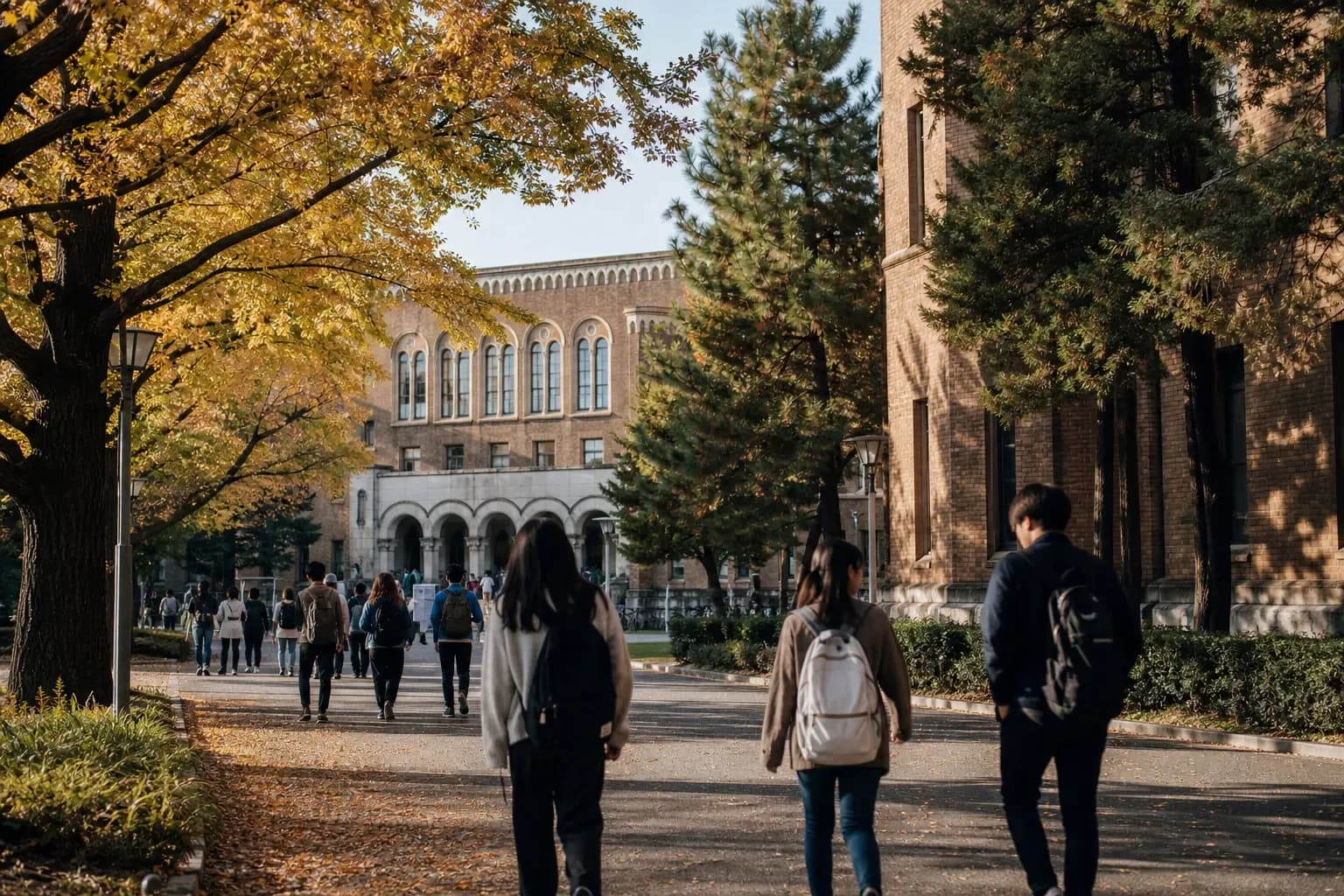
Hitotsubashi University: Japan's Top Business University, English-Taught HGP Undergraduate Program, and Cradle of Captains of Industry
Published on December 24, 2025
There is a famous saying in Japan's business world: "If you want to understand the Japanese economy, read Hitotsubashi; if you want to enter the Japanese economy, study at Hitotsubashi." Hitotsubashi University is Japan's only national flagship university dedicated to the "social sciences". It has no medical school, no engineering school, and no science faculty; only four undergraduate faculties: commerce, economics, law, and social sciences. Yet this narrow focus is exactly what has built its legendary position in Japanese business: among CEOs and directors of listed Japanese companies, the share of Hitotsubashi alumni is comparable to the University of Tokyo despite Hitotsubashi having only 1/8 as many students.
Hitotsubashi was founded in 1875 before the University of Tokyo, originally as the Commercial Training School, Japan's first modern institution for business education. Its alumni are known as "Captains of Industry". From Itochu to Mitsubishi Corporation, and from Sumitomo Mitsui Banking Corporation to Nomura Securities, the upper ranks of Japan's business world are deeply connected to Hitotsubashi. An SGU Type A flagship university and an HSP +10-point bonus university, Hitotsubashi is small and does not sit in the QS Top 200, but its domestic reputation across Japan's business, academic, and political circles is something no ranking can fully quantify.
For Taiwanese families, Hitotsubashi is the G30 / SGU option that is "closest to LSE / Wharton, but with tuition at only 1/30 of the cost."
1. Basic Information
| Item | Details |
|---|---|
| Founded | 1875 (originating from Arinori Mori's Commercial Training School, Japan's oldest higher commercial education institution) |
| Type | National university corporation |
| Location | Kunitachi, Tokyo (JR Kunitachi Station, western suburbs of Tokyo) |
| Campus | About 17 hectares (compact but refined) |
| Undergraduate students | ~4,500 |
| Graduate students | ~2,000 |
| Student-faculty ratio | 1:8 |
| Motto | "Captains of Industry" |
2. Global Rankings
| Ranking | Position |
|---|---|
| QS World 2026 | #621-630 |
| THE World 2026 | #501-600 |
| QS Asia 2026 | #119 |
| QS Business & Management | #101-150 (one of Asia's top business schools) |
| QS Accounting & Finance | #51-100 |
| QS Economics | #151-200 |
| THE Japan University Rankings 2024 | #14 |
Note: Hitotsubashi's overall global ranking is relatively low mainly because QS / THE place heavy weight on STEM research output and institutional scale. Hitotsubashi has no science or engineering fields, and only 4,500 undergraduate students. But in individual subject rankings for business, accounting, finance, economics, and social sciences, Hitotsubashi is top 3 in Japan and top 20 in Asia. Its SGU Type A flagship status means the Japanese government recognizes Hitotsubashi as a flagship university for business / social sciences, on par with other STEM flagship institutions.
3. Admissions Data (2024 Entry)
Hitotsubashi University Global Education Program (HGP)
| Metric | Figure |
|---|---|
| Applicants | ~150-200 |
| Admitted students | ~20-30 |
| Overall acceptance rate | About 15-18% |
| Field | English-taught undergraduate program, commerce + economics + social sciences |
| Taiwanese admits per year | 1-3 students |
Application Requirements (HGP)
| Item | Requirement |
|---|---|
| English proficiency | TOEFL iBT 90+ / IELTS 6.5+ (iBT 100+ recommended) |
| Standardized tests | SAT 1350+, ACT 28+, IB 36+, or A-Level 3 subjects at B+ or above |
| Japanese | Not required at all upon admission |
| Recommendation letters | 2 letters |
| Essay | Statement of Purpose, Study Plan |
| Interview | Mandatory online interview (conducted in English) |
International Students
- International students make up about 90-100% of the HGP undergraduate program
- Across Hitotsubashi overall, international students account for about 8%
- International students mainly come from Asia, Europe, and North America
English-Taught Graduate Programs (Master's)
| Program | Field | International Student Ratio |
|---|---|---|
| HMBA (Graduate School of Business Administration) | Fully English-taught MBA | 100% |
| ICS (International Corporate Strategy) | International Corporate Strategy MBA | 100% |
| English-taught program in the Graduate School of Economics | Economics PhD track | 60-80% |
ICS is one of Asia's leading English-taught business schools and has been ranked among the FT Top 100 MBA programs.
4. Tuition and Financial Aid
2025 Tuition (Standard National University Rate)
| Item | Amount (JPY) | Approx. NTD |
|---|---|---|
| Admission fee | 282,000 | ~60,000 |
| Tuition (annual) | 535,800 | ~110,000 |
| Dormitory (international student dormitory, monthly) | 30,000-55,000 | ~6,600-12,000 |
| Living expenses (monthly, Kunitachi) | 70,000-95,000 | ~15,000-21,000 |
| Estimated total cost for four years | About JPY 6-7.5M | ~NTD 1.3-1.6M |
Compared with LSE tuition of about GBP 25,000 / year (around NTD 1M) and Wharton at about USD 60,000 / year (around NTD 1.8M), Hitotsubashi's annual tuition is NTD 110,000, about 1/10 of LSE and 1/16 of Wharton. If your goal is top-tier business education with a budget-conscious strategy, Hitotsubashi's cost-performance ratio is unmatched.
MEXT Scholarships
- MEXT Embassy Recommendation Scholarship: Full tuition waiver + JPY 117,000 per month
- MEXT University Recommendation Scholarship: Nominated directly by Hitotsubashi
Hitotsubashi Internal Scholarships
- Hitotsubashi Honors Scholarship: Full tuition waiver for top applicants
- JASSO Student Exchange Support Program: JPY 48,000-80,000 per month
- Josuikai (Hitotsubashi Alumni Association) Scholarship: Supported by one of Japan's strongest business alumni networks
5. Program Structure / Signature Programs
HGP (Hitotsubashi University Global Education Program)
HGP is Hitotsubashi's most important English-taught undergraduate entry route. It is a 4-year fully English-taught program:
- Years 1-2: General education + Liberal Arts foundation + fundamentals in economics / commerce
- Years 3-4: Choose a specialization from the four major faculties:
- Faculty of Commerce: Management, marketing, accounting, business history
- Faculty of Economics: Economic theory, econometrics, applied economics
- Faculty of Law: Corporate law, international law, policy
- Faculty of Social Sciences: Sociology, politics, communications, cultural studies
- Japanese minor: N2 is recommended before graduation, but not mandatory
HGP's defining feature is the "LSE model + Japanese corporate ecosystem". Your classmates are genuinely international high achievers, many professors have PhDs from LSE / Chicago / Stanford, and your internship opportunities are with companies such as Mitsubishi, Itochu, and Nomura.
HMBA (Graduate School of Business Administration MBA)
- 2-year fully English-taught MBA
- Suitable for students without an undergraduate business background who want to pivot into business
- Complements Hitotsubashi ICS
ICS (International Corporate Strategy)
- Hitotsubashi University's independent English-language MBA at the Kanda-Hitotsubashi Campus
- FT Top 100 MBA and top 20 in Asia
- Suitable for applicants with 3-5 years of work experience who want a top MBA degree
Informal Supervisor Approval System (Graduate Level)
Graduate school applications at Hitotsubashi usually require contacting a professor in advance to obtain informal supervisor approval. Hitotsubashi professors are highly welcoming to international students; HGP / HMBA / ICS have built English-language academic environments for more than 20 years.
6. Campus Culture / Institutional Personality
Hitotsubashi's campus culture can be summarized in a few words: elite, trading companies, understated, senior-junior network.
- "Captains of Industry" DNA: From the first day of enrollment, Hitotsubashi students are told that they are expected to become future leaders of Japanese companies. This is not empty talk; it is backed by real placement outcomes
- Small school + high density: 4,500 undergraduates + 2,000 graduate students, about 1/5 the size of the University of Tokyo or Kyoto University, but with exceptionally high alumni density
- Josuikai (alumni association): One of the strongest alumni networks in Japan's business world. Any Hitotsubashi graduate can find a "Hitotsubashi senior" inside almost any Japanese company
- OB / OG visit culture: During job hunting, Hitotsubashi students receive extremely thorough guidance from alumni. This is one major reason why Hitotsubashi has such high placement into trading companies, banks, and consulting firms
- The quiet character of Kunitachi: The JR Kunitachi Station campus is located in a quiet residential district in western Tokyo, with cherry blossom avenues and a high density of cafés. It is a campus designed for study and reflection
- 100+ student clubs: More intellectually oriented, including debate, research societies, Model United Nations, finance clubs, and political philosophy clubs
Hitotsubashi's character is "Japan's LSE + Japan's Wharton". No other university in Japan can replicate this combination.
7. Location / Campus Environment
City Positioning
Kunitachi has a population of only 75,000 and is located in western Tokyo. It is often considered "Tokyo's quietest city."
- Tokyo Station to Kunitachi Station: 40 minutes on the JR Chuo Line Rapid
- Shinjuku to Kunitachi Station: 25 minutes on the JR Chuo Line
- Narita Airport to Kunitachi: 1 hour 30 minutes
- Hitotsubashi campus to Kunitachi Station: 8 minutes on foot
Kunitachi's design originated from Hitotsubashi. The city was specially developed in 1927 as an academic town for Hitotsubashi University. The name "Kunitachi" itself comes from "(Kokubunji + Tachikawa) = Kunitachi."
Climate
- Winter: 1-10°C, slightly colder than central Tokyo
- Summer: 23-32°C, slightly cooler than central Tokyo
- Spring cherry blossom landmark: The cherry blossom avenue on Daigaku-dori is one of Tokyo's well-known sakura viewing spots
Campus Landmarks
- Main Building (Kanematsu Auditorium): Built in 1927, Romanesque style, an Important Cultural Property of modern architecture
- Clock tower: Campus landmark
- University Library: About 2 million volumes, with Japan's highest density of social science books
- Daigaku-dori: The cherry blossom avenue from Kunitachi Station to Hitotsubashi's main gate
- West Campus and East Campus: Divided into two sides
Kanda-Hitotsubashi Campus
- Hitotsubashi also has an ICS campus in central Tokyo's Kanda district
- Ideal for MBA students interning in the financial district
8. Research and Resources
Library
- Hitotsubashi University Library: About 2 million volumes
- Japan's highest density of specialized social science books
- Full subscriptions to electronic resources in economics, commerce, and law
Renowned Research Institutes
- Institute of Economic Research: One of Japan's oldest economic research institutes and an authority on long-term Japanese economic statistics
- Institute of Innovation Research: Research on Japanese corporate innovation and strategy
- Graduate School of Law G30: International law and corporate law
Academic Reputation
- Hitotsubashi's economics programs have produced former Bank of Japan governors and administrative vice-ministers of the Ministry of Finance, making it a cradle for Japan's economic and financial bureaucracy
- Hitotsubashi's commerce programs have produced CEOs at major trading companies and corporations such as Toyota, Itochu, Mitsubishi Corporation, Mitsui & Co., and Sumitomo Corporation, a placement pattern few other universities can match
9. Notable Alumni
Hitotsubashi alumni are collectively known through "Josuikai":
- Politics / central banking / finance: Masaaki Shirakawa (former Governor of the Bank of Japan), Hiroshi Komiyama (former President of the University of Tokyo), and multiple administrative vice-ministers of the Ministry of Finance
- Major trading companies / business: Uichiro Niwa (former President of Itochu and former Ambassador to China), Yoshio Tateishi (Chairman of OMRON), Fujio Mitarai (Chairman of Canon), Masahiro Okafuji (Chairman of Itochu)
- Finance: Numerous senior executives at the Bank of Japan, Ministry of Finance, Mitsubishi UFJ, Sumitomo Mitsui, and Nomura
- Academia: Tsuneo Ishikawa (economics), Masahiko Aoki (Stanford economics professor)
- Media / literature: Shintaro Ishihara (former Governor of Tokyo and writer), Takeshi Kaiko (writer)
- Entrepreneurs: Eiichi Shibusawa (one of the key founding figures behind Hitotsubashi), the father of Japanese capitalism and the figure on the current 10,000-yen banknote
The density of Hitotsubashi alumni placement in Japanese business makes it one of Japan's two great elite cradles, alongside the University of Tokyo Faculty of Law.
10. Lesser-Known Facts About Hitotsubashi University
- The name Hitotsubashi comes from the Hitotsubashi-Tokugawa family: One of the Three Lords of the Tokugawa clan in the Edo period, the Hitotsubashi family's residence was located in the Hitotsubashi area of Chiyoda, Tokyo. This was also the location of Hitotsubashi University's earliest campus in Kanda.
- The power of Josuikai: Hitotsubashi's alumni association, Josuikai, has business-network density comparable to Waseda's Tomonkai and Keio's Mita-kai. But Hitotsubashi has only 4,500 undergraduates, giving it about 1/5 the alumni scale of those two universities. This means any Hitotsubashi graduate tends to receive strong support from seniors and juniors.
- Hitotsubashi is Japan's only "comprehensive national university" without medicine, engineering, or science: This narrow focus was a strategic choice at its founding in 1875: to specialize in Japanese business education.
- Hitotsubashi was once one of the founding schools of Tokyo Big6 Baseball: When the Waseda-Keio baseball rivalry began in 1903, Hitotsubashi, then Tokyo Higher Commercial School, also participated, though it later withdrew.
- The cherry blossom avenue on Hitotsubashi's campus: The cherry trees along Daigaku-dori were planted in 1933, making them older than Hitotsubashi's Kunitachi campus itself.
11. Typical Admitted Student Profile (HGP)
- High school GPA of 3.8/4.0 or above across three years
- TOEFL iBT 100+ or IELTS 7.0+
- SAT 1450+, IB 38+, or A-Level 3A or above
- Can clearly explain "Why Hitotsubashi, not LSE / NUS / Waseda SILS / Keio PEARL", one of the most common Hitotsubashi interview questions
- Experience in business competitions, Model United Nations, debate, student council leadership
- A concrete understanding of the "Japanese business world" and "East Asian financial centers"
- Recommendation letters from social science / economics / English teachers
- Demonstrated interest in finance / accounting / economics during high school
12. What Kind of Student Is a Good Fit?
✓ Good fit:
- Students who want to study at a top Asian business university for JPY 535,800 / year
- Students with genuine passion for business, economics, finance, accounting, and consulting
- Students aiming for Japanese trading companies (Itochu, Mitsubishi, Mitsui, Sumitomo, Marubeni), Nomura, Mitsubishi UFJ, or foreign firms (GS, MS, McK, BCG)
- Students who like an environment with small-school elite density and a senior-junior alumni network
- Students who want the dual advantage of "an LSE / Wharton-style experience + Japanese corporate placement"
- Students willing to live in western Tokyo and who do not need central Tokyo nightlife
- Students planning for the HSP highly skilled professional permanent residency pathway (Hitotsubashi is on the +10-point list)
✗ Not necessarily a good fit:
- Students who want medicine, engineering, or science (Hitotsubashi has no STEM fields at all)
- Students seeking the prestige halo of a QS Top 100 degree (Hitotsubashi's overall ranking is lower due to scale)
- Students expecting a large campus, Greek Life, or a highly diverse club scene (Hitotsubashi is small and refined)
- Students with no interest in business or social sciences (Hitotsubashi is entirely concentrated in these four fields)
- Students hoping to use a PEAK / iUP-style "University of Tokyo / Kyoto University brand halo" to open doors
13. HSP Highly Skilled Professional Permanent Residency Pathway
Hitotsubashi University is on the HSP highly skilled professional "+10-point bonus" list, which means:
- Master's degree + annual salary of JPY 6M → permanent residency application after 3 years
- Doctoral degree + annual salary of JPY 8M → permanent residency application after 1 year
- After permanent residency, spouses may work, parents may stay long term, and children may obtain Japanese nationality
The most common HSP pathways for Hitotsubashi graduates are:
- Hitotsubashi HGP → major trading company / major bank / foreign investment bank (starting salary JPY 6M+) → apply for permanent residency within 3 years
- HMBA / ICS → foreign consulting / finance (annual salary JPY 8-15M) → permanent residency in 3 years or even 1 year
- Academic pathway: PhD in economics / commerce → university teaching / central bank / research institution → permanent residency after 1 year
Hitotsubashi's HSP advantage lies in "very high starting salaries from business placement + a powerful alumni association". Many Hitotsubashi graduates exceed JPY 10M in annual income before age 30, allowing HSP points to accumulate very quickly. Hitotsubashi + ICS / HMBA is one of the fastest and most salary-efficient routes to reaching 70 HSP points within Japan's national university system.
For detailed strategy, refer to Dr. G.'s internal resources, Post-Graduation Visa Strategy / 05_Japan_Visa_Strategy and Master Grad School Database / Japan. For overall planning on the "business → permanent residency → long-term Japan development" pathway, also refer to the Hitotsubashi ROI analysis in the Top 30 Cost-Performance Report.
Conclusion
Hitotsubashi is the "secret weapon of Japan's business elite." If, even in high school, you already know that you want to do business, become a CEO, or enter a foreign investment bank, Hitotsubashi is one of Asia's highest-ROI choices. It does not have LSE's global brand, Wharton's American MBA reputation, or the University of Tokyo's "Japan No. 1" halo. But it does have the deepest alumni network in Japan's business ecosystem, the most precisely designed undergraduate structure, and extremely low tuition.
The most common reason Taiwanese families overlook Hitotsubashi is that it is "not in the QS Top 200." But this is one of the biggest misunderstandings in business study-abroad planning: business placement depends on "alumni density" and "employer preference," not overall QS ranking. Hitotsubashi is small and ranked 600+ overall, but in employment placement into Japanese trading companies, banks, and consulting firms, it stands alongside the University of Tokyo Faculty of Law as Japan's best. In one sentence: if your goal is to enter a major trading company before age 30 and exceed JPY 10M in annual salary before age 35, Hitotsubashi is the right gateway in Japan.