
Harvard University: America’s Oldest University, Final Clubs, and a Lifetime Identity Card
Published on November 16, 2025
Ranked #3 nationally by US News, top five globally by QS, and home to the largest university endowment in the United States at over USD $50 billion, Harvard does not need to explain who it is. Founded in 1636, it predates the United States itself by 140 years. For Taiwanese parents, the sentence “my son goes to Harvard” still carries unmatched weight.
But Harvard’s true value is not its ranking or its brand. It is its network. The moment you are admitted, you receive a lifetime “identity card.” That card will continue opening doors you never imagined when you are 30, 50, and 70.
1. Basic Information
| Item | Details |
|---|---|
| Founded | 1636 (oldest university in the United States) |
| Location | Cambridge, Massachusetts (across the river from Boston) |
| Campus | About 209 acres |
| Undergraduates | ~7,200 (Harvard College) |
| Graduate Students | ~14,000 (including medical, law, and business schools) |
| Student-Faculty Ratio | 1:7 |
| Motto | Veritas (Truth) |
2. World Rankings
| Ranking | Placement |
|---|---|
| US News National Universities 2025 | #3 |
| QS World 2025 | #4 |
| THE World 2025 | #4 |
| US News Economics | #1 (tie) |
| US News Business (Pre-MBA Undergrad) | Top 3 |
| US News Government / Political Science | #1 |
3. Admissions Data (Class of 2028)
| Metric | Figure |
|---|---|
| Applicants | ~54,000 |
| Admitted Students | ~1,970 |
| Overall Acceptance Rate | About 3.6% |
| REA Acceptance Rate | ~8.7% |
| RD Acceptance Rate | ~3.0% |
| Yield Rate | ~84% |
SAT/ACT Median Scores
| Test | 25th percentile | Median | 75th percentile |
|---|---|---|---|
| SAT | 1500 | 1560 | 1580 |
| ACT | 34 | 35 | 36 |
International Students
- International students make up about 12%
- Students come from 80+ countries
- About 5-8 students from Taiwan are admitted each year
4. Tuition and Financial Aid
2024-2025 Cost of Attendance
| Item | Amount |
|---|---|
| Tuition | USD $59,320 |
| Housing | USD $12,920 |
| Food | USD $7,950 |
| Personal + Misc | USD $4,860 |
| Total | USD $84,400+ |
Need-Based Aid (Among the Most Generous in the United States)
- Annual family income < $85,000: completely free (zero parent contribution)
- Annual family income $85,000 - $150,000: pay up to 10% of family income
- Annual family income $150,000 - $200,000: assessed case by case; many families still receive major reductions
- Need-Blind for international students: your financial situation is not considered during admissions
- No-Loan Policy: all aid is grant aid
- Average aid: USD $70,000 per year
- About 55% of undergraduates receive need-based aid
For middle-class Taiwanese families, Harvard can be cheaper than many private universities in Taiwan. That is a fact, not marketing language.
5. Academic Structure / Signature Programs
Undergraduate Concentrations
- A total of 50 Concentrations (Harvard does not call them majors)
- Top 5 popular Concentrations:
- Economics
- Computer Science
- Government
- Applied Math
- History
Signature Systems
- House System: First-year students live in the Yard, then enter one of 12 Houses starting sophomore year (Adams, Lowell, Eliot, Currier, and others). A House is not just a dormitory. It is an academic community with tutors, a dean, and its own dining hall.
- Senior Thesis: Required for high honors, but not mandatory for everyone
- Concentration + Secondary: Harvard allows a double concentration or the addition of a secondary field, similar to a minor
- Joint Concentration: Students can combine two departments, such as Math + Philosophy
General Education
Harvard’s Gen Ed curriculum was reformed in 2019 and is divided into four categories:
- Aesthetics & Culture
- Ethics & Civics
- Histories, Societies, Individuals
- Science & Technology in Society
Unlike the Columbia Core, which assigns a specific reading list, Harvard gives students more freedom of choice.
6. Campus Culture / Institutional Personality
Harvard’s culture is a kind of confidence that does not need to prove itself. Students do not go around emphasizing the school’s prestige the way students at some schools might, because everyone already knows. The people you meet on campus form the wildest possible mix: future presidents, future Nobel laureates, future billionaires, and future star actors, all in the same class.
Final Clubs / Greek Life
Harvard does not have typical Greek Life, but it does have historic Final Clubs, similar to Princeton Eating Clubs. These Final Clubs were once extremely elite and closed; in recent years, some have opened to women, and the university has also pressured single-gender organizations. The most representative clubs include Porcellian Club (the oldest), A.D. Club, and Phoenix S.K.
Sports Culture
- Ivy League conference
- Signature sports: Crew, Squash, Hockey, Football
- The Game: the annual Harvard vs Yale football rivalry, with a tradition of 140+ years
7. Location / Campus Environment
City Positioning
Harvard is located in Cambridge, just a few subway stops from MIT. Harvard Square is the liveliest college-town core in New England, with bookstores, cafes, street music, and direct Red Line access to downtown Boston. Boston itself is a major center for academia, biotech, and finance.
Climate
- Winter: -5°C to 5°C, with a long snow season
- Summer: 25-30°C and humid
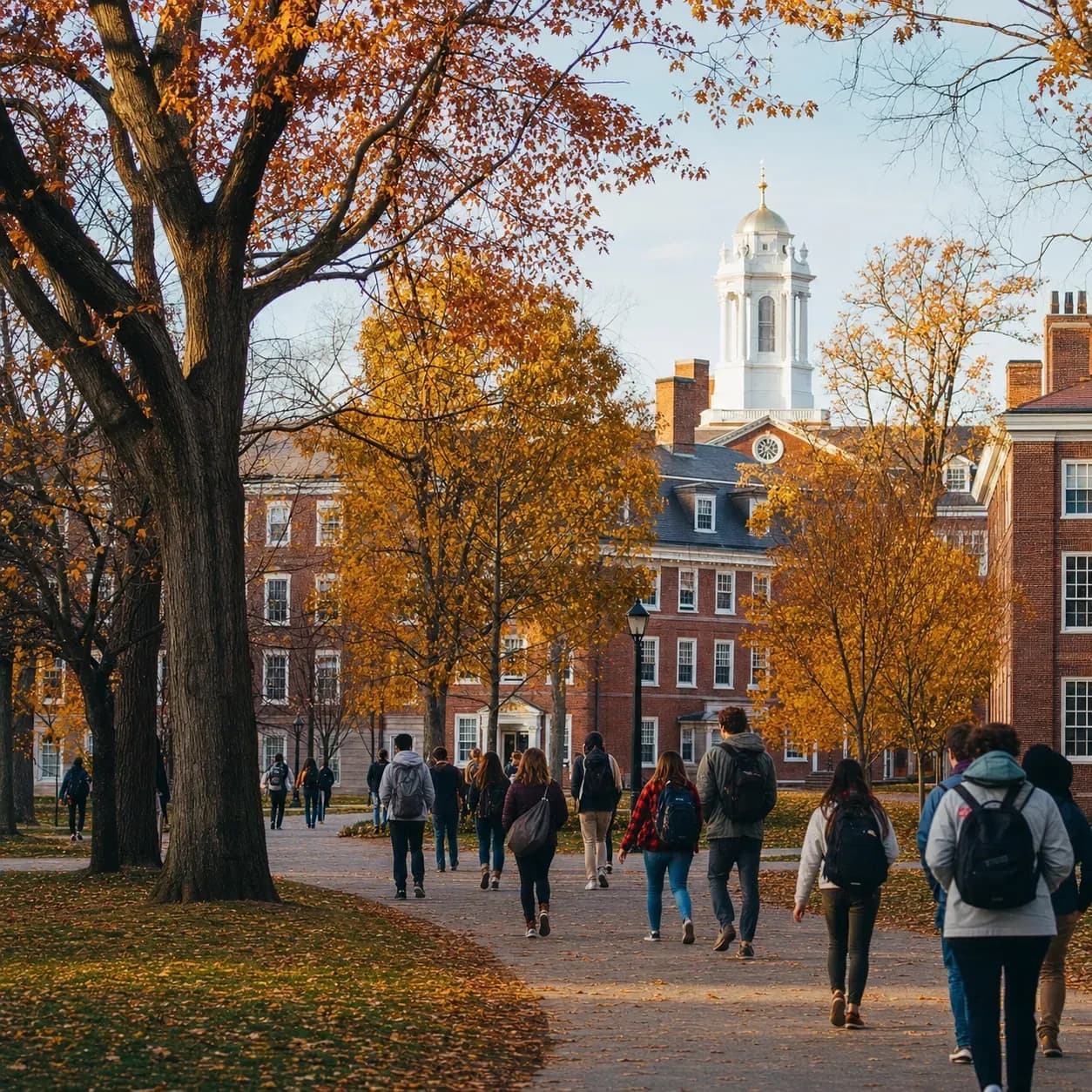
- Spring and fall are pleasant, and autumn foliage is classic New England
Campus Landmarks
- Harvard Yard (the central quad and first-year residential area)
- Widener Library
- John Harvard Statue (“The Statue of Three Lies,” because the founder, year, and identity are all wrong)
- Memorial Hall
- Sanders Theatre
8. Research and Resources
Libraries
- Widener Library is the largest academic library in the United States, with 3.5 million volumes
- The university has 28 libraries and a total collection of 20 million volumes, making it the world’s largest university library system
Well-Known Laboratories / Research Centers
- Harvard Stem Cell Institute
- Wyss Institute for Biologically Inspired Engineering
- Berkman Klein Center (internet and society research)
- Center for Astrophysics (jointly operated with the Smithsonian)
- Belfer Center for Science and International Affairs (international relations policy think tank)
9. Notable Alumni
- Presidents / Politics: John Adams, John F. Kennedy, Barack Obama (Law School), George W. Bush (MBA), Franklin D. Roosevelt
- Technology Entrepreneurship: Bill Gates (dropout), Mark Zuckerberg (dropout), Sheryl Sandberg, Steve Ballmer
- Finance / Business: Michael Bloomberg, Jamie Dimon, Lloyd Blankfein
- Academia / Nobel Prizes: More than 160 Nobel laureates in total
- Entertainment / Literature: Natalie Portman, Matt Damon, Conan O'Brien, John Updike, T.S. Eliot
Since the founding of the United States, Harvard has educated eight U.S. presidents. It is not just a university. It is a training ground for the American elite.
10. Harvard Facts You May Not Know
- The “three lies” of the John Harvard Statue: 1. the statue is not the real appearance of John Harvard, because he left no portrait; 2. the inscription says “Founder,” but he was actually an early benefactor; 3. the year shown is 1638, but Harvard was founded in 1636.
- All first-year students live in Harvard Yard: A longstanding tradition places all new students in the same residential area regardless of background.
- Harvard once refused Bill Gates re-enrollment: After dropping out, Bill Gates reportedly “wanted” to register again, which became an internet legend.
- The alma mater is called “Fair Harvard”, and it is sung at every major ceremony.
- The annual “Primal Scream”: At midnight on the night before final exams, students run naked through Harvard Yard while screaming to release stress.
11. Typical Admitted Student Profile
- GPA Unweighted ~3.95+
- SAT 1500+ or ACT 34+
- 8-12 AP courses / full IB HL load
- Spike is broader than at MIT; it can be music, athletics, debate, business entrepreneurship, social activism, or academics
- Essays show leadership + voice; Harvard asks, “What will you lead others to do?”
- Strong recommendation letters, especially the counselor letter
- Alumni Interview is usually arranged
Harvard admits people who can influence others, not necessarily the people who are simply the smartest.
12. What Kind of Student Is Harvard Right For?
✓ Good fit:
- Students interested in politics, policy, or social movements
- Pre-professional students planning for medical school, law school, or business school
- “Life strategists” who enjoy interdisciplinary study and want to keep every possibility open
- Long-term players who want a global alumni network
- Students who want a college town while staying close to a major city
- International students from families earning under $200,000 who need generous aid
✗ Not necessarily a good fit:
- Hardcore technical students; MIT, Caltech, or CMU may be better fits
- Students who dislike networking or are uncomfortable in social settings
- Students who want a lively Greek Life party campus
- Students who prefer warm southern weather
- Students afraid of the feeling that there is always someone stronger; Harvard is not intensely cutthroat, but everyone is extremely strong
Conclusion
Harvard’s 3.6% acceptance rate leads most families to treat it as a “try your luck” school. That attitude is correct. For 95% of applicants, Harvard truly is a lottery ticket. But for students who match Harvard’s DNA (ideas, leadership, and a story), Harvard is not a reach. It is a match.
If you are the kind of student teachers always remember, or the kind whose classmates quiet down and listen when you speak, you should absolutely apply to Harvard. Being admitted means receiving a lifetime “identity card”. When you are 50, that card will still be opening extraordinary doors.