
Durham University: England's Third-Oldest University, Collegiate System, and a Classic Russell Group Representative
Published on December 7, 2025
Ranked 5th in the UK by the Complete University Guide, 6th by the Guardian, and a member of the Russell Group, Durham University is "England's third-oldest university" (founded in 1832, after only Oxford and Cambridge). Durham's defining feature can be summed up in one sentence: outside Oxbridge, it is the only English university that still preserves a full Collegiate System.
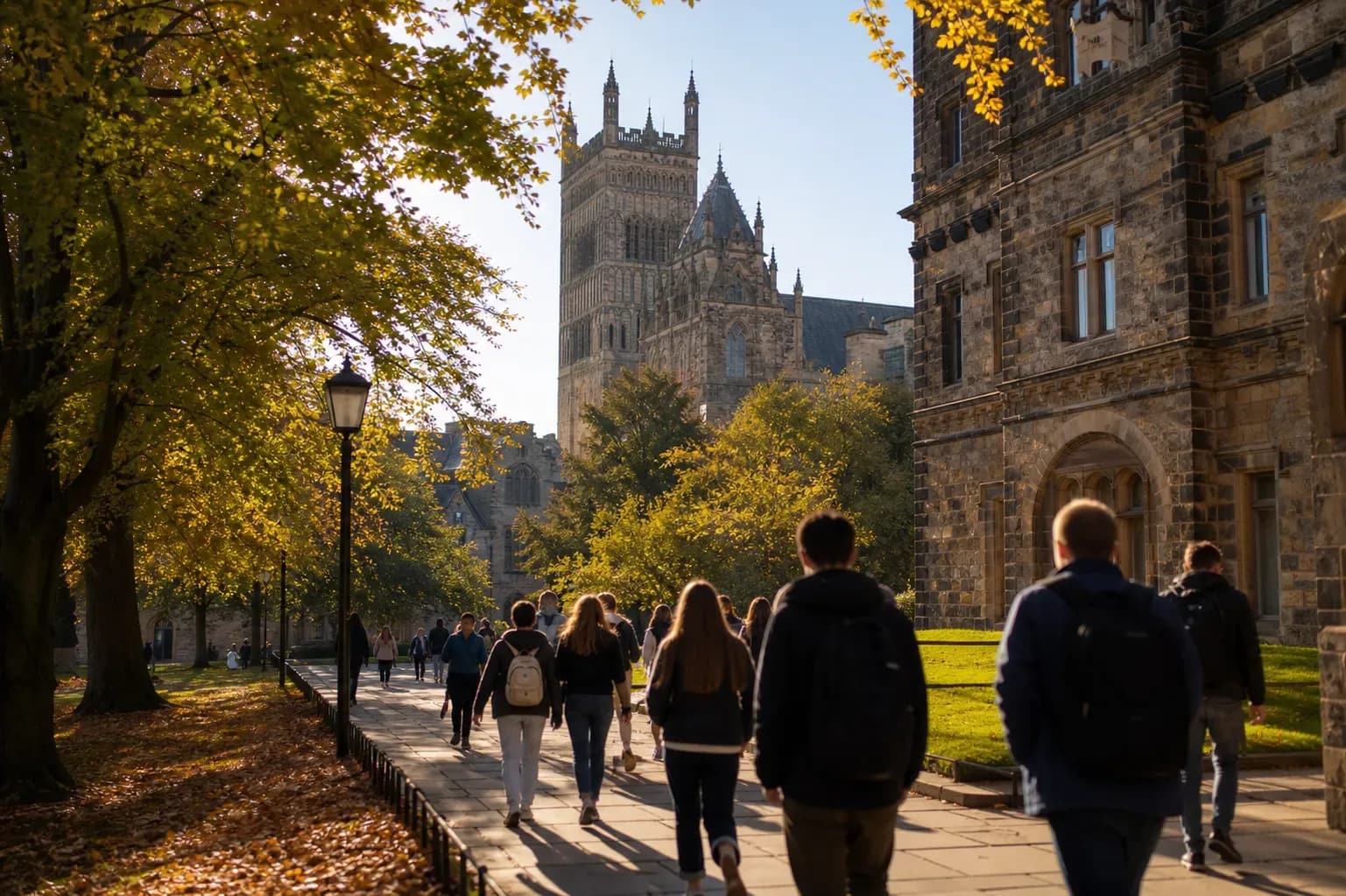
Durham's character: classical, elite, college-based, traditional, and a favorite among middle-class families. In the UK, Durham is often seen as "the next choice after Oxbridge" -- the preferred "insurance option" after an Oxbridge rejection. But Durham is far more than a backup. It has its own distinctive college culture, a medieval campus embraced by Durham Cathedral and Durham Castle, and the strongest college fit culture in England after Oxbridge.
1. Basic Information
| Item | Details |
|---|---|
| Founded | 1832 (England's third-oldest university) |
| Location | Durham, North East England (30 minutes south of Newcastle by car) |
| Campus | Colleges spread across the city + Stockton campus |
| Undergraduates | ~14,500 |
| Postgraduates | ~5,800 |
| Number of colleges | 17 Colleges |
| Group affiliation | Russell Group |
| Motto | Fundamenta eius super montibus sanctis (Her foundations are upon the holy hills) |
2. World Rankings
| Ranking | Position |
|---|---|
| QS World 2026 | #92 |
| THE World 2026 | #199 |
| Complete University Guide 2026 (UK) | #5 |
| Guardian University Guide 2026 (UK) | #6 |
| QS Theology | Top 10 |
| QS Geography | Top 20 |
| QS English | Top 30 |
3. Admissions Data (2025 entry)
| Indicator | Figure |
|---|---|
| Applicants | ~31,000 |
| Admitted students | ~5,200 |
| Overall acceptance rate | around 17% |
| International student acceptance rate | ~14% |
| Acceptance rate for popular subjects (Law / Econ / Politics) | < 15% |
| Yield Rate | ~50% |
| International student proportion | ~25% |
Typical A-Level / IB Offers
| Subject area | Standard A-Level offer | Standard IB offer |
|---|---|---|
| Law (LLB) | A*AA + LNAT | 38 points (HL 666) |
| Economics | A*AA (including Math) | 38 points (HL 666 including HL Math) |
| History / English | A*AA | 38 points (HL 666) |
| Math | A*A*A (Math + Further Math) | 38 points (HL 776 including HL Math) |
| Physics / Engineering | A*A*A | 38 points (HL 666) |
| PPE | A*AA | 38 points (HL 666) |
International Students
- International students account for around 25% of undergraduates
- Students come from 130+ countries
- Around 5-15 students from Taiwan are admitted each year
- Applications are submitted through UCAS
4. Tuition and Living Costs
2025-2026 International Student Tuition
| Subject area | Tuition fee (per year) |
|---|---|
| Arts / Humanities / Social Sciences | £26,800-28,500 |
| Sciences / Math | £30,900 |
| Engineering / CS | £33,100 |
| Business School (Foundation BSc) | £31,500 |
College Fee and Living Costs
| Item | Amount |
|---|---|
| College Fee (including accommodation + meals, tied to college) | £9,500-12,000/year |
| Personal expenses | £2,500/year |
| Total (including tuition) | around £39,000-48,000/year |
Graduate Route Visa
After graduation, students may apply for the Graduate Route, which grants 2 years of post-study work permission for master's / bachelor's graduates and 3 years for PhD graduates, with no employer sponsorship required. Durham graduates often move into the City of London (investment banking, Big Four, law firms) or to Newcastle / Edinburgh.
Scholarships
- Vice-Chancellor's Scholarship: £5,000-10,000/year for top international students
- Durham International Scholarship: £3,000-5,000/year
- Chevening / Commonwealth: postgraduate level
5. Program Structure / Signature Programs
Undergraduate Structure (4 Major Faculties)
- Arts and Humanities: English, History, Theology, Classics
- Social Sciences and Health: Law, Econ, Politics, Sociology, Geography
- Science: Math, Physics, Chemistry, Biology, CS
- Durham University Business School
Signature Programs
- Theology and Religion: QS global Top 10, a world-class theology department (alongside Oxford / Cambridge)
- Geography: UK Top 3, QS global Top 20
- Law (LLB): UK Top 10, with the collegiate system and a strong alumni presence in City of London law firms
- Economics: A core UK contender alongside Warwick / LSE
- PPE: Durham's version of PPE, second only to Oxford
- English Literature: UK Top 5
- Math / Physics: Particularly strong in theoretical physics; Stephen Hawking worked with Durham professors in his early years
- MEng Engineering: 4-year integrated engineering program
Foundation Year (International Student Friendly)
Durham has an International Study Centre (ISC) that offers a Foundation Year for international students whose A-Level / IB results are not yet sufficient or who want a smoother academic transition. This is one of the mainstream pathways for Taiwanese high school students to enter a Russell Group university through a Foundation Year.
Teaching Style
Durham uses a three-layer teaching structure: lectures (80 students) + seminars (10-15 students) + tutorials (4-8 students). Although it is not Oxbridge-style one-on-one teaching, its tutorials are smaller than typical UCL/Imperial small groups. Colleges also often hold academic dinners where students dine and discuss academic topics with fellows / senior members.
6. Campus Culture / School Personality
Durham's character: conservative, traditional, collegiate, sports-oriented, and private-school-like. Durham students have a well-known nickname in the UK: "Tabs" or "posh" -- because Durham has a very high proportion of students from Independent Schools in the UK, and college dinners, formals, and rowing culture are all highly active.
Collegiate System
Durham is the only university in England outside Oxbridge that retains a full collegiate system. Each of its 17 colleges has:
- Its own history and personality (such as University College / "Castle", Hatfield, Van Mildert)
- Its own accommodation + Hall (dining hall) + JCR (undergraduate student association)
- Its own college sports teams and societies
- Its own formal dinners and balls
Castle (University College) is Durham's most famous college -- students live inside the 11th-century Durham Castle. Hatfield is a strong rowing college.
Formal Hall
Formal dinners are held 1-3 times per week, and students must wear academic gowns. Rules vary by college, and some colleges (such as Castle) maintain traditions such as High Table and Latin Grace.
Durham Regatta
The annual rowing regatta in June is one of the biggest student events of the year at Durham. Durham's rowing team stands alongside Oxbridge in the UK university rowing scene.
Lumiere Festival
Held every two years, this light art festival turns Durham Cathedral and Castle into illuminated stages, attracting visitors from across the UK.
7. Location / Campus Environment
City Positioning
Durham is a medieval city of 50,000 people in North East England, 30 minutes from Newcastle by train and around 3 hours from London King's Cross by train. Durham Cathedral (a UNESCO World Heritage Site, built in the 11th century) and Durham Castle are the city's landmarks.
Campus Structure
- The Bailey (city center): colleges such as Castle, Hatfield, St John's, Chad's, and St Cuthbert's
- The Hill (across the river): science departments and modern colleges (Van Mildert, Trevelyan, Collingwood)
- Stockton Campus (closed): former health sciences branch campus, closed in 2018
Climate
- North East England climate, with winters around 0-7°C and summers around 12-20°C
- Occasional snow in winter; autumn is the most beautiful season
Campus Landmarks
- Durham Cathedral (1093, World Heritage Site)
- Durham Castle (1072, University College + student accommodation)
- Palace Green (the lawn between the Cathedral and Castle)
- Bill Bryson Library (main library)
8. Research and Resources
Libraries
- Bill Bryson Library: main library (named after alumnus and travel writer Bill Bryson, former Durham Chancellor)
- Individual colleges also have college libraries
Notable Research Centers
- Institute for Computational Cosmology: elite in cosmology
- Durham Energy Institute
- Centre for Research into Violence and Abuse
- Wolfson Research Institute for Health and Wellbeing
9. Notable Alumni
- Politics: Anthony Eden (former UK Prime Minister, 1955-57), Cherie Booth, wife of Tony Blair, Paul Brierley (and several UK MPs)
- Royal family: Beatrice, Princess Eugenie's sister, briefly studied there
- Science: Tom Stoppard (playwright), Bill Bryson (honorary alumnus, writer)
- Media: Jeremy Vine (BBC presenter), Hugh Dennis (comedian)
- Business: Mo Ibrahim (Sudanese telecom billionaire, founder of the Mo Ibrahim Foundation)
- Performing arts: Helen Atkinson-Wood, Lloyd Owen
10. Durham Fun Facts
- University College is inside a castle: Castle College students really live inside Durham Castle, built in 1072, one of the few still-operating university castle residences in the world.
- Durham Cathedral appeared in Harry Potter: the Hogwarts corridors in the first two films were filmed in the cloisters of Durham Cathedral.
- Durham students call themselves Dunelmensis: a Latin alumni suffix used after names, such as John Smith MA Dunelm.
- The youngest of the 17 colleges is South College: established only in 2020.
- Bill Bryson was Chancellor: travel writer Bill Bryson served as Durham Chancellor from 2005 to 2011, and the library is named after him.
- The annual Class of Dilettantes: Durham students half-jokingly describe themselves as an "elite club of Oxbridge rejects"; Durham has a very high proportion of middle-class private school students.
11. Typical Admitted Student Profile
- A-Level A*AA or IB 38 (HL 666)
- LNAT is required for Law
- Math / STEM applicants must have A* or HL 7 in Math
- Medicine: Durham does not directly admit undergraduate Medicine students (it collaborates with Newcastle)
- Quantifiable academic passion: debate, Model United Nations, subject-based EPQ, local competitions
- Personal Statement of 4,000 characters / 47 lines, with 80% academic content + 20% extracurricular content
- Strong preference for collegiate fit: applicants must choose a college when applying (first choice + random allocation)
- Durham favors "well-rounded students with strengths in sports / music" (private-school style)
12. What Kind of Student Is Durham Suitable For?
✓ Suitable for:
- Students who want Oxbridge but need an insurance choice
- Students who like the collegiate system, tradition, and formal dinner culture
- Students interested in humanities and social sciences such as Theology, Classics, History, Geography, and Law
- Students who can accept North East England's climate and small-city life
- Students who want a middle-class private-school-like campus atmosphere
- Sports enthusiasts (rowing, rugby, hockey)
- Students interested in PPE for whom Oxford PPE is too competitive
✗ Not necessarily suitable for:
- Students who want big-city life and a more diverse social scene (consider UCL / King's / LSE)
- Students who want heavyweight pure STEM and Imperial-level resources
- Students on a very tight budget who need major scholarships
- Students who are uncomfortable with British private-school culture (social circles can be relatively closed)
- Students who want a business undergraduate program that leads directly into City investment banking (Warwick / LSE are more direct)
Conclusion
Durham is not a choice for students who simply think "the name sounds nice." Durham is for students who, at 18, already long for Oxbridge-style college dinners, wearing a gown to formal hall, and spending four years studying beside an 11th-century Cathedral.
If your life trajectory is "study humanities and social sciences, enter City of London law or consulting, and build a stable future in the UK's middle / upper-middle social circles," Durham is one of the UK universities with the densest alumni networks outside Oxbridge -- especially in Magic Circle law firms, the Big Four, and the Big Three consulting firms. If you want pure STEM or Engineering, Durham is not the right fit -- go to Imperial or Manchester.
The point Taiwanese families most often overlook is this: Durham's "collegiate system" truly determines the core of your four-year life -- your college determines your accommodation, dining hall, social circle, sports teams, and formal dinner rules. So when applying, you need to seriously research the differences among the 17 colleges: Castle (most elite, living in the castle), Hatfield (strong in rowing), Van Mildert (largest and friendliest), Collingwood (most modern). Durham is not just about "getting into Durham"; it is about "getting into Castle / Hatfield / Trevelyan" -- that college identity stays with you throughout your four years and remains a marker within the Durham alumni network after graduation.
Sources: